The best Cummins upgrades protect fuel supply, control exhaust and transmission heat, support the gearbox, and match the truck's real workload before adding horsepower. The inline-six may have plenty of headroom, but a worn lift pump, slipping 47RE, cracked charge-air boot, overloaded 68RFE, or unfinished recall can turn a quick bolt-on build into an expensive tow home.

Key Takeaways
Cummins owners should identify the fuel system and transmission, establish clean baseline data, and fix heat or pressure problems before ordering power parts.
- A 12-valve P-pump truck, a VP44 truck, a common-rail 5.9L, and a 6.7L do not share the same safe upgrade order.
- Low supply pressure, unstable rail pressure, boost leaks, high EGT, and transmission flare are stop signs, not invitations to install a larger tune.
- A tow rig needs sustained heat control and predictable shifts; a short-pull street build can tolerate a different combination of turbo, fueling, and gearing.
- GVWR, GAWR, GCWR, tire capacity, hitch rating, and payload do not increase when horsepower, air springs, or an exhaust brake are added.
- Emissions equipment, warranty exposure, recall status, and exact fitment should be checked by VIN before hardware or calibration changes begin.
Identify the Engine, Fuel System, and Transmission First
Model year narrows the platform, but the VIN, engine label, transmission identification, pickup versus Chassis Cab configuration, and installed hardware determine what actually fits.
Use the table as a starting point, then verify the truck itself. Engine swaps, transmission swaps, recall repairs, prior tuning, and midyear production changes can make a clean-looking truck different from the parts catalog description.
| Model years | Engine and fuel system | Common transmission families | First beginner check |
|---|---|---|---|
| 1989–1993 | 5.9L 12-valve, Bosch VE rotary pump | 727 or A518 automatic, or Getrag manual, depending on year | Cooling, supply fuel, pump condition, driveline identification |
| 1994–1998.5 | 5.9L 12-valve, Bosch P7100 inline pump | 47RH or 47RE automatic, or NV4500 manual | EGT instrumentation, boost leaks, converter and clutch condition |
| 1998.5–2002 | 5.9L 24-valve, Bosch VP44 electronic rotary pump | 47RE automatic, or NV4500/NV5600 manual | Lift-pump pressure under load and VP44-related codes |
| 2003–2007 | 5.9L 24-valve, high-pressure common rail | 48RE automatic, or NV5600/G56 manual, depending on year | Injector return behavior, rail-pressure tracking, fuel dilution |
| 2007.5–2012 | 6.7L common rail with VGT and diesel aftertreatment | 68RFE, AS68RC on certain Chassis Cabs, or G56 manual | VGT, regeneration history, boost leaks, shift quality |
| 2013–2018 | 6.7L common rail with EGR, DPF, SCR, and DEF | 68RFE or Aisin AS69RC, depending on truck and output | Transmission ID, CCV service, DEF/SCR health, recall status |
| 2019–2024 | 6.7L common rail; 2019–2020 pump history needs special attention | 68RFE or Aisin AS69RC, depending on truck and output | VIN recall check, installed high-pressure pump, software level |
| 2025–Present | 6.7L High Output common rail | TorqueFlite HD eight-speed automatic | New-generation fitment, calibration, loaded shift and temperature data |

Set the Job Before You Buy Parts
The right Cummins upgrade is the one that survives the truck's normal duty cycle, not the one that produces the largest number in a short unloaded pull.
Write down how the truck is used, its loaded weight, trailer type, terrain, elevation, tire diameter, axle ratio, winter temperature, and acceptable downtime. A stock-tire commuter that occasionally hauls mulch does not need the same turbo or transmission plan as a Ram 3500 pulling a fifth-wheel through the Rockies in July.
- Daily driver: prioritize clean starts, leak control, filtration, stable temperatures, quiet operation, and parts availability.
- Tow rig: prioritize sustained EGT control, exhaust-brake function, cooling reserve, transmission temperature, gearing, and repeatable shifts.
- Farm, ranch, or jobsite truck: prioritize dust control, low-speed cooling, battery health, service access, payload discipline, and bolt-on parts that can be repaired locally.
- Street-performance truck: plan the transmission, fuel delivery, turbo airflow, tires, and brakes as one system before raising commanded torque.
- Off-road-only competition build: separate race-only hardware and calibration from any vehicle that will operate on public roads.
Start a Used Cummins Build With a Pre-Purchase-Style Inspection
A newly purchased 150,000- to 250,000-mile Cummins needs an ownership baseline before it needs a parts order, even when the seller claims the truck is stock.
Compare cold start, hot restart, blow-by, fluid condition, oil level, coolant pressure behavior, supply fuel, commanded versus actual rail pressure, turbo response, transmission shifts, converter lockup, and axle noise. Inspect both sides of the engine, the valley where applicable, bellhousing, cooling stack, charge-air joints, exhaust connections, frame, hitch, and trailer wiring.
Check the ECM calibration status, installed injection pump, recall completion, tire-size programming, and every nonfactory wire passing through the firewall. A clean pre-purchase comparison should account for the truck's transmission, emissions equipment, payload history, and repair documentation instead of choosing by engine badge alone.
Do these jobs before the first performance mod:
- Save a complete scan before clearing codes or disconnecting batteries.
- Send questionable engine oil, coolant, or transmission fluid for analysis when contamination or an expensive internal problem is suspected.
- Verify that emissions hardware, sensors, intake parts, turbo plumbing, and transmission components match the VIN and calibration.
- Repair safety, fuel, cooling, and transmission faults before spending the remaining budget on airflow or appearance parts.
Establish a Healthy Stock Baseline
A Cummins with low supply pressure, contaminated fuel, unstable rail pressure, high EGT, active emissions faults, coolant loss, or transmission slip is not ready for more commanded torque.
Scan current, pending, and permanent diagnostic trouble codes before disconnecting batteries or clearing the ECM. Record cold-start behavior, hot restart, idle rail pressure, commanded versus actual rail pressure under load, boost response, transmission slip or flare, regeneration frequency, and fluid temperatures where the truck supports those data.
Inspect both batteries as a matched system on dual-battery trucks. Uneven battery condition, weak grounds, alternator ripple, corroded cables, and low cranking speed can imitate fuel-system trouble and can make electronic pump or injector diagnosis unreliable.
Baseline action list:
- Decode the VIN and verify engine, transmission, axle ratio, pickup or Chassis Cab, and recall completion through the official VIN lookup.[1]
- Check engine oil level and smell, coolant level, fuel-filter age, water separator, intake restriction, charge-air boots, clamps, exhaust leaks, and visible wiring damage.
- Road-test with data under the truck's real load instead of revving it in Park.
- Stop the test if rail pressure collapses, EGT continues climbing, coolant is expelled, the transmission flares, or the converter will not hold.
- Save the baseline log so the result of each mod can be measured instead of guessed.
Common-rail fuel can reach tens of thousands of psi. Never loosen a high-pressure line on a running engine, and follow the model-year service procedure before opening the rail, injector tubes, or pump circuit.
1989–1993 5.9L 12-Valve: Build the VE-Pump First Gen Around Heat Control
A first-generation VE-pump Cummins should receive cooling, supply-fuel, air-leak, gauge, and driveline work before the pump is adjusted for more fuel.
Verify whether the truck retains its original engine, injection pump, turbo, intercooler arrangement, transmission, axle ratio, and tire height. Many early trucks have lived through engine swaps and homemade fuel adjustments, and a catalog year alone will not describe what is under the hood.
Inspect the front gear housing for evidence of a previously secured killer dowel pin repair, but do not assume a dab of silicone or an old invoice proves the job was done correctly. Check radiator condition, fan and shroud, thermostat behavior, water-pump play, belt drive, charge-air plumbing where equipped, fuel hoses, and return leaks.
Install a pre-turbo EGT gauge before adding meaningful fuel. Many conservative tow builds treat sustained readings around 1,250°F as a reason to reduce load or downshift, but probe location, timing, turbo selection, altitude, and engine configuration change how that number should be interpreted.
Support the automatic transmission or clutch before turning the fuel screw. A tired converter or clutch can slip with a modest torque increase even when the engine feels clean and strong.
1994–1998.5 5.9L 12-Valve: Match P-Pump Fuel to Air and Transmission Capacity
A P7100 truck can gain fuel quickly, but the safe combination requires matched AFC control, timing, injector flow, turbo airflow, EGT monitoring, and transmission capacity.
Start with throttle linkage, shutdown-solenoid travel, supply pressure, injection timing, boost leaks, exhaust leaks ahead of the turbine, turbo shaft condition, and clean air filtration. Verify that previous owners did not remove or misadjust governor, fuel-plate, or AFC hardware.
Change one fuel-control variable at a time and log smoke, boost, EGT, driveability, and transmission behavior. Heavy black smoke under load usually means fuel is arriving faster than the available air can burn it; it is heat and wasted fuel, not proof of a well-matched build.
Plan 47RH or 47RE work around the real torque curve. Converter clutch condition, valve-body calibration, line pressure, cooler flow, clutch clearance, and hard-part condition matter more than a generic horsepower label. A stock unit with 200,000 miles and a fresh purpose-built unit should never receive the same recommendation.
1998.5–2002 5.9L 24-Valve: Protect the VP44 With Stable Supply Pressure
A VP44 Cummins should have verified lift-pump pressure under load before any fueling box, injector change, or performance calibration is installed.
Mount the pressure pickup where it represents supply to the injection pump, damp pressure pulses as the gauge manufacturer directs, and watch the number during a loaded pull. Many healthy aftermarket systems are set to deliver roughly 10–15 psi at the VP44 inlet, while a sustained drop toward about 5 psi under load deserves immediate investigation; the correct range still depends on the pump, regulator, filter, plumbing, and service information for the installed system.
Diagnose hard start, intermittent dead pedal, low power, and VP44-related codes with battery voltage, grounds, APPS data, fuel restriction, air intrusion, supply pressure, and wiring checks. Replacing the injection pump without correcting weak supply fuel can send the new pump into the same conditions.
Inspect 1999–2001 trucks for the block casting identification commonly associated with the so-called 53 block, then check the block itself for coolant seepage or cracking rather than treating the casting number as an automatic failure. Support the 47RE or clutch before adding low-rpm torque.
2003–2007 5.9L Common Rail: Test Injectors and Rail Pressure Before Tuning
A common-rail 5.9L needs clean fuel, controlled injector return, stable commanded-versus-actual rail pressure, acceptable blow-by, and a healthy 48RE or clutch before power is added.
Use the correct model-year return-flow, contribution, and high-pressure diagnostic procedures for hard starting, haze, fuel knock, rough idle, rising oil level, or unexplained cylinder temperature differences. A rail-pressure code can come from supply restriction, excessive injector return, the pressure-control circuit, wiring, a relief device, or the high-pressure pump.
Separate early 2003–2004 and later 2004.5–2007 hardware when ordering injectors, turbo parts, pistons, tuning, and emissions-related components. A listing that says only “2003–2007 5.9 Cummins” may hide a meaningful production split.
Measure crankcase pressure or perform appropriate compression and leak-down testing when blow-by appears excessive. A loose oil cap dancing on the filler neck is a quick observation, not a final engine-health test.
Build the 48RE before relying on aggressive low-rpm torque. Converter lockup, clutch capacity, cooler condition, line pressure, and calibration should be selected for the trailer, tire diameter, axle ratio, and torque delivery rather than a social-media horsepower number.
2007.5–2012 6.7L: Restore VGT, Aftertreatment, and 68RFE Health First
An early 6.7L build should begin with regeneration history, VGT and exhaust-brake operation, charge-air integrity, cooling, fuel supply, and 68RFE shift data.
Check boost command versus actual boost, exhaust pressure where supported, turbo actuator response, exhaust leaks, charge-air boots, intake restriction, DPF differential pressure, soot loading, and exhaust-temperature sensor behavior before condemning the turbo. A boost leak can create low power, smoke, high EGT, and extra regeneration without a failed compressor.
Exercise the exhaust brake regularly when the owner's manual permits and confirm that the vanes move through their commanded range. A truck that spends its life making short unloaded trips can develop frequent regeneration and a different set of VGT problems than a tow rig that reaches full operating temperature.
Watch 68RFE shift timing, converter slip, commanded gear, line-pressure data where available, and sump temperature during the loaded road test. Repeated bulk-fluid temperatures above roughly 220°F deserve investigation, although sensor location, fluid type, ambient temperature, speed, grade, and load affect the reading.
Identify certain Chassis Cab trucks separately because an Aisin AS68RC application does not use the same pan, calibration, service parts, or upgrade logic as a 68RFE pickup. Cab-and-chassis wheelbase and exhaust routing can also change bolt-on fitment.
Inspect the intake grid-heater connection and cable without dropping hardware into the intake. Evidence of overheating, looseness, arcing, or an unknown repair history calls for a model-specific repair plan, not blind tightening.
2013–2018 6.7L: Separate 68RFE and Aisin Builds Before Buying Parts
A 2013–2018 6.7L owner must identify the 68RFE or Aisin transmission and confirm EGR, DPF, SCR, DEF, CCV, VGT, and cooling health before selecting a tune or airflow upgrade.
Check the transmission tag, VIN build data, engine output, pickup versus Chassis Cab configuration, transfer case, and driveshaft before ordering a pan, cooler part, tuning package, or transmission hardware. The Aisin and 68RFE use different parts and behave differently under load.
Service the crankcase ventilation filter at the specified interval and diagnose excessive crankcase pressure instead of treating every oil leak as a failed gasket. Inspect the turbo inlet, compressor outlet, intercooler, boots, clamps, and intake manifold for oil tracks that reveal a pressure leak.
Diagnose poor DEF quality messages, reductant pressure faults, NOx-sensor faults, and frequent regeneration by code and service procedure. Throwing an injector, turbo, or tune at an aftertreatment fault usually adds variables without fixing the original cause.
Use a towing log that includes engine load, commanded gear, converter status, EGT, coolant temperature, transmission temperature, boost, and road speed. Our component testing shows that a small clamp leak or misaligned silicone boot may stay quiet unloaded and open only when sustained boost and engine movement pull the joint apart.
2019–2024 6.7L: Verify the Pump, Recall History, and Output Package
A 2019–2024 Ram HD should be identified by VIN, high-pressure pump hardware, recall completion, transmission, output rating, and software level before any calibration work begins.
Inspect 2019–2020 trucks for completion of the Y78 high-pressure fuel-pump recall. FCA service information hosted by NHTSA distinguishes the original CP4-style pump from the CP3.3 replacement and states that the correct ECM calibration must accompany the updated hardware.[2]
Stop cranking if a truck develops a sudden no-start, major rail-pressure fault, or suspected metal contamination. Inspecting the filter and following the approved fuel-system diagnosis can prevent loose debris from being spread through components that were not yet contaminated.
Check 2021–2023 6.7L trucks by VIN for the intake-air grid-heater relay recall. The NHTSA-hosted recall instructions describe a potential electrical short and engine-compartment fire risk on certain Ram 2500, 3500, 4500, and 5500 vehicles, so recall completion belongs ahead of cosmetic or performance mods.[3]
Separate Standard Output and High Output trucks, then identify 68RFE versus Aisin hardware. Log regeneration behavior, boost response, rail-pressure tracking, shift timing, converter operation, and tire-size calibration under the intended payload or trailer.
2025–Present 6.7L High Output: Treat the Eight-Speed as a New Platform
A 2025-and-later 6.7L build should not reuse 68RFE or Aisin assumptions because the High Output engine and TorqueFlite HD eight-speed operate as a different powertrain package.
Ram lists the 2026 High Output 6.7L at 430 hp and 1,075 lb-ft, paired exclusively with the TorqueFlite HD eight-speed automatic.[4] That factory output already exceeds what many older modified tow rigs made, so beginners gain more from data, traction, cooling, braking, and correct loaded setup than from immediately chasing peak torque.
Verify every intake, charge-air, exhaust, fuel, transmission, PTO, and calibration part by model year, VIN, cab and bed configuration, wheelbase, and pickup versus Chassis Cab. A product labeled only “6.7 Cummins” is not enough evidence of 2025+ fitment.
Log commanded gear, actual ratio, converter behavior, shift timing, engine load, coolant temperature, oil temperature where available, and transmission temperature during the real job. Allow the control system to learn after approved service or calibration work before judging shift quality from one short drive.
What Are the Most Common Cummins Problems by Generation?
Cummins problems by year are easier to diagnose when each generation is tied to its fuel system, transmission, aftertreatment hardware, and documented production changes.
| Generation | Common concern | Evidence to collect | Build consequence |
|---|---|---|---|
| 1989–1993 | Aged cooling, fuel hoses, VE-pump setup, unknown swaps | Pressure test, pump ID, EGT, transmission and axle ID | Restore the truck and install gauges before adding fuel |
| 1994–1998.5 | Killer dowel pin history, boost leaks, excess fuel, 47RH/47RE wear | Front-cover inspection, boost test, pyrometer log, converter behavior | Match P-pump changes to turbo and transmission capacity |
| 1998.5–2002 | Weak lift-pump supply, VP44 complaints, selected 53-block castings | Loaded inlet pressure, codes, wiring checks, block inspection | Correct supply fuel before tuning or replacing the VP44 |
| 2003–2007 | Injector return, fuel dilution, rail-pressure faults, 48RE slip | Return-flow test, oil level, commanded/actual pressure, slip data | Test injectors and transmission before adding torque |
| 2007.5–2012 | VGT sticking, boost leaks, frequent regeneration, 68RFE heat | Boost command, actuator data, soot history, loaded temperature | Restore airflow and aftertreatment before power changes |
| 2013–2018 | DEF/SCR faults, CCV restriction, grid-heater connection, transmission mismatch | Codes, reductant data, crankcase pressure, transmission tag | Identify 68RFE versus AS69RC and repair active faults first |
| 2019–2024 | 2019–2020 pump recall, 2021–2023 heater-relay recall, aftertreatment faults | VIN lookup, installed pump, ECM level, regen and pressure logs | Complete recalls before hardware or calibration changes |
| 2025–Present | New-platform fitment and limited long-term modification history | VIN, software, eight-speed data, loaded temperatures | Keep the first build conservative and preserve the baseline |
What Are the Best First Cummins Mods by Generation?
The best first 5.9 Cummins mods and 6.7 Cummins upgrades are the five service, monitoring, and support-system moves that remove the generation's known weak points before more fuel or boost is commanded.
Do not treat a catalog of Cummins performance parts as a universal build order. Confirm the failure or capacity need first, then select a direct-fit part for the exact year and transmission.
| Generation | First five moves | Power part to postpone |
|---|---|---|
| 1989–1993 VE | Full service; cooling test; pyrometer/boost gauges; fuel-hose and supply check; driveline support | Fuel-screw adjustment |
| 1994–1998.5 P7100 | KDP verification; pyrometer/boost; leak test; timing/AFC baseline; converter or clutch assessment | Large injectors or aggressive pump changes |
| 1998.5–2002 VP44 | Loaded fuel-pressure gauge; filtration; matched batteries/grounds; EGT/boost; 47RE or clutch test | Fueling box |
| 2003–2007 common rail | Fuel filtration; injector-return test; rail log; charge-air pressure test; 48RE or clutch assessment | Injectors or high-pressure pump |
| 2007.5–2012 6.7L | Code/regen review; VGT and boost test; EGT/trans monitoring; cooling-stack service; 68RFE or AS68RC identification | Aggressive low-rpm tune |
| 2013–2018 6.7L | VIN and transmission ID; CCV service; DEF/SCR diagnosis; charge-air test; loaded temperature log | Turbo or injector change |
| 2019–2024 6.7L | Recall check; pump verification; fluid/filter baseline; aftertreatment scan; transmission and tire calibration check | ECM calibration change |
| 2025–Present 6.7L | Software/service baseline; loaded eight-speed log; tire/brake inspection; payload check; new-generation fitment verification | Any part based on pre-2025 assumptions |
How Much Horsepower Can a Stock Cummins Handle?
No single horsepower figure is safe for every stock Cummins because engine condition, cylinder pressure, rpm, EGT, torque delivery, transmission, tire size, altitude, and sustained load change the risk.
The ranges below are conservative planning bands for a healthy, supported street build, not factory ratings, warranty limits, or promises that an untouched engine and transmission will survive. Rear-wheel horsepower and advertised crankshaft horsepower are not interchangeable.
| Platform | Typical beginner planning band | What usually controls the limit first | When it becomes an engineered build |
|---|---|---|---|
| 1989–1998.5 12-valve | Roughly 300–400 rwhp for a supported street/tow combination | EGT, turbo airflow, head sealing, valve-train rpm, clutch or 47-series automatic | Higher sustained output needs matched air, fuel, studs/fasteners where justified, and transmission work |
| 1998.5–2002 VP44 | Roughly 325–400 rwhp for a supported street combination | Supply pressure, VP44 capacity, turbo airflow, 47RE or clutch | Higher targets need a defined pump, injector, turbo, head-sealing, and driveline plan |
| 2003–2007 common-rail 5.9L | Roughly 400–500 rwhp for a mild supported build | Injector health, rail supply, EGT, cylinder pressure, 48RE or clutch | Targets approaching roughly 550–600 rwhp deserve a full engine, fuel, air, and transmission review |
| 2007.5–2018 6.7L | Roughly 425–525 rwhp for a mild supported build | 68RFE/Aisin condition, VGT airflow, cylinder pressure, cooling and aftertreatment | Targets beyond roughly 550–600 rwhp need purpose-selected turbo, fuel, head sealing, transmission, and engine-risk planning |
| 2019–2024 6.7L | Roughly 450–550 rwhp as a conservative modified-street planning band | Pump history, 68RFE/Aisin, calibration, emissions system, cylinder pressure | Higher targets require a builder who understands the exact pump, piston, turbo, transmission, and software package |
| 2025–Present 6.7L | Factory 430 hp is the sensible beginner baseline | New-system calibration, eight-speed strategy, warranty, heat and incomplete long-term aftermarket evidence | Any substantial power target should wait for platform-specific data and proven parts |
Use the lower end of a planning band for fifth-wheel towing, hot climates, high elevation, heavy tires, or long grades. A short unloaded pull does not establish a safe continuous-duty rating.
How Much Does It Cost to Build a Cummins?
A Cummins build can range from roughly $1,000 for overdue baseline work and monitoring to $25,000 or more for matched fuel, air, engine, and transmission hardware.
These are broad U.S. planning ranges, not quotes. Generation, existing damage, parts quality, shop labor, fabrication, tuning access, transmission choice, taxes, and regional rates can move the total sharply.
| Budget level | Typical range | Realistic scope | Common budget trap |
|---|---|---|---|
| Baseline recovery | About $1,000–$3,000 | Fluids, filters, batteries or cables as needed, gauges, leak repairs, pressure tests, minor cooling and charge-air work | Discovering injector, turbo, or transmission damage after buying appearance parts |
| Supported mild build | Roughly $3,000–$7,500 | Monitoring, filtration or lift-pump work, cooling, charge-air hardware, conservative calibration where legal, limited transmission support | Treating a pan, cooler, or valve body as a complete transmission build |
| Transmission-first performance build | Often $7,500–$15,000 | Purpose-built automatic or clutch, converter, cooler circuit, gauges, airflow and fuel support | Spending the full budget on the transmission and leaving no money for diagnosis or tuning |
| Full system build | Often $12,000–$25,000+ | Matched turbo, fuel system, transmission, head sealing or engine work where justified, calibration, labor, testing | Buying mismatched “stage” parts before one shop or builder defines the complete combination |
Reserve roughly 15–25% of the project budget for hidden faults, fluids, clamps, sensors, tuning revisions, fasteners, towing, and rework. A 200,000-mile truck rarely reaches the dyno without exposing something the original shopping list missed.
Follow the Right Cummins Upgrade Order
The lowest-risk order is identification, baseline service, monitoring, support systems, matched airflow and fuel, transmission preparation, calibration, and loaded verification.
| Stage | Work to complete | Move forward when | Stop signal |
|---|---|---|---|
| 0: Identify | VIN, engine, pump, transmission, axle, tire diameter, recall and prior-mod check | Hardware and service history match the plan | Unknown pump, transmission, tuning, or road-use status |
| 1: Baseline | Fluids, filters, batteries, grounds, leaks, codes, supply fuel, rail pressure, cooling, shift test | Truck repeats clean data hot and cold | Contamination, coolant loss, slip, pressure drop, active fault |
| 2: Monitor | EGT, fuel pressure where relevant, boost, rail data, coolant and transmission temperature | Owner can see the truck approach a limit | No reliable way to measure the effect of the next mod |
| 3: Support | Filtration, lift-pump capacity, charge-air joints, cooling, converter or clutch, cooler, gearing | Support systems hold the intended load | Heat rise, pressure instability, flare, weak lockup |
| 4: Match power parts | Turbo, injectors, high-pressure pump where justified, valve springs where required, transmission build | Parts share a defined airflow, fuel, rpm, and duty-cycle target | Parts selected only by advertised maximum horsepower |
| 5: Calibrate and verify | Conservative legal calibration, data log, loaded road test, fastener and leak recheck | Temperatures, pressure, smoke, shifts, and drivability remain repeatable | New code, surge, rattle, smoke, leak, overheat, or shift deterioration |
What Do Stage 1, Stage 2, and Stage 3 Mean on a Cummins?
Stage labels are marketing shorthand rather than shared engineering specifications, so the buyer must compare actual injector flow, turbo map, calibration, transmission capacity, and intended duty cycle.
| Common label | What sellers often mean | What the owner must verify |
|---|---|---|
| Stage 1 | Monitoring, intake or charge-air work, exhaust where compliant, mild calibration | Stock transmission condition, legal compatibility, actual power and torque change |
| Stage 2 | Larger airflow or fuel parts, stronger converter/clutch support, more aggressive calibration | Injector size, turbo response, EGT, rail supply, cylinder pressure and loaded use |
| Stage 3 | Built transmission, large turbo or compounds, major fuel-system and engine changes | Exact component specifications, machine work, safety equipment, test plan and service life |

Choose Mods by the Problem They Actually Solve
Each Cummins mod should have one measurable job, a confirmed fitment, and a test that proves whether it helped.
Monitoring
Monitoring exposes heat, pressure loss, slip, and boost response before parts fail. A gauge does not add capacity, and a clean-looking dashboard number at idle does not replace a loaded log.
Lift Pump and Filtration
A properly sized low-pressure system reduces inlet restriction and keeps filtered fuel available to the injection system. It cannot repair worn injectors, a damaged VP44, contaminated rails, or a failing high-pressure pump.
Intake Manifold, Grid Heater, and Charge-Air Parts
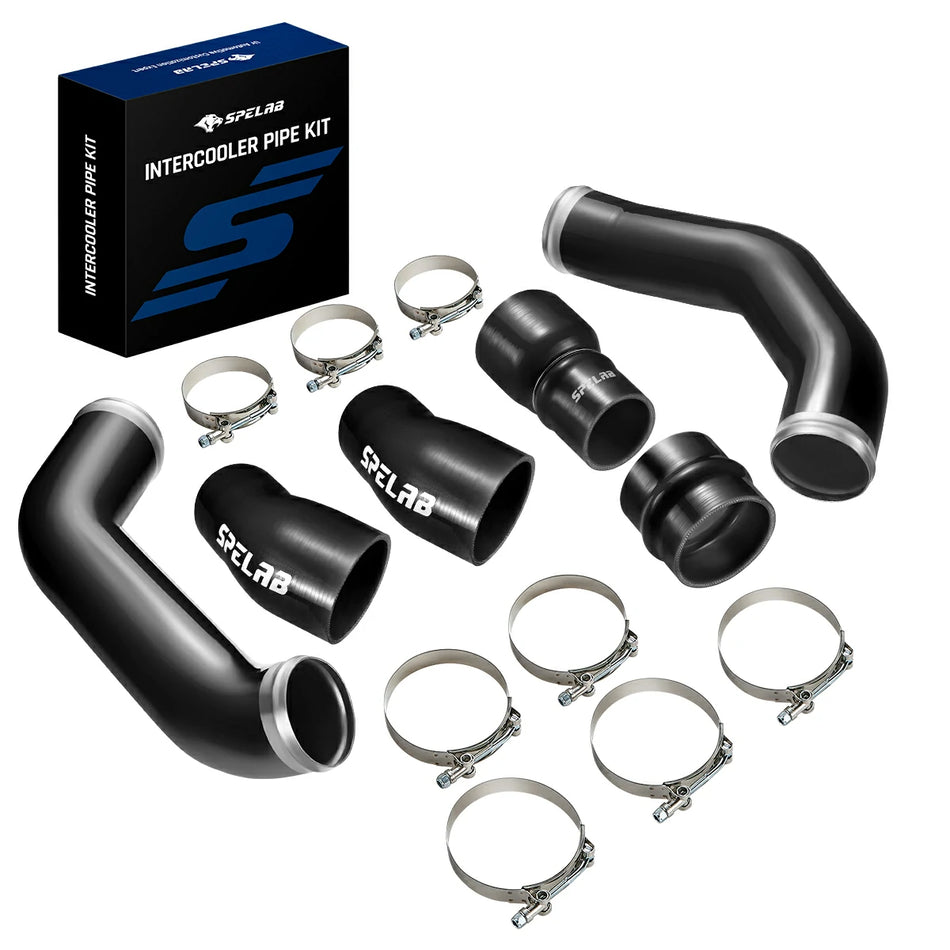
Rigid mandrel-bent aluminum tubing, cast-aluminum manifolds, CNC-machined 6061-T6 adapters, reinforced silicone boots, rolled tube beads, and quality constant-tension or T-bolt clamps can improve durability where plastic, rubber, or factory joints have failed. Material callouts must match the actual part; bore size, wall thickness, sensor ports, grid-heater function, cold-start needs, clamp engagement, and emissions fitment matter more than polished finish.
Intercooler
A larger or more durable intercooler can reduce charge temperature and pressure loss when the stock core is heat-soaked, restricted, or leaking. A bar-and-plate 2013–2018 6.7L Cummins intercooler still must be judged by core thickness, end-tank construction, pressure testing, frontal airflow, condenser and radiator condition, and pipe diameter.
Turbocharger
A correctly sized turbo matches airflow to fuel, elevation, rpm, towing load, and response target. A turbo that supports a large peak number may spool too late for a heavy trailer, while a small fast unit can drive exhaust pressure and EGT when overfueled.
Injectors and High-Pressure Fuel
Injector flow should match the air system, combustion hardware, rail supply, calibration, and transmission plan. Larger injectors do not repair poor compression, low supply pressure, excessive return flow, or contaminated fuel.
Transmission Support
A deeper finned pan can add fluid capacity and surface area, but it does not replace worn clutches, a weak converter, incorrect line pressure, a restricted transmission thermal bypass valve, or bad calibration. Confirm material, gasket surface, pickup clearance, drain plug, sensor ports, and exhaust or crossmember clearance before ordering.
Cooling System
A radiator, coolant reservoir, fan component, thermostat, water pump, or hose upgrade should address a verified leak, restriction, heat-transfer problem, pressure problem, or durability need. Pressure-test the system and clean the radiator, condenser, and charge-air-cooler stack before blaming capacity.
Exhaust Hardware
An emissions-compliant DPF-back system can change sound, routing, corrosion resistance, and serviceability without removing required aftertreatment. Aluminized steel is usually the budget material, T409 stainless commonly trades lower cost for visible surface discoloration, and T304 stainless generally offers stronger corrosion resistance; 4-inch and 5-inch diameter, mandrel bends, hanger position, cab-and-chassis wheelbase, spare-tire clearance, and local noise rules still control the choice.
Gearing, Tires, and Suspension
Axle gearing can restore usable rpm and reduce gear hunting after a large tire change. Springs, air helpers, shocks, track bars, and control arms can improve ride height or control, but none changes the certified axle, tire, hitch, or payload rating.
Diagnose the Symptom Before Buying the Mod
The same Cummins symptom can come from fuel, air, electrical, calibration, aftertreatment, mechanical, or transmission faults, so diagnosis should narrow the system before parts are ordered.
| Symptom | Check first | Data or physical evidence | Do not assume |
|---|---|---|---|
| Hard start or no-start | Batteries, cranking speed, supply fuel, air intrusion, rail pressure, injector return, codes | Voltage during crank, pressure build time, filter inspection, return test | A tuner or larger lift pump will repair every no-start |
| Low power | Fuel filter, boost leak, exhaust leak, VGT operation, regen status, commanded gear | Commanded versus actual boost and rail pressure, smoke, shaft inspection | The turbocharger has failed |
| High EGT | Load, gear, speed, boost leak, timing, excess fuel, intake and exhaust restriction | Pre- or post-turbo probe location, boost, road grade, ambient temperature | A bigger injector or taller gear will help |
| Black smoke | Air supply, charge-air joints, turbo response, injector condition, calibration | Boost response, air restriction, fuel command, cylinder contribution | Smoke equals usable torque |
| Transmission flare or shudder | Fluid, adaptation or fault data, line pressure, converter, clutch condition, tire calibration | Input-output speed relationship, commanded gear, temperature, debris | A pan or cooler repairs internal slip |
| Frequent regeneration | Duty cycle, coolant temperature, sensor faults, intake or exhaust leaks, DPF loading | Distance between regens, differential pressure, temperature sensors, active codes | The engine needs performance parts |
| Excessive blow-by | CCV restriction, oil level, cylinder sealing, turbo oil path | Crankcase-pressure test, compression or leak-down data, oil consumption | A reroute kit repairs worn rings |
| Coolant loss | Cold pressure test, cap, reservoir, hoses, water pump, radiator, heater circuit, combustion-gas evidence | Dried residue, pressure decay, loaded temperature and coolant behavior | Head gasket failure without system testing |
Use One of These Four Beginner Build Plans
A beginner build should have a defined first step, a data requirement, and a stopping point that prevents the project from outrunning the truck's supporting systems.
High-Mileage Daily Driver
A high-mileage daily should prioritize starting, filtration, leaks, cooling, charging, stock-like drivability, and parts that do not create a second maintenance schedule.
- Complete all baseline service and recalls.
- Repair fuel, boost, exhaust, oil, and coolant leaks.
- Add monitoring appropriate to the generation.
- Use stock-size or mildly upgraded components with confirmed bolt-on fitment.
- Stop before a power increase if hot restart, rail tracking, blow-by, or shift quality is questionable.
Tow Rig and Fifth-Wheel Build
A tow build should hold temperature, rail pressure, boost, converter lockup, and braking control during a long grade at loaded travel weight.
- Weigh the complete truck and trailer with passengers, fuel, hitch, tools, and cargo.
- Service cooling, transmission, differentials, brakes, tires, and trailer-brake hardware.
- Log EGT, coolant, transmission temperature, boost, gear, and converter behavior.
- Select a fast-response turbo and conservative torque delivery if airflow changes are justified.
- Stop adding fuel when smoke, EGT, drive pressure, or gear hunting worsens.
Farm, Ranch, and Jobsite Truck
A work truck should favor low-speed cooling, dust protection, easy service, secure wiring, durable joints, and predictable torque over a narrow peak-power setup.
- Inspect the cooling stack and air filter more often in chaff, dust, and mud.
- Protect wiring and fuel lines from abrasion and poorly mounted accessories.
- Choose rigid charge-air parts with adequate bead engagement and serviceable clamps where stock parts have failed.
- Keep cold-start equipment functional in northern climates.
- Retain a repair plan that does not strand the truck waiting for one-off race hardware.
Street-Performance Build
A street-performance build should establish the transmission, tire, brake, fuel, turbo, and calibration plan before injector size or advertised horsepower is selected.
- Set a realistic wheel-horsepower and use target.
- Build the transmission or clutch for the intended torque curve.
- Match turbo airflow, injector flow, fuel supply, valve-train needs, and engine rpm.
- Use staged calibration and review logs after each change.
- Keep street-driven emissions systems and diagnostics compliant.

How Should a Cummins Be Prepared for Cold Weather?
A cold-weather Cummins build should protect cranking speed, fuel flow, block-heater operation, intake-heater function, DEF thawing strategy, and controlled radiator airflow before adding winter power parts.
Load-test both batteries, measure voltage drop across the positive and ground circuits, verify the block-heater cord and element, and use the engine-oil viscosity specified for the expected temperature. Slow cranking can create long starts, low rail-pressure buildup, white smoke, and misleading injection-system symptoms.
Use winter-grade diesel from a high-turnover source and only fuel treatment approved for the engine and temperature. Replace a restricted filter, drain separated water correctly, carry a spare filter on remote trips, and never use gasoline as a homemade anti-gel treatment.
Preserve working intake heat unless the truck has a properly engineered alternative. A 3.5-inch intake manifold with a heating element must match the exact 2007–2024 application, sensor layout, calibration, and cold-start requirement; airflow alone does not decide fitment.
Review cold-start behavior after airflow changes before removing or rerouting factory hardware. A winter front should be used only as the vehicle instructions allow and monitored closely during towing or warmer weather so coolant, charge-air, and transmission temperatures do not climb unnoticed.
Allow the factory DEF heating system time to work before diagnosing frozen fluid as failed hardware. Scan heater, temperature, level, pressure, and NOx-related codes rather than pouring additives into the DEF tank.
Will Cummins Upgrades Improve Fuel Economy?
Cummins upgrades do not guarantee better MPG because vehicle speed, trailer weight, regeneration, tire size, axle ratio, idle time, weather, driving style, and calibration often outweigh a small airflow change.
Measure fuel economy by dividing corrected miles traveled by gallons added over at least three to five comparable tanks. Correct the odometer for oversized tires, use the same pump when practical, record idle hours and regeneration events, and compare similar routes, loads, speeds, and weather.
Repairing a dragging brake, boost leak, restricted filter, failed thermostat, poor alignment, underinflated tire, or abnormal regeneration can recover lost efficiency. A larger turbo, injector, intake, or exhaust part may improve one operating area while lowering economy elsewhere if spool, fueling, gear selection, or driving behavior changes.
Towing MPG should be judged at the same loaded weight and road speed. A tune that shows a better dashboard number during an empty commute does not prove that the truck burns less fuel pulling a 15,000-pound fifth-wheel.
Avoid These Common Cummins Build Mistakes
Most expensive beginner failures come from wrong identification, missing baseline data, mismatched torque delivery, poor installation, or using a race solution on a work truck.
- Treating every 5.9L or 6.7L as identical: midyear engine, pump, transmission, sensor, and emissions changes can break fitment.
- Using smoke as a power gauge: visible fuel without enough air raises heat and soot while wasting fuel.
- Pairing large injectors with the wrong turbo: spool, drive pressure, EGT, cylinder pressure, and towing response move together.
- Calling every oil-cap movement excessive blow-by: use crankcase-pressure and cylinder-health tests.
- Installing large tires without recalibration or gearing analysis: effective gearing, shift schedule, braking, and axle load all change.
- Assuming helper springs add payload: they can change ride height or control, but the certified ratings remain unchanged.
- Skipping the post-install inspection: recheck clamps, fasteners, fluid levels, wiring clearance, and leaks after the first heat cycles.
Keep Emissions, Warranty, and Towing Limits in the Build Plan
A street-driven Cummins build must retain required emissions functionality, stay within certified weight ratings, and document maintenance and modifications for future warranty diagnosis.
Federal law prohibits tampering with certified emissions controls and prohibits defeat devices that bypass or disable EGR, DPF, SCR, sensors, onboard diagnostics, or related control strategies.[5] Product availability does not determine street legality.
An aftermarket part does not automatically cancel the entire vehicle warranty, but a claim may be denied when the modification or its installation caused the failure being claimed. Keep invoices, maintenance records, calibration information, part numbers, installation instructions, and before-and-after logs.[6]
Horsepower, an exhaust brake, air springs, helper springs, larger brakes, or a transmission build do not raise GVWR, GAWR, GCWR, tire capacity, hitch rating, or door-label payload. Use the exact model-year Ram towing data and weigh the loaded combination instead of relying on a badge or engine rating.[7]
Bottom Line
A durable Cummins build supplies clean fuel, controls heat, supports the transmission, preserves required safety and emissions functions, and proves every change under the truck's real workload before adding the next part.
Start with the truck you own, not the build sheet you saw online. Our parts-manufacturing tests produce the cleanest results when owners measure the weak point, choose hardware for a specific duty cycle, install it without forcing fitment, and compare the new data with a saved stock baseline.
Cummins Upgrade FAQ
These direct answers cover the ten decisions Cummins beginners most often need to make before buying parts.
Q: What should I upgrade first on a Cummins?
A: Verify batteries, fluids, filters, supply fuel, rail-pressure tracking, boost integrity, cooling, transmission behavior, recalls, and EGT under load before adding power.
Q: Is the 5.9L Cummins better than the 6.7L Cummins?
A: A 5.9L offers simpler early configurations, while a 6.7L provides more factory torque and VGT exhaust braking but carries more complex emissions and electronic systems.
Q: How much horsepower can a stock Cummins handle?
A: Supported beginner builds commonly fall around 300–400 rwhp for a 12-valve, 400–500 rwhp for a common-rail 5.9L, and roughly 425–550 rwhp for many pre-2025 6.7L trucks; those planning bands are not safe limits and depend heavily on transmission, heat, cylinder pressure, engine condition, and duty cycle.
Q: How much does a Cummins build cost?
A: Baseline and monitoring work often costs roughly $1,000–$3,000, while a matched fuel, turbo, engine, and transmission build can reach $12,000–$25,000 or more before hidden repairs.
Q: Do I need a lift pump before tuning a Cummins?
A: Upgrade the lift pump when testing shows inadequate pressure, restriction, air intrusion, poor filtration, or insufficient flow; a healthy stock system may support a stock or mild build.
Q: What fuel pressure should a VP44 Cummins have?
A: Many aftermarket VP44 systems operate around 10–15 psi at the pump inlet, while a sustained loaded drop toward about 5 psi warrants immediate diagnosis.
Q: Can a stock 47RE, 48RE, or 68RFE handle a tuner?
A: No single power limit fits every stock transmission because clutch wear, converter condition, line pressure, tire diameter, axle ratio, torque delivery, temperature, and loaded weight all change the result.
Q: Do I need an EGT gauge for towing?
A: A pyrometer is a sound choice when factory data cannot show EGT under sustained load, especially on fueled mechanical and early electronic trucks.
Q: Will Cummins performance upgrades improve MPG?
A: No modification guarantees better MPG; compare corrected miles and gallons across three to five similar tanks while controlling trailer weight, speed, regeneration, tire size, weather, and idle time.
Q: Are 6.7L Cummins delete kits legal for street use?
A: Hardware or software that disables required EGR, DPF, SCR, sensors, or onboard diagnostics is not a legal street-performance path under federal anti-tampering rules. State and local requirements can add further restrictions.
Related Articles
- The Duramax Upgrade Roadmap: How to Build It Right, Not Just Fast
- The Power Stroke Upgrade Roadmap: A Beginner’s Guide to Building It Right
Sources
Official manufacturer and United States government sources support the recall, current powertrain, emissions, warranty, and towing statements used in this guide.
- NHTSA Vehicle Recall Lookup
- FCA Bulletin 14-008-22: 6.7L Cummins High-Pressure Pump Identification
- Ram Safety Recall 13A / NHTSA 23V-060: Intake Air Grid Heater Relay
- 2026 Ram Heavy Duty Powertrain, Payload, and Towing Specifications
- EPA Fact Sheet on Aftermarket Defeat Devices and Tampering
- FTC Auto Warranties and Auto Service Contracts
- Ram Official Towing and Payload Guidance

About the Author
John Lee
Mechanical Engineer | 10+ Years Experience
John has spent the last decade engineering and testing high-performance automotive components. Specializing in drivetrain durability and thermal management across Powerstroke, Cummins, and Duramax applications, he bridges the gap between OEM limitations and aftermarket performance. His philosophy: "Factory parts are just a starting point."