What Is the SPELAB Intake System? Unlock Diesel Power Like Never Before
In the world of diesel performance upgrades, the SPELAB Intake System is an all-in-one high-performance air intake solution designed to boost both power and efficiency. It integrates key components like cold air intake kits, turbo intercoolers, wastegates, and intake manifolds—engineered specifically for top diesel platforms like the 2005 Ford F-250 with a Powerstroke 6.0L engine, the 2020 Chevy Silverado 2500HD with a Duramax 6.6L, and the 2018 Ram 2500 with a Cummins 6.7L.
By improving airflow velocity, increasing cooling efficiency, and reducing turbo lag, this system can deliver up to a 15% horsepower gain while significantly enhancing throttle response and towing performance. Whether you're hauling heavy loads, hitting the track, or simply demanding more from your daily drive, the SPELAB Intake System is built to perform.
What’s Included in the SPELAB Intake System? High-Performance Components Built for Diesel Power
Each component of the SPELAB Intake System plays a vital role in optimizing airflow and enhancing performance. Whether you drive a 2016 Ford F-250 6.7L Powerstroke, a 2007 Dodge Ram 2500 5.9L Cummins, or a 2021 Chevrolet Silverado 2500HD 6.6L Duramax, understanding how each upgrade contributes to your engine’s efficiency is key to maximizing results.
The Cold Air Intake Kit replaces the restrictive factory airbox with a high-flow filter and oversized intake tubing. It pulls in cooler, denser air from outside the engine bay, improving combustion and throttle response. On a 2015 GMC Sierra 2500 with a 6.6L Duramax, owners report sharper throttle feedback and fuel economy gains of up to 1.5 MPG.
Pros: Increased horsepower, better fuel burn, deeper engine tone
Cons: Requires regular filter maintenance; water ingestion risk in deep water or heavy rain
The Turbo Intercooler Kit dramatically lowers intake air temperatures post-turbo, resulting in denser air for more efficient combustion. Especially on models like the 2008 Ford F-350 6.4L Powerstroke, where factory intercoolers tend to heat soak under load, this upgrade maintains consistent performance.
Pros: Reduced intake temps, improved torque and power
Cons: Needs ample space for installation; professional installation recommended
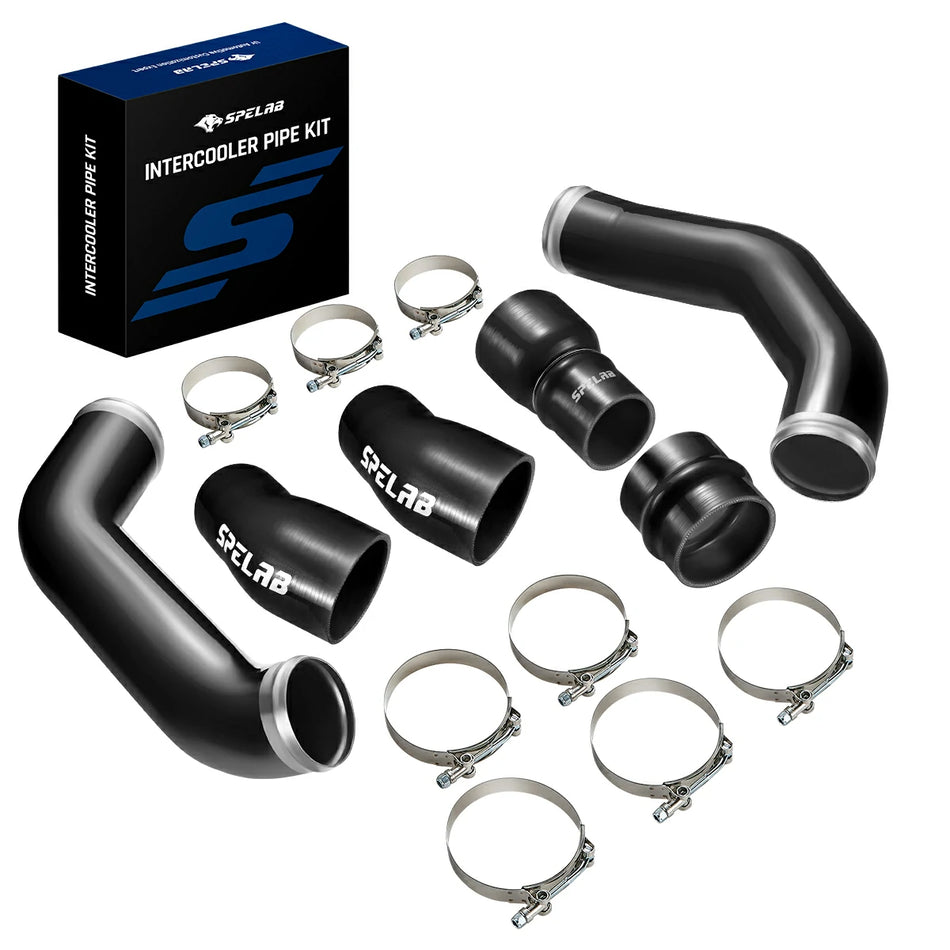
SPELAB’s Intercooler Pipes are mandrel-bent from aluminum or stainless steel to eliminate airflow bottlenecks and prevent flexing under pressure. Trucks like the 2010 Dodge Ram 2500 6.7L Cummins benefit greatly from this upgrade, especially when running higher boost levels.
Pros: High-pressure durability, improved airflow, crack-resistant
Cons: May require custom couplers or clamps for certain models
The Wastegate is essential for turbo pressure control, especially on performance-tuned trucks like the 2013 Ford F-250 6.7L Powerstroke. It ensures your turbo system maintains safe, efficient boost levels and prevents overboost damage.
Pros: Fine-tuned boost control, protects engine, improves drivability
Cons: Requires precise tuning; incorrect setup can reduce performance
SPELAB’s performance Intake Manifold promotes even airflow distribution to all cylinders, helping reduce EGTs and improve mid-range torque. It’s a must-have upgrade for high-load setups like the 2011 Ram 2500 with a 6.7L Cummins engine.
Pros: Balanced air delivery, cooler engine temps, stronger combustion
Cons: More complex to install, typically higher in cost than other components
Together, these components form the core of the SPELAB Intake System, delivering measurable gains for towing, racing, and daily driving alike.
What Does the SPELAB Intake System Replace in OEM Setups? A Complete Upgrade Overview
Compared to the factory OEM intake systems, the SPELAB Intake System delivers a comprehensive upgrade in materials, airflow design, and overall performance. Most stock intake pipes are made from plastic, which is prone to heat damage and airflow restriction. On the 2012 Ford F-250 with the Powerstroke 6.7L diesel engine, the SPELAB Cold Air Intake Kit replaces these with durable aluminum or stainless steel tubing, greatly improving heat resistance and airflow velocity.
OEM intercoolers, especially on models like the 2019 GMC Sierra 2500HD with the Duramax 6.6L, are undersized and often struggle with cooling under load. SPELAB’s Turbo Intercooler Kit and performance-grade Intercooler significantly increase core size and air channel capacity, reducing intake temps by 20–30°F for more stable combustion.
In the case of the 2007 Dodge Ram 3500 with the Cummins 6.7L engine, factory intake manifolds are often restrictive and cause uneven airflow distribution across cylinders. The SPELAB Intake Manifold solves this with a symmetrical high-flow design, boosting intake balance and throttle response.
As for intercooler piping, SPELAB replaces stock rubber hoses with heavy-duty aluminum piping, engineered for high-pressure performance. This upgrade eliminates boost leaks and increases durability under extreme turbo pressure.
Together, these upgrades not only enhance power output but also extend the lifespan and reliability of your diesel engine—whether for towing, hauling, or daily driving.
Powerstroke, Cummins & Duramax: Tailored SPELAB Intake System Solutions for Each Diesel Platform
Each diesel engine platform—Powerstroke, Cummins, and Duramax—has unique design characteristics, torque curves, and performance demands. That’s why the SPELAB Intake System is precisely tuned and matched for each one, ensuring optimized airflow, cooling, and boost management.
- For the 2020 Ford F-250 Super Duty with the Powerstroke 6.7L diesel engine, known for its high torque and heavy-duty hauling, we recommend pairing the Cold Air Intake Kit + Intercooler Pipe + Wastegate. This setup enhances airflow, controls boost pressure more accurately, and improves towing stability under load.
- On the 2016 Ram 2500 Cummins 6.7L, with its long-stroke high-pressure common rail system, the best combination is the Intake Manifold + Turbo Intercooler Kit. This improves intake balance, promotes more even combustion, and reduces heat soak under sustained power.
- For the 2018 Chevy Silverado 2500HD Duramax 6.6L, a platform particularly sensitive to intake temperature, the recommended setup is the Cold Air Intake Kit + high-efficiency Intercooler, which keeps intake temps down and maintains consistent power delivery.
Rather than a one-size-fits-all solution, each SPELAB Intake System is engineered around the specific airflow dynamics, turbo pressure profiles, and real-world use cases—whether you’re towing, off-roading, or driving daily—ensuring precise, practical, and powerful upgrades.
Why Choose SPELAB?
Choosing a SPELAB Intake System means more than just upgrading your diesel engine’s performance—it’s also a commitment to dependable service and unmatched support. SPELAB specializes in precision-engineered intake solutions for Powerstroke, Cummins, and Duramax engines, with a strong focus on model-specific fitment and reliability.
Whether you're driving a 2015 Ford F-350 with a Powerstroke 6.7L, a 2022 Ram 2500 Cummins 6.7L, or a 2019 GMC Sierra 2500HD Duramax 6.6L, SPELAB provides tailored recommendations and personalized support to ensure your setup is dialed in for your needs.
Our dedicated customer support team is ready to assist with fitment questions, tuning guidance, or installation troubleshooting—typically responding within 7 business days. Additionally, SPELAB maintains an active community across its website and social media platforms, where diesel owners nationwide share installs, performance results, and real-world experiences.
With a focus on high-performance upgrades and high-level service, SPELAB has earned its place as a trusted name in the diesel aftermarket world.