Intercooler Pipe Kits for Powerstroke, Cummins & Duramax Diesel Trucks
A diesel truck intercooler pipe kit is more than a cosmetic engine-bay upgrade. It helps maintain a sealed, efficient airflow path between the turbocharger, intercooler, and intake system. If your truck is showing signs of boost leak, sluggish throttle response, black smoke under load, higher EGTs, or power loss while towing, the factory charge pipe, boots, or clamps may be worth inspecting.
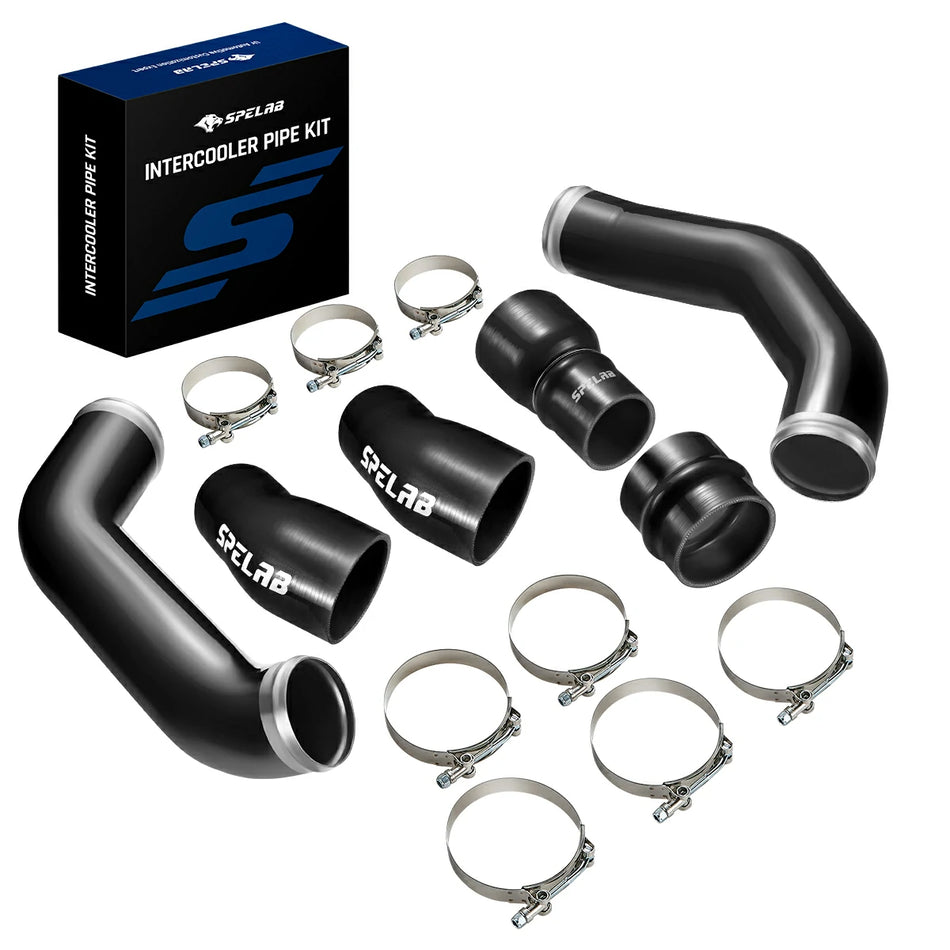
SPELAB intercooler pipe kits are designed for selected Ford Powerstroke, Dodge Ram Cummins, and GM/GMC Duramax diesel trucks. Instead of relying on aging factory plastic pipes or worn stock connections, these kits use aluminum piping, reinforced silicone couplers, and application-specific fitment to help restore airflow reliability under boost.
What Does Intercooler Piping Actually Do?
On a turbocharged diesel, the turbo compresses incoming air to push more oxygen into the engine,
which lets it burn more fuel and make more power. Compressing air also heats it up significantly,
so before that air reaches the engine, it has to pass through the intercooler to cool back down.
The piping is what connects that whole path together. Air leaves the turbo through the
hot side pipe, enters the intercooler core, then continues through the
cold side pipe into the intake system. Every pipe, boot, and clamp along that
route has to hold boost pressure without leaking. The pipes themselves don't cool the air—
that's the intercooler core's job—but if the pipes leak, the truck loses boost before that
cooled air ever reaches the engine, which is why a cracked pipe or a blown boot can cause the same
power loss as a failing intercooler.
Choose the Right Intercooler Pipe Kit by Truck Platform
The best intercooler pipe kit depends on your truck’s year, engine, and whether you need a hot-side pipe, cold-side pipe, Y-Bridge kit, or a more complete pipe upgrade. Use the guide below to narrow your options before checking the individual product page for final fitment.
Y-Bridge upgrades, cold-side pipe replacement, hot-side leak repair, towing support
Hot Side vs Cold Side Intercooler Pipe: Which One Do You Need?
Diesel intercooler piping is usually discussed in two main areas: hot side and cold side. The hot side carries compressed air from the turbocharger toward the intercooler. The cold side carries cooled, compressed air from the intercooler toward the intake system. Both sides must stay sealed under boost, but the failure point can vary by engine platform, age, clamp condition, boot wear, and previous modifications.
Choose a hot-side intercooler pipe if:
You see or hear a leak near the turbo outlet side.
The factory hot-side pipe, boot, or clamp is loose, cracked, oil-soaked, or heat-damaged.
Your truck works under heavy load, high boost, towing, or repeated heat cycles.
You are upgrading other turbo-side airflow components and want a stronger pipe connection.
Choose a cold-side intercooler pipe if:
You notice oil residue, loose boots, or leaking connections between the intercooler and intake side.
The truck feels lazy under throttle or loses boost after the intercooler.
You want to replace a weak factory plastic cold-side pipe with a more durable aluminum pipe.
Your Duramax setup needs a Y-Bridge or cold-side airflow upgrade.
If you are not sure which side is leaking, inspect the couplers, clamps, boots, and pipe connections first. A hissing sound under boost, oily residue around a boot, low boost pressure, black smoke, or higher EGTs can all point to a leak somewhere in the charged-air system.
Why Upgrade from Factory Plastic or Aging Charge Pipes?
Factory intercooler pipes and boots work well when new, but diesel trucks operate under repeated boost pressure, vibration, heat cycles, and oil vapor exposure. Over time, plastic pipes can become brittle, boots can soften or crack, and clamps can loosen. Once pressurized air escapes, the engine receives less air than expected, which can affect throttle response, exhaust smoke, EGT control, and towing performance.
SPELAB intercooler pipe kits use aluminum pipe construction with reinforced silicone couplers to help maintain a stronger sealed path under boost. This makes them a practical upgrade for diesel truck owners who tow, daily drive, run larger tires, operate in hot climates, or want to replace old factory charge-air components before a failure happens on the road.
Common Signs You May Need an Intercooler Pipe Upgrade
Hissing or whooshing noise under boost: Often caused by air escaping from a loose clamp, split boot, cracked pipe, or worn connection.
Loss of power or lazy throttle response: A leaking charged-air system can make the truck feel slow to build boost.
Black smoke under acceleration: On diesel trucks, reduced airflow can create a richer-than-normal combustion condition.
Higher EGTs while towing: Less available air can make the engine work harder under load.
Oil residue around couplers: A light oil film near a boot or clamp can reveal where pressurized air is escaping.
Underboost-related diagnostic codes: Low boost pressure may be caused by leaks in the intercooler piping, boots, clamps, or related charge-air components.
Common Scenarios: Does Your Situation Call for a Pipe Upgrade?
Towing heavy loads or hauling frequently: Sustained boost under load is the
hardest condition on factory piping. If you tow regularly, prioritize replacing the side most
likely to fail rather than waiting for a roadside boost leak.
Driving at high altitude: Thinner air means the turbo has to work harder to
build the same boost pressure, putting more stress on aging pipes, boots, and clamps than the
same drive at sea level.
Hot climates or desert driving: High ambient heat accelerates the breakdown of
factory plastic pipes and rubber boots, making cracking and boot failure more likely sooner.
Recently bought a high-mileage used diesel: Factory plastic pipes and boots
degrade with age and heat cycles regardless of how the previous owner drove the truck.
Inspecting or proactively replacing this piping on a used truck is often cheaper than dealing
with a sudden boost leak later.
Tuned or performance-built trucks: Increased boost puts more stress on every
seal in the charge-air path. A tune alone doesn't require new piping, but it lowers the safety
margin on factory-spec pipes and clamps.
Intercooler Pipe Kit vs Intercooler Kit: What Is the Difference?
An intercooler pipe kit replaces the charge-air piping and connection points that move compressed air through the turbo system. An intercooler kit usually includes the heat exchanger core that cools the compressed air. If your truck has a cracked pipe, loose boot, or leaking clamp, an intercooler pipe kit may be the direct repair path. If your intercooler core is damaged, heat-soaked, or undersized for your build, pairing upgraded pipes with a
SPELAB intercooler kit
may create a more complete airflow upgrade.
For intake-side upgrades, some truck owners also pair intercooler piping with an
air intake kit
or
intake manifold upgrade,
depending on the engine platform and build goal. Always confirm fitment before combining multiple airflow parts.
Fitment Notes Before Ordering
Intercooler pipe kits are not universal. Before ordering, verify your truck’s year, make, model, engine, cab/chassis configuration if applicable, and whether the product is a hot-side, cold-side, Y-Bridge, or complete pipe kit. Also check whether your truck still uses the factory intercooler, factory intake bridge, factory turbo location, or other modified airflow components.
For best results, inspect your existing boots and clamps during installation. Reusing worn clamps or damaged couplers can cause a new pipe kit to leak even when the pipe itself fits correctly. If your truck has custom tuning, aftermarket turbo components, or non-factory intercooler routing, review the product photos and fitment notes carefully before purchase.
An intercooler pipe moves compressed air through the turbocharged intake system, typically between the turbocharger, intercooler, and intake side of the engine. The pipe itself doesn't cool the air—that's the intercooler core's job—but a sealed, smooth path is what lets the engine actually receive that pressurized air under boost.
An intercooler pipe kit replaces the piping, boots, and clamps that move air through the charge-air system. An intercooler kit usually includes the core itself, the heat exchanger that cools the air. If your issue is a cracked pipe or loose boot, start with the pipe kit; if the core is damaged or heat-soaked, you need the intercooler.
It can, if the leak is caused by a cracked pipe, failed boot, loose clamp, or worn connection that the kit replaces. If the leak comes from the intercooler core, EGR connection, turbo compressor cover, or another gasketed joint, that part must be diagnosed separately.
Choose based on where the failure is located. The hot side is closer to the turbo outlet; the cold side is closer to the intake after the intercooler. If you can't identify the leak visually, pressure testing the charge-air system can help confirm the failure point before ordering.
Most direct-fit intercooler pipe replacements don't require tuning by themselves, since they mainly replace the pipe path and connection hardware. Trucks with larger turbochargers, custom intake routing, or non-factory tuning should be evaluated as a complete system.
For most diesel truck applications, yes. Aluminum piping handles heat, pressure, and repeated boost cycles better than aging factory plastic, which becomes brittle over time. The main benefit is durability and sealing reliability, especially paired with quality silicone boots and clamps.
For towing, prioritize fitment accuracy, strong couplers, secure clamps, and replacing the side most likely to leak under sustained load. A sealed charge-air system matters most when the truck is pulling grades, running in hot weather, or holding boost for long periods.
Yes. High altitude means the turbo works harder to build the same boost, which stresses aging pipes and boots more than at sea level. Hot climates accelerate the breakdown of factory plastic and rubber over time. Neither condition changes which parts fail, but both make failure more likely sooner on a marginal factory system.
It's a reasonable precaution. Factory plastic pipes and rubber boots degrade with age and heat cycles regardless of how the previous owner drove the truck. Inspecting or replacing this piping before a failure is usually cheaper and less disruptive than dealing with a sudden boost leak later.
Many diesel truck owners install a direct-fit kit with basic hand tools, but difficulty depends on engine bay space, rust, clamp condition, and whether it's a hot-side, cold-side, or Y-Bridge setup. Allow extra time to inspect boots, clamps, and nearby connections during installation.
Anonymous
Purchased for my 2011 ram 2500 6
Purchased for my 2011 ram 2500 6.7 Cummins. Great product all the sensors holes lined up perfectly helped with acceleration a lot more responsive now on acceleration
SPELAB Cold Air Intake Kit For 2007.5-2012 Dodge Ram 6.7L Diesel Ram 2500 3500 4500 5500
Caleb
Installed on a 14 3500, seamless install
Installed on a 14 3500, seamless install maybe takes 10min. Definitely opens intake up. Noticeably more sound. Not sure any performance gains other than throttle response
SPELAB Cold Air Intake Kit For 2007.5-2012 Dodge Ram 6.7L Diesel Ram 2500 3500 4500 5500
Dennison Collard
Full delete
I’ve purchased the EGR and CCV deletes as well as the upgraded intake manifold, upper radiator hose and thermostat block, and compressed air piping. Overall I am very satisfied with the quality and fit of all of the parts. Some of the instructions could use a little more detail, but if you are in any way mechanically inclined, you’ll be able to do these yourself no problem. I did have to make a very small modification to the aluminum quick connector on the upper radiator hose in order to get it to lock in place, but other than that everything has been great!
Intake Manifold for 2011–2019 Ford F250 F350 F450 F550 6.7L Powerstroke | SPELAB