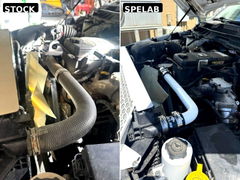
Duramax Intercooler Upgrades for Chevy Silverado & GMC Sierra 2500HD/3500HD
If your 6.6L Duramax is used for towing, hauling, daily driving, or tuned diesel performance, a stronger intercooler can support more consistent charge air cooling under load. SPELAB Duramax intercoolers are engineered for both Chevrolet Silverado and GMC Sierra 2500HD/3500HD trucks, covering every major Duramax generation from 2001 through 2016—LB7, LLY, LBZ, LMM, and LML.
This collection includes all-aluminum Tube-Fin intercoolers and Bar-and-Plate intercooler upgrades, at a fraction of the cost of premium aftermarket brands offering similar core designs. Whether you're replacing a leaking factory intercooler, fighting heat soak while towing, or upgrading for better airflow reliability, confirm your model year and engine code below before ordering.
Note: Duramax production began in 2001. 1999–2000 Silverado/Sierra HD trucks used the 6.5L diesel, which has a different intercooler design and is not covered in this collection.
Why the Factory Duramax Intercooler Fails
On every 6.6L Duramax from LB7 through LML, the factory intercooler shares the same weak point: plastic end tanks crimped onto the aluminum core. Under sustained boost—towing, tuning, or simply 15–20 years of heat cycles—that crimped seam is what fails first.
- Heat cycling and boost pressure stress the crimped plastic-to-aluminum seam.
- The seam cracks, creating a boost leak.
- You lose charge pressure, so intake air temps and EGTs climb.
- Power drops and, in some cases, a hissing or whistling sound appears under acceleration.
SPELAB replaces that failure point with either welded 100%-aluminum end tanks (Tube-Fin design) or cast-aluminum end tanks (Bar-and-Plate design)—no plastic, no crimped seams. Every core in this collection is rated to hold 100+ PSI without ballooning.
Find the Right Duramax Intercooler by Year and Engine
Chevrolet and GMC Duramax trucks use different intercooler fitments depending on model year. Match your year below, then check each product page for exact fitment.
- 2001–2004 (LB7): Choose an LB7 intercooler replacement or upgrade if your factory unit is leaking, damaged, or no longer keeping intake air temperatures under control.
- 2004.5–2005 (LLY): LLY trucks benefit from an upgraded intercooler when towing or refreshing an aging charge air system—see the radiator-airflow note below before choosing a core thickness.
- 2006–2007 (LBZ): An LBZ intercooler upgrade is a common supporting modification for owners who want stronger cooling capacity and improved reliability under load.
- 2007.5–2010 (LMM): LMM trucks used for towing or performance driving may benefit from a heavy-duty intercooler designed to reduce heat soak and support stable charge air flow.
- 2011–2016 (LML): Upgrading the intercooler can help support consistent performance during towing, high-load driving, and long-distance diesel use.
Tube-Fin vs Bar-and-Plate: The Real Difference
| Spec | Tube-Fin | Bar-and-Plate |
|---|---|---|
| Core thickness | 40mm (LB7/LLY) – 64mm (LML) | 2.05″ (LB7/LLY) – 3.35″ (LBZ/LMM/LML) |
| Core volume vs. stock | Baseline replacement | +34% larger |
| Approx. weight | ~36 lbs | 55–77 lbs |
| End tanks | Welded 100% aluminum | Cast aluminum |
| Pressure rating | Standard duty | 100+ PSI |
| Best for | Daily driving, factory-style replacement, radiator-safe airflow | Towing, tuned setups, sustained high-boost use |
For most Silverado/Sierra Duramax owners doing daily driving with occasional towing, the Tube-Fin intercooler is the best overall choice. If you tow frequently, run a tune, or regularly see sustained high boost, the Bar-and-Plate upgrade is the better fit.
A thicker core cools intake air more, but it can also block airflow to your main radiator. This is especially important on the LLY, which is already known for running hot while towing—more core thickness is not automatically the better choice for every engine. SPELAB's Tube-Fin cores use a “flow-through” fin design specifically to protect radiator airflow.
Related Duramax Upgrades
If you're refreshing your Duramax charge air system, you may also want to compare Duramax intercooler pipe upgrades, Duramax performance parts, Duramax up-pipe upgrades, and Duramax downpipe upgrades for a more complete diesel airflow and performance setup.