2 Products
DPF Back
What a DPF-Back Exhaust Actually Replaces
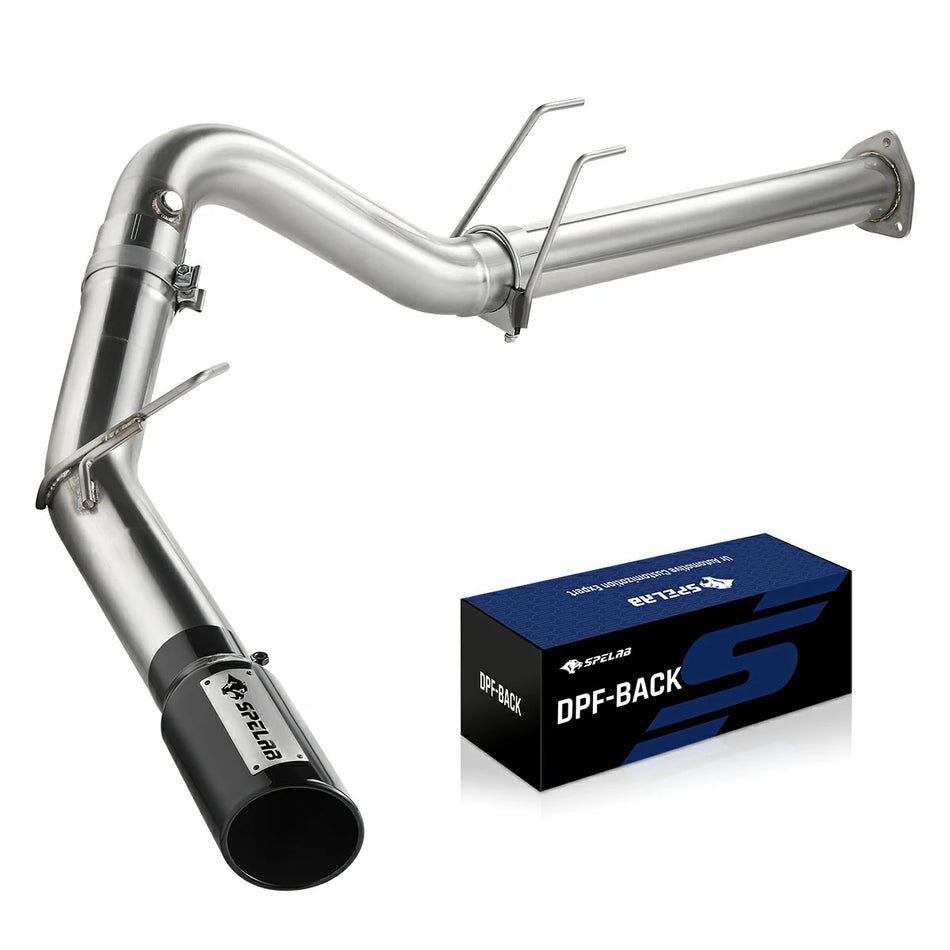
A DPF-back exhaust replaces the pipework behind the diesel particulate filter and nothing else. Everything upstream stays exactly as the truck was built: the filter stays in place, the sensors stay connected, the aftertreatment strategy stays untouched. The section that comes off is the pipework between the filter outlet and the tailpipe - the part that rusts, that carries the muffler, and that decides what the truck sounds like from behind.
That boundary is the same whether the truck is a Powerstroke or a Cummins-powered Dodge Ram: the filter stays, and the pipework behind it is what comes off. What differs between those platforms is the packaging behind the cab and the length of the rear section, not the principle.
Two things follow from it: nothing about the engine's emissions calibration has to change, and nothing about the truck's compliance posture has to change either.
Where the Sections Begin and End
Exhaust naming is a boundary problem, and the same piece of pipe gets called different things depending on where the speaker starts counting.
| Term | Starts at | What it implies |
|---|---|---|
| Turbo-back | The turbine outlet | The whole system behind the turbo - includes emissions hardware, so it is never an emissions-neutral change |
| DPF-back | The outlet of the diesel particulate filter | Filter and everything ahead of it stay stock |
| Filter-back | The filter outlet | The same section under a different name - on a diesel this is DPF-back by another label |
| Axle-back | The rear axle | Only the short run to the tip - mostly a sound and appearance change |
That table is worth reading carefully, because listings mix these labels. A part described as filter-back on a diesel truck is the same job as a DPF-back exhaust, while a part described as turbo-back is not remotely the same job. If a listing only says "exhaust system" without a boundary, the boundary is the first thing to establish.
Why Keeping the Filter Changes Everything
This is the part that separates this category from every other exhaust modification on a diesel.
- Nothing the ECU monitors is disturbed. The pressure and temperature sensing around the filter stays in place, so the aftertreatment system sees the hardware it expects. A DPF-back exhaust does not set off a diagnostic for missing emissions equipment, because no emissions equipment was removed.
- No supporting calibration is required. There is no monitor to address and no fault to manage. That is a genuine difference from a change upstream of the filter, where the answer depends on the generation and the platform.
- Regeneration behaves normally. The filter still loads and still regenerates on the schedule the engine management decides, because nothing upstream of it changed.
For an owner who tows, commutes, or simply does not want the legal exposure, that is the entire argument. It is also why this category is the one to recommend to someone who asks for "more sound" rather than the more invasive options.
What a DPF-Back Exhaust Changes, and What It Does Not
Honesty here prevents most of the disappointment in this category.
What changes: the tone behind the truck. The muffler is the component that shapes it, and the section behind the filter is where that component lives. Expect a deeper, more present note under load. The tailpipe finish and outlet style also change how the rear of the truck looks, which for many owners is half the reason for doing it. And on a truck with an ageing original system, rust resistance is a real gain: the factory rear section is usually the first part of the exhaust to go, particularly where roads are salted.
What does not change much: output. The dominant restriction in a modern diesel exhaust is the particulate filter and everything ahead of it, and a DPF-back exhaust sits downstream of all of it. Relieving a restriction that was never the main one produces a small effect. Anyone promising large gains from this section alone is describing a different modification. Buy this for sound, appearance and durability - and treat anything else as a bonus.
Choosing Material by Where the Truck Lives
Stainless is offered in two families, and the right one depends on the environment rather than on the budget alone.
- Ferritic stainless is the sensible direct replacement. It handles heat and exhaust condensates well and costs less. On a truck in a dry inland climate it is usually the correct answer, and it is the material most original systems use.
- Austenitic stainless carries more nickel and resists chloride attack far better. It is the choice for coastal use, for anywhere roads are salted heavily in winter, and for a truck kept long enough that the extra cost is amortised.
Whichever is chosen, the finish on the tip is cosmetic and takes the most abuse from road grime and heat. A coated tip looks right when new and is the part most likely to discolour, so judge it as appearance rather than as protection.
DPF-Back Fitment Traps Behind the Axle
Most of what goes wrong with an order in this category is not the pipe - it is the assumption about what is behind the cab.
- Body and chassis configuration. Pickups and chassis-cab trucks run different frames and different rear sections, and a system built for one will not line up with the other.
- Wheelbase. The rear section is cut for a specific wheelbase. Same model, different bed and cab combination, different pipe.
- Single versus dual exit. Some trucks left the factory with one outlet and some with two, and the rear valance usually differs with it.
- What hangs underneath. Spare tyre, trailer hitch, rear axle and, on some configurations, a secondary tank or def tank all sit in the space the pipe has to pass through.
- The hanger positions. A system that uses factory mounting points only fits if the factory hangers are where the system expects them.
Installation Reality
The job is a bolt-on one: support the old section, release the hangers, separate the joint at the filter outlet, and transfer the hardware across. The hours go into the fasteners rather than the pipe. Exhaust clamps and flange bolts at the front of that section have spent years at temperature, and seized ones are the usual reason a two-hour job becomes an afternoon.
Two details decide whether it stays quiet afterwards. Fit everything loose first, align the whole run so the tip sits where it should and nothing touches the body or the axle, and only then tighten progressively. Then drive it and re-check after the first few heat cycles, because gaskets and slip joints settle. If a new drone appears at a particular speed, it is almost always contact or alignment rather than the muffler being wrong.
Before You Order a DPF-Back Exhaust
Confirm the platform first - a Powerstroke and a Cummins-powered Ram do not share rear sections, and neither do two trucks of the same model with different beds. Then confirm the body configuration, wheelbase and single or dual exit. Check what is mounted under the bed at the back. Decide on material by climate rather than by price. And read the boundary in the listing - if it says filter-back, that is the same section; if it says turbo-back, it is not this job at all.
Sound and Local Rules
A DPF-back exhaust keeps the emissions equipment intact and does not require calibration, which puts it in a different position from a delete. What still applies is noise: local rules on exhaust sound levels and on modified outlets are enforced separately from emissions rules, and they vary by state and municipality. Where an inspection regime applies, check what it says about exhaust modifications where the truck is registered before ordering.
Filter products
- ENGINE
-
POWERSTROKE
- DPF Delete Exhaust
- All In One Kit
- EGR Delete Kit
- CCV PCV Reroute Kit
- DPF Delete Dual Exhaust
- Tuner
- Intercooler Pipe Kit
- Up-Pipe
- Intercooler
- CP4 Bypass Kit
- CCV Recirculating Kit
- Muffler
- Downpipe
- Intake Manifold
- Air Intake Kit
- Radiator
- Oil Catch Can
- Differential Cover
- Coolant Tube
- Valve Cover
- Transmission Pan
- Coolant Expansion Tank
- Exhaust Manifold
- Turbo
- Suspension & Lift
-
DURAMAX
- Tuner
- EGR Delete Kit
- CCV Reroute/delete kit
- DPF Delete Exhaust
- DPF Delete Dual Exhaust
- All In One Kit
- Muffler
- Up-Pipe
- Downpipe
- Intake Elbow Bridge Kit
- Intercooler
- Intercooler Pipe Kit
- Air Intake Kit
- Radiator
- Differential Cover
- Valve Cover
- Oil Pan
- Cooler Line Kit
- Fuel Sump Return Kit
- Tonneau Cover
- Coolant Tube
- Suspension & Lift
-
DODGE RAM
- Tuner
- EGR Delete Kit
- CCV Reroute/delete kit
- EGT Relocation Kit
- DPF Delete Exhaust
- All In One Kit
- Muffler
- Air Intake Kit
- Intercooler
- Intercooler Pipe Kit
- Radiator
- Valve Cover
- Differential Cover
- Intake Manifold
- Coolant Bypass Kit
- Coolant Leak Repair Kit
- Fuel Rail Plug
- Fuel Tank Sump Kit
- Oil Catch Can
- Oil Pan
- Coolant Tube
- Suspension & Lift
- ALL-IN-ONE KITS
- CATEGORIES
- 🔥BFCM
Let customers speak for us
from 6354 reviews
Installed this on my 2012 F-150 5.0L using a LubeLocker gasket instead of RTV. Installation went smoothly, and so far everything is working great with no leaks.
One helpful note for other buyers: I couldn't find the recommended cover bolt torque specification in the documentation, so I contacted SPELAB support. Their technical team confirmed a specification of 25–30 N·m (approximately 18–22 ft-lbs). I torqued mine to 20 ft-lbs.
It would be helpful if SPELAB included this information in the installation instructions. Otherwise, very happy with the purchase so far!
The fuel line they sent with the intake horn did not fit properly and also there was a issue with the flare nut not reaching the threads
I have been having issues with the tune (hopefully not the tuner). I emailed customer service with my concerns and got a response within an hour. I didn’t even think to check my email that quick because “normal” customer service takes days. They responded both times in such a rapid manner I was not able to respond with the issues that fast. They have been great to deal with. I will continue to purchase from them because of that alone
I recently purchased the SPELAB grid heater delete plate kit and installed on my 2018 Ram 2500 with the 6.7 Cummins diesel engine
I Was not left disappointed with the ease of ordering and speed of service along with the completeness of the kit and High quality fit and finish !
I now have the piece of mind as well as the High performance that the grid heater deleate plate offers for my Ram 2500
Very Pleased with with customer service and the quality of the product
Thanks SPELAB
PHIL with
Peterson Farms Of Nashville DIY YT Channel
This kit is put together so well love the packaging it came in and how simple it is to assemble i did notice a slight drop in EGTs like it said it would and also no leaks what so ever. Only issue is not stickers
Got rid of my factory horn and went with this one for 93% more air flow and it looks sick
Great quality and fit Perfect
Great Product. Quality seems really good too.
Easy to install, beautifully crafted
That's beautiful !
beautifully crafted
It's beautiful, easy to install.
Great Product easy installation work flawlessly on my 2018 Ram 2500
As promised great product and perfect fit..Thank you SPELAB
i love how they look on my truck
DPF Back FAQs
No, not meaningfully. The main restriction in a modern diesel exhaust is the particulate filter and everything ahead of it, and a DPF-back system sits downstream of all of it. Buy one for sound, appearance and corrosion resistance. Large power claims from this section alone describe a different modification.
No. A DPF-back exhaust keeps the filter, its sensors and the aftertreatment strategy exactly as built, so nothing the ECU monitors is disturbed, no calibration is needed and regeneration behaves normally. A delete removes emissions hardware and carries legal consequences on a road-registered vehicle.
DPF-back and filter-back mean the same section on a diesel: the pipework behind the particulate filter, with the filter staying stock. Turbo-back starts at the turbine outlet, so it includes emissions hardware and is not an emissions-neutral change. Check which boundary a listing means.
Choose by climate. Ferritic stainless is the sensible direct replacement in a dry inland climate and is what most original systems use. Austenitic stainless carries more nickel and resists salt far better, so it suits coastal areas, heavily salted winter roads, and trucks being kept long term.
Yes in emissions terms, because the filter and its sensors stay in place and no calibration is needed. What still applies is noise: local rules on exhaust sound and modified outlets are enforced separately and vary by state and municipality. Check the requirement where the truck is registered first.