What a Duramax Coolant Tube Carries
A Duramax coolant tube is the hard line that carries the hottest coolant in the whole system out of the engine and up to the radiator. It leaves the engine at the block or the thermostat housing and runs to the upper section of the radiator - which puts it on the outlet side rather than the return side, so everything passing through it has just come out of the engine rather than being on its way back in.
That position explains most of what happens to it later. This is the run that sees peak coolant temperature instead of the cooled fluid returning to the engine, and it gets there by crossing the top of the engine, above the hottest castings in the bay.
On a turbocharged diesel the same circuit also feeds the turbocharger, so the line is not only moving coolant between two castings. Flow through it has to stay consistent, and an air pocket in a line that also cools the turbo is not a small inconvenience - it is heat with nowhere to go.
Why a Duramax Coolant Tube Ages Faster Than the Rest of the System
Cooling systems fail at their joints rather than in the middle of a run, and the upper tube sits where several of the reasons overlap at the same time.
-
It lives in the hottest air under the hood. Heat rises, and this line runs above the engine rather than beside it. After shutdown nothing carries that heat away, so the tube sits in it.
-
It bridges two parts that do not move together. The engine moves on its mounts under torque; the radiator and the body do not. Anything spanning that gap absorbs movement every time the drivetrain loads and unloads.
-
It sees pressure cycling, not steady pressure. Every drive is a cycle - cold to hot, pressurised, then cooled. That is what works a joint loose and turns a small weakness into a real one.
Those three together are why this particular section is built the way it is, and why it is the one that gets replaced most often on a high-mileage truck.
The Factory Tube Is a Compromise, Not a Mistake
When one of these fails it is easy to read it as a bad part. It is usually a packaging compromise that has simply reached the end of its service life.
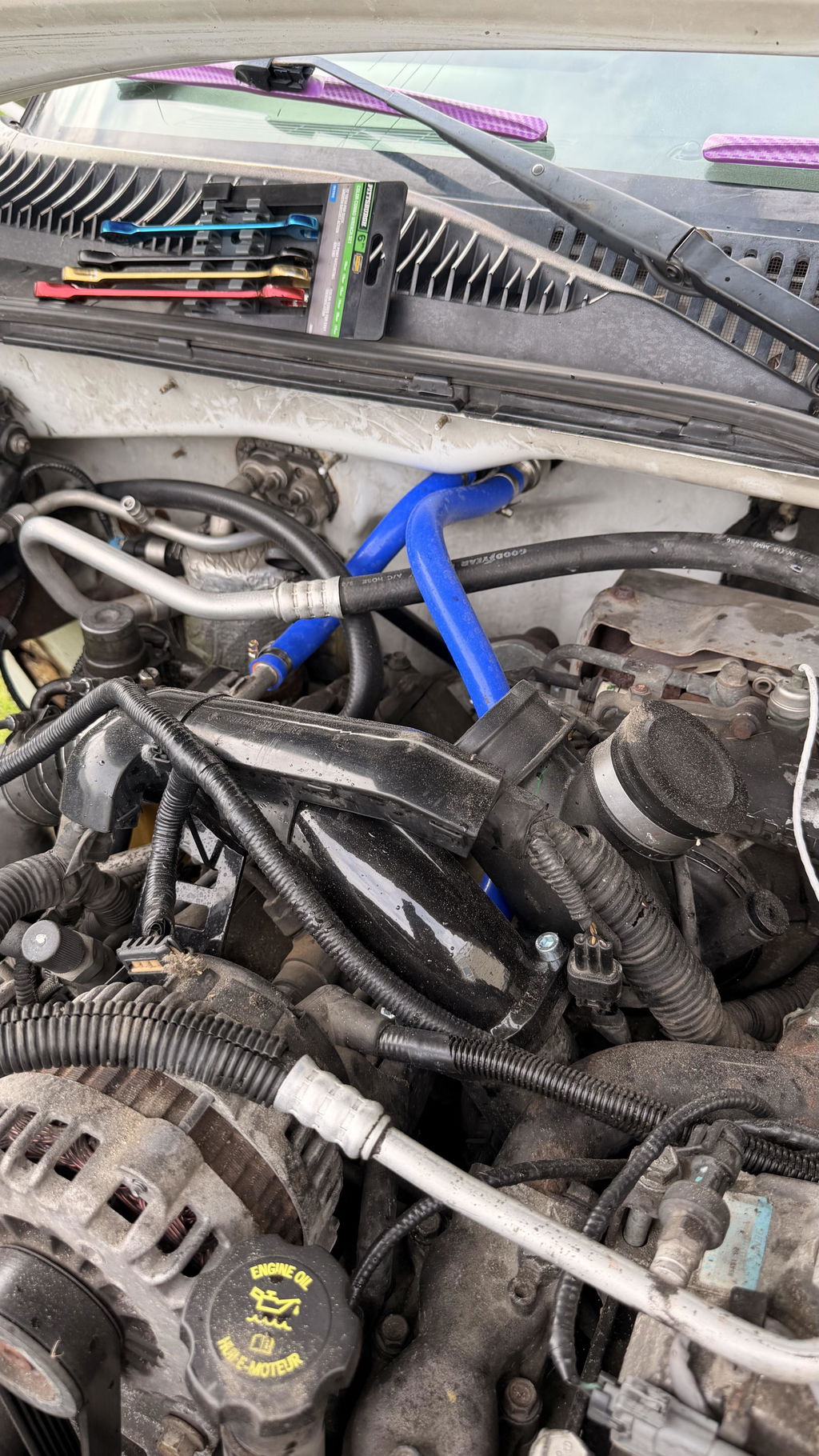
A one-piece metal line cannot absorb the movement between engine and radiator without cracking, and it is harder to route through a crowded engine bay. A fully flexible rubber line absorbs that movement well but ages badly here. The factory answer - a formed line with plastic sections joined by rubber couplings - solves both cheaply and lasts for years. What it gives up is resistance to heat and time: plastic embrittles with heat cycles, bonded joints let go first, and rubber hardens and weeps at the clamps.
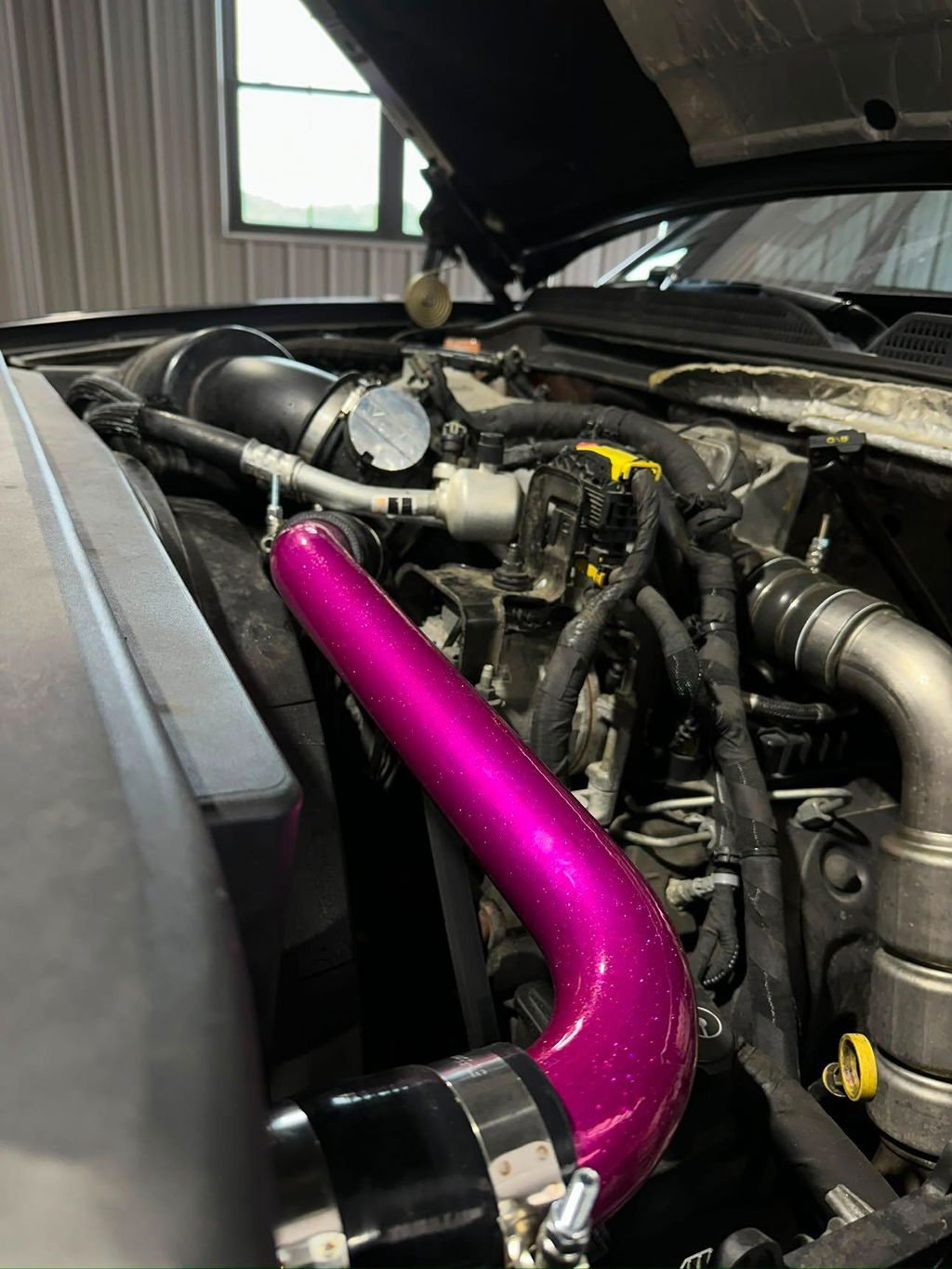
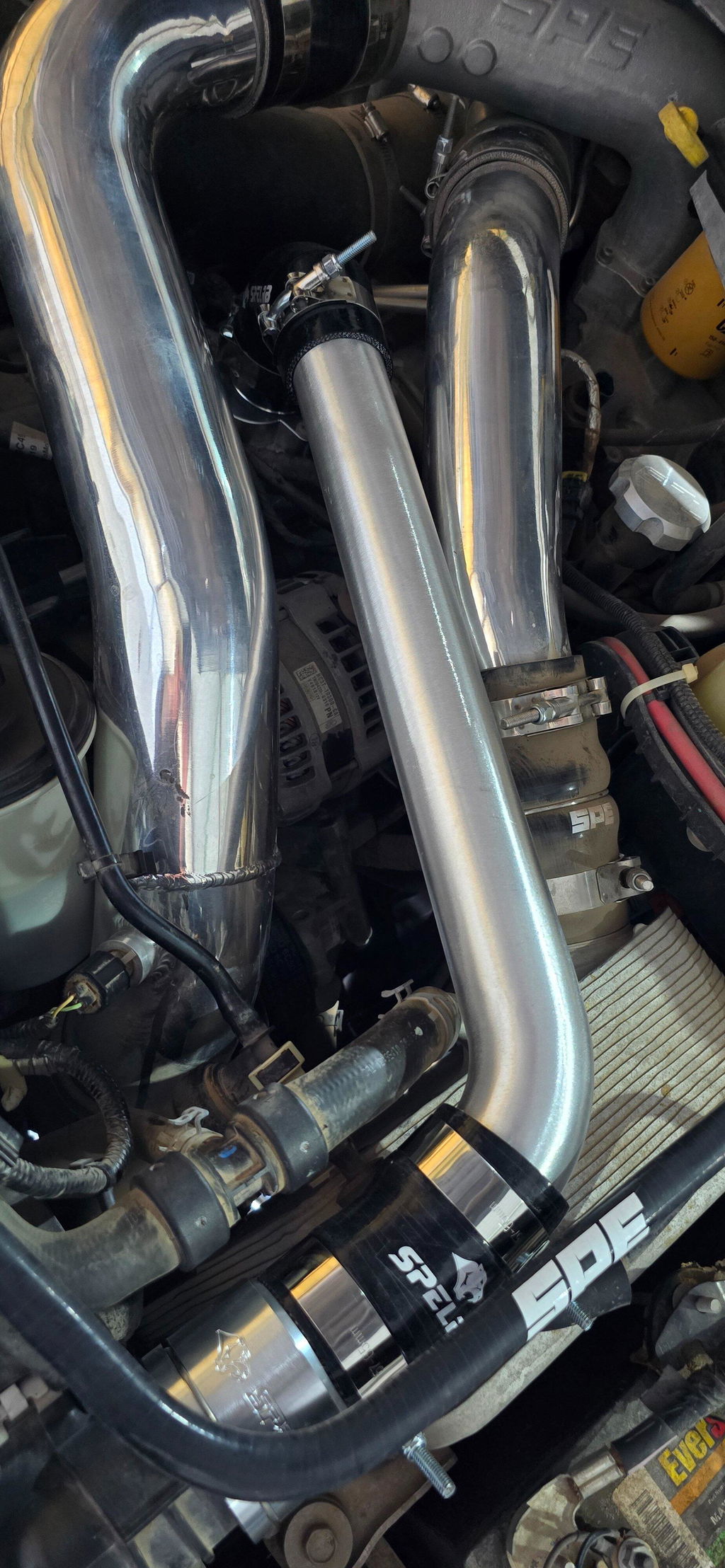
An aluminium replacement keeps the formed shape and moves the flexibility somewhere it can be inspected and serviced - into silicone couplers - instead of leaving it in a bonded joint that cannot be checked or replaced on its own.
Heat Soak Is the Part Most Owners Miss
Cooling parts get judged by what happens while driving, but the upper tube spends its worst minutes after the engine stops.
With the engine running, coolant circulates and the fan moves air. Switch off after a hard pull - a grade with a trailer, or slow traffic in summer - and both stop while the metal around the tube is still at full temperature. With no flow and no airflow, temperature there climbs before it falls. A Duramax coolant tube sits in the middle of that cycle, and thermal cycling is what embrittles plastic sections and works joints loose.
It is also the reason a failing tube usually shows up as a level that drops between services rather than as a puddle on the driveway. The leak opens when the system is hot and pressurised, and closes again as it cools.
What Each Part of a Duramax Coolant Tube Kit Does
A tube kit is three components doing three different jobs. Knowing which does what helps with both choosing one and diagnosing one later.
| Component |
Its job |
What it replaces |
What goes wrong if it is wrong |
| Formed aluminium tube |
Holds the routing and takes the heat and pressure |
The formed line with its bonded plastic sections |
Movement ends up being absorbed by the tube instead of by the couplers |
| Silicone couplers |
Absorb the movement between engine and radiator |
The rubber sections and short flex hoses |
An assembly that is effectively rigid, loading its own ends |
| T-bolt clamps |
Hold sealing load evenly without cutting into the coupler |
Factory spring or worm-drive clamps |
Sealing load lost as the joint expands and contracts |
The last row is the one worth reading twice. A clamp is not a formality - it is the part that maintains sealing load through every cycle, and the load has to stay even all the way around the joint.
Reading the Signs Correctly
Coolant loss has several possible sources and the upper tube is only one of them. What points at it is the pattern rather than the symptom itself:
-
Level drops after load, not after ordinary driving. If the loss appears following towing or a long grade, suspect a joint that opens under heat and pressure rather than a part that is simply porous.
-
Residue at a joint rather than along a run. Dried coolant leaves a crust, and where that crust sits tells you whether a joint is weeping or the line itself has cracked.
-
A smell after shutdown rather than on the road. A leak that only opens when hot is often masked by airflow while moving and becomes obvious once you park.
-
Temperature that climbs under load and settles when you back off. That pattern points to a loss of volume or pressure, not to a system that is too small - it is losing what it has.
None of these is unique to the tube, which is really the point: they tell you where to look first, and the upper tube is the cheapest place to start looking.
Fitting Notes That Matter on This Layout
Replacing the upper tube is straightforward work, and two details decide whether it stays that way.
-
Air collects at the top. This run feeds the highest part of the radiator, which is where trapped air ends up. A pocket left there shows up as overheating that appears only after a cooling repair - the part is fine, the system is not full.
-
Mating surfaces decide whether it seals. Corrosion or pitting on the sealing surface will weep regardless of how good the new part is. Clean it, and fit new seals rather than reusing hardened ones.
-
Re-check after one full heat cycle. Cold level and hot level are not the same, and every joint should be looked at after the system has been up to temperature once.
Choosing a Duramax Coolant Tube
-
Confirm which section you need. Upper and lower runs are different parts, and both get called a coolant tube.
-
Match the routing and the number of connections. The shape of the run and the type of ends have to agree with the engine the tube came off - coolant routing changed between engine generations, and tubes are not interchangeable across them.
-
Check what is supplied with it. Couplers and clamps are part of the assembly rather than add-ons; a tube supplied without them is not a complete job.
-
Look at the finish. A coating is doing real corrosion work in an area that stays wet and sees road salt through winter.
-
Buy seals and coolant at the same time. Both are consumables in this job, and reusing hardened seals is the usual reason a fresh repair weeps.
What This Part Is Not
A Duramax coolant tube is a cooling system component, not an emissions device. Replacing it changes no emissions function and does not alter how the engine is managed. If the truck is still under factory or extended coverage, ask how the dealer views aftermarket cooling parts before fitting one.