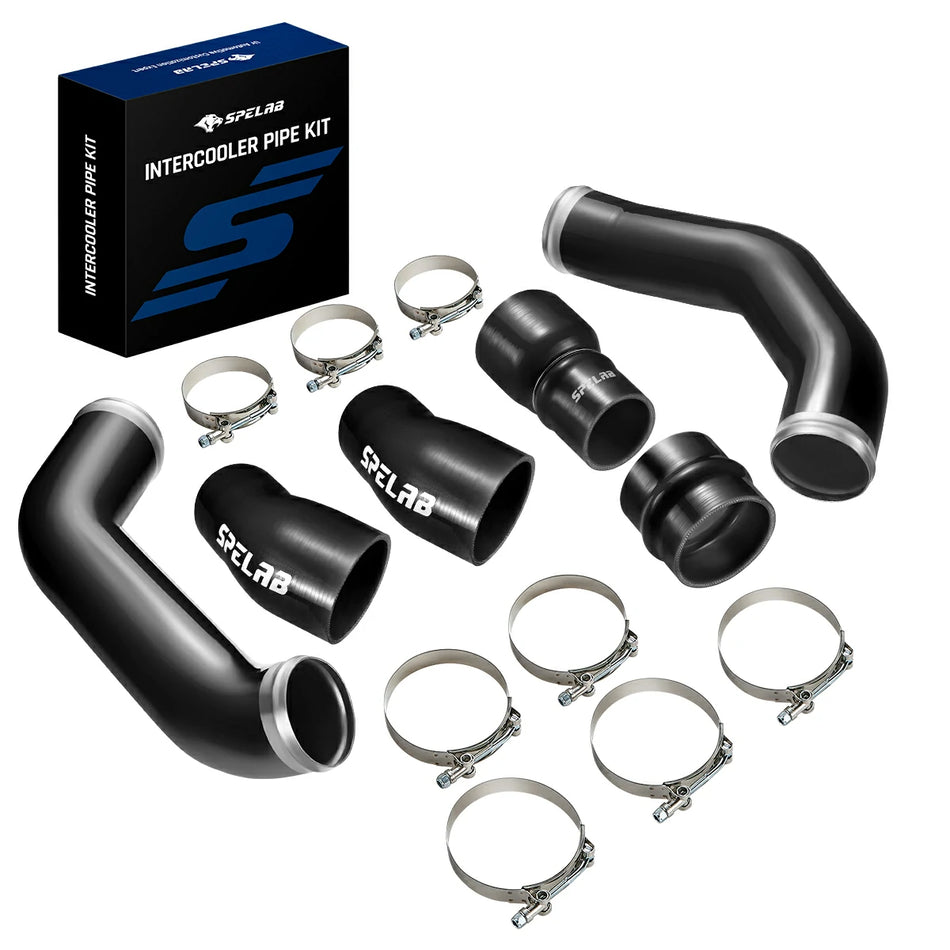
SPELAB Cummins intercooler pipe kits replace selected sections of the pressurized charge-air path between the turbocharger, intercooler, and intake side of the engine. Current products cover selected 2003–2007 5.9L and 2007–2018 6.7L Dodge Ram 2500/3500 applications.
Depending on the model year and product, a kit may replace the hot-side pipe, cold-side pipe, both sides of the system, or additional intake-side components. Choose by model year and engine first, then confirm the exact pipe configuration, supplied couplers, clamps, hardware, and component compatibility on the individual product page.
What to Expect From a Cummins Intercooler Pipe Kit
SPELAB Cummins intercooler pipe kits are built around specific Dodge Ram model-year groups rather than sold as universal charge pipes. While exact package contents vary, the available kits share the same basic purpose: replacing selected factory charge-air components with a more secure and application-specific piping setup.
Application-specific routing: Pipe shape and connection points are designed around the listed Ram Cummins model-year group.
Rigid replacement piping: Metal pipe sections replace selected factory components that may be aging, cracked, damaged, or no longer sealing reliably.
Reinforced connections: Depending on the kit, silicone boots or couplers connect the piping while accommodating boost pressure, heat, vibration, and engine movement.
Secure clamping: Many kits include clamps matched to their supplied pipes and couplers to help maintain a sealed charge-air connection.
Hot-side and cold-side configurations: Available products may replace one side of the system, both sides, or additional intake-side components depending on the application.
Pipe material, diameter, supplied boots, clamp style, intake-side components, and complete package contents vary by product. Use the individual product page as the final reference before ordering.
Choose a Cummins Intercooler Pipe Kit by Year
Do not order by engine displacement alone. Pipe routing, connection points, and system coverage can change between model-year groups, even when the trucks use the same 6.7L Cummins engine.
Available Cummins intercooler pipe kits by model year
Truck Fitment
Engine
System Coverage
Product
2003–2007 Dodge Ram 2500/3500
5.9L Cummins
Hot-side and cold-side piping with additional intake-side components
The hot side and cold side describe where a pipe sits in the turbocharged charge-air system. They do not describe the exterior temperature of the pipe or a separate cooling system.
Hot-Side Intercooler Pipe
The hot-side pipe carries compressed air from the turbocharger toward the intercooler. Because the air has just left the turbocharger compressor, this section operates before the intercooler removes heat from the charge air.
When inspecting the hot side, check the turbo outlet connection, pipe joints, welds, boots, couplers, and clamps for looseness, oil-stained leak points, physical damage, or signs of pressure loss.
Cold-Side Intercooler Pipe
The cold-side pipe carries cooled charge air from the intercooler toward the intake side of the engine. Common inspection points include the intercooler outlet, cold-side boots, clamps, pipe joints, and intake-manifold connection.
Not every Cummins pipe kit includes both sides. Some products replace a specific section, while others include hot-side piping, cold-side piping, or additional intake-side components. Confirm the exact configuration on the product page.
Signs You May Need a Cummins Intercooler Pipe Kit
A boost-related symptom does not automatically prove that an intercooler pipe has failed. The same symptoms can come from boots, couplers, clamps, the intercooler core, turbo connections, or intake-side joints.
Hissing under acceleration: Escaping compressed air may become more noticeable as boost pressure rises.
Oil residue around a connection: Oily staining near a boot, coupler, pipe joint, or intercooler connection can help identify a possible leak point.
Split, swollen, or loose boots: Aging connections may crack, soften, deform, or stop sealing correctly.
Repeated boot blow-off: A damaged boot, loose clamp, misaligned pipe, or incompatible connection can repeatedly separate under load.
Slow or inconsistent boost response: A leaking charge-air component may prevent the system from building or holding pressure normally.
Visible pipe damage: Cracks, damaged welds, corrosion, deformation, or confirmed pressure-test leakage may indicate that a pipe needs replacement.
Start by inspecting the boots and clamps, then check for oil-stained joints, pipe or weld damage, and leaking intercooler end tanks. A controlled charge-air pressure test or smoke test can help isolate the actual leak before parts are ordered.
Intercooler Pipe Kit vs. Intercooler Core
An intercooler pipe kit carries compressed air between the turbocharger, intercooler, and intake side of the engine. The intercooler core removes heat from that compressed air before it reaches the engine.
Choose a pipe kit when inspection confirms a cracked pipe, leaking connection, damaged boot, loose clamp, or another problem in the charge-air piping. If the aluminum core or end tanks are damaged or leaking, inspect the available 5.9L and 6.7L Cummins intercoolers instead.
A new pipe kit cannot repair a leaking intercooler core, and a new intercooler cannot correct a split boot or cracked charge pipe. Diagnose the complete system before deciding which component needs replacement.
When Is an Aftermarket Cummins Charge Pipe Worth It?
An aftermarket pipe kit makes the most sense when the factory piping or connections are damaged, leaking, corroded, repeatedly separating under boost, or no longer compatible with the truck’s current turbo, intercooler, or intake setup.
High-mileage work trucks and tow rigs may also benefit from replacing worn pipes, boots, and clamps before repeated sealing problems make the charge-air system unreliable. Replace only the components that are worn, leaking, damaged, or unsuitable for the current build.
A larger charge pipe does not guarantee a fixed horsepower increase. The main goal is to maintain a secure, correctly routed, and compatible path for compressed air.
A direct-fit pipe replacement typically does not require tuning by itself. The complete setup should be reviewed when the truck also has a different turbocharger, aftermarket intercooler, increased boost, added fueling, or custom calibration.
No. System coverage varies by model year and product. Some kits replace both sides, while others cover a specific section or include additional intake-side components. Review the product-page package list before ordering.
Not necessarily. Included boots, couplers, clamps, brackets, hoses, and hardware vary between products and available options. Use the individual product page as the final included-parts reference.
Inspect them during the repair. Replace boots and clamps that are cracked, swollen, oil-soaked, corroded, loose, deformed, leaking, or incompatible with the replacement piping. Reusable components should still be cleaned, aligned, and tightened correctly.
Yes. A leak in a pipe, boot, coupler, clamp, intercooler core, or another charge-air connection can allow compressed air to escape. Low boost can also have other causes, so test the complete system before replacing a specific component.
Inspect for oil-stained joints, split boots, loose clamps, cracked pipes, damaged welds, and leaking intercooler end tanks. A controlled pressure test or smoke test can identify the leak location more reliably than performance symptoms alone.
A larger pipe does not guarantee a specific horsepower gain. Results depend on the original restriction, turbo and intake setup, pipe routing, connection quality, boost level, and calibration. Reliable sealing and correct fitment should come before pipe diameter alone.
Yes. A non-factory turbocharger, intercooler, intake manifold, boot, or previously installed charge pipe can change routing and connection dimensions. Compare all existing modifications with the product-page fitment before ordering.
Most 2007–2018 6.7 Cummins intercooler pipe boots use 2.5-inch or 3.0-inch diameters at the hot side and cold side connections. However, exact 6.7 Cummins intercooler boot size and pipe size vary by model year and kit design — always confirm fitment for your specific Dodge Ram 2500 or 3500.
Replacing a 6.7 Cummins hot side intercooler pipe involves disconnecting the battery, removing the grille and upper shroud, loosening the hot side intercooler pipe boots and clamps at both ends, and lifting the pipe out. Most owners complete this in 1–2 hours with basic hand tools. Always replace boots and clamps together with the new pipe.