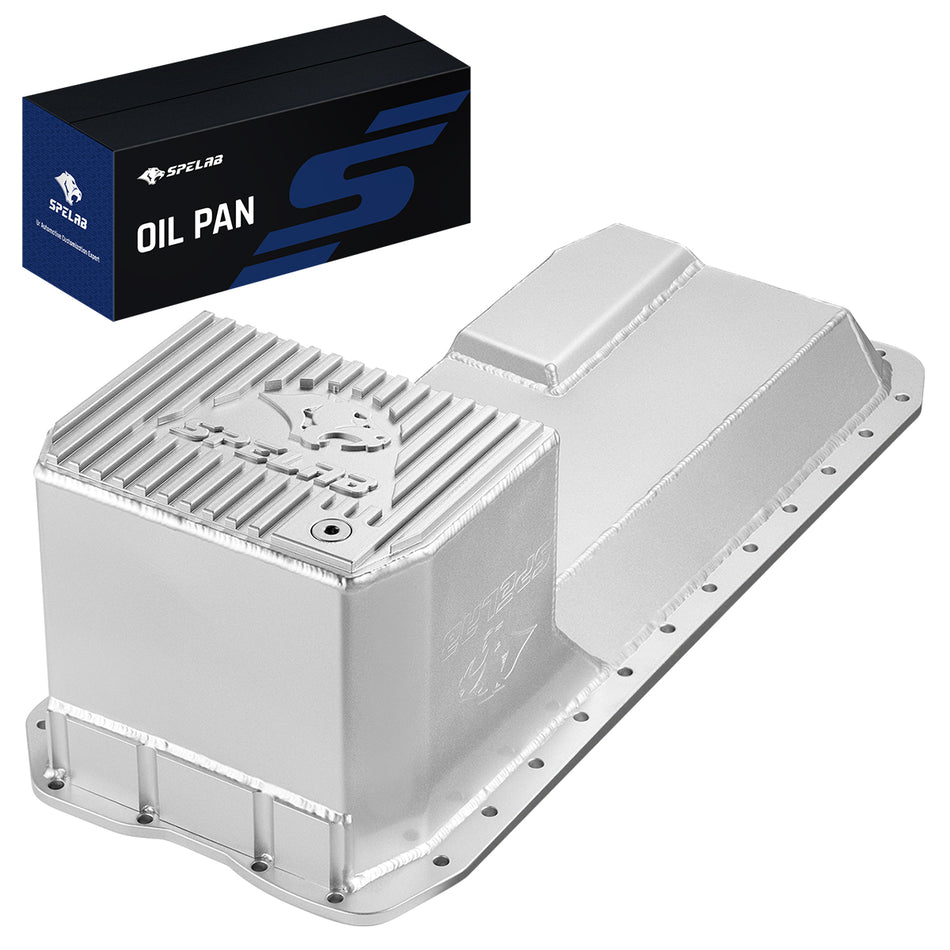
An aluminum oil pan is the reservoir bolted to the bottom of the engine, and on a diesel truck it does more than hold oil. It is where the oil drains back to, one of the surfaces that sheds heat from it, and the flat face that seals the bottom of the block. Changing the pan changes all three at once.
What an Aluminum Oil Pan Does on a Diesel Truck
An aluminum oil pan carries three jobs at once. It is the lowest point the oil drains back to, it is a large surface that sheds heat into the airstream under the truck, and its machined flange is what seals the bottom of the block. Cast aluminum does all three better than the thin stamped steel pan it usually replaces.
On a diesel that tows, idles for long stretches or climbs loaded, the second job is the one that starts to matter. Oil that cannot shed heat thins out, and thin oil is not doing its job at the bearings.
Most owners end up here for one of three reasons: the original pan has taken a hit or started to seep, the truck works hard enough that oil temperature has become something worth managing, or the engine is going into a chassis it was never fitted to. Those are different jobs, and they lead to different pans. A diesel work truck and a weekend build want different things from the same part.
Where the Factory Pan Falls Short
Stamped steel pans are cheap to produce and they hold up fine on a stock diesel truck that never leaves pavement. Three things push owners away from them.
-
Damage. A stamped pan dents when it hits something. Once the flange is bent, it no longer sits flat on the block, and no amount of tightening a bolt harder fixes a surface that has lost its shape.
-
Corrosion. Road salt and moisture work on thin steel from the outside. A pan that rusts through at the bottom of a seam is not a gasket problem.
-
Capacity and surface area. The factory part is sized to the minimum the engine needs. It carries no extra reserve and no cooling surface, which is fine until the truck starts towing, idling for long stretches, or climbing loaded.
None of those mean the original pan was badly designed. It means the job asked of it has changed.
Aluminum vs Stamped Steel: What Actually Changes
The material change is worth separating from the shape change, because they do different things. A pan can be cast in the factory shape and still gain most of the material benefit. Cast aluminum brings stiffness, heat transfer and a machined sealing face. The shape — deeper, wider, baffled — is a separate decision, and a stock-shaped aluminum pan still gets most of the material benefit.
|
Cast aluminum |
Stamped steel |
What neither one changes |
| Sealing face |
Thick, machined flange that resists distortion and spreads bolt load evenly |
Thin flange that bends and then leaks at the bolt line |
The condition of the block rail itself. A damaged block surface is not fixed by a new pan |
| Heat |
Aluminum moves heat out, and finned pans add surface area |
Little surface area, no finning |
What the cooling system can reject. A pan does not replace an oil cooler |
| Capacity |
Deeper or wider sump carries more oil in reserve |
Sized to the engine's minimum |
What the oil pump can deliver. Reserve volume is not pump output |
| Impact |
Thick walls shrug off contact that would dent steel |
Dents easily, and a dent usually means a leak |
A hard enough hit will crack either one. A pan is not a skid plate |
| Drain plug |
Usually magnetic and often recessed, so it catches wear metal and drains cleanly |
Standard plug, sometimes friction-welded in place |
How often the oil needs changing in the first place |
| Ground clearance |
Deeper pans hang lower than stock |
Factory height |
Ride height and suspension travel, which are what the pan has to clear |
Capacity, Baffles and Windage
More capacity is the headline on most aluminum oil pan listings, and on its own it does not keep oil at the pickup. Under braking, on a side slope, or through a long grade, the oil moves. If it moves away from the pickup, reserve volume sitting somewhere else is not doing anything useful.
That is what internal hardware is for. Baffles and trap doors hold a pocket of oil around the pickup while the rest of the sump sloshes. A windage tray or scraper sits above the crank and keeps the rotating assembly from dragging through oil it does not need, which cuts aeration and the parasitic loss that comes with it.
So the useful question when comparing an aluminum oil pan is not how much it holds. It is what keeps oil at the pickup when the truck is not level, and whether the pan hangs low enough afterwards to become the next thing you hit.
Reading an Aluminum Oil Pan by Its Sump Shape
Shape tells you more about a pan than capacity does, and it is the part most buyers skip.
-
Rear sump vs front sump. Which one fits is decided by where the engine sits in the chassis and what has to clear it — the crossmember, the steering linkage, the front differential. The same engine does not always take the same sump.
-
Depth. A deep sump adds capacity straight down, which is exactly where clearance runs out.
-
Width and kick-out. Carrying extra oil out to the sides adds reserve without dropping the lowest point of the pan.
-
Baffles and trap doors. Internal, so they have to be described in the listing rather than seen in a photo. Their absence is easy to miss.
-
External oil lines. Alongside the pans, this category includes a line kit that ties an external pump into the pan for dry sump plumbing. That is a different job from swapping a pan, and it is sold by which engine the line set was built for.
Fitment Checks Before Ordering an Aluminum Oil Pan
Oil pans are not close enough between engines to buy on displacement alone. These are the checks that catch most wrong orders.
-
Engine family and generation. Cummins, Powerstroke and Duramax each have their own pan shape, because each one was laid out around a different crossmember, steering package and oil filter position. The same displacement across two generations can also use different flange patterns and pickup positions. Identify the engine, then the generation, then the pan.
-
What mounts to the pan. On a modern diesel that list is longer than it looks: oil level sensor, oil temperature sender, drain-back or turbo return fittings — the openings have to be there and in the right place.
-
Dipstick and fill volume. A deeper pan changes how much oil the engine takes. The factory fill figure stops applying, and the dipstick may read differently.
-
What sits underneath. Crossmember, steering linkage, exhaust, starter. Check them at full suspension compression, not at ride height.
-
Four-wheel drive. The front differential and axle travel take up space a two-wheel-drive truck has free.
-
Access afterwards. Whether the drain plug and filter can still be reached once the pan is on, and whether anything has to come off first.
Engine swaps are the case where these checks matter most. When an LS or LT engine goes into an older chassis, the sump position is usually what decides whether it fits at all, because the crossmember and steering box were not placed for that engine. On that kind of build the pan is chosen from the chassis compatibility list, not from the vehicle year.
What an Aluminum Oil Pan Does Not Fix
-
Low oil pressure. Pressure comes from the pump, the bearing clearances and the relief valve. An aluminum oil pan holds the oil; it does not pressurise it.
-
A leak from somewhere else. Valve covers, the oil cooler housing and the rear main seal all drain down the outside of the engine and pool at the pan. Fitting a new pan does not stop them, and this is the most common reason a new pan still looks like it leaks.
-
Oil change intervals. More oil degrades at the same rate per mile. Extra capacity does not stretch the interval on its own.
-
High oil temperature on its own. A finned pan helps shed heat, but a truck that is genuinely overheating its oil needs the cause found — load, cooling capacity, or a restriction elsewhere.
-
Worn bearings. Oil that has been starving has already done its damage. Replacing the pan afterwards does not undo it.
Installation and Post-Install Checks
Worth knowing before the pan goes on, because most comebacks trace back to one of these.
-
Follow the gasket the pan was designed for. Some use a formed reusable gasket, some specify sealant, and mixing the two is how a new pan seeps.
-
Tighten to the figure the manufacturer gives, in the sequence it gives. Aluminum threads are not steel threads, and the bolts are small enough that overtightening distorts the very flange you paid for.
-
Refill by the dipstick, not by the old number. Capacity has changed, so the factory fill figure no longer applies. Fill, run, recheck.
-
Watch the gauge on first start. Pressure should come up promptly. If it does not, look at the pickup seal and the oil level before anything else.
-
Recheck after a heat cycle. Look along the flange and around the drain plug once the engine has been up to temperature and back down.
An aluminum oil pan is ordinary replacement hardware. It sits below the emissions system and has nothing to do with it, and swapping one does not change what the engine is certified with.