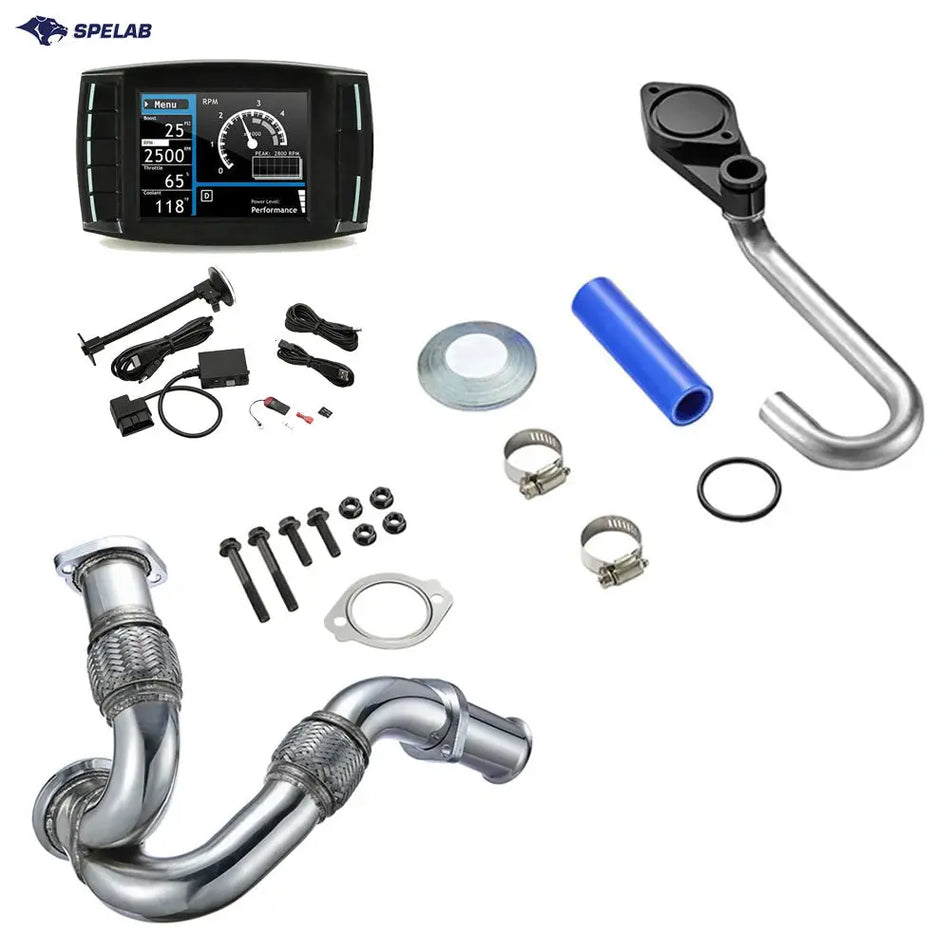
A Mini Maxx V1 delete kit bundles the tuner together with the exhaust and EGR hardware for one specific engine and one year window - one box, one platform, nothing to mix and match. The five bundles in this collection cover the pre-DEF diesel pickups the V1 was built around.
Which Platforms a Mini Maxx V1 Delete Kit Covers
The V1 is the older-generation tuner, and the bundles here follow the truck generations it was built around. Each one is a package - tuner plus hardware - matched to one engine and one year window:
| Platform |
Model years |
What the bundle is built around |
| 6.0L Powerstroke |
2003-2007 |
EGR hardware and an up-pipe, with the tuner |
| 6.4L Powerstroke |
2008-2010 |
DPF and EGR hardware, F-250 through F-450 |
| 5.9L Cummins |
2006-2007 |
Turbo-back exhaust in 4 in or 5 in |
| 6.7L Cummins |
2007.5-2009 |
EGR hardware and DPF race pipe |
| 6.7L Cummins |
2010-2012 |
Adds CCV hardware; excludes air-ride suspension trucks |
Two exclusions run across the range and account for most of the returns in this category. Cab & Chassis commercial trucks are not covered by any Mini Maxx V1 delete kit here, and the 2010-2012 6.7L package additionally does not fit trucks with factory air-ride suspension.
Mini Maxx V1 vs V2: Why the Older Tuner Still Has a Job
The assumption that the newer tuner is automatically the better buy is often backwards on these trucks. The two generations were built for different eras of diesel emissions equipment:
|
Mini Maxx V1 |
Mini Maxx V2 |
| Interface |
Classic LCD |
Updated interface with wireless updates |
| Calibration coverage |
DPF and EGR |
DPF, EGR, DEF and SCR |
| Built for |
Older diesel trucks |
Newer models, generally 2013 and up |
| Why it matters here |
Matches the pre-DEF platforms in this collection |
Covers equipment these trucks were never built with |
Match the tuner to the truck's generation rather than to the newest release. Every Mini Maxx V1 delete kit in this collection is V1-based because these platforms sit in the window the V1 was designed for.
What Ships in a Mini Maxx V1 Delete Kit
The bundles differ by platform, but they are assembled from the same four groups of parts:
-
The tuner. The Mini Maxx V1 handheld, which arrives with the OBD connection box, the cable linking the box to the tuner, a power adapter and a micro SD to USB adapter.
-
EGR hardware. The components matched to the platform the kit was built for.
-
Exhaust section. A DPF delete race pipe, a turbo-back system, or an up-pipe, depending on which bundle.
-
CCV hardware. Included on the 2010-2012 6.7L Cummins package.
One caveat applies across the whole range: accessories vary by order, so the exact contents are not guaranteed to match the list. Confirm the packing list for the specific kit rather than assuming.
Where a material spec is published it is worth reading. The 5.9L turbo-back system, for example, is T409 stainless at 2 mm wall thickness, offered in 4 in and 5 in inlet diameter, and the 5 in version requires the 04.5+ turbo elbow. Details at that level are what decide whether the exhaust bolts up on the first attempt.
The CCV Detail Most Buyers Miss
The tuners supplied with a Mini Maxx V1 delete kit are pre-loaded with DPF and EGR calibration. They are not programmed to support a crankcase ventilation (CCV) modification. Running a CCV change without corresponding calibration in the tuner can set sensor fault codes - MAP, MAF, BARO and turbo speed are the ones usually reported - and the truck will not drive correctly afterwards.
If a CCV change is part of the plan for a Mini Maxx V1 delete kit, the tuner support has to exist first. It takes a minute to check and it costs a lot more than a minute to discover after the hardware is already on the truck.
Fitting a Mini Maxx V1 Delete Kit: What Slows the Job Down
The installs are not exotic, but four things decide whether they go smoothly:
-
The year window. The 6.7L Cummins splits at 2007.5 and again at 2010, and hardware is not shared across those splits. Ordering by "6.7L" alone is the most common way to get the wrong box.
-
Cab & Chassis and air-ride. Both are excluded, and neither is visible in a listing photo. Check the VIN or the build sheet.
-
Exhaust access. Penetrating fluid on the old hardware the night before, and room to work at the turbo outlet, changes the job more than any tool does.
-
Keeping the factory parts. Taking them off is one thing; being able to put them back is what preserves the option of returning the truck to stock later.
Intended Use
These bundles are sold for off-road and competition vehicles. Removing emissions equipment from a truck driven on public roads is prohibited under US federal law, so a street-driven truck is better served by keeping its factory equipment in place, or by replacing failed components with compliant replacement parts.