Updated on August 02, 2026.
A 5.9L Cummins is the practical choice for a simpler project truck when you accept old-chassis repairs and lower factory torque. A 6.7L Cummins is the stronger choice for heavy towing, factory exhaust-brake control, newer safety hardware, and a complete emissions-compliant work truck. Pick the whole Ram by model year, transmission, axle, GVWR, service history, and duty cycle. Do not choose an engine from a badge or a dyno claim.
5.9 vs 6.7 Cummins: The Fast Answer
| Decision | 5.9L Cummins advantage | 6.7L Cummins advantage |
|---|---|---|
| Simple project or farm truck | Less aftertreatment hardware, broad mechanical knowledge base, and easier access on many years | More electronics and emissions hardware than the 5.9L, but better factory diagnostics on later trucks |
| Heavy towing | Strong low-rpm pull when healthy, especially with a sound manual or properly built automatic | More displacement, more stock torque, factory exhaust brake, and newer tow-rated chassis choices |
| Daily street use | No DPF regeneration on Ram pickup 5.9L generations, but the truck may be 19-37 years old | Quieter, newer, and more refined; short-trip use must still support complete regeneration cycles |
| High-power build | Popular foundation, but the fuel system, head sealing, clutch or automatic, axle, and brakes set the real limit | Higher airflow and torque potential, with more cylinder pressure, thermal load, tuning complexity, and driveline cost |
| Lowest ownership risk | The best-documented, least-rusted, least-abused 5.9L truck | The best-documented, emissions-intact 6.7L truck with completed recalls and clean scan data |
First, Identify Which 5.9 or 6.7 You Mean
Cummins lists the Ram pickup timeline as 1989-1998 for the 12-valve 5.9L, 1998-2007 for the 24-valve 5.9L, and 2007-present for the 6.7L. The 6.7L arrived during the 2007 model year, which is why parts catalogs use 2007.5. An early 2007 truck can still be a 5.9L; check the VIN, emissions label, engine hardware, and build date before ordering anything.
Owners and sellers also talk in chassis generations rather than engine families, so it helps to hold both in your head: second gen covers 1994-2002, third gen covers 2003-2009, fourth gen covers 2010-2018, and fifth gen covers 2019 and newer. A third-gen truck can carry either engine depending on build date.
| Ram Cummins group | Fuel and air hardware | Published factory output range | Buyer focus |
|---|---|---|---|
| 1989-1998 5.9L 12-valve | Bosch VE or P7100 direct injection, turbocharged; intercooler added during the 1991 model year | 160-215 hp and 400-440 lb-ft | Cold start, blow-by, fuel leaks, killer dowel pin history, timing-case repairs, transmission, steering, rust, and cooling |
| 1998.5-2002 5.9L 24-valve | Electronic engine management and VP44-era fuel system | Within the official 215-325 hp and 420-610 lb-ft 24-valve range | Lift-pump supply history, injection-pump behavior, block casting number and coolant seepage, transmission, and wiring |
| 2003-2007 5.9L common rail | High-pressure common rail, four valves per cylinder, fixed-geometry turbo by application | Up to 325 hp and 610 lb-ft | Injector return, fuel dilution, rail-pressure control, blow-by, turbo, 48RE or manual-clutch condition |
| 2007.5-2012 6.7L | Common rail, variable-geometry turbo, EGR, oxidation catalyst and DPF; no DEF/SCR on these pickups | Started at 350 hp and 650 lb-ft, with later ratings higher by calibration and transmission | DPF loading, regeneration history, VGT actuator, EGR cooling, grid heater, 68RFE or G56 condition |
| 2013-2018 6.7L | Common rail, VGT, EGR, DPF, and SCR/DEF beginning with the 2013.5 update | Up to 385 hp and 900 lb-ft in Cummins' 2016 comparison | DEF/SCR history, turbo and exhaust brake, 68RFE/Aisin/G56 fitment, front end, and cooling under load |
| 2019-2024 6.7L | Standard- and high-output calibrations, VGT, EGR, DPF, SCR/DEF, 68RFE or Aisin by configuration | Reached 1,000 lb-ft in 2019 and 1,075 lb-ft in later high-output applications | VIN recall completion, high-pressure fuel-pump history, grid-heater connection, aftertreatment, transmission, and payload sticker |
| 2025 6.7L | 430-hp high-output engine with TorqueFlite HD eight-speed in Ram pickup applications | 430 hp and 1,075 lb-ft | Use the current Ram tow chart and door label; do not transfer 2019-2024 parts or service assumptions |
The historical ratings above come from the Cummins 5.9L-to-6.7L engine history. The current specification comes from the 2025 Cummins pickup-engine specification. Output is year-, transmission-, chassis-, and calibration-specific, so never apply the highest number to every truck carrying that displacement.
The Physics: 359 vs 408 Cubic Inches
The 5.9L displaces 359 cubic inches. The 6.7L displaces 408 cubic inches, roughly 13.6% more. Base B-series geometry also grows from about a 4.02-inch bore and 4.72-inch stroke to a 4.21-inch bore and 4.88-inch stroke. More swept volume can move more air per revolution and make more low-speed torque, but it also raises cylinder filling, heat rejection, fuel demand, and driveline load when the calibration uses that capacity.
Horsepower is a function of torque and engine speed:
Horsepower = Torque (lb-ft) x RPM / 5,252
A 6.7L making 900 lb-ft at 1,700 rpm is producing about 291 hp at that point. That low-rpm torque is what a driver feels when a loaded trailer starts up a grade. It does not raise the truck's legal payload, rear-axle rating, tire capacity, hitch rating, or GCWR. Those limits stay with the exact VIN and chassis.
Compression ratio also changes across the long 6.7L production run. The current 2025 specification lists 16.0:1; do not paste that number onto a 2008 or 2019 engine. Use the service information for the exact model year when compression pressure, piston, injector, or head-gasket diagnosis depends on it.
Reliability: Simpler Does Not Mean Maintenance-Free
5.9L Cummins
The 5.9L earns its simple reputation because Ram pickup versions predate the 6.7L's factory EGR/DPF aftertreatment package. That does not make every 5.9L identical or automatically reliable. A 12-valve with a mechanical pump, a VP44 24-valve, and a 2003-2007 common-rail engine have different fuel-system risks, diagnostics, and upgrade paths.
- 12-valve: inspect cold start, blow-by, killer dowel pin and timing-case history, fuel leaks, coolant condition, valve adjustment records, and the transmission behind it.
- VP44 24-valve: verify lift-pump supply under load, hot restart, dead-pedal complaints, stored fuel codes, wiring, block casting number, and injection-pump replacement records.
- Common-rail 5.9L: check injector return, rail-pressure tracking, fuel in the oil, haze at idle, cold misfire, piston or cylinder damage symptoms, and 48RE clutch slip.
Age is now a primary failure system. Rubber hoses, steering joints, brake lines, cab mounts, wiring repairs, HVAC, door seals, radiator crimps, grounds, axle seals, and old tuning can cost more than the long block. A clean engine in a worn-out truck is not a cheap tow rig, and telling a surface gasket leak from something deeper is worth doing before you negotiate.
6.7L Cummins
The 6.7L adds useful hardware: greater displacement, VGT control, a factory exhaust brake, newer calibration, and much higher stock torque. It also adds systems that must work together. A stuck EGR valve, biased differential-pressure sensor, leaking charge-air boot, VGT actuator problem, low coolant temperature, failed NOx sensor, cracked plastic coolant plumbing that a 6.7L Cummins upper coolant pipe would replace, or interrupted regeneration can all produce a weak or derated truck without a damaged long block.
For 2019-2020 Ram 2500, 3500, 4500, and 5500 trucks, confirm completion of NHTSA Campaign 21V-880. The recall covers high-pressure fuel pumps that could fail and stall the engine; the remedy calls for pump replacement, a PCM update, and inspection or replacement of additional fuel-system parts when necessary. Check the VIN and invoices, not just the seller's statement, against the Ram 6.7L fuel-pump recall notice.
Do Not Compare Fuel Economy Without the Duty Cycle
A lighter pre-emissions 5.9L truck can return strong highway MPG because it carries less hardware and does not perform DPF regeneration. A later 6.7L can pull the same trailer with less throttle opening and better exhaust-brake control, but regeneration, axle ratio, tire size, idle time, wind, payload, trailer frontal area, and transmission behavior can erase any paper advantage.
Cummins reported that the 2013.5 SCR update improved fuel efficiency by 10% and doubled oil-change intervals relative to the preceding 6.7L configuration. Treat that as a model update claim, not a promise that any 2013.5 truck beats any 5.9L. Compare hand-calculated gallons over the same route and load. Dashboard MPG is screening data, not a controlled test.
Short-trip use is a poor match for any DPF-equipped diesel that never reaches stable temperature. Ram's operating guidance says restoring a loaded aftertreatment system through highway driving can take as little as 45 minutes. The Ram DPF message procedure is a better baseline than forcing a commute pattern the truck cannot complete.
Match the Engine to Real Truck Work
Towing and Mountain Descents
The 6.7L is the straightforward choice for frequent heavy towing because the engine, factory exhaust brake, newer transmission logic, larger brake packages, and later chassis were developed as a system. A 5.9L can tow well, but added fuel and boost do not add brake rotor, cooling, hitch, axle, or tire capacity. For a fifth-wheel, compare the truck's yellow payload label after passengers, hitch, tools, auxiliary tank, and bed load are subtracted.
On a repeatable loaded pull, log boost, commanded and actual rail pressure, coolant, transmission temperature, intake temperature, and pre-turbo EGT when equipped. A common workshop screening range is to ease out near 1,250-1,300 degrees F pre-turbo and investigate sustained heat, but probe position and the exact build matter. Follow the OEM and gauge limits first. If the automatic is the component running hot, price heavy-duty transmission upgrades alongside the engine decision.
Payload and Jobsite Use
A diesel option can reduce available payload because the engine and related hardware are heavy. A higher-torque 6.7L badge does not guarantee more capacity than a different 5.9L configuration. Read the door sticker. For cranes, welding bodies, transfer tanks, or constant trailer tongue weight, weigh the truck by axle in working trim.
Long idle time is not free. A 5.9L can wet-stack, build carbon, dilute oil, and run too cool. A 6.7L adds soot-loading and regeneration concerns. Dust and short trips also load filtration faster than the odometer suggests, so keep the air filter and Dodge Ram Cummins cold air intake hardware on the service list. Use approved high-idle or PTO strategy where equipped, monitor temperature, and schedule loaded operation instead of letting either engine loaf at low coolant temperature all shift.
Off-Road and Project Builds
The 5.9L is attractive when the owner wants a rigid, serviceable trail or farm build and can fabricate mounts, plumbing, exhaust, and wiring. The 6.7L makes more sense when high low-rpm torque, a factory exhaust brake, and scan-based control are part of the plan. Either way, cylinder sealing usually sets the ceiling before airflow does, so a Cummins head stud kit belongs in the budget before a larger turbo does.
An engine swap is not a bolt-on intake job. It can involve the ECM, TIPM or body modules, immobilizer, transmission controller, pedal, fuel supply and return, cooling stack, charge pipes, air conditioning, driveshafts, crossmembers, transfer case, gauges, exhaust, and emissions certification.
Extreme Cold
Condition beats displacement. Test both batteries individually, verify cable voltage drop, use winter-grade fuel, drain water separators, confirm block-heater operation, and repair the factory intake-heater circuit. A 5.9L with weak cranking speed can be miserable at zero degrees F. A 6.7L with an incomplete heater modification can crank longer, haze, set P2609-type faults, and lose post-heat behavior, and what those cold-start faults look like on an older Ram is worth reading before you test drive in winter.
Pre-Purchase Diagnostic Workflow
- Verify identity: decode the VIN, engine sales code, build date, transmission, axle ratio, GVWR, emissions label, and pickup versus chassis-cab status.
- Demand a true cold start: arrive before the seller runs it. Watch cranking speed, Wait To Start behavior, white smoke, misfire, rail-pressure buildup, oil pressure, and coolant pressurization.
- Scan every available module: save current, pending, and permanent codes; readiness; freeze frame; regeneration history; DPF differential pressure; EGR and VGT commands; injector or balance data supported by the tool; and transmission faults.
- Check fuel-system health: inspect filters and water separators, compare commanded versus actual rail pressure on common-rail engines, test injector return to the year-specific procedure, and verify VP44 lift-pump supply under load where applicable. Price the diesel fuel system parts a repair would need before you make an offer.
- Measure crankcase pressure: use the OEM procedure and a manometer. An oil cap that dances is not a calibrated blow-by test, and how often that service actually comes due explains why a neglected truck reads high.
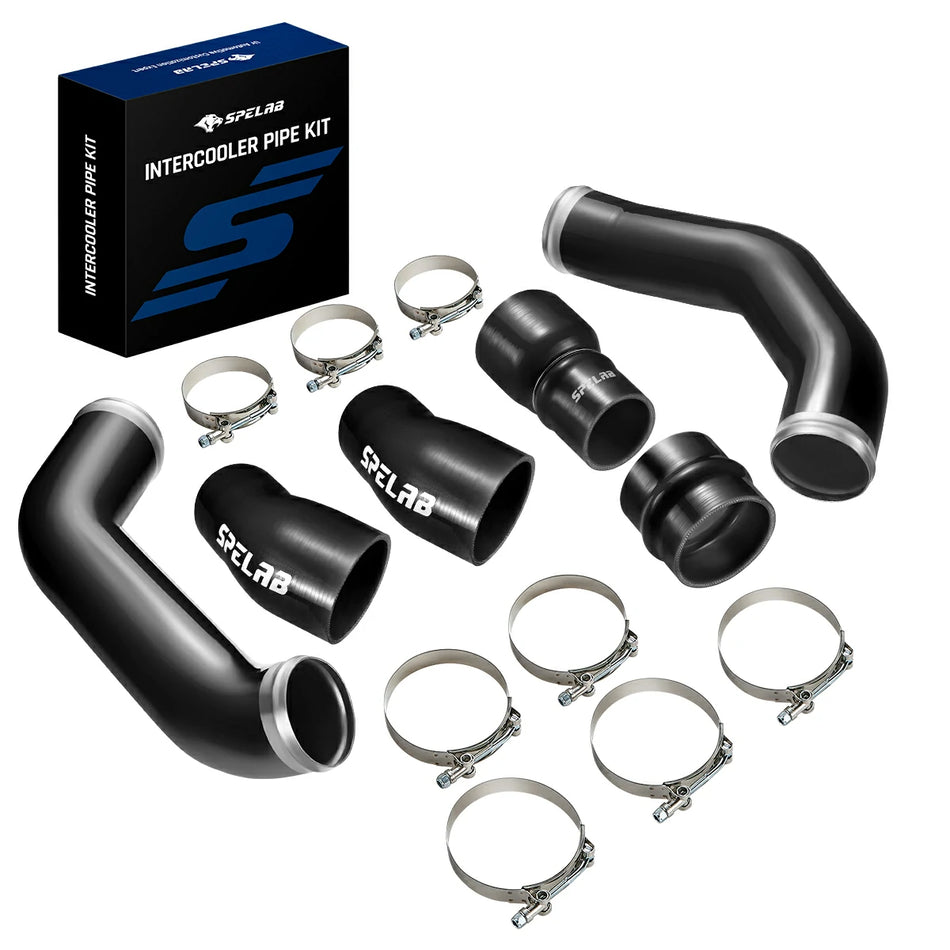
- Pressure-test the charge-air path: use a regulator and correct block-off adapters. Start around 5 psi for a large leak, then increase only within the tester and vehicle limits. On a third-gen truck, a leaking factory connection is often the fault a 5.9 Cummins intercooler pipe kit is bought to solve.
- Load-test the complete truck: verify converter lockup or clutch hold, commanded gear, exhaust-brake response, steering, brakes, cooling, smoke, rail pressure, boost, and transmission temperature on a safe route.
- Inspect fluids and structure: send oil for analysis when the purchase price justifies it; inspect coolant chemistry, fuel dilution, transmission debris, frame rust, cab mounts, brake lines, front end, axle leaks, and tires.
Symptoms That Change the Buying Decision
| Symptom | 5.9L direction | 6.7L direction | Decision |
|---|---|---|---|
| Long crank or hot no-start | Supply pressure, VP44, common-rail return, rail control, batteries, or starter speed | Filter restriction, injector return, rail control, pump history, batteries, or grid-heater strategy | Price a measured fuel-system diagnosis before purchase |
| Coolant pushed from reservoir | Cap, hose, radiator, thermostat, combustion leak, or overloaded cooling system | Same basics plus EGR cooler and higher-load cylinder-pressure concerns | Do a cold pressure test and combustion-leak diagnosis |
| Weak pull with normal idle | Charge leak, fuel supply, turbo, injector, lift pump, transmission slip, or bad tune | Charge leak, VGT actuator, EGR, DPF restriction, sensor bias, rail pressure, or transmission slip | Log a loaded run; do not buy a turbo from an idle video |
| Frequent regeneration or derate | Not a factory 5.9L DPF behavior; verify engine identity or a nonfactory conversion | Check soot and ash load, differential-pressure tubes, EGT sensors, thermostat, injectors, EGR, and drive cycle | Require a complete emissions-system diagnosis |
| Flare, shuttle shift, or unlocked converter | Automatic or clutch condition may set the practical torque ceiling | 68RFE, Aisin, manual, or eight-speed diagnosis depends on model year | Budget the transmission before adding power |
| Heavy blow-by or fuel-diluted oil | Possible ring, cylinder, piston, or injector damage | Possible ring, cylinder, piston, injector, or aftertreatment-related dilution | Stop negotiating from sound alone; test and price a long-block path |
Upgrade the Truck or Swap the Engine?
For most owners, repairing the existing engine or buying a complete 6.7L truck is a better decision than installing a 6.7L into a 5.9L chassis. The swap becomes reasonable when the owner already has a solid rust-free truck, a complete compatible donor, fabrication skills, wiring and calibration support, state approval, and a clear reason to keep that exact chassis.
| Path | Planning labor | Typical planning range | Largest cost risk |
|---|---|---|---|
| Pre-purchase inspection with scan and loaded road test | 2-4 hours | $300-$880 | No trailer load, seller-warmed engine, or no access to enhanced diesel data |
| Baseline a sound 5.9L truck | 8-30 hours | $2,500-$12,000 | Fuel system, automatic transmission, steering, rust, cooling, brakes, and old wiring |
| Baseline a sound emissions-intact 6.7L truck | 10-35 hours | $3,000-$15,000 | Aftertreatment, VGT, fuel-system damage, transmission, front end, and neglected maintenance |
| Complete 5.9-to-6.7 drivetrain conversion | 80-160-plus hours | $25,000-$55,000-plus | Incomplete donor, electronics, transmission and transfer case, cooling, fabrication, exhaust, title, and emissions approval |
These are planning ranges using roughly $150-$220 per shop hour, not quotes. Region, rust, donor completeness, machine work, tuning, body-module integration, and state inspection can move the total sharply. A cheap engine on a pallet is not a complete conversion budget.
Three Parts to Compare After the Truck Passes Diagnosis
Parts do not decide whether a 5.9L or 6.7L is the right engine. These three current listings cover specific years from both families and are useful only after VIN, dimensions, duty cycle, and the actual failed component are confirmed. Prices below were checked on August 02, 2026.
| Product | Current listed price | Fitment and decision note |
|---|---|---|
| Intercooler Bar and Plate for 2003-2009 Dodge Ram 2500/3500 5.9L/6.7L Diesel | SPELAB | $545 bar-and-plate; $389 tube-fin | Only for the listed 2003-2009 range; verify core style, connection diameter, transmission cooler layout, and measured charge-air leak or temperature need |
| Radiator - Cool Direct-Fit Performance for 2003-2009 Dodge Ram 2500/3500 5.9L/6.7L Diesel | SPELAB | $247.99 | Listed for 2003-2007 5.9L and 2007.5-2009 6.7L trucks; match connection sizes, transmission cooling, fan clearance, and OEM number |
| Oil Pan For 2003-2022 Dodge Ram 2500/3500 5.9L/6.7L Diesel Billet Aluminum | SPELAB | $598 | The listing describes a sump about 2 inches deeper than stock; verify axle, crossmember, skid-plate, ground-clearance, oil-pickup, drain, and fill requirements |


For additional platform-specific options, browse Dodge Ram diesel truck parts and filter by the exact generation before comparing color, finish, or price.
Emissions and Used-Truck Legality
The original version of this article recommended an EGR delete for both engines and claimed removal reduced emissions. That is mechanically and legally wrong. Ram pickup 5.9L generations do not use the 6.7L's factory EGR/DPF package, so there is no 5.9L EGR system to delete. On an emissions-equipped 6.7L, removing or disabling EGR, DPF, SCR/DEF, sensors, diagnostic codes, or certified calibration is prohibited for public-road use under the Clean Air Act.
EPA guidance states that tampering and aftermarket defeat devices are illegal and can expose manufacturers, sellers, installers, and operators to enforcement. Review the EPA enforcement guidance before buying a deleted truck or planning a swap. A label such as "off-road use only" does not make a public-road installation legal.
A used truck with missing emissions hardware can also create inspection, registration, warranty, resale, calibration, and return-to-stock costs. Photograph the underbody and engine bay, scan readiness and permanent codes, verify the emissions label, and price restoration before making an offer.
Frequently Asked Questions
Q: Is the 5.9 or 6.7 Cummins more reliable?
A: A stock, maintained 5.9L is mechanically simpler, while a maintained 6.7L offers newer diagnostics, more factory torque, and better towing controls. At this age, service records, cold-start behavior, transmission condition, rust, and previous tuning predict ownership risk better than displacement.
Q: Which Cummins is better for towing?
A: The 6.7L usually wins for frequent heavy towing because of higher stock torque, factory exhaust-brake operation, and newer Ram chassis options. The exact truck must still have enough payload, GCWR, axle, tire, hitch, cooling, and brake capacity for the trailer.
Q: Does a 5.9L Cummins need an EGR delete?
A: No. Ram pickup 5.9L Cummins generations do not have the later 6.7L EGR/DPF package. A product or article selling a 5.9L EGR delete is mismatched to the engine.
Q: Is a 5.9-to-6.7 Cummins swap bolt-on?
A: No. Expect engine and transmission mounts, electronics, fuel, cooling, charge air, exhaust, driveshaft, transfer case, gauges, body modules, calibration, air conditioning, title, and emissions work. A complete donor helps, but most owners spend less buying the correct complete 6.7L truck.
Q: Which 5.9L Cummins is best for a project?
A: Choose by skill set. A 12-valve suits a mechanical build, a 1998.5-2002 24-valve needs strong lift-pump and VP44 diagnosis, and a 2003-2007 common-rail offers quieter operation and precise tuning with higher injector and rail-system cost.
Q: What should I check on a 2019-2020 6.7L Cummins?
A: Confirm NHTSA Campaign 21V-880 by VIN and invoice, then inspect fuel-system data, cold start, grid-heater connection, VGT and exhaust brake, DPF/SCR history, transmission behavior, front end, and payload label.
Q: Can a tuner make a 5.9L tow like a newer 6.7L truck?
A: A tune can change fuel, timing, boost, and torque delivery. It cannot upgrade the frame, brakes, axle rating, hitch, payload sticker, cooling stack, steering, tires, or crash structure. Build power only after the entire truck passes diagnosis.