Updated July 13, 2026.

The 6.6L Duramax L5P is a strong tow platform, but the emissions system, cooling layout, and encrypted ECM make EGR delete decisions more complicated than older LBZ, LMM, or LML trucks. If you own a 2017-2025 Silverado or Sierra HD and you are seeing soot buildup, EGR cooler concerns, rising EGT, limp mode, or repeated aftertreatment warnings, the right first move is diagnosis - not tearing parts off the engine.
The L5P is not a simple "bolt on hardware and go" platform. The ECM must be handled correctly, the tune must match the removed hardware, the coolant circuit must be routed and bled properly, and the truck's legal-use status has to be clear before the job starts. A bad plan can turn a running truck into a no-start, derate, or expensive return-to-stock project.
This guide explains what an L5P EGR delete can change, what it cannot fix, what real owners should check first, and where a direct-fit kit makes sense for documented off-road, competition, or legally allowed non-public-road use.
Key Takeaway: An L5P EGR delete can remove a soot-heavy exhaust recirculation path and eliminate the EGR cooler from the coolant loop, but it is not a cure for every regen, DEF, SCR, boost, or tuning problem. On the L5P, tuning readiness matters as much as hardware fitment. Do not remove parts until ECM unlock, calibration support, coolant routing, inspection risk, and return-to-stock cost are understood.
L5P Owner Reality: Diagnose Before You Delete
A real L5P owner usually does not start with a calm parts-shopping question. He starts with a check engine light, a DEF countdown, a regen complaint, a coolant smell, or a truck that feels hotter than it should while pulling a trailer. That is why the first question is not "Which kit should I buy?" It is "What system is actually failing?"
The L5P's EGR system, DPF, DEF tank, SCR catalyst, NOx sensors, MAP/MAF data, E41 ECM calibration, and coolant circuit all talk to each other. If you skip diagnosis and treat every emissions message as an EGR problem, you can spend money and still have the same warning on the dash.
Here is the shop-floor rule: show the codes, freeze-frame data, soot load, DEF/SCR status, EGR cooler behavior, boost target vs actual, and coolant pressure before ordering parts. That is how you avoid fixing the wrong side of the truck.
What the L5P EGR System Does
The Exhaust Gas Recirculation system routes a controlled amount of exhaust gas back into the intake stream to reduce NOx emissions. On an L5P Duramax, that means the EGR valve, EGR cooler, crossover plumbing, intake tract, coolant passages, sensors, and engine calibration all work as part of one emissions strategy.
That system is useful for emissions compliance, but it creates real mechanical tradeoffs. Exhaust gas carries soot. The cooler adds heat and coolant failure points. The intake side can collect carbon and oily residue over time, especially when the truck idles often, tows hard, runs short trips, or already has airflow or fueling issues.
For a street-driven truck, the EGR system is part of the legal emissions package. For a documented off-road or competition build where the configuration is legally allowed, removing it requires more than block-off plates. It requires the truck's electronic strategy to match the hardware change.
The 9th Injector Detail Most Owners Miss
The L5P aftertreatment system also uses an exhaust-side indirect fuel injector, often called the 9th injector or dosing valve, as part of the DPF regeneration strategy. That detail matters because a regen complaint is not automatically an EGR complaint. Fuel dosing, DPF pressure, EGT sensor behavior, NOx data, DEF/SCR status, and soot-load calculation can all be involved.
Do not assume that removing the EGR system will fix every regen issue. If the truck is regenerating too often, check whether the aftertreatment system is actually seeing excess soot, bad pressure data, incomplete heat events, or a dosing-side problem. The L5P's factory emissions system is more refined than older internet lore makes it sound, so the diagnosis needs to be just as specific.
Common L5P Problems Owners Blame on the EGR
Some L5P complaints do point toward the EGR system. Others only look related because the emissions system reports the symptom. Before any parts are removed, separate these patterns.
| Owner Complaint | Possible EGR Link | Other Causes to Check | Smart First Move |
|---|---|---|---|
| Sooty intake, lazy airflow, dirty Y-bridge area | EGR flow can add soot to the intake path | CCV oil mist, boost leak, dirty MAP sensor, weak filtration | Inspect intake tract, MAP/MAF data, and crankcase ventilation |
| Coolant smell or unexplained coolant loss | EGR cooler may seep internally or externally | Reservoir, hose, upper coolant pipe, radiator, water pump, head gasket | Pressure test the cooling system before teardown |
| High EGT while towing | EGR flow and intake restriction can add heat under load | Boost leak, dirty air filter, injector issue, aggressive tune, overloaded trailer | Compare boost target vs actual and check scan data |
| Frequent regen or DPF warning | Combustion quality may affect soot production | DPF pressure sensor, ash load, thermostat, injector balance, DEF/SCR issue | Do not blame EGR until DPF and SCR data are checked |
| DEF countdown, NOx code, SCR efficiency code | Usually not an EGR-only problem | DEF quality, NOx sensor, SCR catalyst, wiring, calibration | Separate SCR faults from EGR complaints |
This is where many owners go wrong. If the truck has a DEF countdown, P20EE, NOx sensor code, or DPF pressure issue, an EGR kit alone is not the answer. For a deeper system-level explanation, read the platform overview before treating the truck as a one-part problem.
What an L5P EGR Delete Can Change
An L5P EGR delete removes the exhaust recirculation loop from the intake side and eliminates the EGR cooler from the coolant path. In a legally allowed off-road or competition setting, that can reduce soot entering the intake tract, simplify the engine bay, and remove a known coolant-related failure point.
Cleaner intake air can help combustion consistency, especially on trucks that tow hard, idle often, or already have intake residue. Removing the EGR cooler can also simplify future service access around a crowded engine bay. But those benefits depend on correct fitment, correct coolant reroute, and correct tuning.
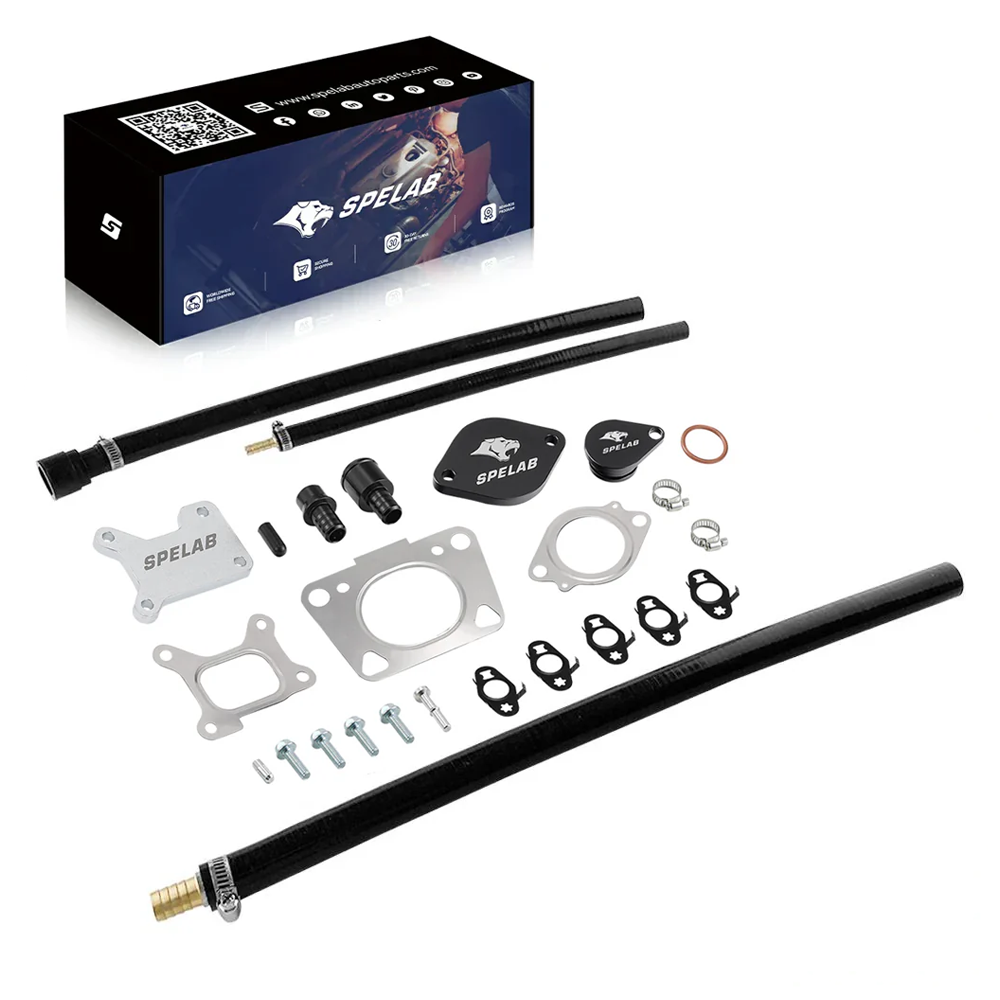
For owners comparing options, the main product category is Duramax EGR delete kits. If you are preparing a dedicated competition puller, off-road tow project, or private-property work truck where the configuration is legally allowed, avoid generic block-off parts that leave coolant routing and plate alignment to guesswork. A fitment-specific SPELAB 2017-2025 6.6L Duramax L5P EGR Valve Cooler Delete Kit keeps the coolant bypass plan, block-off plate alignment, and crowded Y-bridge area tied to the L5P layout instead of a universal guess.
What It Cannot Fix
An EGR delete does not magically fix a failing injector, bad turbo control, plugged DPF, DEF quality problem, NOx sensor fault, weak thermostat, head gasket concern, or poor tune. If the original complaint is a DPF full warning or SCR fault, deleting the EGR may skip the root cause and create a new electronic problem.
This matters even more on a daily-driven or work-use truck. A ranch truck, hotshot pickup, construction tow rig, and weekend fifth-wheel hauler all need predictable behavior more than a flashy parts list. If the truck is still in warranty, still needs inspection, or may be sold in the next year, the ownership cost deserves a hard look.
Owners planning a larger emissions-related configuration sometimes compare an 2017+ 6.6L Duramax L5P delete kit or an All-In-One Duramax delete kit. That decision should come after diagnosis, legal-use confirmation, and cost planning - not before.
The L5P Tuning Reality: ECM Unlock Comes First
The L5P's E41 ECM is the part that separates this truck from older Duramax platforms. Hardware installation alone is not enough. If the calibration still expects the factory EGR system, the truck can set faults, enter limp mode, refuse to complete readiness behavior, or fail to operate correctly.
Before any wrenching starts, confirm the E41 ECM unlock path, tuner support, file source, transmission strategy, tire/gear changes, emissions configuration, and whether the tune is built for towing or only for a power number. HP Tuners, SOTF tuning, and other calibration paths all need to be matched to the exact model year and ECM status. A tune that feels strong empty can be ugly under a trailer if it raises heat, smokes, shifts poorly, or ignores torque management.
For owners comparing tuning hardware, a Duramax tuner delete kit needs to match the exact engine year, ECM status, emissions layout, and intended use. This is not the place for a mystery file from a forum.
John Lee's Shop Note: Do not schedule the install until the tune is ready and verified. I have seen owners pull hardware first, then discover the ECM path was not sorted. That is how a truck that drove into the shop under its own power ends up sitting there with the hood open and no clean way home.
Installation Reality: Why the L5P Is Not a Beginner Job
The L5P engine bay is tight. Access around the passenger-side Y-bridge area, EGR cooler, intake horn, coolant lines, heat shields, firewall harnesses, and AC compressor area can test your patience. This is not the same as changing an air filter or bolting on a simple exhaust tip.
Set your expectations before the first bolt turns: the Y-bridge is buried deep enough that this job rewards patience more than muscle. You need good light, the right extensions, clean parts trays, and enough time to stop before you get mad and snap a plastic connector.
Before You Start
- Disconnect both negative battery terminals.
- Let the engine cool completely before draining coolant.
- Document hose routing, connector positions, and sensor locations with photos.
- Confirm ECM unlock and compatible calibration before removing hardware.
- Have fresh coolant, caps, plugs, clamps, and spill control ready.
During the Job
- Remove intake components carefully to avoid breaking aged plastic clips.
- Watch coolant line orientation around the EGR cooler and bypass plug.
- Do not force O-rings into place dry or crooked.
- Keep debris out of the intake and exhaust ports.
- Do not leave harness plugs strained, hanging, or heat-exposed.
After the Job
- Refill and bleed the cooling system carefully.
- Check for coolant seepage after the first full heat cycle.
- Watch EGT, coolant temperature, boost, and transmission behavior under light load first.
- Re-scan for codes after idle, after road test, and after the first tow.
- Keep the removed parts labeled if return-to-stock is part of your future plan.
If the truck also needs exhaust-side service in a legally allowed off-road configuration, a 3.5 inch L5P Duramax high-flow turbo downpipe is a separate exhaust-flow decision. Do not confuse that with diagnosing an EGR cooler leak.
Fitment and Decision Table
| Truck / Situation | Best First Step | When EGR Delete Enters the Conversation | Red Flag |
|---|---|---|---|
| 2017-2025 Silverado/Sierra 2500HD or 3500HD L5P | Confirm codes, coolant pressure, EGR data, boost data, and SCR/DPF status | Documented off-road or competition use with tuning ready | Ordering hardware before ECM unlock is confirmed |
| Daily driver that must pass inspection | Repair the legal emissions system | Usually not a practical public-road path | Assuming "off-road only" language protects street use |
| Tow rig with high EGT | Check boost, airflow, fuel data, coolant temp, load, gear, and tune | Only after root cause and legal-use status are clear | Using delete to cover up an overfueling or boost problem |
| Truck with DEF/SCR countdown | Diagnose DEF quality, NOx sensors, SCR efficiency, wiring, and calibration | Not as an EGR-only repair | Blaming EGR for every aftertreatment message |
| Used L5P already modified | Inspect missing hardware, tune source, readiness status, and stored codes | Only if the current setup is known and supportable | Seller says "it is tuned" but cannot show who tuned it |
If you are planning a broader build, use reliability planning before stacking parts. The best L5P builds usually start with monitoring, cooling, airflow, clean tuning, and known weak-point repair - not the biggest advertised power number.
Legal and Warranty Reality
EGR delete kits are not legal public-road repairs in many regions, including the United States, where emissions-control tampering and defeat devices are regulated. This article is for education and for documented off-road, competition, or legally allowed non-public-road use cases. Always confirm federal, state, and local rules before modifying emissions-related hardware or software.
Warranty is also not a simple yes-or-no topic. Using an aftermarket part does not automatically erase a warranty in every situation, but a dealer or manufacturer can scrutinize modifications when the modified system is related to the failure. A tuned and deleted L5P gives them plenty to inspect. If the truck still matters for warranty, resale, financing, or inspection, think carefully before crossing that line.
Related Part to Consider
FAQ
Is an L5P EGR delete worth it?
It can be worth considering for documented off-road or competition use when the truck has a clear EGR-side reason, the ECM unlock is ready, and the tune is matched to the hardware. It is not a smart first move for a public-road truck that needs inspection or warranty protection.
Will an EGR delete stop L5P regen problems?
Not by itself. Regen problems can come from DPF restriction, soot load, ash load, bad EGT sensors, pressure sensor data, DEF/SCR faults, NOx sensors, weak thermostats, injectors, boost leaks, or driving cycle. Diagnose the aftertreatment data before blaming EGR.
Can I install L5P EGR delete hardware before tuning?
No. On the L5P, hardware should not be removed until the ECM unlock and compatible calibration are ready. Otherwise the truck may set fault codes, enter limp mode, or fail to run correctly.
Does an L5P EGR delete lower EGT?
It may help reduce intake soot and thermal load in the EGR path, but EGT depends on trailer weight, tune, boost, fueling, air filter, turbo behavior, gear, and cooling system health. Do not use EGR delete as a shortcut for high-EGT diagnosis.
What is the hardest part of the install?
The hardest parts are access, coolant routing, O-ring seating, harness care, and tuning readiness. The tight Y-bridge and EGR cooler area can turn a simple-looking job into a long day if the truck is hot, rusty, or missing the right tools.
What should I check before buying parts?
Check active and pending codes, freeze-frame data, coolant pressure, EGR cooler leak signs, soot and ash load, DPF pressure, DEF/SCR status, boost target vs actual, NOx data, and whether the ECM can be unlocked and supported. For budgeting, review cost planning before teardown.
The L5P Owner's Takeaway
The L5P Duramax is a serious tow engine, but it is not forgiving of sloppy emissions work. An EGR delete can simplify one problem area in a legally allowed off-road or competition build, yet it can also create electronic, legal, warranty, and resale problems if done casually.
The right sequence is simple: diagnose first, confirm legal-use status, verify ECM unlock and tuning, plan coolant routing, then choose parts. If any of those steps are fuzzy, wait. A clean plan is cheaper than fixing a truck that was modified before anyone knew what problem they were solving.

About the Author
John Lee
Mechanical Engineer | 10+ Years Experience
John has spent the last decade engineering and testing high-performance automotive components. Specializing in drivetrain durability and thermal management across Powerstroke, Cummins, and Duramax applications, he bridges the gap between OEM limitations and aftermarket performance. His philosophy: "Factory parts are just a starting point."