Updated July 13, 2026.
The 6.6L Duramax L5P is already a strong engine from the factory. GM lists the current L5P at 470 hp and 975 lb-ft of torque, with cooled EGR, SCR, DPF, and intake throttle systems built into the emissions package. That means the smartest L5P upgrades are not about throwing parts at the truck first. They are about watching heat, protecting fuel delivery, improving airflow, and keeping the truck reliable under towing load.

Quick Engineer Summary
- Start with monitoring: EGT, boost, fuel pressure, coolant temperature, and regen behavior.
- For towing, heat control matters more than peak horsepower.
- A high-flow intake, downpipe, and up-pipes can improve airflow and thermal stability when correctly matched.
- A lift pump is a protection upgrade, not just a power part.
- Throttle controllers, inline modules, and ECM unlock tuning are not the same thing.
- Do not confuse legal repair access with emissions delete legality.
Real User Check: What Problem Are You Actually Solving?
Most L5P owners do not need a full race build. They need a truck that can tow a fifth wheel, pull equipment, climb grades without runaway EGT, and stay out of limp mode during work. Before buying parts, ask which problem you actually have.
| Owner Complaint | Likely Direction | First Check |
|---|---|---|
| EGT climbs while towing | Airflow, exhaust restriction, intercooler efficiency, driving load | Log EGT, boost, gear selection, trailer weight, and ambient temperature. |
| Slow spool or lazy low-end response | Boost leak, up-pipe leak, intake restriction, throttle mapping | Inspect up-pipes, charge pipes, clamps, and boost readings. |
| Frequent regen or DPF warning | DPF load, sensor faults, short trips, failed regen, exhaust temperature behavior | Scan codes and review soot load before buying performance parts. |
| Fuel pressure instability under load | Lift pump, filter condition, air in fuel, supply restriction | Check fuel filter history and commanded vs actual rail pressure. |
| Wants more power | Monitoring, airflow, fuel support, tuning, turbo efficiency | Set a realistic power goal and decide whether the truck must stay street-compliant. |
If your main issue appears during towing, read this guide on towing heat and regen behavior before chasing horsepower. The data usually tells you whether you have a heat problem, airflow problem, fuel problem, or emissions-system fault.
Compliance and Warranty Disclosure
Some L5P modifications affect emissions hardware, calibration, or warranty risk. Public-road trucks must follow federal, state, and local emissions rules. Repair access and diagnostics are not the same as permanent emissions removal for street use.
Using aftermarket parts does not automatically void a warranty, but if an aftermarket part or incorrect installation causes damage, the related warranty claim can be denied. Keep service records, installation documentation, and scan data.
Stage 0: Monitoring Before Modifying
This is the step many owners skip. If you do not know your EGT, boost, fuel pressure, coolant temperature, and regen pattern, you are guessing. A stock L5P can feel strong while still running hot under sustained grade towing.
- Watch EGT under the same trailer load and route.
- Monitor boost and intake air temperature.
- Track fuel pressure stability during long pulls.
- Scan for DPF, DEF, SCR, NOx sensor, and EGR-related codes.
- Record baseline data before installing performance parts.
John Lee’s Shop Note: Do Not Turn Your Truck Into a Test Mule
I have seen too many L5P owners hurt a perfectly good truck by stacking parts because a forum thread made it sound easy. More parts do not automatically mean better performance. If you tow occasionally or daily-drive the truck, start with heat management, clean airflow, fuel stability, and monitoring. Do not flash, unlock, or over-fuel the truck before you know its baseline.
The best tow-truck upgrade is the one you barely notice. The truck should feel calmer, cooler, and more confident under load, not louder, twitchier, and harder to diagnose.
Stage 1: Airflow and Thermal Management
A diesel under load is an air and heat management system. Better airflow can reduce pressure drop, improve turbo efficiency, and help keep exhaust temperature under control. The goal is not a louder parts list. The goal is a truck that holds speed without constantly living in the danger zone.
High-Flow Intake and Filter
The factory L5P intake is designed for filtration, noise control, packaging, and emissions compliance. A quality intake can reduce restriction and sharpen response, but it should not sacrifice filtration. For a towing truck, dust protection matters as much as airflow.
For owners comparing intake choices, the Duramax air intake kit category is the right place to evaluate airflow parts by fitment, filtration, and intended use.
High-Flow Downpipe
The L5P downpipe area is tight, and factory packaging can create restriction near the turbo outlet. A well-designed downpipe can improve exhaust flow and help heat leave the turbine area more efficiently. This is especially useful for towing, where sustained load matters more than a short dyno pull.
The 3.5 inch downpipe exhaust for L5P Duramax is best viewed as a thermal support upgrade. It should be paired with correct fitment checks and a clear understanding of local emissions rules.

Turbo Up-Pipes
Up-pipes live a hard life. They see heat cycling, vibration, and drive pressure. When a flex section cracks or starts leaking, the truck may not always sound broken. The owner may only notice slower spool, softer low-rpm response, and EGT that creeps higher during long pulls.
For trucks in the 60,000 to 100,000 mile range, especially tow rigs, inspect the bellows and sealing points before assuming the turbo is tired. The exhaust up-pipe for 2017-2023 L5P 6.6L Duramax is relevant when the failure point is the up-pipe path, not the turbo itself.
Intercooler and Charge-Air System
The intercooler does not create power by magic. It helps control intake air temperature and boost stability. On a tow truck, that means repeatable performance when ambient temperature rises, the trailer is heavy, and the grade is long.
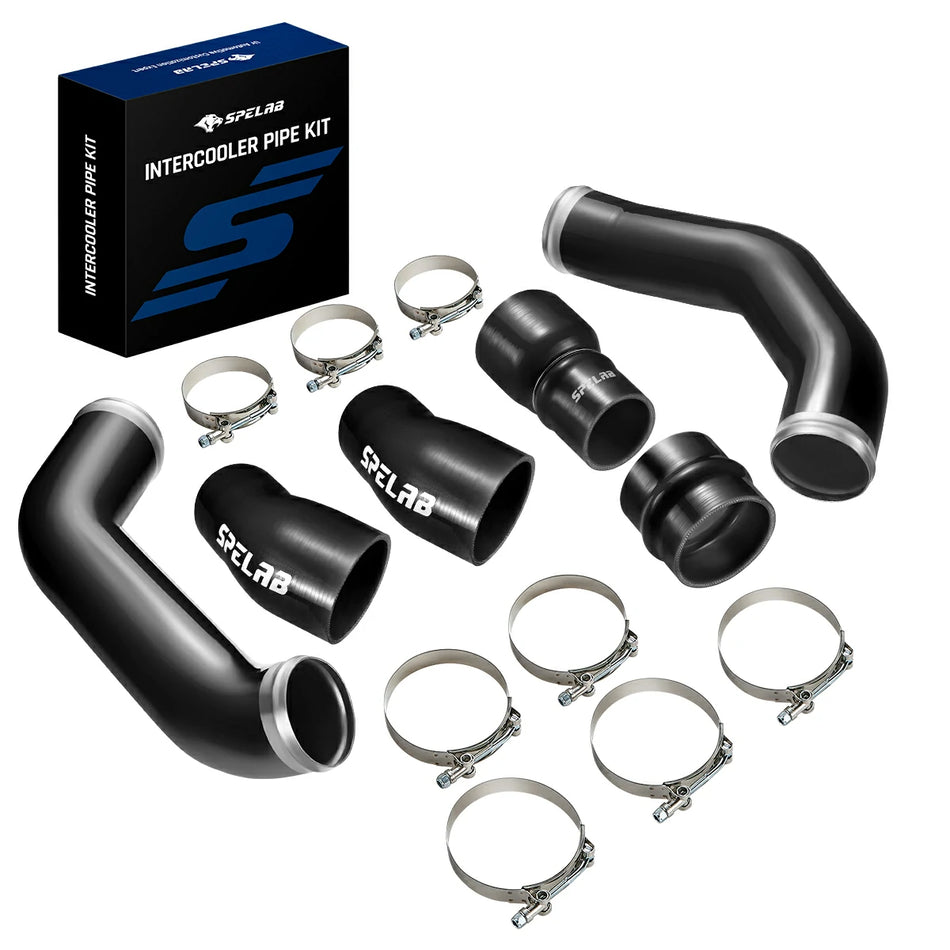
If your concern is charge-air temperature or boost drop, compare the L5P against earlier platforms in this article on charge-air temperature diagnosis. For product comparison, browse the Duramax intercooler pipe category when the weak point is pipe restriction, clamp sealing, or charge-air path reliability.

Stage 2: Fuel System Protection
The L5P moved away from the older CP4 conversation that caused so much anxiety on some earlier diesel platforms. The Denso HP4 system is generally respected, but that does not mean fuel supply should be ignored. Clean fuel, steady supply pressure, and good filtration still matter.
Lift Pump System
A lift pump is not just a power part. On a working L5P, it can help stabilize supply, reduce aeration, and support consistent fuel delivery under sustained load. This matters most on trucks that tow often, run higher mileage, or see long grades in hot weather.
Before installing one, check filter condition, tank quality, water contamination, and any scan data showing fuel-pressure behavior. A lift pump helps the system work better; it does not fix bad fuel, clogged filters, or injector damage.
Stage 3: Tuning and Electronics
The L5P ECM is not like older Duramax platforms. Full tuning is more involved, more expensive, and more consequential. This is the section where owners need to slow down.
| Option | What It Actually Changes | Best Use Case | Real-World Risk |
|---|---|---|---|
| Throttle controller | Pedal mapping only | Drivers who want sharper response without adding horsepower | Can feel twitchy if set too aggressively; does not add power. |
| Inline module | Limited signal-based adjustment | Owners wanting reversible, mild control changes | Less complete than real calibration work; still requires compatibility checks. |
| ECM unlock and tune | Fuller calibration access | Purpose-built trucks with defined power goals and supporting hardware | Higher cost, warranty risk, emissions risk, and more dependence on tuner quality. |
A throttle controller does not tune the engine. An inline module does not equal a full ECM calibration. A true ECM unlock is a deeper commitment with bigger consequences. If you are considering that path, read about tuning workflow and unlock risks before buying hardware.
Stage 4: Advanced Power Adders
Turbo upgrades, larger fuel upgrades, and water-meth systems should come after monitoring, airflow, fuel supply, and drivability are under control. Past moderate power goals, efficiency matters more than boost numbers. More boost without temperature control can simply make the engine work harder.
For most owners, a turbo upgrade only makes sense when the truck has a defined horsepower target, the supporting fuel and airflow systems are already healthy, and the owner accepts the added maintenance and tuning responsibility.

Engineer-Recommended L5P Modification Roadmap
| Stage | Upgrade Focus | Best For |
|---|---|---|
| Stage 0 | EGT, boost, fuel pressure, coolant temperature, scan data | Every L5P owner before buying parts |
| Stage 1 | Intake, downpipe, up-pipe inspection, charge-air leaks | Towing, heat control, daily drivability |
| Stage 2 | Lift pump, fuel filtration, fuel pressure stability | Heavy towing, high mileage, long grades |
| Stage 3 | Throttle controller, inline module, or careful tuning plan | Owners who understand warranty and emissions tradeoffs |
| Stage 4 | Turbo, advanced fuel upgrades, water-meth, custom calibration | Purpose-built performance trucks |
If you want a platform-specific shopping path, use the 2017-2019 L5P 6.6L Duramax applicable products collection for earlier L5P trucks, or the 2020-2024 L5P 6.6L Duramax applicable products collection for later trucks.
What I Would Do on a Daily Tow L5P
If this were my own Silverado or Sierra HD used for real towing, I would not start with an ECM unlock. I would start with scan data, temperature monitoring, fuel-filter history, and a careful inspection for boost leaks or up-pipe leaks. Then I would improve airflow and fuel supply only where the data shows a need.
The truck should feel calmer under load, not just louder. A good L5P build pulls cleanly, keeps EGT predictable, avoids unnecessary regen drama, and does not turn every road trip into a diagnostic session.

FAQ
Is the stock Duramax L5P reliable without modifications?
Yes. The L5P is strong in stock form. Most owners should treat upgrades as heat control, monitoring, airflow improvement, and fuel-system protection rather than a repair for a weak engine.
What is the best first modification for an L5P?
Monitoring. EGT, boost, coolant temperature, fuel pressure, and scan data should come before major power parts. You cannot improve what you are not measuring.
Does a high-flow downpipe reduce EGT on the L5P?
It can help reduce restriction at the turbo outlet and support better heat evacuation under load, but results depend on the truck, trailer weight, tune, ambient temperature, and total exhaust setup.
Is a lift pump necessary on an L5P?
Not for every stock truck. It becomes more useful on high-mileage trucks, towing trucks, or builds where stable fuel supply matters. It should not be used to mask bad fuel, clogged filters, or injector issues.
What are signs of cracked L5P up-pipes?
Slower spool, rising EGT, reduced low-rpm response, soot marks, exhaust smell, or faint ticking under load can all point to an up-pipe leak. Physical inspection is often required.
Will a throttle controller add horsepower?
No. It changes pedal response, not engine output. It may make the truck feel sharper, but it does not create real horsepower.
Is an inline module the same as an ECM tune?
No. An inline module usually changes or intercepts certain signals within a limited range. An ECM tune changes calibration logic more deeply and carries greater warranty, emissions, and drivability consequences.
Should I tune my L5P?
Only after you understand the cost, warranty risk, emissions implications, tuner quality, and supporting hardware. For a public-road tow truck, reliability and compliance should come first.
What about DPF, DEF, SCR, and EGR issues?
Scan and diagnose them directly. Frequent regen, DEF quality faults, SCR efficiency codes, NOx sensor issues, or EGR faults are repair problems before they are performance problems.
Owner’s Takeaway
The right L5P build starts boring: data, fuel quality, airflow checks, and temperature control. Once the truck is healthy, upgrades like intake work, a better downpipe, reinforced up-pipes, intercooler piping, and fuel-supply support can make the engine feel more confident under load. Chasing power before solving heat, fuel, and emissions-system behavior is how expensive trucks become expensive projects.

About the Author
John Lee
Mechanical Engineer | 10+ Years Experience
John has spent the last decade engineering and testing high-performance automotive components. Specializing in drivetrain durability and thermal management across Powerstroke, Cummins, and Duramax applications, he bridges the gap between OEM limitations and aftermarket performance. His philosophy: “Factory parts are just a starting point.”