
The L6P is the new Duramax Turbo-Diesel V8 RPO code listed in GM's early 2027 Silverado HD ordering material. GM has separately confirmed an all-new 8.3L Duramax Turbo-Diesel V8, nicknamed Mongoose, for the refreshed 2027 Chevrolet Silverado HD and GMC Sierra HD. The two programs appear to describe the same engine, but a final production specification linking every identifier has not been released.
Key Takeaways
GM has confirmed a major new HD diesel program and several supporting truck configurations, while the core performance and service specifications remain pending.
- GM officially confirmed an all-new 8.3L Duramax Turbo-Diesel V8 called Mongoose for refreshed 2027 Silverado HD and Sierra HD pickups.
- GM's 2027 Silverado HD ordering material identifies L6P as a B20-compatible Duramax V8 paired with an Allison 10-speed automatic and a 3.42 rear axle.
- The listed supporting hardware includes an exhaust brake, dual batteries, a 220-amp alternator, an engine block heater, a winter grille cover, and an available PTO transmission.
- The larger displacement may support towing, durability, emissions, or future output goals, but GM has not explained why it selected 8.3 liters.
- L5P parts should not be labeled as L6P bolt-ons until production VIN, RPO, OEM part number, physical fitment, electronics, and loaded operation have been verified.

What Information About the L6P Duramax Is Confirmed?
GM has established the new diesel program through a public 8.3L Mongoose announcement and early 2027 Silverado HD ordering material that identifies the L6P RPO and its supporting equipment.
| Confirmed item | Published information | Source type | Why it matters |
|---|---|---|---|
| Engine program | All-new Duramax Turbo-Diesel V8 | GM public announcement | GM describes a new HD diesel program rather than another output update for the existing 6.6L engine. |
| Displacement | 8.3 liters, roughly 506 cubic inches | GM public announcement | The displacement is 1.7 liters, or roughly 26%, larger than the current 6.6L Duramax. |
| Development nickname | Mongoose | GM public announcement | The nickname identifies the new engine program, although it may not become the customer-facing engine name. |
| Vehicle program | Refreshed 2027 Chevrolet Silverado HD and GMC Sierra HD | GM public announcement | The engine is intended for GM heavy-duty pickups rather than the Silverado 1500 or Sierra 1500. |
| Engine RPO | L6P Duramax Turbo-Diesel V8 | GM Online Order Guide | The RPO is the build code used by dealers, service systems, vehicle records, and parts catalogs. |
| Fuel compatibility | B20-compatible | GM Online Order Guide | The listed engine can use approved diesel fuel containing up to 20% biodiesel when the fuel meets GM requirements. |
| Standard transmission | MGM Allison 10-speed automatic | GM Online Order Guide | The standard pickup configuration retains an Allison-branded heavy-duty 10-speed automatic. |
| PTO transmission | MGU Allison 10-speed with integrated PTO | GM Online Order Guide | Eligible configurations can support vocational equipment after the final PTO operating limits are confirmed. |
| Rear axle ratio | GU6 3.42 | GM Online Order Guide | The axle ratio affects launch feel, cruising rpm, grade performance, and tire-change calculations. |
| Exhaust brake | K40 included with L6P | GM Online Order Guide | The exhaust brake helps control downhill speed and reduces service-brake workload while towing. |
| Cold-weather equipment | K05 engine block heater and BHP winter grille cover | GM Online Order Guide | The equipment supports cold starting and diesel temperature management in low ambient temperatures. |
| Electrical system | KW5 220-amp alternator and dual 730 CCA, 70 Ah batteries | GM Online Order Guide | The configuration supports diesel starting loads and accessories used by fleet, snowplow, and jobsite trucks. |
| DPF service feature | Manual regeneration under specified soot-load conditions | GM Online Order Guide | Eligible operators may initiate regeneration after the system reaches the required load and displays the appropriate driver message. |
GM announced the engine on September 21, 2026, in its official 8.3L Mongoose preview. Model-specific ordering resources are available through the official GM Fleet guide hub.
Which L6P Specifications Have Not Been Confirmed?
The remaining questions cover engine output, internal construction, airflow and fuel hardware, vehicle capability, service requirements, production timing, and aftermarket access.
| Open question | Current evidence | Status | What would confirm it |
|---|---|---|---|
| Is L6P the 8.3L Mongoose? | The RPO and 8.3L announcement appear in the same 2027 GM HD program, and GM has announced no second new HD diesel. | Strongly indicated | A GM specification, service document, production build record, or emissions label using all three identifiers |
| Horsepower and torque | No current GM specification supports an exact output figure. | Unknown | Official powertrain ratings or an SAE-rated GM output chart |
| Towing, payload, and GCWR | Early chassis and package details exist, but final truck-specific ratings do not. | Unknown | GM trailering guide, door-jamb labels, and configuration charts |
| Internal construction | Bore, stroke, compression ratio, block material, head design, pistons, and bearing dimensions are not public. | Unknown | GM engine specifications or service information |
| Turbo and fuel system | Turbo count, boost pressure, injection pressure, injector design, and pump supplier are not public. | Unknown | GM service information and production parts catalog |
| Fuel economy and DEF use | No production consumption data has been released. | Unknown | Applicable EPA data and manufacturer operating specifications |
| ECM and diagnostic access | GM has not identified the L6P controller, gateway-security protocol, programming process, or independent-shop access requirements. | Unknown | GM service-tool documentation and production-controller identification |
| Parts interchange | No broad L5P-to-L6P carryover has been physically or electronically validated. | Unknown and unsafe to assume | OEM cross-references plus production-truck fitment testing |
| Retail availability | GM describes the announcement as a first look without a firm HD dealer-delivery date. | Unknown | Chevrolet or GMC production and on-sale announcement |
Which L6P Conclusions Are Reasonable Inferences?
The official documents support a strong L6P-to-Mongoose connection and several possible engineering motives, but they do not prove GM's output, durability, emissions, or aftermarket strategy.
The strongest inference is that L6P is the production RPO for the 8.3L Mongoose. Both appear in the same 2027 HD program, and no separate new Duramax V8 has been announced for those trucks. A production VIN record or GM service document should still close that final evidence gap.
The displacement increase also gives GM more potential airflow and torque-producing capacity. GM could use that capacity for higher peak output, lower specific load at a given torque target, better sustained-load control, future calibration headroom, or some combination of those goals.
Exact power rumors remain unsupported, and a larger displacement does not automatically prove lower stress, cooler combustion, better fuel economy, lower DEF use, or longer engine life. Those outcomes depend on the finished turbo, compression ratio, injection strategy, EGR calibration, cooling system, aftertreatment, transmission control, and duty cycle.
Why Might GM Have Increased the Duramax to 8.3 Liters?
GM may have selected 8.3 liters to create more room for towing performance, sustained-load durability, emissions compliance, and future output growth, but GM has not stated which objective drove the displacement decision.
The timing overlaps with tighter U.S. emissions requirements beginning in the 2027 model year. EPA has adopted multiple programs affecting medium- and heavy-duty vehicles, with the exact requirements depending on regulatory class, certification pathway, useful life, and model year. That makes emissions compliance a reasonable design constraint, not proof of GM's internal reasoning.
A larger displacement can produce the same torque target at lower specific output if boost, fueling, and calibration are selected accordingly. Engineers could use that margin to control cylinder loading, exhaust temperature, transient response, or aftertreatment conditions during sustained work. They could also spend the margin on more peak output.
Engine-out NOx does not fall automatically when displacement increases. Combustion temperature, oxygen concentration, injection timing, injection pattern, EGR flow, boost, compression ratio, catalyst temperature, SCR performance, and calibration all affect the result. GM has not published L6P BMEP, cylinder-pressure, engine-out NOx, EGR, DEF-consumption, or catalyst-temperature data.
The safe conclusion is that the 8.3L architecture gives GM more choices. The final calibration will show whether GM prioritized headline output, repeatable towing performance, emissions margin, service life, or a balance of all four.
EPA describes the 2027-and-later requirements on its heavy-duty engine and vehicle standards page and its light-duty and medium-duty vehicle standards overview.
How Does the 8.3L Duramax Fit the Current HD Diesel Market?
The 8.3L Duramax enters a segment where Ford and Ram already publish higher peak diesel torque than the current 6.6L Duramax, giving GM a clear competitive reason to expand capability.
| 2026 HD diesel benchmark | Displacement | Published maximum output | Published maximum towing |
|---|---|---|---|
| Chevrolet Silverado HD Duramax | 6.6L V8 | 470 hp / 975 lb-ft | Up to 36,000 lbs |
| Ford Super Duty High Output Power Stroke | 6.7L V8 | 500 hp / 1,200 lb-ft | Up to 40,000 lbs |
| Ram HD High Output Cummins | 6.7L inline-six | 430 hp / 1,075 lb-ft | Up to 36,610 lbs |
| 2027 GM Mongoose / expected L6P | 8.3L V8 | Pending | Pending |
Current GM figures come from the Chevrolet Silverado HD specifications. Competing figures come from the Ford Super Duty towing guide and the Ram Heavy Duty capability page.
Maximum ratings require specific cab, drivetrain, axle, wheel, tire, hitch, and package combinations. They are comparison points, not ratings for every truck carrying the same engine badge.
What Could the L6P Mean for Heavy Towing?
The L6P's biggest real-world opportunity is stronger and more repeatable operation under sustained load, but the engine alone cannot determine a legal or practical trailer rating.
A fifth-wheel owner crossing the Rockies needs more than one big torque number. Coolant control, charge-air temperature, transmission shift strategy, exhaust braking, fan capacity, axle load, and service-brake temperature decide whether the truck stays composed halfway up and back down the grade.
The listed Allison 10-speed, 3.42 axle, and exhaust brake point toward a complete towing system. The transmission keeps the engine in its useful operating range, the axle balances launch force against cruising rpm, and the exhaust brake helps control downhill speed.
Why the Max Trailering Package Matters
The early 2027 Silverado 2500 HD NHT Max Trailering Package shows that GM is adding chassis hardware instead of treating towing as an engine-only number.
- 3500 HD frame
- 3500 HD leaf springs
- 3500 HD shock package
- 12-inch rear axle
- Required L6P engine
- Required gooseneck or fifth-wheel preparation
- Required compatible 18-inch or 20-inch wheels and tires
The final decision must use the truck's payload label, trailering label, GVWR, GAWR, GCWR, hitch rating, tire rating, passenger weight, cargo, and trailer pin or tongue weight.
What Could the L6P Mean for Fleet and Jobsite Trucks?
The PTO-capable transmission, high-idle availability, 220-amp alternator, dual batteries, and manual DPF regeneration listing make the L6P relevant to vocational operators as well as private towing owners.
A service body with work lights, radios, an inverter, a compressor, and hydraulic equipment can spend more time powering accessories than pulling a trailer. Alternator output, battery reserve, cooling at idle, and regeneration behavior directly affect downtime.
The PTO option deserves close review from tow operators, contractors, municipalities, and utility fleets. Buyers still need confirmed PTO torque limits, operating-speed ranges, stationary and mobile modes, thermal requirements, wiring instructions, and warranty conditions.
Manual DPF regeneration can help manage a truck that spends too much time at idle or low speed. Repeated soot loading still calls for diagnosis of duty cycle, failed thermostats, boost leaks, injector correction, exhaust sensors, idle time, and interrupted regeneration events.
What Could the L6P Mean for Cold-Weather Owners?
The block heater, winter grille cover, dual batteries, and 220-amp alternator show that cold-weather operation is built into the early L6P configuration.
Two batteries do not eliminate winter electrical problems. One weak battery can pull down its partner, reduce cranking speed, trigger low-voltage faults, and make glow-system or communication complaints look worse than they are. Both batteries should be tested as a matched system.
B20 compatibility also needs context in freezing weather. Fuel behavior can vary with temperature, storage, blend quality, and regional winter formulation. The production owner's manual should decide approved fuel, additives, filter service, oil viscosity, and warm-up practices.
The winter grille cover should be used within GM's final ambient-temperature and towing guidance. Blocking airflow at the wrong temperature or under heavy load can create a different heat problem.
Will L5P Parts Fit the L6P Duramax?
No L5P intake, turbo, cooling, fuel, exhaust, tuning, mount, or emissions part should be sold as an L6P bolt-on until production fitment has been physically and electronically verified.
A 26% displacement increase can change block dimensions, cylinder-head layout, accessory drives, port locations, sensor ranges, heat shields, hose routing, and service clearance even if the engine still looks like a familiar Duramax V8.
Our fitment policy as a parts manufacturer is straightforward: an L6P application needs a production VIN, engine and transmission RPOs, OEM reference numbers, measured mounting points, connector verification, cold and hot clearance checks, pressure or boost testing, diagnostic scans, and loaded road validation before receiving a direct-fit claim.
Mechanical Parts That Need New Validation
Any component connected to airflow, fuel pressure, coolant pressure, exhaust heat, engine movement, or emissions control needs L6P-specific evidence.
- Air boxes, intake tubes, mass-airflow housings, and turbo inlet pipes
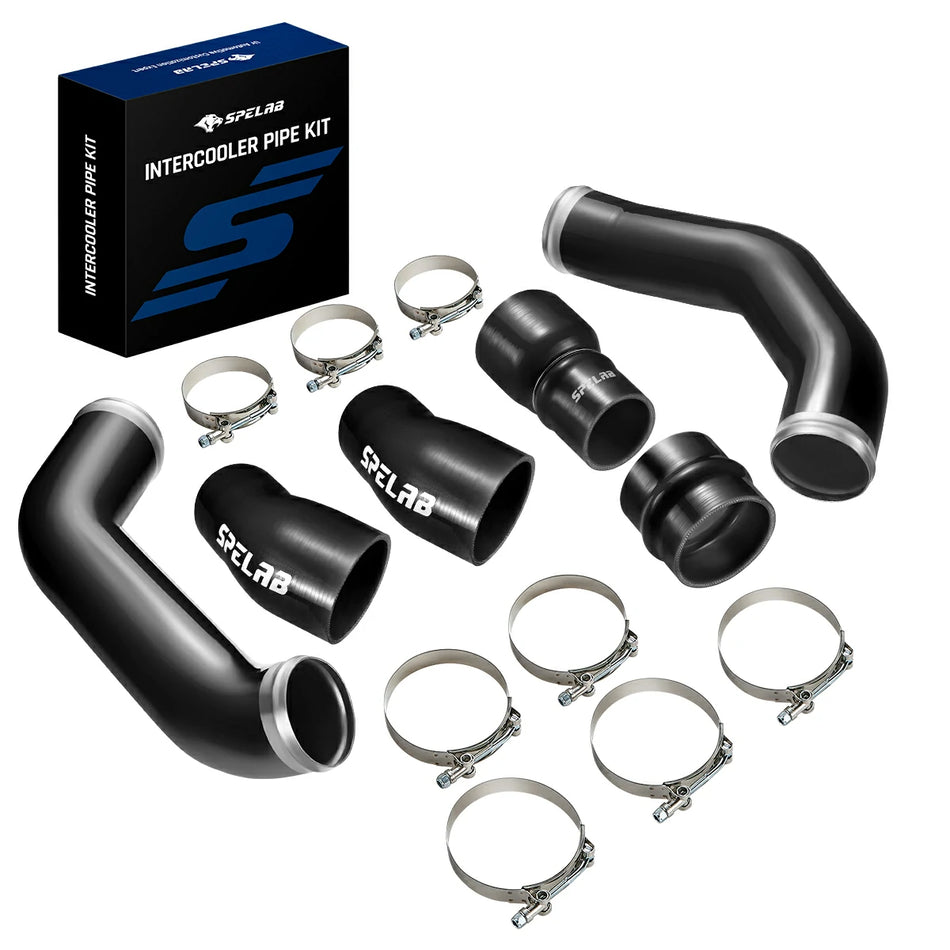
- Charge pipes, intercoolers, boots, clamps, and intake manifolds
- Turbochargers, exhaust manifolds, up-pipes, downpipes, and heat shields
- Fuel filters, filter heads, lift pumps, high-pressure pumps, rails, lines, and injectors
- Radiators, fans, coolant hoses, thermostats, surge tanks, and oil coolers
- Engine mounts, transmission mounts, brackets, skid plates, and crossmembers
- EGR, DOC, DPF, SCR, DEF, NOx-sensor, and exhaust-temperature components
ECM, Scan-Tool, and Calibration Access
L6P owners and independent shops should watch for GM's final controller identification, gateway-security rules, programming process, and scan-tool requirements.
GM is expanding secure, software-defined vehicle architecture across its portfolio, but it has not publicly identified the L6P ECM or confirmed the exact security architecture for the refreshed 2027 HD trucks. It is reasonable to expect that tuning and module programming may require updated tools or authorization, but any specific unlock procedure remains speculation.
GM describes its broader software direction in its centralized vehicle computing platform announcement.
Fitment Evidence Owners Should Demand
A credible L6P listing should identify the exact truck configuration and explain how both mechanical fit and system operation were validated.
- Supported model year, make, model, cab, drivetrain, engine RPO, and transmission RPO
- OEM reference or supersession numbers where applicable
- Measured flange, tube, port, thread, and mounting dimensions
- Verified sensor connectors and calibration requirements
- Clearance through engine movement and loaded drivetrain torque
- Cold-start and full-temperature leak testing
- Pressure, boost, temperature, or flow testing appropriate to the part
- DTC and readiness-monitor checks after installation
Current Duramax owners do not need to delay normal maintenance while L6P specifications develop. Owners preparing an LB7, LLY, LBZ, LMM, LML, or L5P truck for the next towing season can browse Duramax parts by engine generation, then confirm the exact model year, engine RPO, emissions configuration, and product fitment before ordering.
Should You Wait for the L6P or Buy a Current Duramax?
Wait for the L6P when future factory capability matters more than launch-year certainty; buy or keep a current 6.6L Duramax when you need published ratings, mature service knowledge, and established parts support now.
| Your situation | Practical decision | Reason | Next action |
|---|---|---|---|
| Your L5P runs well and handles the current trailer | Keep the truck | An engine preview is not a reason to replace a correctly rated, paid-for truck. | Maintain the cooling, fuel, transmission, brake, tire, and emissions systems. |
| You need a work truck before complete L6P specifications arrive | Price a current 6.6L Duramax | Current trucks have published capability, service procedures, and established replacement parts. | Match the VIN-specific payload and trailering labels to the actual job. |
| You regularly tow near your current truck's limits | Wait for final L6P ratings | The new platform may change capability, but the complete truck limits remain unsettled. | Compare GCWR, axle ratings, payload, tires, hitch, cooling equipment, and braking after release. |
| Your fleet needs powered equipment | Evaluate the PTO-capable configuration | The early guide lists an integrated PTO-capable Allison transmission. | Confirm PTO limits, cooling, high-idle control, electrical load, and upfitter documentation. |
| You plan immediate performance modifications | Wait for production hardware | Fuel, turbo, transmission, ECM, and emissions support will take time to validate. | Do not pre-order L5P parts based on photographs or engine-family assumptions. |
| You operate in severe winter conditions | Compare the complete cold-weather package | The early L6P listing includes useful hardware, but operating guidance is still pending. | Review the production manual's fuel, oil, heater, grille-cover, and warm-up requirements. |
What Information Should L6P Buyers Watch for Next?
The next useful updates will be factory specifications, capability charts, service documents, emissions information, and production records rather than another teaser image.
- SAE-rated output and engine-speed figures
- Silverado HD and Sierra HD towing, payload, and GCWR charts
- Final 2500 HD and 3500 HD cab, drivetrain, axle, and trim availability
- Owner's manual, fluid specifications, capacities, and maintenance intervals
- Cooling, turbocharger, fuel-system, and aftertreatment details
- Production warranty and emissions-warranty terms
- EPA certification information
- ECM identification, programming access, and service-tool requirements
- Production VIN records and OEM parts catalog
- Official ordering, production, and dealer-delivery timing
Editorial Status and Update Policy
This pre-release report was last technically reviewed on September 23, 2026, and should be reviewed again whenever GM publishes a material L6P production document.
- Confirmed: Directly stated in a GM announcement, GM ordering resource, or official manufacturer specification.
- Strongly indicated: Supported by multiple pieces of official information that GM has not yet connected in one explicit statement.
- Engineering interpretation: A practical explanation based on heavy-duty diesel design, towing, service, or fitment principles.
- Unknown: Not supportable as a production specification with currently available documents.
This page should receive an immediate review when GM releases output, towing, payload, service, emissions, warranty, controller, production, or retail-availability information.
Fitment, Towing, and Emissions Notice
Vehicle fitment, towing limits, installation requirements, emissions compliance, warranty impact, and road-use legality vary by truck configuration and location.
L6P Duramax FAQ
These answers reflect information available as of September 23, 2026, and preserve the line between factory documentation and engineering interpretation.
Q: What is the L6P Duramax?
A: The L6P is the Duramax Turbo-Diesel V8 RPO listed in early 2027 Silverado HD ordering material and is strongly indicated to be the production code for GM's new 8.3L Mongoose diesel.
Q: Is the L6P officially the 8.3L Mongoose?
A: GM has confirmed both pieces within the same 2027 HD program but has not yet published one production specification that explicitly combines the L6P code, 8.3L displacement, and Mongoose name.
Q: Why did GM increase the Duramax displacement to 8.3 liters?
A: GM has not disclosed the reason. The larger displacement could provide additional room for towing performance, lower specific load at a given torque target, emissions calibration, durability, or future output growth, depending on the final hardware and calibration.
Q: How powerful will the L6P be, and how much will it tow?
A: Factory output and towing ratings are still pending. Truck-specific capability will depend on the engine, transmission, axle, frame, suspension, tires, hitch, cab, drivetrain, and trailering package.
Q: What transmission is paired with the L6P?
A: Early Silverado 2500 HD ordering material lists the MGM Allison 10-speed automatic and an MGU Allison 10-speed with integrated PTO for eligible configurations.
Q: Will L5P parts fit the L6P?
A: Compatibility should not be assumed. A valid direct-fit claim requires OEM cross-references plus physical, electrical, diagnostic, thermal, and loaded-operation testing on a production L6P truck.
Q: Should I wait for an L6P truck?
A: Wait if you need to evaluate GM's newest factory capability and can accept launch-year uncertainty. Keep or buy a current 6.6L Duramax if you need established ratings, service support, and parts fitment now.

About the Author
John Lee
Mechanical Engineer | 10+ Years Experience
John has spent the last decade engineering and testing high-performance automotive components. Specializing in drivetrain durability and thermal management across Powerstroke, Cummins, and Duramax applications, he bridges the gap between OEM limitations and aftermarket performance. His philosophy: "Factory parts are just a starting point."





1 comment
Estimated sticker price of the 2027 Denali Ultimate 3500hd drw diesel.