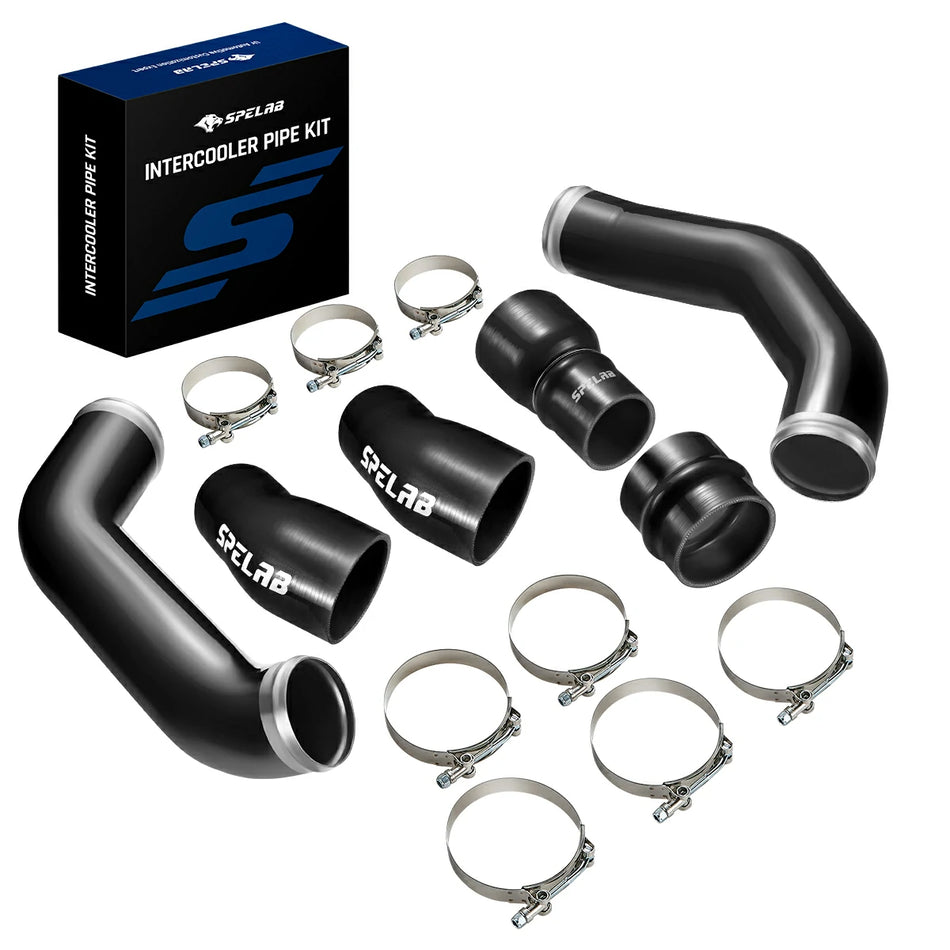
A cracked intake manifold and a failed cold-side CAC pipe can both cause P0299, low boost, black smoke, weak acceleration, and a hissing noise on a 6.7 Power Stroke. A gunshot-like pop followed by immediate boost loss points first toward the CAC outlet tube, boot, or crimped connection, while a broken MAP sensor boss or a pressure-tested leak from the upper intake supports manifold failure. Use the failure pattern, scan data, physical evidence, and a regulated charge-air test to identify the damaged part.
Key Takeaways
The location and timing of the leak should determine which 6.7 Power Stroke intake part gets replaced.
- Ford documented CAC outlet tube disconnection and crimp-clamp separation on certain 2011–2016 trucks with low power and P0299.
- A sudden pop under towing load usually puts the factory cold-side pipe connection at the top of the inspection list.
- A broken MAP sensor boss, visible manifold crack, or bubbles from the manifold body supports manifold replacement.
- A light oil film can be normal, while a directional oil-and-dust trail often marks a pressurized leak.
- A metal replacement pipe removes the original plastic/crimped failure point but cannot prevent boot, clamp, intercooler, or installation failures.
Quick Diagnosis: Manifold Crack or Cold-Side CAC Pipe?
A cold-side pipe failure is usually more sudden, while a small manifold crack or sealing fault may appear only when boost and engine load rise.

| What the truck does | More likely area | First check |
|---|---|---|
| Makes a sharp pop and immediately loses boost | CAC outlet tube, crimped joint, boot, or connection | Inspect the throttle-body connection and both pipe ends |
| MAP sensor is loose or its mounting boss is broken | Upper intake manifold | Inspect the sensor seal and surrounding material |
| Runs normally unloaded but hisses while towing | Small pipe, boot, joint, or manifold leak | Run a regulated pressure test |
| Shows a directional oil-and-dust trail at a pipe connection | Cold-side connection | Check pipe engagement, boot condition, and clamp position |
| Produces repeatable bubbles from the manifold body | Intake manifold | Mark the crack before removing the manifold |
| Has P0299 without a visible leak | Not determined | Compare desired and actual boost |
Know the Two Failure Areas Before Testing
The upper intake manifold and cold-side CAC pipe share the pressurized airflow path, but their failure points require different parts and different repairs.

Upper Intake Manifold Inspection Points
The upper intake deserves attention when the MAP sensor mounting area, manifold body, sealing surface, or adjoining connection shows physical damage.
- Inspect the MAP sensor boss for cracks, missing material, damaged threads, and a pinched O-ring.
- Check the manifold body and seams for oil tracks, dust outlines, and polished marks caused by escaping air.
- Inspect mating surfaces for distortion or debris left from prior work.
- Check nearby wiring and connectors before blaming the manifold structure.
Cold-Side CAC Pipe Inspection Points
The 2011–2016 factory CAC outlet tube deserves an early inspection because Ford documented separation at the throttle body and at the tube’s crimp clamp.[1]
The original assembly uses plastic sections and a crimped connection that can separate under load. A gunshot-like pop during a towing pull, followed by immediate P0299 and low power, makes that factory joint a primary suspect without proving that every 2011–2016 pipe will fail.[2]
- Inspect the connection at the throttle body before removing the intake manifold.
- Check the crimped joint for movement, separation, oil spray, and missing material.
- Inspect molded bends and the underside of the tube where a split can hide from a top-down view.
- Confirm that every boot and pipe end is fully seated before tightening its clamp.
Owners comparing the complete charge-air routing and replacement priority should separate a confirmed cold-side failure from unrelated hot-side, intercooler, or turbo faults.
Use the Failure Pattern Under Real Truck Loads
The moment the leak appears—during towing, unloaded cruising, or immediately after repair—often narrows the search faster than the trouble code.
Sudden Failure While Towing
A pop followed by instant power loss during a grade pull usually puts a separated CAC connection ahead of a small manifold crack.
Heavy towing and jobsite payload increase airflow demand and charge pressure. A weakened factory crimp or partially seated connection may survive unloaded cruising, then separate when the truck downshifts and boost rises. Lift off the throttle and inspect the cold side instead of repeating a full-load pull.
Leak That Appears Only Under Boost
A truck that drives normally at light throttle but hisses or falls short of commanded boost under load may have a small crack or marginal seal anywhere in the charge-air path.
Heat expansion can open a crack that remains quiet when the engine is cold. Pressure can also lift a partially seated boot or expose a distorted sealing edge. A loaded scan log tells more than revving the truck in Park.
Failure Immediately After Intake Work
A no-boost complaint that begins immediately after repair should be treated as an installation problem until every disturbed sensor, boot, clamp, and seal passes inspection.
Check the MAP sensor, similar nearby electrical connectors, pipe engagement, clamp position, O-rings, and every port opened during the job. A MAP sensor left out of its port creates a large leak and unusable boost data without any crack in the new hardware.
Read the Scan Data Before Pressurizing the System
P0299 proves that actual boost failed to meet the PCM target, but it cannot identify the leaking component by itself.
- Save current, pending, and history codes before clearing them.
- Check for P0236, P0237, P0238, or other MAP and boost-signal codes.
- Compare MAP with BARO during key-on, engine-off conditions; the readings should be reasonably close for the local altitude and weather.
- Log desired boost, actual boost, engine load, RPM, throttle demand, and vehicle speed during a controlled road test.
- Mark the load and RPM where actual boost first falls away from the commanded value.
Black smoke combined with sharply reduced boost supports a large air-supply problem. Owners whose pipe and manifold pass inspection should continue through the broader underboost diagnostic path, including the intercooler, remaining boots, exhaust-side leaks, sensor plausibility, and VGT control.
Run a Five-Minute Visual Inspection
A disconnected CAC tube, damaged MAP boss, split boot, or misplaced clamp can often be found without major disassembly.
- Confirm that the MAP sensor is installed, sealed, and connected.
- Inspect the MAP boss for cracks or missing material.
- Verify that the cold-side tube is fully seated at the throttle body and intercooler connections.
- Check the crimped connection and retaining hardware for movement or separation.
- Inspect each boot for cuts, folded edges, and clamp damage.
- Follow oily dust tracks toward their cleanest, wettest point.
- Inspect the intercooler end tanks and remaining charge-air joints.
A thin oil film inside the charge-air tract is common because the CCV system carries some oil vapor into the intake. A wet spray pattern extending away from one joint is stronger evidence because pressurized air can drive oil mist and dust through the leak.
Run a Regulated Charge-Air Leak Test
A regulated pressure test can isolate the leak, but pressure decay alone cannot prove that the intake manifold is cracked.

- Install a properly retained tester sized for the charge-air connection.
- Secure every plug and adapter before adding pressure.
- Start at roughly 5 psi to find a disconnected tube or major opening.
- Spray soapy water around the manifold body, MAP boss, boots, crimped joint, pipe ends, clamps, and intercooler seams.
- Increase pressure in controlled steps only within the limit of the lowest-rated component and test equipment.
- Record where bubbles begin and whether the leak changes as pressure rises.
Unregulated 90-plus-psi shop air can launch a test plug, blow off a boot, or damage the intercooler. The system may also lose pressure through an open engine valve, so a falling gauge does not automatically condemn the manifold.
Our parts inspection process treats repeatable bubbles at one component as stronger evidence than an unsupported pressure-decay number. A marked leak location gives the technician a repair target.
Failure Patterns That Point to the Intake Manifold
A broken MAP sensor boss, visible manifold crack, damaged sealing surface, or repeatable bubbles from the manifold body provides direct evidence for manifold repair.

- The MAP sensor has blown out and removed part of its mounting boss.
- The sensor screw or threaded mounting point no longer holds correctly.
- A visible crack opens when regulated pressure is applied.
- Oil and dust trace back to the manifold body rather than a boot.
- The leak returns at the same manifold location after the adjoining pipe is reseated.

A confirmed structural failure can justify a 2011–2019 cast-aluminum intake manifold. A manifold should not be sold as a guaranteed P0299 fix when the pipe, boot, intercooler, or turbo-control system has not been tested.
Failure Patterns That Point to the Cold-Side CAC Pipe
A separated throttle-body connection, failed crimp clamp, split boot, cracked tube, or oil spray around the pipe end supports cold-side CAC pipe repair.
- The truck made a sharp pop and immediately lost most or all boost.
- The factory tube has separated at the throttle-body end or crimped connection.
- The pipe is visibly out of position or can be moved at a joint that should remain secure.
- The boot has a hidden cut under the clamp.
- Soapy water forms bubbles at the pipe while the manifold remains dry.
Re-tightening a clamp cannot repair a separated crimp, cracked plastic tube, deformed pipe end, or sliced boot. A correctly fitted 6.7 Power Stroke cold-side intercooler pipe kit removes the original plastic/crimped failure point, but its boots, clamps, seals, and installation still determine whether the system remains leak-free.
Verify the truck’s 2011–2024 fitment differences before assuming that a pipe listed for one Super Duty generation matches another.
Replace the Manifold, CAC Pipe, or Complete Bundle?
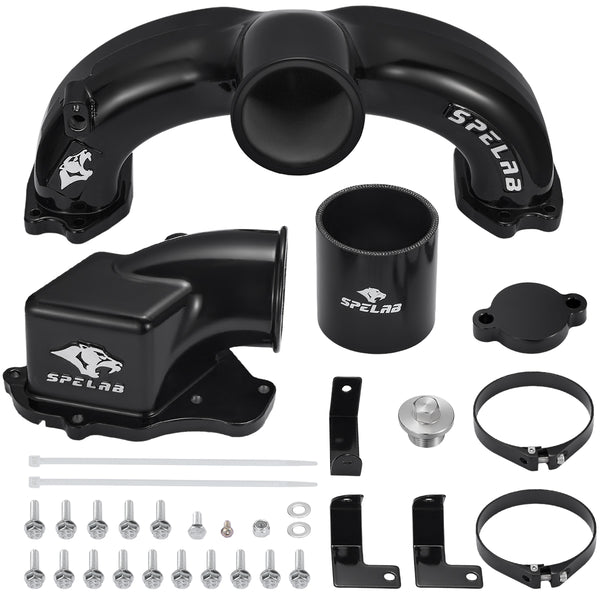
Replace one component for one confirmed failure, and choose a complete bundle only when both parts fail inspection or their combined condition supports the added work.
| Confirmed test result | Correct repair direction | Do not buy automatically |
|---|---|---|
| Manifold body or MAP boss is damaged | Intake manifold | CAC pipe |
| Cold-side tube or crimped joint has failed | Cold-side CAC pipe | Intake manifold |
| Only a boot, seal, or clamp has failed | Correct replacement hardware | Manifold and pipe |
| Manifold and pipe both leak | Matched intake manifold and intercooler pipe bundle | Duplicate single parts |
| Both parts pass the leak test | Continue P0299 diagnosis | Any unconfirmed intake part |
Fitment must be checked by model year, F-250/F-350/F-450/F-550 application, pickup or chassis-cab configuration, sensor location, installed charge-air modifications, pipe diameter, and included sealing hardware. Compare verified Power Stroke intake manifold options only after the leak has been isolated to the manifold.
Frequently Asked Questions
These answers cover the high-intent repair and buying questions owners ask after a 6.7 Power Stroke suddenly loses boost.
Should I upgrade to a metal cold-side CAC pipe?
A metal cold-side CAC pipe is a reasonable reliability upgrade when the 2011–2016 factory plastic tube or crimped connection has failed, shows damage, or supports a towing truck where roadside failure carries a high cost. A metal pipe removes that original failure point but does not prevent leaks from its boots, clamps, seals, or adjoining components.
Does the 2011–2016 6.7 Power Stroke have a documented CAC outlet tube problem?
Ford TSB 19-2143 covers certain 2011–2016 F-Super Duty 6.7L trucks with low power and only P0299 caused by the CAC outlet tube disconnecting at the throttle body or separating at the crimp clamp.
Can a disconnected MAP sensor cause no boost?
A disconnected or missing MAP sensor can eliminate a usable boost reading and disrupt fueling calculations. Check the sensor, connector, O-ring, and mounting boss when the problem begins immediately after intake work.
How do I pressure-test a 6.7 Power Stroke charge-air system?
Use a securely retained, regulated tester and begin at roughly 5 psi to locate major leaks. Increase pressure only within the limit of the lowest-rated component and inspect each joint with soapy water.
Does oil around a CAC boot mean the pipe is leaking?
A light oil film does not confirm a leak, but a directional oil-and-dust trail around one boot often marks escaping charge air. Confirm the source with a regulated pressure test before replacing the pipe.
Should I buy the manifold, cold-side pipe, or complete bundle?
Buy the manifold for a confirmed manifold or MAP-boss failure, buy the cold-side pipe for a confirmed tube or crimp failure, and choose a bundle only when both components are damaged or leaking.
Sources
The cold-side failure description and affected model years are supported by Ford service information and long-running Ford owner discussions.

About the Author
John Lee
Mechanical Engineer | 10+ Years Experience
John has spent the last decade engineering and testing high-performance automotive components. Specializing in drivetrain durability and thermal management across Powerstroke, Cummins, and Duramax applications, he bridges the gap between OEM limitations and aftermarket performance. His philosophy: "Factory parts are just a starting point."