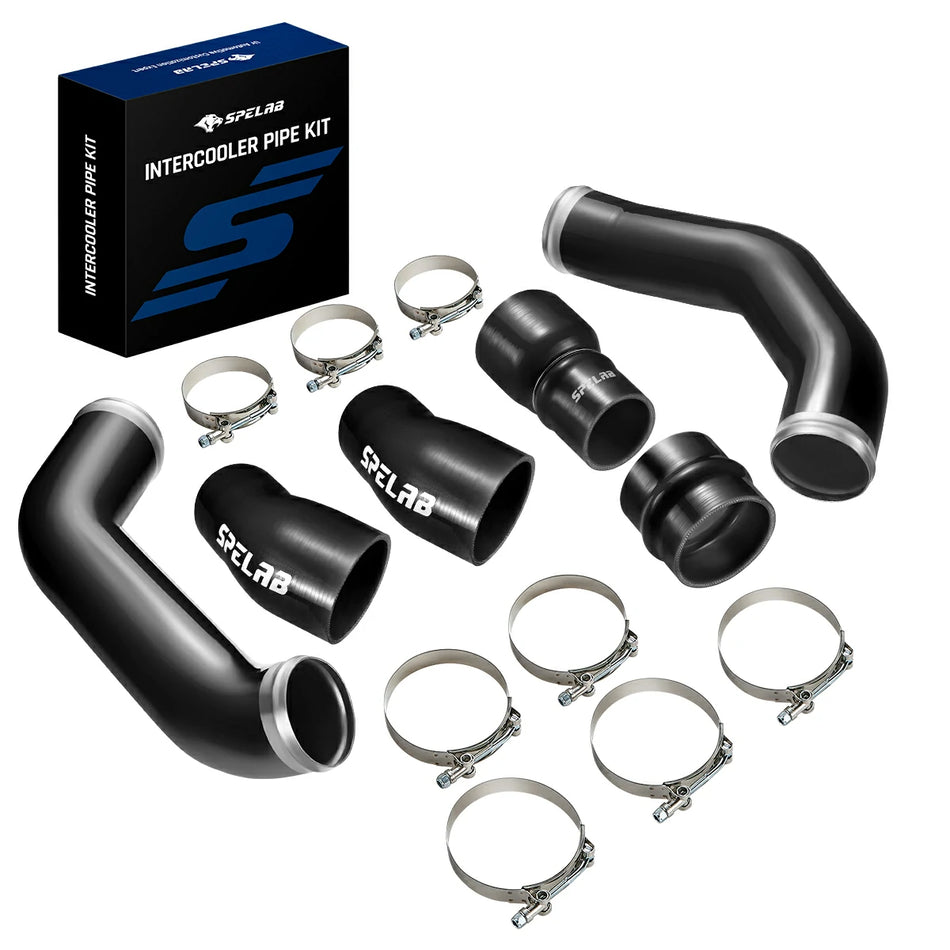
P0299 means the ECM logged actual boost running below commanded boost. It does not name a part. A hissing cold-side boot, a cracked Y-bridge, a stuck wastegate actuator, and a restricted intercooler core can all throw the same code. Guessing at a part before you know the actual cause wastes money and time under the truck. This page gets you sorted into the right diagnosis fast — pull up the section below that matches what you're actually seeing on your truck.
Key Takeaways
Several very different failures can trigger this one code — the fastest fix starts with matching your symptoms, not guessing at parts.
- P0299 reports underboost. It never points to one specific part on its own.
- A steady hiss usually means a slow leak; one loud pop and instant power loss usually means a joint let go.
- Record your symptoms before you touch anything — what you write down now saves a wasted trip back under the truck.
- Oil residue inside a charge pipe is common on a PCV-vented engine and is not proof of a leak by itself.
- If you can't find a leak anywhere in the charge-air path, stop chasing pipes and check the turbo control, sensors, or airflow next.
Record These Three Things Before You Open Any Repair Guide
Write down what the truck is actually doing before you start pulling clamps — every diagnosis path below asks for the same information, and having it ready saves you a second trip under the hood.
How the boost loss shows up. A constant hiss under load points to a slow leak somewhere in the charge-air path. One hard pop followed by an immediate loss of power points to a boot or joint that let go all at once. These are two different repair jobs, and they don't start the same way.
What the truck was doing when it happened. Idle, hard acceleration, a grade under a loaded trailer, or a hot afternoon in stop-and-go traffic — the load and heat at the moment of failure narrow down which part of the system to check first.
What you can see and smell. An oily film, a wet track running down a pipe, a dirty oil-caked clamp, or a scorched smell all point somewhere different. Photograph anything you find before you clean it off. Every guide below asks for this evidence, and you don't get a second look at it once it's wiped down.
Pull the full code list on the scanner too. Whether P0299 is riding alone or showing up with other codes changes which guide below actually fits your truck.

Find the Guide That Matches Your Truck
Match what you found in the pre-check to a row below, then go read the full diagnosis — each guide goes deep on one failure path so this page doesn't have to repeat it. Found nothing at all in the pre-check — no oil, no hiss, no visible damage? Skip straight to the last row; a clean charge-air path usually means the cause sits somewhere else in the system.
| What you're seeing | Read this next |
|---|---|
| Oil inside a charge pipe or on a boot, not sure if it's normal | Why Is There Oil in My Intercooler Pipe? — Duramax owners, see Oil in Duramax Intercooler Pipes |
| Not sure if the leak is on the hot side or the cold side, or which to fix first | Hot-Side vs. Cold-Side Intercooler Pipes: Which Should You Replace First? |
| Boost drops mainly when towing or pulling a grade in hot weather | Diesel Truck Losing Boost in Hot Weather? A Towing Diagnosis Guide |
| Duramax truck, suspect the Y-bridge or a cold-side boot walking off | Duramax Y-Bridge & Cold Side: Why It Cracks, Leaks, and Blows Off |
| Got P0299 right after installing a new pipe or boot | How to Seal Intercooler Pipes — covers the clamp position, alignment, and seating mistakes that cause a fresh install to leak |
| Checked every joint, found no leak — suspect turbo control, a sensor, or restricted airflow | Wastegate and VGT Boost Control: Failure Codes, Diagnosis, and Sizing — includes pressure-testing and sensor checks |
| Found the leak, need to reinstall the pipe and boot correctly this time | How to Seal Intercooler Pipes |

P0299 FAQ
Q: What does P0299 mean, exactly?
A: The ECM commands a target boost pressure and measures what the engine actually makes. P0299 sets when actual boost stays below that target longer than the calibration allows. It's a generic OBD-II code, not brand-specific.
Q: Does P0299 point to one specific part?
A: No. A leaking boot, a cracked pipe, a failed seal, a stuck wastegate actuator, and a dirty MAP sensor can all set the same code. That's why this page routes you to a diagnosis path instead of naming one part to buy.
Q: Is it safe to keep driving with a P0299 code alone?
A: Short trips at reduced power are usually fine to get the truck home or to a bay — but only if that's the only symptom. If you're also getting abnormal turbo noise, heavy smoke, rising coolant or oil temps, or a sudden hard loss of power, stop and don't keep pulling a load. Underboost alone is a reduced-power problem; those other signs mean something is actively getting worse.
Q: What other codes commonly show up alongside P0299?
A: Codes tied to turbo vane position or actuator control point toward the turbo control system rather than a physical leak. Codes tied to MAF or MAP sensor circuits point toward a sensor or wiring issue instead. Check the full code list before you start pulling parts.
Q: Does P0299 always mean a boost leak?
A: No. A charge-air leak is one of the first things worth checking, but it isn't the only cause — a stuck wastegate, a failing VGT actuator, a restricted air filter, or a bad boost sensor can set the same code with every joint sealed tight.
Q: How is P0299 different from P0234?
A: They're opposites. P0234 sets on overboost, when actual pressure runs above target. P0299 sets on underboost, when actual pressure runs below target. Both are generic turbo/boost control codes, not specific to one make.
Confirmed the Leak? Shop Your Platform
Once a guide above has you pointed at a specific pipe, boot, or kit, go straight to your platform's parts.
- GM Duramax: browse the Duramax intercooler pipe collection. LB7 and LLY (2001–2005) owners: there's no standalone pipe kit for these years yet — check the intercooler core upgrades instead.
- Ford Power Stroke: browse the Power Stroke intercooler pipe collection and confirm your engine year before ordering.
- Ram Cummins: browse the Cummins intercooler pipe kit collection, sorted by model year.