A light oil film inside a diesel intercooler pipe can be normal because a closed crankcase ventilation system carries some oil mist back into the turbo inlet. Oil showing up outside a boot, O-ring, or quick-connect usually marks a boost-leak path. Heavy pooling, blue smoke, rising oil consumption, or abnormal crankcase pressure needs diagnosis for a restricted CCV system, excessive blow-by, or a compressor-side turbo oil leak.
Key Takeaways
Oil location, accumulation rate, and accompanying symptoms matter more than finding a single wet spot.
- A thin internal film is common on many closed-CCV diesel trucks and does not prove the turbo is bad.
- Fresh oil outside a charge-air joint often exposes the same path where boost is escaping.
- Pooling oil, blue smoke, fast oil consumption, or high crankcase pressure is not a monitor-and-forget condition.
- Power Stroke, Cummins, and Duramax trucks use different connections, sensors, seals, and diagnostic PIDs.
- Fix the confirmed leak or oil source before buying a full pipe kit, turbocharger, or CCV mod.
| What You Find | Likely Meaning | Risk Level | Next Move |
|---|---|---|---|
| Thin film inside the pipe | Normal CCV carryover may be present | Low if oil use and drivability are stable | Document it and inspect again at the next service |
| Wet boot, O-ring, or clamp outside the pipe | Possible boost leak carrying oil mist through the joint | Moderate | Clean, inspect, and pressure-test the charge-air path |
| Liquid oil collected in the intercooler | Excessive carryover, CCV restriction, blow-by, or turbo leakage | High until the source is identified | Measure what is removed and continue system diagnosis |
| Blue smoke with a falling oil level | Oil may be entering the intake or combustion path at an abnormal rate | High | Stop heavy-duty use and inspect the turbo, CCV system, and engine |

How Does Oil Get Into the Charge-Air System?
Oil normally reaches the charge-air system through CCV vapor entering the turbo inlet, but abnormal oil can also come from a restricted ventilation system, excessive blow-by, an overfilled crankcase, or the compressor side of the turbocharger.
Crankcase -> CCV outlet -> turbo inlet -> compressor -> hot-side pipe -> intercooler -> cold-side pipe -> intakeClosed CCV systems return crankcase gases and suspended oil mist to the intake. The compressor does not create that oil, but it can spread the mist through the hot-side pipe, intercooler, and cold-side plumbing.
Rising accumulation deserves more attention. Excessive blow-by increases the vapor load, while a restricted CCV filter or hose can raise crankcase pressure and push oil toward seals and connections.
A compressor-side turbo oil leak belongs on the list when the turbo inlet is relatively dry but the compressor outlet becomes wet quickly, especially when oil consumption or blue smoke is also present. Do not condemn the turbo from pipe residue alone. Turbo bearing clearance, oil drainage, crankcase pressure, and the amount of oil upstream all affect what the technician sees.
| Possible Source | Typical Evidence | Other Symptoms | How to Check It |
|---|---|---|---|
| Normal CCV carryover | Even, light film through the intake path | Stable oil level and normal boost | Record the condition and monitor accumulation rate |
| Charge-air leak | Oil witness line concentrated at one joint | Hiss, P0299, black smoke, or weak loaded acceleration | Clean the joint and run a regulated pressure or smoke test |
| Restricted CCV system | Increasing oil carryover or leaks around several seals | Elevated crankcase pressure | Inspect the filter, separator, hoses, and pressure against service data |
| Compressor-side turbo leak | Oil increases between the compressor inlet and outlet | Blue smoke or measurable oil consumption may appear | Inspect both sides of the compressor and follow turbo service checks |
| Excessive blow-by | Heavy vapor and oil carryover despite a serviceable CCV path | High crankcase pressure and possible engine wear symptoms | Measure crankcase pressure and continue mechanical diagnosis |

Is Oil Outside the Pipe a Boost Leak?
Oil outside an intercooler pipe often marks a boost leak because pressurized air carries the existing oil mist through a weak boot, O-ring, clamp, end tank, or quick-connect seal.
A small leak may stay quiet around town and open only when the truck is pulling a 5th-wheel, climbing a long grade, or accelerating with a heavy payload. Heat softens the coupler, boost loads the joint, and engine movement pulls the pipe out of its relaxed position. The fresh wet track left behind is more useful than a clean-looking engine bay.
We see the same pattern during parts fitment checks and returned-part inspections: oil frequently identifies the escape route, not its original source. Clean the joint, mark it, and inspect it again after a controlled loaded run.
| Oil Location | Inspect First | Common Failure Pattern |
|---|---|---|
| Turbo outlet | Hot-side boot, clamp, and pipe bead | Heat-hardened or oil-softened coupler, poor clamp position, or pipe misalignment |
| Intercooler inlet or outlet | Coupler, end tank, core seam, and pipe contact points | Split boot, cracked tank, rubbed tube, or loose clamp |
| Cold-side quick-connect | O-ring, retaining clip, flange, and pipe alignment | Flattened seal, partially seated clip, or worn connection |
| Intake or Y-bridge connection | Model-specific seal, boot, clip, and mounting geometry | Seal damage, movement under torque, or an incorrectly seated pipe |
Where Should Power Stroke, Cummins, and Duramax Owners Check First?
Power Stroke, Cummins, and Duramax trucks share the same basic oil-carryover problem, but their pipe materials, connection hardware, CCV layouts, sensors, and common leak points change by engine generation.

| Platform | First Inspection Area | Common Complaint | Evidence That Matters |
|---|---|---|---|
| Ford 6.7L Power Stroke | Cold-side pipe, intake connection, boots, sensor ports, and molded plastic sections where equipped | Loud pop, P0299, black smoke, or immediate loss of towing power | Cracked flange, separated pipe, fresh oil trace, or actual boost below desired boost |
| Ram 5.9L or 6.7L Cummins | Turbo outlet boot, hot-side pipe, intercooler couplers, intake-horn joint, and pre-turbo inlet duct | Boot blow-off, whoosh under throttle, weak grade performance, or intermittent underboost | Oil-wet coupler, heat damage, clamp ahead of the bead, rubbed pipe, or a soft inlet hose |
| GM 6.6L Duramax | Cold-side O-ring and retaining clip where equipped, intercooler boots, hot-side plumbing, and applicable Y-bridge connections | Oil around a joint, P0299, smoke under load, or power fade with a trailer | Flattened O-ring, loose clip, oil witness line, worn coupler, or movement under engine torque |
Why Is There Oil in a Power Stroke Intercooler Pipe?
Oil in a Power Stroke charge pipe usually starts as CCV carryover, while oil outside one connection points the inspection toward the cold-side pipe, boot, flange, or sensor-port seal.
Early 6.7L Power Stroke applications, especially 2011-2016 trucks with factory-style molded plastic cold-side connections, can suffer plastic fatigue and separation during a hot loaded pull. Inspect the MAP and post-cooler charge-air temperature sensor seals and wiring; scan tools may identify the temperature PID as CAC temperature, CACT, or IAT2 depending on model year.
Why Is There Oil in a Cummins Intercooler Pipe?
Oil around a Cummins intercooler boot points the inspection toward CCV service condition, hot-side heat damage, clamp placement, pipe beads, and coupler alignment.
The 5.9L and 6.7L engines span several air-handling configurations, so review MAF only where equipped and use the MAP, load, fueling, and boost data the truck actually supports. Replace a confirmed damaged section with a vehicle-specific 2019-2024 Ram 6.7L Cummins intercooler pipe kit only after checking exact fitment.
Why Is There Oil on a Duramax Cold-Side Pipe?
Oil on a Duramax cold-side connection often acts as a witness mark for a leaking O-ring, retaining clip, quick-connect, coupler, or applicable Y-bridge connection.
LB7 through L5P layouts are not interchangeable, so confirm the engine code and connection style before ordering parts. The Duramax cold-side oil and boost-leak case covers O-ring and retaining-clip inspection in detail. When an LBZ or LMM pipe is cracked rather than merely leaking at the seal, a correctly fitted 2006-2010 LBZ/LMM Duramax cold-side intercooler pipe kit addresses the damaged section.
How Much Oil in an Intercooler Is Too Much?
No universal oil-volume limit works across every diesel truck; accumulation rate, engine-oil consumption, smoke, boost behavior, and crankcase pressure provide a more reliable decision than an unsupported ounce or milliliter cutoff.
Normal Observation
A thin film with stable oil level, normal boost, no blue smoke, and no liquid collecting at the low point can be documented and monitored.
Needs Diagnosis
A boot that becomes wet again after cleaning, oil that can be poured from the intercooler, recurring P0299, or a coupler that repeatedly slips off calls for pressure testing and oil-source checks.
Stop Heavy-Duty Use
Blue smoke, rapidly falling engine-oil level, large amounts of wet oil at the compressor outlet, abnormal turbo noise, or signs that the engine is consuming its own oil are reasons to stop towing and continue diagnosis before another loaded run.
Measure anything removed from the intercooler in milliliters, record the mileage since the last inspection, and note ambient temperature, payload, towing time, and recent oil additions. No validated half-liter rule separates safe from unsafe across every core shape and engine. Oil position and the chance of liquid ingestion matter along with total volume. One truck's measurement is a case record, not a normal limit for every Power Stroke, Cummins, or Duramax.
Does Oil in the Intercooler Mean the Turbo Is Bad?
Oil in the intercooler does not automatically mean the turbo is bad; a turbo becomes a stronger suspect when the inlet is relatively dry, the compressor outlet gets wet quickly, and oil consumption or blue smoke appears with it.
- Verify that the crankcase is not overfilled and that the oil grade and level-check procedure are correct.
- Inspect the CCV separator, filter, and hoses for service condition, restriction, kinks, or incorrect routing.
- Check the turbo inlet before the compressor to see whether oil is already arriving from the CCV path.
- Inspect the compressor outlet and hot-side pipe for a meaningful increase in fresh oil.
- Track oil consumption over known mileage instead of relying on one dipstick reading.
- Check turbo shaft condition, oil drain function, and compressor housing evidence using the correct service procedure.
- Measure crankcase pressure if blow-by or a restricted ventilation path remains possible.
Some radial shaft movement can be present on an unpressurized journal-bearing turbo, and a visual wiggle test alone is not a rebuild verdict. Blade contact, abnormal noise, housing damage, measured clearance outside specification, or confirmed oil leakage carries more weight.
How Do You Diagnose Oil in an Intercooler Pipe?
Diagnose the system in this order: document oil use, locate the wettest point, inspect CCV plumbing, verify every seal and coupler, pressure-test the charge-air path, review supported scan data, and measure crankcase pressure when needed.
- Record the oil level. Note recent additions, mileage, smoke, and whether the symptom appeared during towing, off-roading, high idle, or normal commuting.
- Photograph the oil trail. Keep the wettest joint and the direction of the witness line visible before cleaning.
- Inspect the turbo inlet and CCV entry point. Determine whether oil is entering before the compressor.
- Clean and mark the suspect connection. Recheck after a controlled load to find fresh leakage.
- Inspect the hardware. Check boot condition, O-ring shape, retaining clips, pipe beads, clamps, end tanks, sensor seals, and pipe alignment.
- Run a regulated pressure or smoke test. Follow the vehicle procedure and the lowest-rated component in the test setup.
- Review live data. Compare desired or commanded boost with actual boost where supported; review MAP, BARO, charge-air temperature, load, and MAF where equipped.
- Measure crankcase pressure. Use a suitable manometer and compare the result in inches of water, or in. H2O, with the correct OEM service specification.
- Remove the intercooler only when evidence supports it. Measure recovered oil and inspect the cooling stack while access is open.
Can You Drive With Oil in the Intercooler Pipe?
A truck with only a light oil film, stable oil level, normal boost, and no smoke can usually be monitored, but a truck with external leakage, P0299, black or blue smoke, liquid oil, or falling oil level should not keep towing or hauling until the cause is known.
- Monitor: A light internal film with stable oil level, normal boost, and no smoke can be documented and rechecked at service.
- Limit use: Fresh oil outside a joint, P0299, black smoke, or weak boost calls for inspection and pressure testing before towing.
- Stop driving: Blue smoke, fast oil consumption, liquid pooling, or possible engine runaway requires diagnosis before the engine is loaded or restarted.
Should You Clean Oil Out of the Intercooler?
Clean the intercooler when liquid oil or heavy contamination is confirmed, but do not tear apart a sealed, dry-running system just to remove a harmless surface film.
Wipe and repair an external joint when the problem is limited to a boot, O-ring, or clamp. Remove the intercooler when liquid oil has collected at a low point, the core contains heavy sludge, foreign material entered the system, or a turbo failure sent oil downstream.
Use a manufacturer-approved aluminum-safe, non-caustic, low-residue degreaser. High-purity isopropyl alcohol may be suitable only when the core manufacturer allows it; IPA is flammable and must stay away from heat, sparks, and ignition sources. Do not use sodium-hydroxide cleaner, aggressive alkaline wash, or an unverified chlorinated solvent on an aluminum brazed core. Drain the core, rinse it when the approved cleaner requires rinsing, allow it to dry completely, and keep lint, shop towels, and loose debris out of the charge path.
Cleaning without repairing the CCV, turbo, blow-by, or boost-leak source guarantees another dirty job later.
Will a Catch Can or CCV Reroute Stop Intercooler Oil?
A well-designed catch can or closed CCV solution may reduce oil mist, but it cannot repair worn piston rings, a restricted crankcase path, a leaking turbo, or a charge-air joint that will not hold pressure. A vehicle-specific 2011-2025 Ford 6.7L Power Stroke CCV reroute kit should be considered only after crankcase pressure, road-use requirements, and exact fitment have been checked.
Compare stock filtration, catch cans, closed reroutes, and open vents by flow capacity, maintenance, condensation control, odor, and road-use requirements. The guide to diesel CCV filters, catch cans, and reroute options covers those tradeoffs without turning this oil-diagnosis page into a second CCV article.
Should You Replace the Seal, Pipe, CCV Part, Turbo, or Engine Component?
Replace the part proven faulty: seal a leaking joint, service a restricted CCV path, replace a cracked pipe, diagnose a wet compressor, or continue engine testing when crankcase pressure remains excessive.
- Leaking boot or misplaced clamp: Clean and align the joint, then replace damaged coupler or hardware. This does not correct turbo leakage or excessive blow-by.
- Flattened O-ring or weak retaining clip: Install the correct seal and mechanical retainer. A new seal cannot rescue a cracked quick-connect flange.
- Cracked plastic or rubbed metal pipe: Replace the model-specific pipe and correct the alignment. Pipe replacement does not stop oil entering from the CCV system.
- Restricted CCV filter or hose: Restore the factory-specified ventilation path. CCV service does not repair worn rings or damaged turbo hardware.
- Confirmed compressor-side turbo oil leak: Repair or replace the turbo and clean the downstream system as required. Check crankcase pressure before assuming the turbo was the only cause.
- Crankcase pressure remains above specification: Continue blow-by and mechanical engine diagnosis instead of hiding the symptom with a catch can.
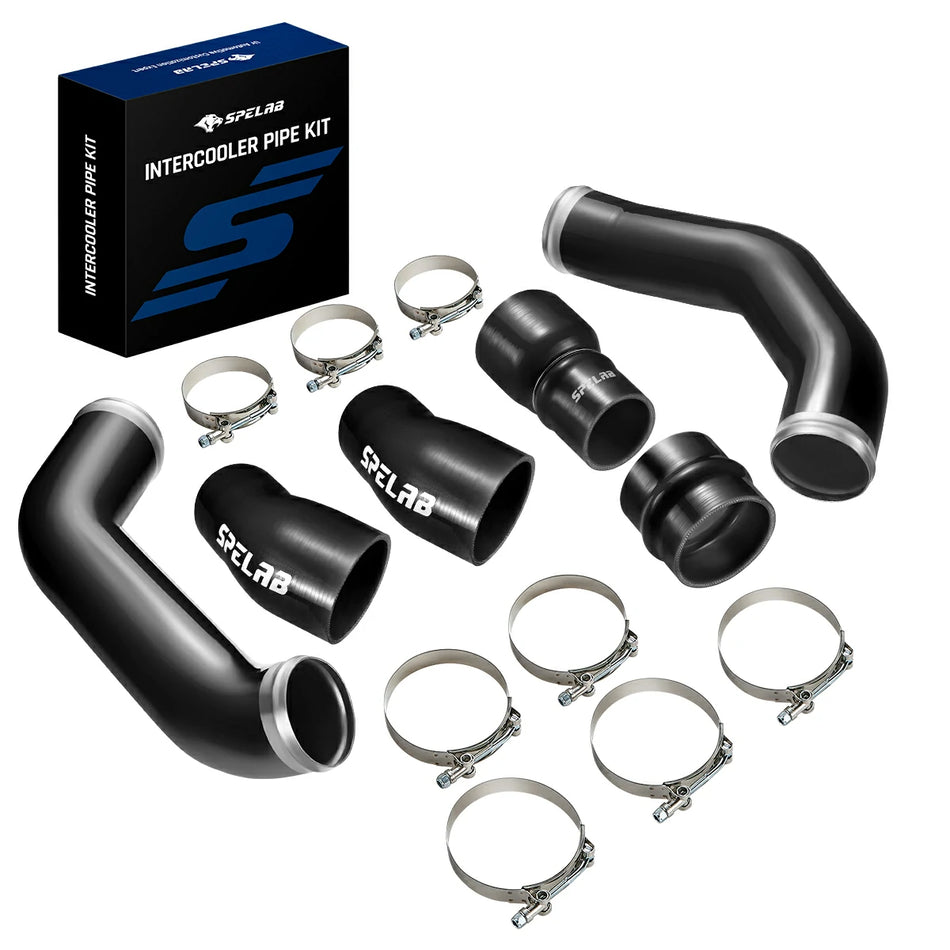
We have found in component fitment and leak checks that a rigid aluminum pipe is useful when a molded plastic section is cracked or repeatedly distorts, while reinforced silicone is useful where engine movement must be absorbed. Neither material rescues poor fitment. Compare vehicle-specific intercooler pipe kits for Power Stroke, Cummins, and Duramax only after matching model year, engine code, sensor provision, emissions configuration, connection style, and surrounding clearance.
What Data Should Be Recorded Before Calling the Oil Normal?
Record the truck, engine, operating conditions, oil quantity, boost behavior, and test method because one vehicle's result cannot become a universal limit for every diesel platform.
- Model year, engine code, mileage, and stock or modified status
- Recent towing, payload, ambient temperature, idle time, and trip length
- Oil level over a known mileage interval and oil recovered from the intercooler
- Desired versus actual boost and supported MAP, BARO, temperature, load, or MAF data
- Crankcase pressure, pressure-test setup, confirmed leak location, and repair performed
A 200,000-mile tuned tow rig cannot establish the normal oil limit for a stock low-mileage daily driver. Label field observations as field observations and keep the operating conditions with the measurement.
Frequently Asked Questions
These answers cover the short questions owners ask after finding oil in a diesel charge-air system.
Q: Is a little oil in a diesel intercooler normal?
A: A light internal film can be normal on a closed-CCV diesel when oil consumption, boost, smoke, and crankcase pressure remain normal. Liquid pooling or fast accumulation needs diagnosis.
Q: Can a boost leak push oil out of an intercooler pipe?
A: Yes. Pressurized charge air can carry existing CCV oil mist through a weak boot, O-ring, clamp, end tank, or quick-connect and leave a wet witness line outside.
Q: Does oil in the intercooler always mean a bad turbo?
A: No. CCV carryover is common. A turbo becomes more likely when oil increases across the compressor and appears with blue smoke, oil consumption, abnormal noise, or failed service checks.
Q: Can oil in the intercooler cause P0299?
A: Oil by itself usually does not set P0299, but the boost leak marked by that oil, a damaged charge pipe, a restricted intake, or a turbo-control problem can leave actual boost below the commanded value.
Q: Why does an oily intercooler boot keep blowing off?
A: Oil reduces grip, but repeated blow-off also points to poor alignment, a damaged pipe bead, wrong boot size, weak clamp placement, engine movement, or pressure spikes. Clean and correct the joint instead of only tightening harder.
Q: Can too much oil in the intercooler cause engine runaway?
A: Liquid oil entering a diesel intake can become an uncontrolled fuel source. A light film is not the same condition, and there is no universal 0.5-liter threshold. Confirmed pooling, blue smoke, or a rapidly falling oil level should be handled before restarting or loading the engine.
Q: Should I drill a drain hole in the intercooler?
A: No. Drilling the core creates a boost-leak and structural risk. Remove and service the intercooler correctly when drainage or cleaning is required, then repair the source of the oil.

About the Author
John Lee
Mechanical Engineer | 10+ Years Experience
John has spent the last decade engineering and testing high-performance automotive components. Specializing in drivetrain durability and thermal management across Powerstroke, Cummins, and Duramax applications, he bridges the gap between OEM limitations and aftermarket performance. His philosophy: "Factory parts are just a starting point."