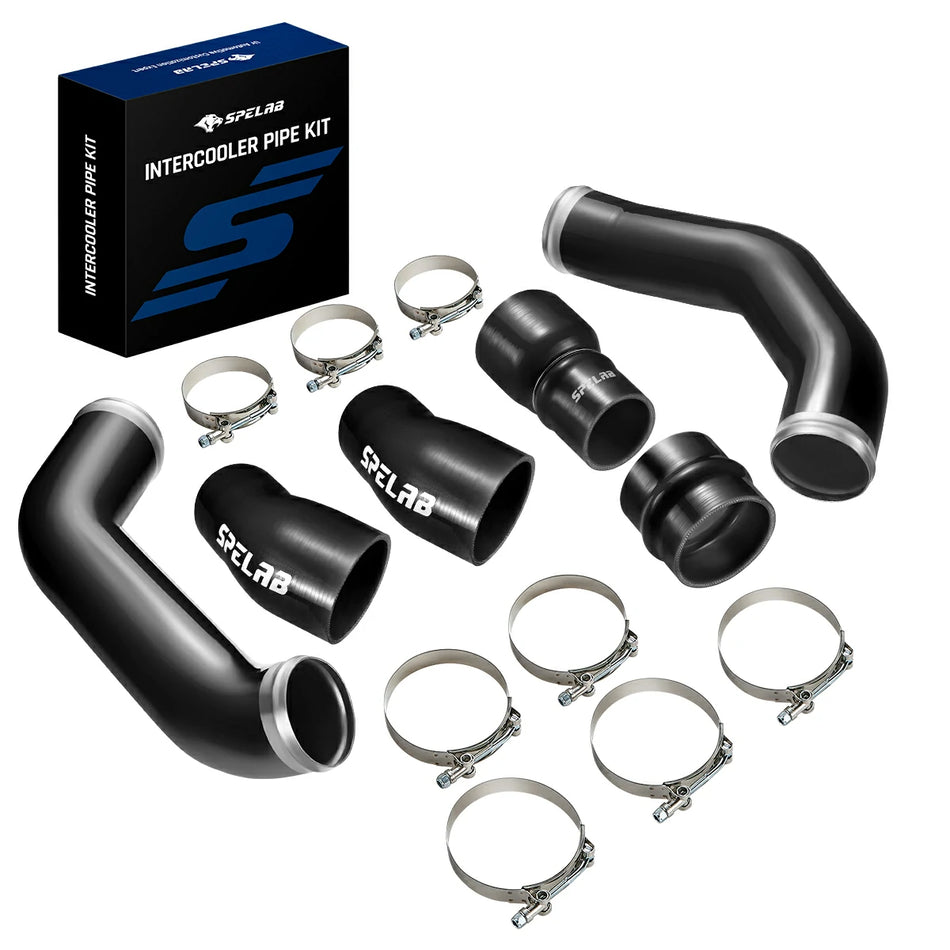
Should You Replace the Hot-Side Pipe, Cold-Side Pipe, or Both?
The hot-side intercooler pipe carries compressed air from the turbo outlet to the intercooler inlet, while the cold-side pipe carries cooled charge air from the intercooler outlet to the engine intake. Replace the side that fails inspection or a controlled leak test. Do not order both sides just because the truck sets P0299 or leaves oil around one connection. Hot-side trouble usually follows heat-cycled boots, clamp movement, or a damaged rigid pipe. Cold-side trouble depends more on the platform and may involve a cracked molded pipe, flattened O-ring, loose retaining clip, or failed quick-connect.
Key Takeaways
Match the repair to the failed connection, the truck's exact engine generation, and the way it works under load.
- The hot side runs hotter, but the cold side can still fail under full boost pressure.
- A P0299 code does not identify which pipe is leaking and does not prove the intercooler core is bad.
- Oil outside a pressurized joint is an inspection clue, not automatic proof of turbo failure.
- A full hot-and-cold-side refresh makes more sense when both assemblies are aged, modified, or repeatedly moving under Towing load.
- Power Stroke, Cummins, and Duramax trucks use different joints, sensors, and pipe layouts, so Fitment must be checked by year and engine.
Hot-Side vs. Cold-Side Intercooler Pipe Comparison
Pipe location changes the heat load, hardware, failure pattern, and first inspection point even though both sides belong to the same pressurized charge-air system.
| Inspection Point | Hot Side | Cold Side |
|---|---|---|
| Airflow route | Turbo outlet to intercooler inlet | Intercooler outlet to intake manifold, intake elbow, or Y-bridge area |
| Air condition | Hotter air immediately after compression | Cooler air after heat rejection through the intercooler |
| Main stress | Heat, pressure pulses, oil mist, vibration, and engine movement | Boost pressure, joint alignment, engine movement, and quick-connect or seal integrity |
| Common hardware | Rigid pipe, silicone boots, pipe beads, and clamps | Rigid or molded pipe, boots, clamps, O-rings, CNC flanges, and retaining clips depending on platform |
| Common failure evidence | Heat-hardened boot, oily clamp track, split hose, rubbed pipe, or pipe blow-off | Cracked plastic, flattened O-ring, incomplete clip engagement, loose adapter, or oily witness line |
| Driver complaint | Pop under load, sudden smoke, lost towing power, or hiss near the turbo side | P0299, lazy response, intermittent boost loss, oil outside a lower joint, or reduced-power operation |
| First check | Turbo outlet, boot engagement, clamp position, and intercooler inlet | Intercooler outlet, pipe seam, O-ring or clip, intake connection, and nearby clearance |
Temperature alone does not decide which side should be upgraded first. A 5th-wheel truck can cook a hot-side boot on a long grade, while a daily-driven truck can split a cold-side molded connection during one hard merge. Inspect the evidence on the truck instead of assuming the hotter pipe is always the weak one.

Which Side Is Leaking?
Oil tracks, joint movement, break location, and pressure-test results identify the leaking side more reliably than sound or a trouble code.
| What You Find | Check First | How to Verify It | Do Not Assume |
|---|---|---|---|
| Oil mist around the turbo-outlet boot | Hot-side boot, clamp, bead, and pipe alignment | Clean the joint, mark the boot and clamp, then perform a regulated leak test | The turbo is automatically bad |
| Oil outside the intercooler outlet or intake connection | Cold-side seal, quick-connect, pipe seam, or boot | Inspect the O-ring or clip where equipped and trace the clean oil witness line | A light internal oil film caused the pipe to crack |
| Sharp pop followed by black smoke and low power | Both sides for a blown boot, separated connection, or split molded pipe | Perform a visual inspection before restarting a loaded pull | The intercooler core failed |
| P0299 with no visible separation | Entire charge-air path, sensors, intake restriction, and turbo control | Compare commanded or desired boost with actual boost under a repeatable load | A larger pipe will clear the code |
| IAT2 or charge-air temperature keeps climbing while pressure holds | Intercooler airflow, core condition, and cooling-stack debris | Log temperature through the same grade, Payload, gear, and ambient condition | Larger pipes will correct heat soak |
Sound can fool you in a noisy diesel cab. A small seal can open only when boost, Payload, and engine roll rise together. A clean oil line around a pressurized joint often marks the exit point even without an obvious hiss.
Where Should Power Stroke, Cummins, and Duramax Owners Check First?
Each platform puts different materials and connection styles in the charge-air path, so the best first inspection point changes by engine generation.

Ford Power Stroke
Power Stroke owners should identify the engine and model year before using a 6.7L cold-side failure pattern to diagnose a 6.0L or 6.4L truck.
Check boots, clamps, end-tank connections, and pipe contact points on 2003-2007 6.0L and 2008-2010 6.4L trucks. Inspect the molded cold-side connection and quick-connect area early on a 2011-2016 6.7L with sudden boost loss, P0299, or black smoke. Read the post-intercooler temperature PID as IAT2, CACT, or the scanner's equivalent label, not the pre-turbo IAT reading.
Verify later 6.7L Fitment by configuration when selecting a 2011-2025 6.7L Power Stroke intercooler pipe kit. Current SPELAB records separate 2023-2025 Standard Output and High Output hot-side applications.
Ram Cummins
Cummins owners should separate a pre-turbo inlet restriction from a hot-side or cold-side boost leak before ordering charge-air parts.
Inspect heat-cycled hot-side boots, then check cold-side couplers for movement. Log MAP and boost response, and log MAF only where equipped; many 5.9L applications do not provide the same MAF stream as later 6.7L calibrations.
Check cab-and-chassis and modified intake-horn routing separately. A 2013-2018 6.7L Cummins intercooler pipe kit does not establish Fitment for an early 5.9L or 2019-up truck.
GM Duramax
Duramax owners should treat the engine code as part of the part number because LB7, LLY, LBZ, LMM, LML, and L5P charge-air layouts are not one interchangeable system.
Inspect quick-connect seating, O-rings, retaining clips, molded sections, and Y-bridge Fitment where used. A wet LBZ/LMM cold-side joint may point to a flattened O-ring or clip problem, while a heat-cycled turbo-outlet boot directs attention to the hot side. Do not copy one generation's Y-bridge or seal layout to another.
| Platform | Application Window | Priority Inspection | Hardware to Identify | Best First Move |
|---|---|---|---|---|
| 6.0L / 6.4L Power Stroke | 2003-2007 / 2008-2010 | Boots, clamps, pipe joints, and core connections | Rigid pipes, silicone boots, beads, clamps, and end tanks | Pressure-test; replace the failed connection |
| 6.7L Power Stroke | 2011-2016; later trucks require configuration-specific Fitment | Cold-side molded or quick-connect area, then both sides | Plastic or aluminum sections, quick-connect flange, clip, boots, and T-bolt clamps | Replace the failed side; verify output configuration |
| 5.9L / 6.7L Cummins | Year-specific Dodge and Ram applications | Hot-side heat exposure, cold-side coupler movement, and pre-turbo inlet condition | Boots, rigid tubes, constant-tension or application-specific clamps | Separate inlet restriction from a boost leak, then repair the proven side |
| Duramax | LB7 through L5P, matched by engine code | O-rings, clips, boots, hot-side joints, and Y-bridge where used | Generation-specific quick-connects, retaining clips, boots, and pipe sections | Order by engine code and leak location |
Should You Replace One Side or Buy a Full Intercooler Pipe Kit?
Replace one side when one failure is proven; refresh both sides when condition, labor overlap, modifications, and Heavy-duty use show that the rest of the plumbing is close behind.
| Inspection Result | Best Choice | Why | What It Will Not Fix |
|---|---|---|---|
| One cut O-ring, torn boot, cracked pipe, or damaged flange | Repair or replace that side | Keeps sound hardware in service and controls cost | A leak in the opposite side or core |
| Both sides show hardened boots, corrosion, rub marks, or repeated movement | Matched hot-and-cold-side kit | Refreshes related pipes, couplers, and clamps during one service window | Turbo-control or sensor faults |
| Tuned tow rig repeatedly pushes boots or cracks old molded plumbing | Pressure-test, then consider a complete pipe refresh | Removes multiple aged weak points before the next loaded pull | Excessive crankcase pressure or a bad engine mount |
| Intercooler core or end tank fails the leak test | Repair or replace the intercooler | The failed pressure boundary is the core, not the pipes | Pipe leakage elsewhere |
| IAT rises during a sustained grade but the system holds pressure | Inspect airflow and intercooler heat rejection | Targets heat soak instead of replacing sealed plumbing | Cooling-stack blockage or poor fan airflow |
Labor changes the math. Replace both sides when access overlaps and every boot shows the same aging. A full kit rarely makes sense for one fresh O-ring on an otherwise sound daily driver.

Run This 10-Minute Inspection Before Ordering Parts
A short visual and scan-data check can separate a failed pipe connection from an intercooler, turbo-control, sensor, or inlet problem before money leaves the account.
- Record the evidence. Photograph oil tracks, clamp positions, boot depth, and the lowest wet point before cleaning.
- Check both sides by hand. Look for cracks, soft spots, hardened silicone, polished rub marks, missing pipe-bead engagement, and loose adapters.
- Inspect platform-specific seals. Remove and examine O-rings and retaining clips only where the service procedure and joint design call for them.
- Read codes before clearing them. Save P0299 and related MAP, MAF where equipped, turbo-control, and temperature data.
- Compare requested and delivered boost. Log Commanded or Desired Boost against Actual Boost when supported. If the scanner reports MAP as absolute pressure, account for BARO before treating the number as gauge boost.
- Use a regulated charge-air leak test. Follow the engine-specific service limit, restrain the test caps, and never apply unregulated shop air to the system.
- Check the intercooler separately. Inspect core damage, end-tank seams, cooling-stack debris, and oil escaping away from a pipe joint.
- Verify Fitment before checkout. Match VIN, engine code, model year, cab-and-chassis status, Standard Output or High Output configuration where applicable, and existing Mods.
What Upgraded Intercooler Pipes Can and Cannot Fix
A correctly fitted rigid pipe and quality coupler can restore a durable pressure path, but pipe diameter and polished aluminum do not repair a leaking core, worn turbo, bad sensor, or high crankcase pressure.
At SPELAB, our fitment checks and support cases point to one rule: material specifications matter only after the failed side and exact application are identified. Aluminum that fits the wrong generation is still the wrong part.
| Application Example | Verified Pipe or Coupler Detail | Fitment Boundary | Practical Meaning |
|---|---|---|---|
| 2011-2016 6.7L Power Stroke hot side | 3-inch lower and 3.5-inch upper mandrel-bent 6061 aluminum sections; triple-reinforced silicone; T-bolt clamps | Do not apply these dimensions to every later hot-side configuration | Check both pipe diameter transitions and engine configuration before ordering |
| 2013-2018 Ram 2500/3500 6.7L Cummins pipe kit | 3.5-inch listed diameter; 4-ply and 5-ply silicone; spring-loaded constant-tension clamps | Not a blanket Fitment statement for 5.9L or 2019-up trucks | Coupler construction and clamp style must match the intended kit |
| 2006-2010 LBZ/LMM Duramax cold side | 3.5-inch mandrel-bent 6061 aluminum; triple-reinforced silicone; T-bolt clamps | Limited to the listed LBZ/LMM application, not every 6.6L Duramax | Engine code and connection layout control the purchase |
| 2011-2016 LML Duramax intercooler pipe kit | Mandrel-bent aluminum and triple-reinforced silicone listed for the LML kit | Separate from LBZ/LMM and L5P plumbing | Shared displacement does not create shared Fitment |
Repeat the same tune, gear, Payload, grade, ambient condition, and RPM range before claiming a change. A repaired leak can restore lost response; it does not prove a fixed horsepower gain from the pipe alone.
How the Decision Changes in Real Truck Use
Towing, Jobsite idle hours, tuning, mileage, Off-roading, and winter operation expose different weak points, so the right repair depends on how the truck earns its keep.
- Fifth-wheel tow rig: A boot that stays put unloaded may move when a long grade adds heat, boost, and engine roll.
- 6.7L Power Stroke work truck: A pop, smoke, and P0299 call for an early-layout cold-side check followed by a full charge-air inspection.
- High-mileage Duramax: Oil outside a cold-side quick-connect can mark an O-ring or clip problem even when the driver never hears a hiss around town.
- Tuned Cummins: Repeated coupler movement calls for checks of both sides and engine movement before adding clamp torque.
- Jobsite or off-road truck: Idle hours, oil vapor, dust, chassis movement, and rubbing can expose a weak joint without proving a rigid pipe is cracked.
- Cold-weather truck: Hardened elastomers and freeze-thaw cycles can expose a marginal seal.
How to Keep the Diagnosis and Performance Claims Honest
Use controlled before-and-after evidence for the truck in front of you, and treat product dimensions or one owner's failure as application-specific data rather than a universal rule.
- Record engine code, model year, mileage, tune, tire size, Payload, ambient temperature, and road grade.
- Save Commanded or Desired Boost, Actual Boost or MAP, BARO, RPM, engine load, VGT command or position, and MAF where equipped.
- Mark boots and clamps before the road test so movement can be seen after a full heat cycle.
- Repeat the same safe operating condition after repair instead of comparing two unrelated hard pulls.
- Report a restored seal as a restored seal unless a controlled dyno or repeatable log supports a broader performance claim.
Manufacturer product records verify the dimensions and materials listed in this article. They do not establish a universal failure rate, temperature reduction, pressure-drop percentage, or horsepower gain across the Big 3.
Hot-Side and Cold-Side Intercooler Pipe FAQ
These short answers cover the decisions owners usually need to make before buying a single pipe, a full kit, or an intercooler core.
Q: Is the hot-side intercooler pipe hotter than the cold side?
A: Yes. The hot side receives compressed air directly from the turbo, while the cold side carries air after it passes through the intercooler. Both sides remain pressurized and both can leak.
Q: Which intercooler pipe fails more often?
A: No single side fails most often across every diesel truck. Generation, connection design, mileage, heat, tuning, and Payload determine the weak point.
Q: Should I replace both intercooler pipes if only one is leaking?
A: Replace the failed side when the opposite assembly passes inspection. Replace both when both are aged, damaged, or repeatedly moving.
Q: Can a cold-side pipe leak cause P0299?
A: Yes. A cold-side leak can keep actual boost below the commanded value, but P0299 can also come from the hot side, intercooler core, intake restriction, sensors, exhaust leaks, or turbo control.
Q: Does oil around an intercooler pipe show where the boost leak is?
A: Oil outside a pressurized joint is a useful witness mark because charge air can push CCV oil mist through a weak seal. It does not prove the turbo is bad.
Q: Do upgraded intercooler pipes add horsepower?
A: Upgraded pipes can restore boost lost through a cracked or leaking factory section and may improve durability. They do not guarantee a fixed horsepower gain on a sealed stock truck.
Q: Do I need a tune after replacing an intercooler pipe?
A: A correct-fit Bolt-on replacement normally does not require tuning by itself. Existing calibration still changes boost targets and data interpretation, so verify the selected part against the exact truck and tune.
Final Decision Path
Find the failed pressure boundary, match the part to the exact platform, and replace only as much hardware as the inspection and work cycle justify.
- Locate the leak with visual evidence, scan data, and a controlled pressure test.
- Choose a seal, boot, single pipe, full intercooler pipe kit, or intercooler core based on the confirmed failure.
- Verify engine code, model year, configuration, and existing Mods before calling any pipe Bolt-on.