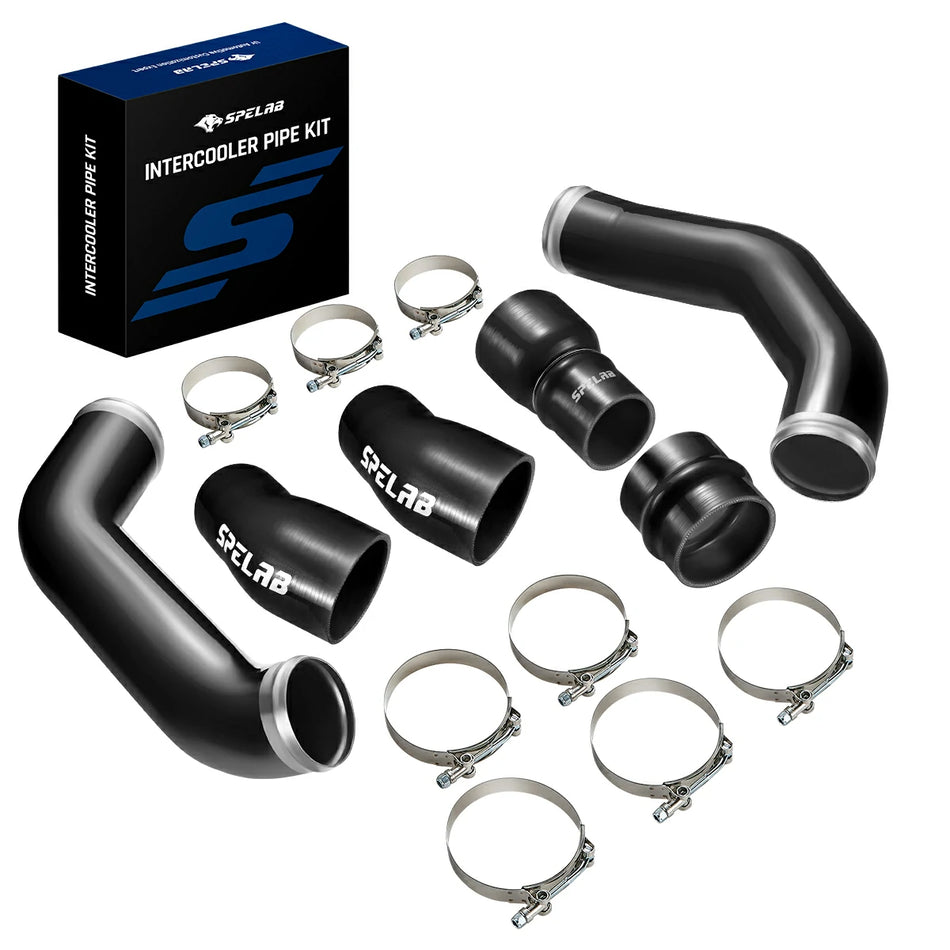
A 6.7 Powerstroke needs an intercooler pipe upgrade when a pressure test finds a leak, a plastic connection cracks, a boot loses its grip, or a pipe repeatedly comes loose under load. A healthy stock truck does not need aluminum charge pipes just because somebody on social media called them mandatory. Find the failed side first, verify the model year and connection geometry, then buy the part that fixes that leak.
Key Takeaways
Most owners should inspect and pressure-test the charge-air system before replacing either pipe.
- A P0299 underboost code can point toward a boost leak, but it does not prove an intercooler pipe is cracked.
- 2011-2016 trucks have different hot-side and cold-side options; the leak location decides which one belongs in the cart.
- The current product range covered here includes a 2017-2024 cold-side kit, but no supplied 2017-2024 hot-side product.
- A rigid aluminum pipe can remove a failure-prone plastic section, but it cannot repair a damaged turbo, CAC core, sensor, or calibration.
- Use the exact kit or clamp maker's torque value; no single T-bolt clamp torque applies to every size and coupler.
6.7 Powerstroke Intercooler Pipe Fitment by Year
Order by model year, pipe location, selected variant, and physical connection style, not by the words "6.7 Powerstroke" alone.
| Truck Application | Pipe Location | Verified Product Path | SKU | Fitment Action |
|---|---|---|---|---|
| 2011-2016 Ford F-250, F-350, F-450 6.7L | Cold side | 2011-2016 6.7 Powerstroke cold-side intercooler pipe | SPIS26004 | Select the "Cold Side (2011-2016)" variant on the combined product page. |
| 2011-2016 Ford F-250, F-350, F-450 6.7L | Hot side | 2011-2016 6.7 Powerstroke hot-side pipe kit | SPIS08110 | Use the dedicated hot-side page and verify every supplied connection before installation. |
| 2017-2024 Ford F-250, F-350, F-450 6.7L | Cold side | 2017-2024 6.7 Powerstroke cold-side pipe kit | SPIS08836 | Do not substitute the 2011-2016 cold-side configuration. |
| 2017-2024 Ford 6.7L | Hot side | No supplied product in this guide | - | Identify the failed assembly and locate a physically verified application. |
| 2025 and newer Ford 6.7L | Hot or cold side | Requires separate confirmation | - | Do not infer Fitment from a combined page title or engine displacement. |
2011-2014 Trucks
Use the 2011-2016 product family only after confirming whether the leak is on the hot side or cold side.
Check the quick-connect geometry, couplers, brackets, and original pipe routing. An early truck with swapped intake or CAC hardware needs a physical comparison before parts are ordered.
2015-2016 Trucks
These trucks remain inside the supplied 2011-2016 hot-side and cold-side product ranges, but the side and SKU still have to match.
Do not extend that compatibility into 2017 just because the engine displacement stayed at 6.7 liters. The Super Duty platform and charge-air hardware changed.
2017-2019 Trucks
The supplied product path covers the cold side through SPIS08836; this guide does not assign the 2011-2016 hot-side pipe to these trucks.
Inspect the complete cold-side route and compare the flange, boots, brackets, and pipe clearance with the kit before removing the original hardware.
2020-2022 Trucks
The supplied 2017-2024 cold-side page includes these model years, but the truck's exact Pickup or Chassis Cab configuration still controls Fitment.
Confirm engine-output configuration, connection locations, and adjacent cooling hardware rather than treating the page year range as a substitute for inspection.
2023-2024 Trucks
The supplied cold-side page lists these years, while high-output and standard-output engine hardware make configuration checks more important.
Verify the selected kit against the VIN-built truck and actual pipe connection. This guide does not assign a supplied hot-side product to either output version.
2025 and Newer Trucks
No product supplied for this article should be presented as a confirmed 2025-and-newer Bolt-on application.
A combined product-page title or a broad variant label is not enough evidence. Confirm the exact SKU and physical interfaces before publishing or ordering a newer-truck recommendation.
Pickup and Chassis Cab hardware can differ even when the hood badge looks the same. Check the VIN-built configuration, pipe routing, quick-connect flange, sensor ports, brackets, and clearance around cooling lines. As a parts manufacturer, we see wrong orders start with a year-range assumption more often than with a complicated mechanical problem.

Hot-Side vs Cold-Side Pipe: Find the Failed Half
The hot side carries compressed air from the turbo toward the charge air cooler, while the cold side carries cooled charge air from the CAC toward the intake.
Charge-air path: Turbo compressor outlet → hot-side pipe → charge air cooler → cold-side pipe → intake.
| Inspection Point | Hot Side | Cold Side |
|---|---|---|
| Heat exposure | Higher compressor-outlet and engine-bay heat | Lower charge temperature after the CAC, but still under boost and vibration |
| Common inspection area | Turbo outlet, couplers, clamp position, pipe rub points | Quick-connect flange, intake connection, boots, sensor or adapter area |
| Visible clue | Heat-aged coupler, shifted clamp, fresh oil mist at a joint | Cracked plastic, loose retaining connection, oil track near the intake side |
| Correct next move | Pressure-test and repair the hot-side leak | Pressure-test and repair the cold-side leak |
Oil film alone does not condemn a pipe. Turbo-diesel charge plumbing often carries a light oil haze. Clean the joint, load the truck under controlled conditions, and look for a fresh wet track, movement, or bubbles during a proper leak test.

Diagnose the Leak Before Buying a Pipe
P0299, black smoke, lazy throttle response, or a hiss under load starts a charge-air inspection; none of those symptoms identifies the failed part by itself.
| Symptom or Finding | What It May Mean | First Check | Do Not Assume |
|---|---|---|---|
| P0299 underboost | Charge-air leak, turbo control problem, sensor error, airflow restriction, or calibration issue | Freeze-frame data, commanded versus actual boost, and CAC pressure test | The cold-side pipe is automatically bad |
| Hiss or whoosh under load | Boot, clamp, pipe, flange, sensor port, or CAC leak | Inspect every pressurized joint | The turbocharger has failed |
| Black smoke with weak pull | Fuel delivery is exceeding the air actually reaching the cylinders | Charge-air sealing, air filter restriction, and scan data | More fueling will fix the truck |
| Fresh oil at one connection | Escaping charge air may be carrying oil mist through a loose joint | Clean, pressure-test, and inspect the pipe bead and boot | The CAC core is leaking internally |
| Sudden limp mode during Towing | A connection may have separated, or the control system detected underboost | Stop the pull, scan the truck, and inspect both sides | It is safe to keep loading the engine |
- Read all powertrain codes before clearing anything.
- Save freeze-frame data and compare commanded boost with actual boost.
- Inspect boots, clamps, retaining clips, sensor ports, brackets, and pipe rub points.
- Clean oily joints so a fresh leak leaves a readable track.
- Pressure-test the CAC system using the model-year service procedure and appropriate regulated equipment.
- Rule out a restricted air filter, damaged CAC core, turbo actuator problem, biased MAP/IAT reading, and calibration fault.
Ford's OBD documentation describes P0299 as an underboost monitor, not a parts verdict. Review the applicable Ford OBD System Operation document alongside the exact service information for the truck.

Will an Intercooler Pipe Add Horsepower or Lower EGT?
A pipe upgrade does not have one honest horsepower, EGT, or fuel-economy gain that applies to every 6.7 Powerstroke.
A leaking stock pipe can lose boost and make the truck smoke, downshift, or feel flat with a trailer. Replacing that failed section may restore the power and response the truck already had. A healthy stock system may show little measurable change from pipe material alone.
Controlled testing matters because ambient temperature, altitude, trailer weight, road grade, vehicle speed, turbo calibration, DPF regeneration, and sensor location all move the result. Record the same truck on the same route with the same Payload before and after the Mod.
| Test Variable | Baseline | After Repair or Upgrade |
|---|---|---|
| Ambient temperature and altitude | Record exact conditions | Match as closely as practical |
| Trailer weight and road grade | Document load and route | Repeat the same load and route |
| Commanded versus actual boost | Log under steady load | Compare the same RPM and gear |
| CAC outlet temperature | Record rise and recovery | Compare recovery after the pull |
| EGT and engine load | Log without active regeneration | Repeat without active regeneration |
| Pressure-test result | Record leak location or decay | Confirm the repaired system holds |
Ford's 2023 6.7L training material describes a separate low-temperature cooling system for the CAC and related components. That architecture is another reason one dashboard coolant reading cannot prove charge-air performance. Use the Ford 6.7L Power Stroke training material for system context, then use model-year-specific data for the truck being tested.
Choose the Pipe That Matches the Confirmed Failure
Match the repair to the failed side and year range; replacing a healthy pipe does not fix a leak somewhere else.
| Option | Published Physical Details | Best Use | What It Does Not Fix |
|---|---|---|---|
| 2011-2016 cold-side variant, SPIS26004; $149.88 checked August 06, 2026 | Combined page lists a 2.02 kg configuration, mandrel-bent aluminum, reinforced silicone, a 6061-T6 quick-disconnect flange, 3-inch and 3.5-inch sections, and four heavy-duty T-bolt clamps; confirm the selected variant contents and weight before ordering | Verified 2011-2016 cold-side pipe or connection failure | Hot-side leak, failed CAC core, bad sensor, or turbo fault |
| 2011-2016 hot-side kit, SPIS08110; $129.99 checked August 06, 2026 | 3-inch lower section, 3.5-inch upper section, mandrel-bent 6061 aluminum, triple-reinforced silicone, CNC connection hardware, and four T-bolt clamps | Verified hot-side pipe, coupler, or connection problem | Cold-side quick-connect or intake-side leak |
| 2017-2024 cold-side kit, SPIS08836; $199.99 checked August 06, 2026 | 3.5-inch polished aluminum pipe, high-temperature reinforced silicone, stainless spring boot clamps, and a published product weight of 2.11 kg | Verified 2017-2024 cold-side failure | Unverified 2025+ Fitment or a hot-side failure |
| Keep the OEM pipe | No purchase required when the pipe, boots, connections, and test data are healthy | Stock truck with no confirmed leak or reliability issue | Existing cracks, loose connections, or heat-damaged couplers |
Prices are a dated catalog snapshot, not a permanent quote. Recheck the selected SKU at checkout because sales, bundles, and variant pricing can change.


Our bench-fit and installation checks keep coming back to the same rule: a rigid pipe only helps when its flange, bead, bracket, coupler, and sensor clearance match the truck. Diameter by itself is not Fitment.
Install the Pipe Without Creating the Next Boost Leak
A clean, fully seated connection matters more than how polished the new aluminum looks.
- Let the engine and charge-air hardware cool completely.
- Photograph the original pipe routing, clamp positions, brackets, and electrical connections.
- Compare every new flange, bend, boot, port, and mounting point with the removed hardware before forcing anything into place.
- Inspect adjacent wiring, coolant hoses, fuel-system components, and fan clearance.
- Clean the pipe beads and inside of the silicone connections with a residue-free cleaner approved for the materials.
- Discard boots that are hard, swollen, split, oil-saturated, or no longer clamp evenly.
- Seat each boot past the pipe bead and place the clamp behind the bead rather than on top of it.
- Tighten evenly to the exact kit or clamp manufacturer's specification. Stop if the silicone pinches, rolls, or extrudes.
- Reconnect sensors and verify that no pipe or bracket is preloaded against another component.
- Pressure-test the assembled system, run a short loaded drive, then check for fresh oil mist, clamp movement, and contact marks.
Do You Need Tuning?
A direct-fit pipe replacement that retains the intended sensors and factory connection layout normally does not require tuning by itself.
Turbo, fueling, intake, sensor, or calibration changes can alter that answer. Follow the exact kit instructions and the calibration provider's requirements for a modified truck.
How Tight Should the Clamps Be?
No universal torque number is safe for every T-bolt or spring clamp because fastener size, band width, coupler construction, and manufacturer rating differ.
Use the published specification for the clamp supplied with the selected kit. A borrowed forum number can cut a silicone boot, distort a flange, or leave the connection too loose.
Match the Upgrade to How the Truck Works
Towing, Jobsite idle time, Off-roading, cold weather, and added power expose different weak points in the same charge-air system.
| Use Case | What Changes | Inspection Priority |
|---|---|---|
| Long-grade Towing | Sustained boost and heat can reveal a connection that survives an unloaded drive | Log boost under load and inspect both sides after the pull |
| Heavy Payload or Jobsite service | Heat cycles, long idle hours, and dust attack boots and joints | Check coupler condition, clamp tension, and abrasion at every service |
| Off-roading | Engine movement and chassis twist can reduce clearance | Look for fresh contact marks at brackets, wiring, and nearby hoses |
| Extreme cold | Stiff silicone and contraction can expose a marginal seal | Inspect after the first full heat cycle and retest if boost changes |
| Tuned street truck | Higher airflow demand may find the weakest joint sooner | Establish a clean baseline before raising boost or fueling |
A loaded truck that suddenly loses boost needs less throttle, not another wide-open pull. Back out of the load, watch temperatures, scan the truck, and inspect the charge path before trying to prove the failure twice.
Official Sources
Ford's own technical material supports the engine-generation, CAC-system, and underboost context used in this guide; exact repair procedures still depend on model year and configuration.
Final Verdict
Upgrade the 6.7 Powerstroke intercooler pipe that has a verified leak, weak connection, or documented Fitment-driven reliability problem; leave a healthy side alone.
Use SPIS26004 for the confirmed 2011-2016 cold-side application, SPIS08110 for the confirmed 2011-2016 hot side, and SPIS08836 for the confirmed 2017-2024 cold side. Check the selected variant before payment, compare the hardware before installation, and pressure-test the finished job. That sequence keeps a simple Bolt-on repair from turning into two weekends of chasing the wrong leak.
FAQ
These short answers cover the questions owners ask most often before diagnosing or ordering a 6.7 Powerstroke intercooler pipe.
Q: Which intercooler pipe fails most often on a 6.7 Powerstroke?
A: Failure patterns depend on the model year and hardware. Owners often inspect plastic sections, quick-connect flanges, boots, and clamp points first, but the correct answer comes from a pressure test. Do not replace the cold side just because another truck cracked there.
Q: Should I replace the hot-side or cold-side pipe first?
A: Replace the side that leaks or has damaged hardware. A hot-side kit cannot seal a loose cold-side quick-connect, and a cold-side pipe cannot repair a split hot-side coupler. Inspect and test both halves before ordering.
Q: Can an intercooler pipe leak cause P0299?
A: Yes. A charge-air leak can reduce actual boost enough to contribute to P0299. The same code can also involve turbo control, sensors, restrictions, or calibration, so read freeze-frame data and pressure-test the system before naming the pipe.
Q: Does an aluminum intercooler pipe add horsepower?
A: Not by a guaranteed amount. Replacing a leaking or restrictive damaged pipe can restore lost boost and response. A healthy stock truck may show little measurable power change from material alone without other airflow or calibration changes.
Q: Do I need tuning after installing an intercooler pipe kit?
A: A direct-fit replacement that preserves the intended sensors and factory-style connections normally does not require tuning by itself. Trucks with turbo, fueling, intake, or calibration changes should follow the tuner and kit maker's instructions.
Q: Can one pipe kit fit every 2011-present 6.7 Powerstroke?
A: No. Routing, connections, brackets, sensors, Pickup versus Chassis Cab configuration, and engine revisions can change. Match the exact year range, side, SKU, and selected variant rather than trusting a broad page title.
Q: Should I replace the boots and clamps with the pipe?
A: Replace any boot that is hard, swollen, split, oil-saturated, or unable to grip the pipe bead evenly. Replace bent, damaged, or incorrect clamps. Reusing healthy hardware is acceptable only when the kit instructions allow it and the connection passes inspection.