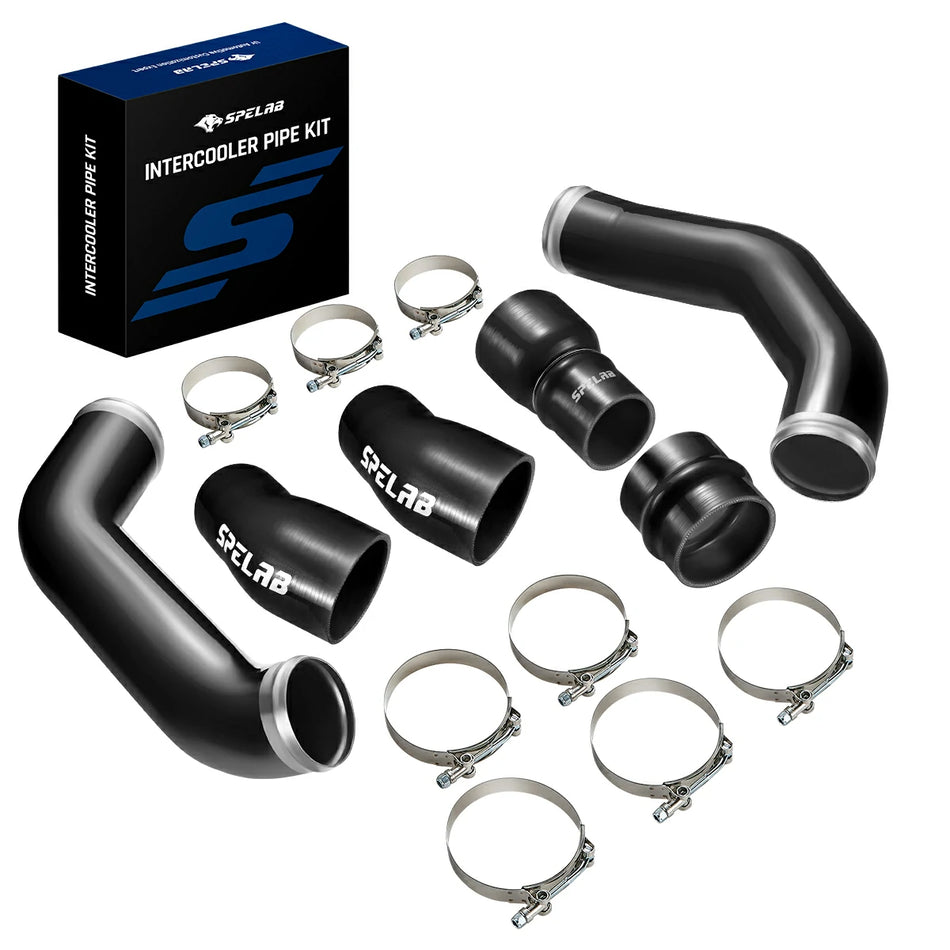
A 6.0 Powerstroke needs an intercooler or pipe upgrade only after the charge-air system has been tested: replace leaking pipes, boots, or clamps when the core holds pressure, replace the intercooler when its tank or core leaks, and consider a complete setup when an older truck has failures on both sides or works under sustained towing load.
Key Takeaways
The right repair follows the leak, the Fitment, and the truck's workload rather than the biggest part in the catalog.
- Pressure-test the charge-air tract before blaming the intercooler or turbo.
- Fix a failed boot, clamp, or pipe before replacing a core that still holds pressure.
- Choose tube-fin for lower weight and everyday work; choose bar-and-plate when sustained thermal load and rigid construction matter more.
- Verify the exact variant because the available pipe-and-intake combination is marked for 2005-2007 trucks.
- Do not expect a larger core to repair a sticking VGT, bad sensor, exhaust leak, restricted filter, or worn engine.
Should You Upgrade the Intercooler or Pipes First?
Replace the component that fails inspection first; a sound intercooler does not need to be discarded because a boot leaks, and fresh pipes cannot seal a split tank or damaged core.
Start with a cold visual inspection. Follow the hot-side route from the turbocharger outlet to the charge-air cooler, then follow the cold side from the cooler outlet to the intake connection. Look for a boot pushed away from the pipe bead, a clamp sitting on top of the bead, polished rub marks, wet oil tracks, cracked rubber, bent mounts, damaged fins, and separation at a tank-to-core joint.
Use the table below as the first decision gate. It keeps a simple leak from turning into an expensive parts cannon job.
| Inspection result or truck use | First action | Why |
|---|---|---|
| Loose clamp, split boot, damaged pipe, or leak at a pipe connection | Repair the connection or replace the pipe kit | The core may still be serviceable |
| Leak at the intercooler tank, weld, seam, or core | Replace the intercooler | A pipe upgrade cannot seal the cooler itself |
| Stock daily driver with no leak and stable loaded operation | Keep the healthy system | Extra size alone does not guarantee a useful gain |
| Tuned truck, repeated heavy towing, or an aging system with leaks in several places | Evaluate pipes and intercooler as one system | Sustained load exposes weak connections and limited thermal reserve |
| Low power or smoke with a sealed charge-air tract | Continue engine and turbo diagnosis | VGT control, sensors, intake restriction, exhaust leakage, and fueling can mimic a CAC leak |

What Fails First on a 6.0 Powerstroke Charge-Air System?
Boots, clamp locations, pipe joints, and tank seams deserve inspection before the core is condemned because these points can open only when boost, temperature, and engine movement rise under load.
A light oil film inside a charge-air pipe is common on a diesel that routes crankcase vapor back into the intake. Oil becomes a diagnostic marker when it forms a fresh wet trail around one joint, drips from a coupler, or returns quickly after cleaning. That trail often shows where pressurized air is escaping. The separate guide on why oil appears in charge-air plumbing explains how to separate ordinary CCV residue from a turbo, ventilation, or sealing problem.
Replace any boot that is cut, swollen, oil-softened, heat-hardened, or permanently deformed by an overtightened clamp. Reusing a tired coupler saves a few dollars at the bench and can leave the truck nose-down on the shoulder after the next loaded pull.
Check the intercooler mounts and isolators as well. A rigid aluminum tank should not be forced to carry chassis movement through a bent bracket or missing isolator. Ford describes the intercooler isolator as the part that separates the cooler from shock and vibration at its mounting points, so missing mounting hardware is not cosmetic.
How to Diagnose a Boost Leak Before Buying Parts
A controlled pressure or smoke test is more reliable than revving the engine in Park, listening for a hiss, or replacing the turbo because the truck feels flat.
- Scan before touching parts. Record stored and pending DTCs, freeze-frame data, MAP, BARO, exhaust back pressure, VGT duty cycle, engine load, and any available mass-airflow data. Do not clear the evidence first.
- Inspect the complete path cold. Check the air filter and pre-turbo tract, turbo connections, hot-side pipe, intercooler, cold-side pipe, intake connection, boots, clamps, brackets, and nearby rub points.
- Clean suspicious joints. Remove loose oil from the outside so a new wet track can identify the active leak. The procedure for how to seal oily charge-air connections covers surface preparation and clamp placement without using RTV as a shortcut.
- Test with regulated pressure. Use caps, plugs, a gauge, and a test method that match the exact diagnostic setup. Keep foreign material out of the turbo outlet and intake.
- Find the leak. Listen, use an approved leak-detection solution at joints, and inspect the tanks and core. Repair one confirmed failure at a time.
- Retest before the road test. A repaired system should hold the specified test condition without a new leak appearing at the next weakest joint.
- Load-test under repeatable conditions. Use the same route, similar payload or trailer weight, similar ambient temperature, and the same transmission strategy when comparing before and after data.
Ford TSB 09-15-6 uses 25 psi (172 kPa) in a specific smoke-and-pressure procedure for certain early 2003-2004 6.0L trucks built on or before September 29, 2003. That number belongs to that Ford procedure and setup; it is not permission to pressurize every homemade test rig or aftermarket part to 25 psi. Follow the applicable service information and the limits of the test equipment.
Separate an EGR cooling-system fault from a charge-air leak when a sealed 6.0L still loses power under load. White exhaust vapor, unexplained coolant loss, degas-bottle venting, overheating, or no cabin heat point toward the EGR cooler, oil cooler, cooling system, or head-gasket diagnostic path. The platform overview on the classic 6.0L EGR cooler failure path explains the EGR-side symptoms; Ford TSB 09-8-3 supplies the factory cooling-system test sequence. Do not buy an intercooler to chase coolant loss.
| Symptom | Check first | Do not assume |
|---|---|---|
| Hiss under acceleration | Boots, clamps, pipe beads, tank seams | The turbocharger is bad |
| Black smoke and weak pull | CAC leak, air filter, VGT operation, MAP and EBP data | The intercooler is too small |
| Oil around one coupler | Joint sealing and CCV carryover | The turbo seal has failed |
| Higher temperatures while towing | Charge-air leaks, cooling-stack blockage, fan operation, engine cooling | A thicker core is the only fix |
| Pipe repeatedly blows off | Bead condition, boot size, contamination, clamp position, alignment | More clamp torque will solve it |

2003-2007 Fitment: What Actually Changes?
Match the truck, production details, original connection layout, and selected SKU because a listing that mentions the 6.0L engine does not make every pipe-and-elbow configuration universal.
Ford's 6.0L application chart separates Super Duty engines by model year, transmission, production period, and engine serial number break. Those engine replacement breaks do not prove that every intercooler connection changed, but they show why VIN, build date, existing hardware, and actual connection geometry matter on an older truck that may have received years of repairs.
Use the broader guide to compare how 6.0L, 6.4L, and 6.7L Power Stroke systems differ; use this page for the 6.0L-specific leak test, core choice, pipe SKU, and installation checks.
| Vehicle | Current relevant option | Fitment check before ordering |
|---|---|---|
| 2003-2004 F-250, F-350, F-450, F-550 6.0L | SPIS08113 pipe variant; 2003-2007 intercooler options | Verify production details, factory-location connections, brackets, and included boots |
| 2005-2007 F-250, F-350, F-450, F-550 6.0L | SPIS08113 or SPIS08114; 2003-2007 intercooler options | Choose the exact pipe variant and confirm whether the 6061 intake elbow is required |
| 2003-2005 Excursion 6.0L | Intercooler pages list Excursion Fitment | Do not assume the F-Series pipe kit fits unless the selected product page explicitly confirms it |
| E-Series 6.0L | No automatic recommendation from this guide | Body packaging and charge-air routing differ; use an E-Series-specific listing |
Inspect any prior Mod before ordering. A swapped turbo, custom intake elbow, non-stock intercooler, repaired pipe, altered battery tray, or relocated accessory can change an otherwise straightforward Bolt-on job.
Use the verified 2003-2007 6.0L Powerstroke parts page to check adjacent vehicle-specific hardware, but confirm each product's own Fitment instead of treating the collection label as a blanket guarantee.
Pipe-Only, Intercooler-Only, or Complete Kit?
Choose a pipe-only repair when the cooler passes the leak test, an intercooler-only repair when the cooler fails, and a combined package when both sides are worn or the truck's workload justifies replacing the system once.
Pipe-Only Upgrade
A pipe-only upgrade fits a truck with a sound core and damaged piping, worn couplers, unreliable connections, or repeated pipe movement under load.
The current 6.0L Powerstroke intercooler pipe kit uses mandrel-bent aluminum pipes, triple-reinforced silicone couplers, and T-bolt clamps. Variant SPIS08113 is the polished pipe configuration. Variant SPIS08114 adds a CNC-machined 6061 aluminum intake elbow and is marked for 2005-2007 Fitment. Confirm the chosen variant on the order page instead of relying on the broad page title.

Browse the verified Powerstroke intercooler pipe options when comparing this application with other Ford diesel generations, but do not cross-shop by appearance.
Intercooler-Only Upgrade
An intercooler-only upgrade makes sense when the tank, seam, or core leaks and the existing pipes, boots, and clamps remain serviceable.
The all-aluminum tube-fin intercooler uses a 64 mm core, weighs 13.34 kg (29.4 lb), and is listed as a direct Bolt-on for 2003-2007 Super Duty and 2003-2005 Excursion 6.0L applications. That construction is the practical choice for daily driving, fleet service, and light-to-medium Towing when lower mass and quick recovery matter.
The heavy-duty bar-and-plate intercooler uses an 85 mm (3.35 in) core, cast aluminum end tanks, a 25.75 by 21.54 in core face, 3.25 in inlet, 3.00 in outlet, and an internal hot-side air diverter. Its denser, Rigid construction suits sustained Heavy-duty use, but size and thermal mass are not substitutes for before-and-after pressure-drop and temperature data.

Complete Intercooler and Pipe Setup
A complete setup is most defensible when an old truck has a leaking core plus brittle boots, damaged pipes, or a planned high-load build that would otherwise require paying for overlapping labor twice.
Check every included component and SKU. The store currently carries overlapping product variants, and the pipe-plus-intake configuration is specifically identified as 2005-2007. A 2003-2007 intercooler Fitment statement does not automatically widen the Fitment of every pipe bundled with it.
Tube-Fin vs. Bar-and-Plate on a 6.0 Powerstroke
Tube-fin is the lighter everyday choice, while bar-and-plate offers greater thermal mass and structural density for sustained load; neither design wins without matching the truck's duty cycle and measuring the complete cooling stack.
| Decision point | Tube-fin | Bar-and-plate |
|---|---|---|
| Typical priority | Lower mass, daily response, fast thermal recovery | Thermal reserve and Rigid construction under sustained load |
| Verified SPELAB core specification | 64 mm | 85 mm (3.35 in) |
| Verified published weight | 13.34 kg (29.4 lb) | Measure the production unit before publishing a comparison |
| Best starting use case | Daily driver, fleet truck, Jobsite use, light-to-medium Towing | Frequent heavy Towing, high sustained load, aggressive build |
| Cooling-stack concern | Inspect fin condition and external blockage | Confirm radiator and A/C airflow with the denser core installed |
| Claim that still needs controlled testing | Pressure drop and outlet-air temperature | Pressure drop and outlet-air temperature |
Do not publish a fixed horsepower gain, EGT reduction, or efficiency percentage without a controlled comparison. Record ambient temperature, trailer or Payload, road grade, speed, engine load, inlet and outlet charge-air temperature, boost, pressure drop, coolant temperature, and transmission temperature on the same truck. One unloaded pull on a cool morning proves very little.

Use the Powerstroke intercooler lineup to compare verified core styles and Fitment rather than selecting by paint color or the largest advertised percentage.
Which Upgrade Matches the Truck's Real Work?
Match the repair to how the truck earns its keep because a stock commuter, a fifth-wheel tow rig, and a tuned Jobsite truck stress the charge-air system in different ways.
| Use case | Best starting move | What to monitor |
|---|---|---|
| Stock daily driver | Repair confirmed leaks; keep healthy parts | Boost response, smoke, fuel use, fresh oil tracks |
| Long-distance Towing | Secure pipe connections first; evaluate core recovery under repeatable load | MAP, EBP, EGT if instrumented, coolant and transmission temperature |
| Heavy Payload or tuned street truck | Evaluate pipes, boots, clamps, intercooler, turbo control, and calibration together | Actual versus expected boost and repeated heat-soak behavior |
| Jobsite idle and low-speed work | Clean the cooling stack and inspect fan operation before buying a thicker core | Coolant temperature and airflow through packed fins |
| Off-roading or rough access roads | Inspect mounts, isolators, pipe rub points, and debris damage | Movement marks and leaks that return after chassis flex |
| Extreme cold | Inspect hardened couplers, loose clamps, and oil-water residue | Cold sealing, delayed leaks, and restricted crankcase ventilation |
Ford classifies frequent idling, severe dust or off-road operation, sustained temperatures below -10 degrees F (-23 degrees C) or above 100 degrees F (38 degrees C), extended trailer Towing, and sustained operation at GVWR as special service. Those conditions justify shorter inspection intervals even though Ford does not publish a universal mileage for replacing an intercooler.
Installation Details That Prevent Repeat Boost Leaks
Clean, aligned, fully seated connections prevent repeat failures better than blindly adding clamp torque.
- Photograph the original routing, brackets, sensor connections, and clamp positions before disassembly.
- Cover every open turbo, intercooler, and intake connection so hardware and shop debris cannot enter the engine.
- Degrease the pipe sealing surfaces with a cleaner compatible with the selected coupler material, then let them dry completely.
- Reject any boot that is hard, swollen, sliced, blistered, or permanently necked by an old clamp.
- Seat each coupler evenly and place the clamp behind the pipe bead, not on top of it and not at the edge of the boot.
- Align the full system before final tightening so a pipe is not pulling sideways on the intercooler tank.
- Check clearance at the fan shroud, battery tray, wiring, brackets, hood, and other hard parts through normal engine movement.
- Use the torque value supplied with the exact clamp or kit. T-bolt clamp size, thread, band width, coupler material, and manufacturer specification vary, so a made-up universal torque can cut a boot or distort a pipe.
- Pressure-test the completed assembly before the first loaded road test, then inspect it again after a full heat cycle.
The deeper hot-side and cold-side diagnosis helps isolate which half of the system deserves attention when the leak location is not obvious.
How to Verify Whether the Upgrade Worked
Verify sealing first and thermal performance second, using the same truck under repeatable conditions instead of judging the Mod from sound or one empty-road pull.
Build a baseline before the repair. Record ambient temperature, route, road grade, speed, Payload or trailer weight, transmission strategy, engine load, MAP, BARO, EBP, VGT duty cycle, EGT if a trustworthy probe is installed, coolant temperature, transmission temperature, and any available charge-air temperature data. Repeat the run after the repair under conditions close enough to make the comparison useful.
| Validation item | Before repair | After repair | Pass condition |
|---|---|---|---|
| Static leak test | Record pressure loss and leak location | Repeat with the same setup | Confirmed leak is gone and no new joint leaks |
| Loaded boost response | Log the same route and load | Repeat under similar conditions | Stable response without hiss, pipe movement, or new codes |
| Thermal behavior | Record temperatures after a sustained pull | Repeat the same pull | Results remain stable and repeatable, not one lucky snapshot |
| Post-run inspection | Mark existing oil and clamp positions | Inspect after heat cycles | No fresh oil track, coupler walk, rubbing, or loose mount |
A sealed system with no measurable thermal change can still be a successful reliability repair. A cooler outlet temperature with an unresolved leak is not a successful installation. Keep those two judgments separate.
Official Sources
Ford service information supports the Fitment boundaries, special-service context, and diagnostic method used in this guide.
- Ford TSB 09-15-6: early 6.0L DTC and charge-air leak diagnosis
- Ford TSB 09-8-3: 6.0L coolant-loss and EGR cooler diagnostic sequence
- Ford 6.0L Power Stroke application and engine serial number chart
- Ford F-250 through F-550 Power Stroke maintenance intervals
- Ford 6.0L charge-air cooler mounting isolator
6.0 Powerstroke Intercooler and Pipe FAQ
These answers cover the short questions owners usually ask before ordering or opening the charge-air system.
Q: Should I replace the intercooler or pipes first on a 6.0 Powerstroke?
A: Replace the part that fails a visual and pressure test. Fix pipes, boots, or clamps when the core holds pressure; replace the intercooler when its tank, seam, or core leaks.
Q: Is tube-fin or bar-and-plate better for Towing?
A: Tube-fin suits most daily drivers and light-to-medium tow rigs because it keeps weight down and recovers quickly. Bar-and-plate is the stronger starting choice for repeated heavy pulls and high sustained load, provided cooling-stack airflow remains healthy.
Q: Does a larger intercooler lower EGT on a 6.0 Powerstroke?
A: It may help stabilize charge-air temperature under sustained load, but there is no honest universal EGT reduction. Fueling, VGT operation, exhaust restriction, boost leakage, road grade, Payload, ambient temperature, and calibration all affect the result.
Q: Why is there oil inside my intercooler pipes?
A: A light film commonly comes from crankcase vapor entering the intake. Fresh dripping oil, blue smoke, rising oil consumption, or a wet trail that returns quickly calls for CCV, turbo, boot, and engine-condition checks.
Q: Can a boost leak cause black smoke and low power?
A: Yes. Lost charge air can reduce the oxygen reaching the cylinders under load, but the same symptoms can come from VGT control, MAP or EBP errors, a dirty filter, an exhaust leak, or a fueling problem.
Q: Do all 2003-2007 6.0 Powerstroke intercooler pipes fit the same?
A: Do not assume they do. Verify the truck, build details, current hardware, connection layout, and selected variant. The current SPIS08114 pipe-and-6061-elbow configuration is marked for 2005-2007 Fitment.
Q: Is an intercooler upgrade worth it on a stock 6.0 Powerstroke?
A: Keep a stock system that is sealed, clean, properly mounted, and stable under the truck's real workload. Upgrade when a part fails, when repeated Heavy-duty use exposes heat-soak limits, or when a planned build creates a documented need.