Last updated: September 11, 2026.

A Ford Power Stroke intercooler upgrade, often searched as a Powerstroke intercooler upgrade, should correct a measured charge-air problem rather than simply add a larger core. On a Ford Super Duty that tows, hauls, or runs added power, the charge-air cooler system must hold boost and control intake-air temperature under sustained load. A split boot, loose clamp, cracked plastic pipe, leaking end tank, restricted core, or sensor problem can produce similar complaints but require different repairs.
The correct repair changes with the engine generation and the trucks workload. A 20032007 6.0L Power Stroke with an aging plastic end tank does not have the same failure pattern as a 20112016 6.7L Power Stroke with a damaged cold-side connection, and a weekly tow rig needs more repeatable load testing than a stock commuter.
Key Takeaway: For many 6.0L and 6.4L Powerstroke trucks, an all-aluminum intercooler becomes worth considering when the stock plastic-tank core leaks or the truck tows in heat. For many 6.7L trucks, intercooler pipes and boots are often the smarter first upgrade unless the core is damaged, leaking, or clearly heat-soaked under real load.
What the Intercooler Does on a Powerstroke
A Power Stroke charge air cooler removes part of the heat added by turbocharger compression before the air reaches the intake manifold. Lower charge-air temperature can improve air density and consistency, but the intercooler must also maintain acceptable pressure drop and preserve airflow through the radiator and other heat exchangers behind it.
On a diesel truck, this matters most under load. A 6.7L Powerstroke pulling a trailer up a long grade asks the charge-air system to hold boost, manage heat, and recover quickly after sustained throttle. That is why many owners compare diesel performance intercoolers alongside pipe kits, boots, clamps, and broader cooling checks.
The intercooler is only one part of the system. Hot-side pipes, cold-side pipes, silicone boots, clamps, MAP sensor readings, turbo condition, air filter restriction, and tuning all influence how the truck feels. If you are also watching oil or coolant temperatures while towing, this guide on oil temperature under towing is a useful companion topic.
6.0L vs 6.4L vs 6.7L Powerstroke Intercooler Comparison
The three Power Stroke generations require different first checks because age, turbo layout, piping design, and factory charge-air hardware change across 2003-present Ford Super Duty trucks.
| Comparison Point | 6.0L Powerstroke | 6.4L Powerstroke | 6.7L Powerstroke |
|---|---|---|---|
| Model years | 2003-2007 | 2008-2010 | 2011-present |
| Factory turbo layout | Single VGT | Compound sequential turbos | Single VGT |
| Factory system character | Adequate when healthy, but age and limited airflow headroom matter | More capable hardware with greater heat and plumbing complexity | Strong factory baseline for stock and mildly modified trucks |
| Common weak point | Aging boots, clamps, plastic end tanks, and accumulated leaks | Heat-stressed hot-side connections, couplers, and pipe joints | Factory charge pipes, boots, and connection points before core size |
| Best first check | Pressure-test the system and inspect core seams and every boot | Check hot-side connections and monitor the system under sustained load | Inspect cold-side and hot-side pipes, boots, clamps, and sensor ports |
| Typical first upgrade | Boots and pipes if they leak; full aluminum core if the stock core or end tank has failed | Repair pipes and connections first, then reassess charge-air temperature recovery | Cold-side or complete pipe kit first on many stock and mildly tuned trucks |
| When a full intercooler makes sense | Core leakage, repeated heat soak, hard towing, larger turbo, or added fueling | Confirmed core restriction or poor recovery during repeated high-load operation | Damaged or leaking core, larger turbo, demanding build, or verified heat-soak limitation |

Tube-Fin vs. Bar-and-Plate Intercooler Cores
Tube-fin and bar-and-plate cores solve different packaging and thermal problems; neither construction is automatically the correct choice for every tow rig. Core dimensions, internal passage design, pressure drop, weight, frontal airflow, and the condition of the radiator stack matter more than the construction label alone.
| Core Design | Typical Strength | Tradeoff to Check | Best Decision Basis |
|---|---|---|---|
| Tube-fin | Often lighter with lower restriction to cooling-stack airflow | Construction and durability vary by tube, fin, and end-tank design | Daily driving, towing, and applications where radiator airflow must remain strong |
| Bar-and-plate | Often higher thermal mass and robust core construction | Can add weight and may restrict airflow to heat exchangers behind the CAC | High-load builds where logged temperature recovery and pressure data justify the added core |
A useful comparison requires the same ambient temperature, road load, sensor locations, and test route. A larger advertised core is not an upgrade if it creates excessive pressure loss or reduces radiator-stack airflow without improving repeatable charge-air temperature recovery.
Real Symptoms That Point to the Charge-Air System
Drivers often describe intercooler problems as a power issue, but the first clue is usually inconsistency. The truck may pull normally when empty, then feel soft with a trailer. It may build boost slowly, leave oily residue around a boot, or make a hiss under throttle.
- Hissing, whooshing, or fluttering under boost.
- Oil mist around an intercooler boot, clamp, pipe bead, or end tank seam.
- Lower-than-expected boost compared with normal scan-tool readings.
- Higher intake air temperature after repeated pulls or long grades.
- More smoke, lazy throttle response, or frequent downshifts while towing.
- Cracked plastic pipe, swollen boot, loose clamp, or visible intercooler damage.
Charge-Air Symptom Decision Table
A symptom identifies where diagnosis should start, not which part should be ordered. Match the complaint to a repeatable test before replacing the Power Stroke intercooler or charge pipes.
| What the Driver Notices | Inspect First | Best Confirmation | Likely First Action |
|---|---|---|---|
| Hiss or sudden boost loss under throttle | Boots, clamps, pipe beads, and quick-connect fittings | Regulated pressure test with leak-detection solution | Reseat or replace the failed connection |
| Fresh oil mist around one joint | The nearby boot, clamp, sensor port, and pipe | Clean the area, repeat the same loaded drive, and inspect again | Repair the confirmed leak instead of replacing the full core |
| Performance fades only during repeated loaded climbs | Boost control, charge-air temperatures, core condition, and cooling stack | Log the same route, load, ambient conditions, and sensor locations | Address the measured restriction, leak, or poor heat recovery |
| Smoke or weak response without a confirmed air leak | Air filter, MAP/MAF data, turbocharger, fueling, and calibration | Diagnostic trouble codes and commanded-versus-actual scan data | Diagnose the engine system before buying CAC hardware |
These symptoms do not prove the intercooler core is bad. A loose boot can feel like a weak turbo, a restricted air filter can reduce airflow, and incorrect sensor data or calibration can send a diagnosis toward parts that remain healthy.
Do Not Blame the Intercooler Too Fast
A regulated pressure test can separate a boot, clamp, pipe, sensor-port, or end-tank leak from a healthy intercooler core. Perform the test with the engine off and cool, and use the pressure limit specified by the vehicle service information or the exact test tool because no single pressure value is safe for every Power Stroke configuration.
Safe Boost-Leak Test Sequence
- Shut the engine off, let the charge-air components cool, and keep loose clothing and tools away from open intake plumbing.
- Inspect the tester, couplers, pipes, and clamps before applying pressure.
- Connect a regulated air source and stay within the test pressure specified for the vehicle or tester.
- Apply a leak-detection solution to boots, pipe beads, quick-connect fittings, sensor ports, and end-tank seams; bubbles identify the leak location.
- Release all pressure before adjusting a connection, then repair the source and repeat the same test.
Do not connect unregulated shop air to the charge-air system. Excess pressure can eject a test cap or coupler and can damage components that were not leaking before the test.
If the truck is tuned, towing heavy, or running larger-than-stock airflow parts, the weak point may move. Stock pipes and boots can become the first failure point before the intercooler core itself is the limitation. That is where Powerstroke intercooler pipe kits may be the more practical first step.
Test Context Matters
Repeatable testing compares the truck against its own healthy baseline under the same route and load. One unloaded pull or one dashboard temperature snapshot cannot establish that a Power Stroke intercooler is undersized.
| Record | Why It Matters |
|---|---|
| Ambient temperature and altitude | Both affect compressor work, air density, and the starting temperature of the cooling stack. |
| Trailer weight, payload, road grade, speed, and gear | The comparison is useful only when engine load is reasonably similar. |
| Commanded boost and actual boost | A persistent difference can point toward leakage, control, sensor, or turbocharger problems. |
| Available pre-CAC and post-CAC temperature readings | Sensor location determines what the temperature value actually represents. |
| Temperature recovery after the loaded pull | Recovery trend is more useful than an isolated peak value when evaluating heat soak. |
A larger core should earn its place by correcting a documented leak, restriction, or heat-recovery problem. Without matching conditions and measurement points, a claimed temperature drop or spool improvement is not a reliable comparison.
6.0L Powerstroke: Why It Often Benefits Earliest
The 6.0L Powerstroke is old enough now that age matters as much as design. Many trucks have lived through years of heat cycles, towing, boot replacements, and previous repairs. If the original intercooler has plastic tanks or tired seals, a hard-working truck can start showing leaks and inconsistent boost.
For a 2003-2007 F-250, F-350, F-450, or F-550 that tows, an all-aluminum intercooler is often more than a performance upgrade. It can be a reliability repair. A direct-fit 6.0L Powerstroke all-aluminum intercooler is worth considering when the stock core, end tanks, or repeated boot issues are already costing time.

Best 6.0L Upgrade Path
- Inspect boots, clamps, and hot-side/cold-side connections first.
- Pressure-test before replacing the core if the leak source is unclear.
- Choose a pipe kit if the pipes or boots are the weak point.
- Choose a full intercooler if the core or end tank is damaged or the truck tows in heat.

6.4L Powerstroke: Stronger Starting Point, Still Heat-Sensitive
The 20082010 6.4L Power Stroke can move substantial air, but sustained load also puts heat into a more complex compound-turbo and charge-air system. A towing or work truck with smoke, weak response, or rising temperatures needs separate checks for leaks, CAC behavior, turbo operation, regeneration status, and the engine cooling system.
Ford TSB 11-2-2 documents one narrow 6.4L CAC-related complaint: significant white exhaust smoke in high humidity or rain above 40F (4C), during moderate-to-heavy throttle after roughly 20 minutes of steady driving, with no diagnostic trouble codes and no active regeneration event. Those conditions should be confirmed before treating the CAC as the cause because coolant, fuel, turbocharger, and emissions-system faults can also produce white smoke.
A 6.4L Powerstroke tube-fin intercooler is most relevant when the factory core or end tanks are no longer reliable. If inspection points to piping instead, hot-side and cold-side pipe upgrades can be the better use of money.

When a 6.4L Owner Should Slow Down and Diagnose
If a 6.4L truck has high exhaust temperature, coolant concerns, smoke, or repeated limp behavior, do not treat the intercooler as the only suspect. Scan data, EGR condition, turbo health, fuel delivery, and cooling-system condition can all affect the same driving complaints.
6.7L Powerstroke: Often Pipes Before Core
A stock 6.7L Power Stroke daily driver usually needs a confirmed charge-air fault before a full intercooler replacement makes sense. The 20112014 engine used a single-unit VNT DualBoost turbocharger with two compressor wheels, while the 2015+ engines moved to a different conventional single-VGT layout; later chassis, output, pipe, sensor, and connection changes make model-year-specific fitment essential.
On some 2011-2016 6.7L trucks, owners commonly inspect the cold-side plastic pipe near the throttle-body adapter, quick-disconnect area, C-clip flange, and intake connection. Heat cycling, oil film, and higher boost under loaded climbs can make that area more likely to crack or pop loose, sometimes causing a sudden boost drop and limp-mode behavior.
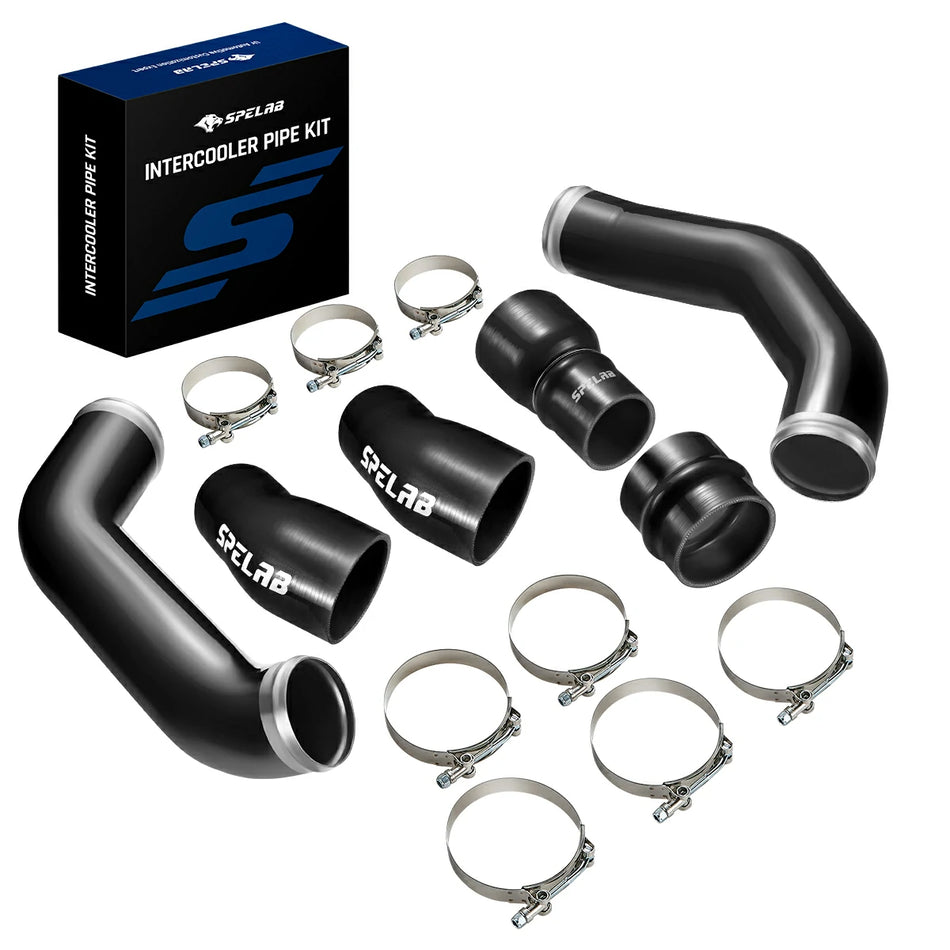
For 2011-2025 Super Duty applications, a 6.7L Powerstroke cold-side pipe kit can make sense when the cold side is cracked, leaking, or being upgraded as preventive maintenance. On 2011-2016 trucks, a 6.7L Powerstroke hot-side intercooler pipe is more relevant if inspection shows heat-side wear, boot movement, or boost leakage near that section. Mandrel-bent aluminum piping is not a cure for every drivability complaint, but it can remove a known plastic-pipe weak point when fitment is correct.
Match the 6.7L Pipe Variant to the Truck
A product page covering 20112025 Power Stroke trucks represents several different pipe variants, not one interchangeable kit. Confirm the exact model year, standard-output or high-output engine where applicable, hot-side or cold-side location, factory connection style, and selected SKU before ordering.
| Truck Group | Relevant Listed Variants | Fitment Check |
|---|---|---|
| 20112016 | Cold Side, Hot Side, or Hot + Cold Side Kit | Confirm each connection, sensor port, and included coupler against the truck. |
| 20172019 | Standard Cold Side or Upgraded Cold Side; standard-output hot-side option where listed | Do not select a 20112016 pipe solely because the engine displacement matches. |
| 20202022 | Upgraded Cold Side and standard-output hot-side options where listed | Verify the selected product variant covers the exact model year. |
| 20232025 | Upgraded Cold Side; Standard Output or High Output hot-side variants | Confirm the engine output package before selecting the hot-side pipe. |
| 2026 or later | No fitment should be inferred from a 20112025 listing | Use a current application listing or manufacturer confirmation. |
When a Full 6.7L Intercooler Upgrade Makes Sense
- The intercooler core is physically damaged or leaking.
- The truck tows heavy in heat and intake air temperature recovery is poor.
- The truck is modified enough that the stock core is a documented limitation.
- You have already confirmed pipes, boots, clamps, and sensors are not the main issue.
Installation Checks That Prevent Comebacks
Intercooler work is not complicated in theory, but small installation mistakes can create annoying repeat leaks. A coupler that is not fully seated, a clamp placed behind the bead, or a sensor left loose can make a new part look like a bad part.
- Let the truck cool fully before working around hot charge pipes.
- Inspect the boots for oil saturation, swelling, cracks, or clamp damage.
- Replace hardened, swollen, split, or oil-saturated boots instead of moving them onto new pipes. Reusing a weak coupler can turn a clean bolt-on job into another boost leak.
- Clean metal pipe beads with a residue-free cleaner approved by the pipe or boot manufacturer. Use isopropyl alcohol only when the component instructions permit it, and do not soak silicone, rubber, plastic, painted, or powder-coated parts in brake cleaner.
- Make sure the boot fully engages the pipe bead before tightening the clamp.
- Use quality clamps, and consider constant-tension T-bolt clamps where the kit or application calls for them.
- Seat clamps behind the bead and tighten evenly so the boot is not pinched or walked off-center.
- Confirm sensor connections and any bracket clearance before the first drive.
- After a short loaded test drive, recheck clamps and look for fresh oil mist.
How Tight Should a T-Bolt Clamp Be?
There is no honest universal torque value for every charge-air T-bolt clamp. Clamp width, fastener size, band material, coupler construction, and the pipe manufacturer's bead design all affect the rated torque. Use the value supplied with the exact pipe kit or clamp, tighten the connection evenly, and stop if the boot begins to pinch, roll, or extrude. A generic number borrowed from a different clamp can damage the coupler or create a leak instead of preventing one.
If the truck is being prepared for vacation towing, combine charge-air inspection with broader summer diesel cooling maintenance steps. Tires, coolant, transmission temperature, oil temperature, and charge-air leaks all show up faster when the truck is loaded.
How to Choose the Right Upgrade
A stock commuter with stable boost and no leaks should establish a healthy baseline instead of replacing parts preemptively. A high-mileage work truck with a confirmed end-tank leak needs a different repair, while a tuned tow rig that repeatedly moves a boot needs its connection hardware and pipe geometry checked before core size becomes the main question.
| Choose This | When It Makes Sense | What It Does Not Fix |
|---|---|---|
| Monitor and inspect | No leaks, no towing complaints, normal scan data | Existing cracks, weak boots, or damaged clamps |
| Pipe and boot upgrade | Boost leak is at the pipe, boot, clamp, or plastic charge tube | A cracked intercooler core or damaged end tank |
| Full intercooler upgrade | Core leak, end tank failure, poor recovery under towing load | Bad turbo, bad sensor, air filter restriction, or poor tuning |
| Broader cooling-system refresh | The truck shows coolant, oil, or transmission temperature problems too | A single isolated boost leak unless it is repaired directly |
For owners planning a larger airflow or tuning path, compare the intercooler decision with broader diesel cooling system upgrades and realistic power goals. This guide on turbocharged diesel towing behavior also helps explain why heat soak recovery and airflow matter so much on diesel pickups.
Final Verdict
The correct Power Stroke intercooler upgrade is the repair supported by a pressure test, physical inspection, and repeatable load data. Replace a leaking connection as a connection fault, replace a failed core as a core fault, and justify a larger heat exchanger with measured heat-recovery or pressure-drop evidence rather than engine displacement alone.
Official Sources
Ford service and technical publications support the engine-year references and the specific 6.4L white-smoke diagnostic context used in this guide.
FAQ
These answers address the most common Power Stroke intercooler questions about horsepower, boost leaks, oil residue, tuning, installation, and model-year fitment.
Q: Does a Powerstroke intercooler upgrade add horsepower?
A: A replacement intercooler does not create the same horsepower gain on every truck. A properly matched core or pipe kit can reduce leakage, pressure loss, or heat soak, but the result depends on whether the factory system was limiting airflow and on the turbocharger, fueling, calibration, ambient conditions, and engine load.
Q: What are the signs of a Powerstroke boost leak?
A: Hissing under throttle, fresh oil mist around one connection, actual boost below commanded boost, lazy response, increased smoke, or a pipe that moves under load can indicate a charge-air leak. A regulated pressure test is the cleanest way to identify the exact leak point.
Q: Is a small amount of oil inside a Power Stroke intercooler normal?
A: A light oil film can occur in a turbo-diesel charge-air system because crankcase vapor and compressor-side residue travel through the intake path. Pooled oil, rapidly increasing oil volume, blue smoke, or measurable engine-oil consumption requires diagnosis of the crankcase ventilation system, turbocharger, and engine condition instead of being dismissed as a normal intercooler issue.
Q: Can a Power Stroke intercooler leak cause limp mode?
A: A large charge-air leak can contribute to reduced-power behavior when actual boost and airflow no longer match the control module's expected values. Limp mode can also result from turbocharger, sensor, fuel, exhaust, or emissions faults, so retrieve diagnostic trouble codes before assigning the problem to the intercooler.
Q: Is a bigger intercooler always better for towing?
A: No. A larger core can help when repeatable data shows poor charge-air temperature recovery or when the original core is damaged, but a poorly matched core can add weight, pressure loss, or cooling-stack airflow restriction without fixing the truck's complaint.
Q: Do I need tuning after installing an intercooler or pipe kit?
A: A direct-fit intercooler or like-for-like charge-pipe repair usually does not require tuning by itself. Follow the vehicle, product, and calibration provider's instructions when pipe diameter, sensor placement, turbocharger, fueling, or other airflow hardware has changed.
Q: How do I choose the correct 6.7L hot-side or cold-side pipe variant?
A: Match the selected variant to the exact model year, pipe location, connection style, sensor ports, and standard-output or high-output engine where applicable. A product listing that spans 2011-2025 contains multiple fitment variants and does not mean every included option fits every 6.7L Power Stroke truck.
Q: Do I need to remove the grille or bumper to replace a Power Stroke intercooler?
A: Access varies by F-250, F-350, F-450, F-550, model year, bumper, grille, auxiliary equipment, and the part being replaced. Review the exact service procedure and product instructions before quoting labor because a pipe-only repair and a full CAC replacement require different disassembly.
Q: Should I replace the boots and clamps when installing new intercooler pipes?
A: Replace boots that are hardened, swollen, split, oil-saturated, or unable to grip the pipe bead, and replace clamps that are distorted, damaged, or incorrect for the connection. Reuse healthy application-specific hardware only when the product instructions allow it.

John Lee
Mechanical Engineer with more than a decade of hands-on experience
John works with diesel airflow, charge-air cooling, thermal management, and heavy-duty truck fitment. His Power Stroke experience connects shop diagnosis with what Super Duty owners see while towing, hauling payload, chasing boost leaks, and maintaining high-mileage work trucks.