Quick Answer: Diesel Pickups Use Turbos Because They Fit the Job
Diesel pickups use turbochargers instead of superchargers because a turbo uses exhaust energy, supports heavy low-RPM torque, works better under long towing load, and avoids the crankshaft power loss that comes with a belt-driven supercharger.
For most Ford F-250/F-350, Ram 2500/3500, Chevy Silverado 2500HD/3500HD, and GMC Sierra 2500HD/3500HD diesel owners, the real question is not whether to install a diesel truck supercharger. The better question is whether the factory turbo system, charge-air path, intercooler, intake, exhaust flow, and boost control are healthy enough to do the work.
Key Takeaways
- Modern diesel pickups are engineered around turbocharged airflow, not supercharger swaps.
- Superchargers react fast, but crankshaft drag, heat, packaging, and limited diesel support make them a poor fit for most HD trucks.
- Towing, payload, mountain grades, hot weather, and jobsite use favor steady boost, EGT control, and charge-air cooling.
- Most diesel owners should fix boost leaks, weak intercooler piping, intake restriction, slow spool, and exhaust restriction before chasing more boost.
Turbocharger vs Supercharger: The Difference That Matters on a Diesel Truck
A turbocharger is driven by exhaust gas, while a supercharger is driven by the crankshaft, and that mechanical difference decides why diesel pickups almost always run turbos.
A supercharger gives quick boost because a belt, pulley, or gear drive spins it as soon as the engine turns. That sharp pedal hit makes sense on a gas performance car. The tradeoff is parasitic drag. The crankshaft has to spend power to spin the blower before the engine gets the airflow benefit back.
A turbocharger uses exhaust flow that is already leaving the engine. Under towing load, diesel combustion creates strong exhaust energy, and that energy spins the turbine side. The compressor side then pushes denser air through the charge-air cooler and into the intake system. That setup fits a heavy-duty truck because the harder the truck works, the more useful exhaust energy the turbo has available.
| Feature | Turbocharger | Supercharger |
|---|---|---|
| Drive source | Exhaust gas energy | Crankshaft belt, pulley, or gear drive |
| Main strength | Efficient boost under load | Instant throttle response |
| Main drawback | Can lag if poorly matched or worn | Uses engine power to make boost |
| Diesel pickup fit | Factory-standard on modern HD diesel trucks | Rare, custom, and usually not the practical route |
| Best use case | Towing, payload, long grades, diesel torque | Gas performance builds chasing instant hit |
Why Diesel Engines Are Better Matched to Turbochargers
Diesel engines are better matched to turbochargers because they need heavy air mass to make clean torque, and they produce strong exhaust flow under load.
A diesel pickup does not live like a lightweight street car. It idles at the ranch gate, pulls a skid steer, hauls tools, pushes through mud, or drags a fifth-wheel across a hot interstate. That workload favors controlled boost pressure, low-RPM torque, charge-air temperature control, and steady airflow below 2,000 rpm.
Factory HD diesel numbers tell the story. Ford lists the 6.7L High Output Power Stroke V8 Turbo Diesel B20 engine at 500 hp and 1,200 lb-ft of torque. Ram lists the 2026 Ram 2500 with an available High-Output 6.7L Cummins Turbo Diesel I6 rated at 430 hp and 1,075 lb-ft. Chevrolet lists the Silverado HD available Duramax 6.6L Turbo-Diesel V8 at 470 hp and 975 lb-ft, and GMC lists the Sierra HD available Duramax 6.6L Turbo-Diesel V8 with 975 lb-ft.
| Diesel HD Platform | Factory Induction Type | Factory Torque Focus | Why It Matters |
|---|---|---|---|
| Ford F-250/F-350 6.7L Power Stroke | Turbo Diesel | Up to 1,200 lb-ft | Built for heavy towing, payload, and low-RPM pull |
| Ram 2500/3500 6.7L Cummins | Turbo Diesel I6 | Available 1,075 lb-ft | Strong match for heavy-duty work and trailer load |
| Chevy Silverado 2500HD/3500HD 6.6L Duramax | Turbo-Diesel V8 | 975 lb-ft | Paired with HD trailering and long-load duty cycles |
| GMC Sierra 2500HD/3500HD 6.6L Duramax | Turbo-Diesel V8 | 975 lb-ft | Factory system is engineered around turbo airflow and cooling |
Why Superchargers Are Rare on Diesel Pickups
Superchargers are rare on diesel pickups because their instant response does not outweigh fitment work, heat load, belt-drive stress, tuning complexity, and weak aftermarket support.
A blower can be a fun mod on the right gas build. A heavy diesel tow rig needs a different kind of muscle. It needs repeatable airflow after 20 miles of grade, not just a hard punch leaving a stoplight.
Packaging gets ugly fast. A diesel engine bay already has intercooler piping, emissions hardware on stock trucks, fan shrouds, cooling stack parts, exhaust brake hardware, sensors, and service access points. A custom supercharger setup can create bracket, pulley, hood clearance, belt wrap, and heat problems before the truck ever sees a trailer.
| Supercharger Problem | Why It Hurts a Diesel Pickup |
|---|---|
| Belt-drive load | More accessory drive stress on an engine already built for heavy duty cycles |
| Heat management | Towing, payload, and high boost already push charge-air temperature and cooling capacity |
| Fitment complexity | Custom brackets, belt routing, hood clearance, and accessory alignment can become a headache |
| Limited diesel support | Most modern HD trucks are engineered, tuned, and serviced around turbo systems |
| Wrong performance target | Instant hit matters less than sustained torque, clean boost control, and EGT stability |
Which Is Better for Towing: Turbocharger or Supercharger?
A turbocharger is usually better for towing because it supports sustained boost, works with the charge-air cooler, and uses stronger exhaust flow as load rises.
Hook a 12,000-pound camper behind a diesel truck in July, point it at a long grade, and the truck does not care about dyno talk. It cares about EGT, IAT, coolant temperature, boost pressure, exhaust backpressure, turbo spool, and whether the charge-air path holds pressure without popping a boot. If that sounds familiar, our guide on heat soak under boost explains why air temperature matters when a truck is working hard.
We see the same pattern when testing airflow parts and inspecting customer trucks. Weak pull under load often comes from cracked plastic pipes, tired boots, loose clamps, heat-soaked charge air, intake restriction, or a turbo actuator that cannot control vane position cleanly. A supercharger does not fix those base problems.
| Real Truck Situation | Turbo System Priority | What to Watch |
|---|---|---|
| Long uphill towing | Clean spool and steady boost pressure | EGT, IAT, coolant temperature |
| Heavy payload | Low-RPM torque and sealed charge-air path | Boot blow-off, boost leak, smoke |
| Hot weather cruising | Charge-air cooling and intercooler efficiency | Heat soak and power fade |
| Jobsite or ranch use | Factory-supported parts and easy service | Downtime, cracked pipes, worn clamps |
Before You Chase More Boost
Most diesel owners get better results by sealing and cooling the factory turbo airflow path before changing the forced-induction layout.
Start with the parts that decide whether turbo boost actually reaches the cylinders: intercooler condition, diesel air intake systems, boots, clamps, intake horns, manifolds, and charge pipes. These parts do not sound as wild as a custom blower swap, but they are the pieces that keep a tow rig alive under load.
For Ram owners dealing with slow spool, high EGT, or intake-side restriction, a 3.5-inch intake horn makes more sense than trying to reinvent the whole boost system. It works with the turbo layout the truck already has instead of fighting the factory design.
What About Turbo Lag?
Turbo lag is real, but modern diesel pickups manage it with turbo sizing, VGT control, transmission calibration, and low-RPM torque mapping.
A supercharger responds faster because it is mechanically driven. That part is true. The mistake is assuming faster response automatically makes it better for a diesel tow rig. A truck pulling a trailer needs controlled torque delivery, not just a hard snap at the pedal.
Variable-geometry turbocharger systems help the engine build usable boost at lower rpm, then open up to support flow as load and speed rise. That is why a modern 6.7L Power Stroke, 6.7L Cummins, or 6.6L Duramax can feel strong leaving a stop with a trailer and still keep pulling on the highway. The target is usable boost without smoke, heat, or drivability problems.
| Driver Concern | Practical Answer |
|---|---|
| I want instant throttle response. | A supercharger reacts fast, but a healthy turbo diesel setup is usually smoother and more useful under load. |
| I tow in the mountains. | Watch EGT, charge-air temperature, boost leaks, and cooling health before chasing a blower swap. |
| My truck feels lazy down low. | Check intake restriction, boots, charge pipes, turbo actuator behavior, and transmission strategy first. |
| I daily drive and tow on weekends. | A well-matched turbo setup gives the best mix of torque, drivability, and efficiency. |
Why Factory Diesel Pickups Focus on Turbo Systems
Factory diesel pickups focus on turbo systems because the engine, transmission, cooling stack, exhaust brake, sensors, and towing calibration are all engineered around turbocharged airflow.
Ford, Ram, Chevrolet, and GMC did not choose turbos by accident. Their heavy-duty diesel trucks are certified, cooled, packaged, and warrantied around turbocharged powertrains. That matters when the truck is pulling a gooseneck, plowing snow, carrying tools, or idling all day with a trailer hooked up.
The turbo also works with parts that diesel owners actually service and upgrade: charge pipes, intake horns, intake manifolds, exhaust manifolds, downpipes, clamps, boots, sensors, and cooling hardware. If the truck starts showing oil starvation, shaft play, smoke, or slow spool behavior, read our breakdown of oil starvation and shaft play before throwing parts at the wrong problem.
| System Area | Why It Matters More Than a Supercharger Swap |
|---|---|
| Charge air cooler / intercooler | Lowers intake air temperature during towing and hot-weather load |
| Charge pipe / intercooler pipe | Controls boost leaks, boot blow-off, and restriction between turbo and intake |
| Intake horn / intake manifold | Improves the airflow path into the engine and removes weak factory restriction points on some platforms |
| Exhaust flow | Helps control heat, backpressure, and turbine-side efficiency |
| Turbo health | Shaft play, vane issues, actuator faults, and oiling problems can kill response and towing power |
What Diesel Pickup Owners Should Upgrade or Diagnose First
Diesel pickup owners should inspect the turbo airflow system first because most real power complaints come from leaks, restriction, heat, or worn parts instead of a missing supercharger.
Start with the simple stuff. Check the boots for oil soak and cracking. Check clamps for bite marks and loose bands. Check plastic charge pipes for splits. Look for soot trails near exhaust joints. Watch boost pressure under load if you have a monitor. Watch EGT if you tow heavy. If the truck keeps losing pressure during a pull, this guide to boost leaks under load is a better first step than guessing at a major forced-induction swap.
As a parts manufacturer, we see the same failure pattern in real testing: thin factory pipes and tired boots often become the weak link when trucks see higher load, larger tires, aggressive tuning, or long hot pulls. Stronger piping, better clamps, cleaner intake routing, and better charge-air control usually give a diesel owner more useful results than chasing a custom supercharger idea.
For owners building beyond stock airflow, performance turbo kits and performance exhaust systems are a cleaner fit with the way diesel trucks are designed to work.
| Symptom | Check First | Smart Upgrade Direction |
|---|---|---|
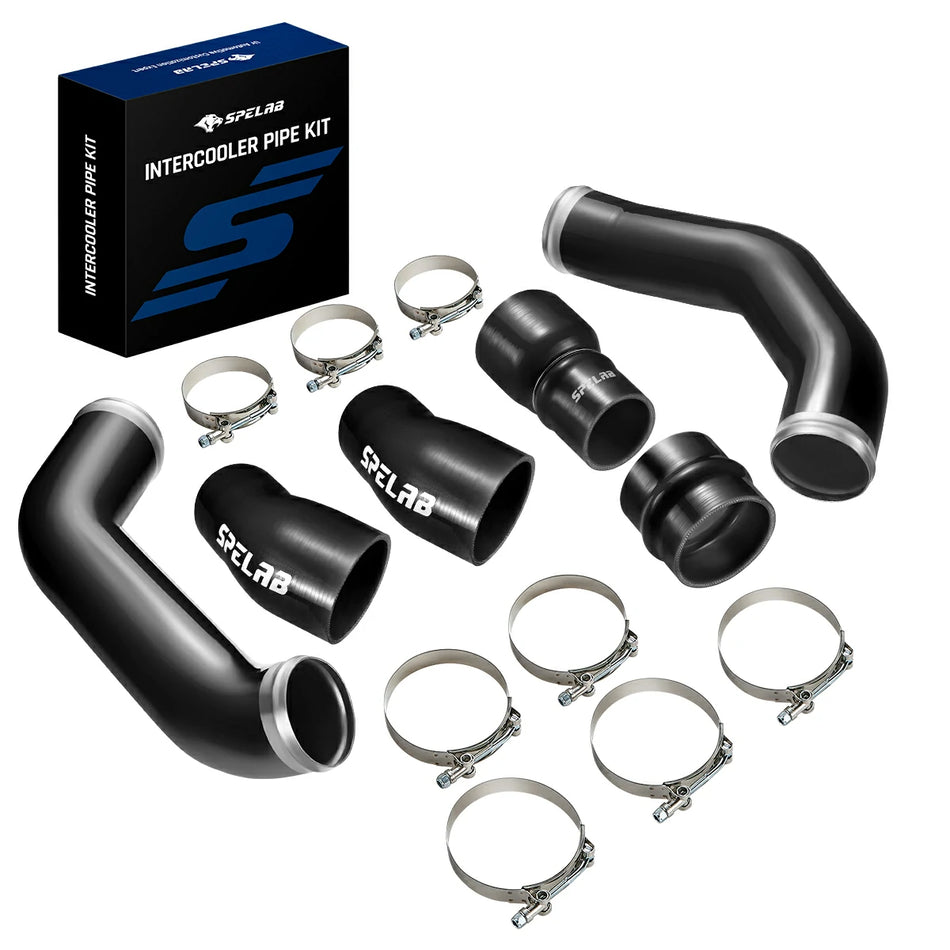
| Weak pull while towing | Boost leak, loose clamp, cracked charge pipe, tired boot | Heavy-duty intercooler pipe or charge pipe upgrade |
| High EGT on grades | Airflow restriction, exhaust restriction, dirty cooling stack, tune/load mismatch | Improve intake flow, charge-air cooling, and exhaust flow |
| Lazy throttle response | Turbo actuator behavior, intake restriction, boot leak, sensor data | Inspect turbo system and improve intake-side airflow |
| Boot keeps blowing off | Clamp bite, oil contamination, pipe bead, coupler condition | Rigid piping with better couplers and clamps |
| Power fades in hot weather | Charge-air temperature, intercooler efficiency, heat soak | Intercooler and charge-air system support |
Supercharger vs Turbocharger for Diesel Trucks: Final Verdict
Turbochargers win for diesel pickups because they fit the way heavy-duty diesel engines make torque, tow under load, manage heat, and work with factory-engineered truck systems.
For 99% of Ford Super Duty, Ram Cummins, Silverado HD, and Sierra HD diesel owners, the answer is simple: do not start with a supercharger. Fix the turbo-side airflow system first. Keep the charge-air path sealed, keep the turbo healthy, control temperature, and remove restriction before chasing a forced-induction setup the platform was never built around.
FAQ
Q: Are diesel pickups turbocharged or supercharged?
A: Most modern diesel pickups are turbocharged from the factory. Superchargers are rare on Ford F-250/F-350, Ram 2500/3500, Chevy Silverado HD, and GMC Sierra HD diesel platforms.
Q: Can you supercharge a 6.7L Cummins or 6.7L Power Stroke?
A: Yes, a custom shop can build almost anything, but it is rarely practical. Modern 6.7L Cummins, 6.7L Power Stroke, and 6.6L Duramax trucks are engineered around turbocharger airflow, charge-air cooling, exhaust braking, and towing calibration.
Q: Is a turbocharger more fuel efficient than a supercharger on a diesel truck?
A: In most diesel pickup use, yes. A turbocharger uses exhaust energy that is already leaving the engine, while a belt-driven supercharger requires crankshaft power to spin.
Q: Why do diesel trucks need so much boost?
A: Diesel engines rely on heavy air mass to make clean torque under load. More controlled airflow helps the engine burn fuel more efficiently, reduce smoke, support towing power, and manage EGT.
Q: Is a supercharger better for towing because it responds faster?
A: No, not for most diesel pickups. Fast response helps in short bursts, but towing needs sustained torque, controlled EGT, efficient airflow, and a charge-air system that can hold boost for miles.
Q: What should I upgrade instead of adding a supercharger?
A: Inspect the turbo, intercooler, boots, clamps, charge pipes, intake horn, intake manifold, exhaust flow, and sensor data first. Fixing airflow restriction and boost leaks usually helps more than adding a custom blower.
Q: Is turbo lag bad on a diesel truck?
A: Turbo lag can be annoying, but modern diesel trucks reduce it with turbo sizing, variable-geometry control, transmission calibration, and low-RPM torque mapping. A small delay is usually less important than clean, sustained boost under load.