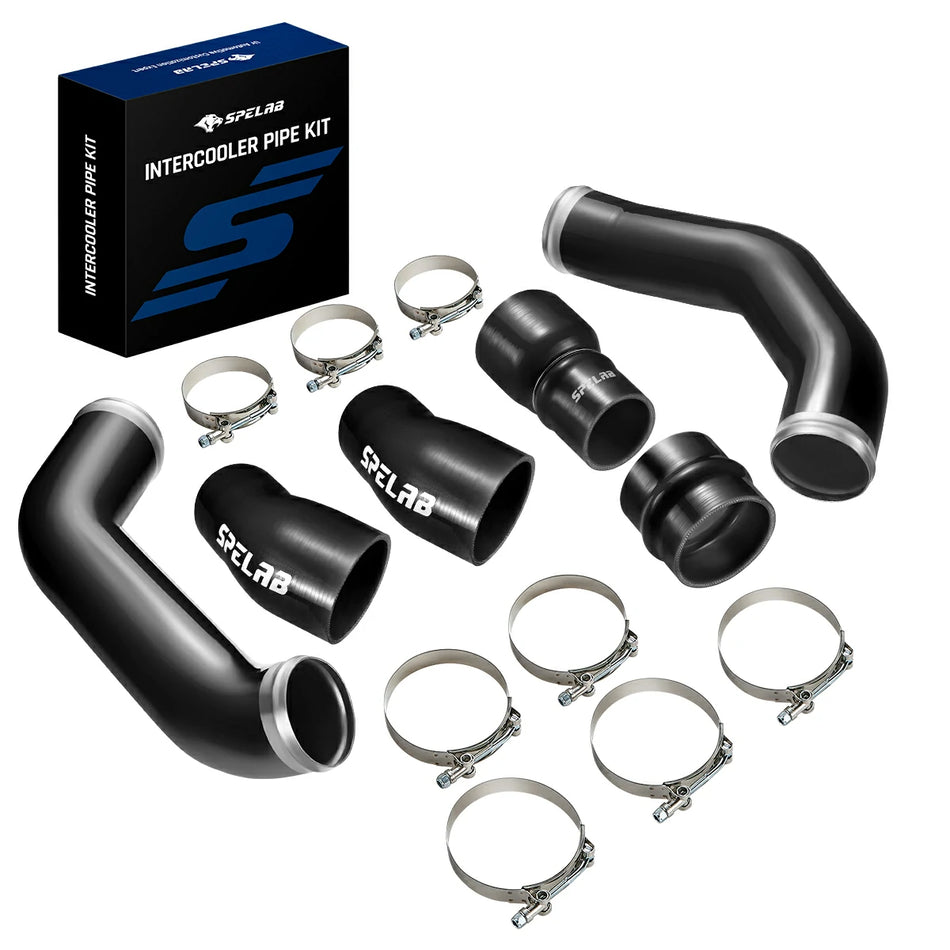
A 6.7 Cummins intercooler upgrade is not always about replacing the entire core. For many Ram 2500 and 3500 owners, the smarter first step is checking the intercooler pipes, boots, clamps, and boost-leak points before buying a full intercooler.
This guide explains how to choose between an intercooler pipe kit and a full intercooler upgrade for 2010–2024 Ram 2500/3500 trucks with the 6.7L Cummins diesel engine. We’ll cover year-by-year fitment, common failure signs, towing symptoms, installation difficulty, tuned-truck considerations, and SPELAB product recommendations.
TL;DR: Pipe Kit or Full Intercooler?
For most 2013–2018 Ram 6.7L Cummins trucks, an intercooler pipe kit is usually the best first upgrade if the factory core is still healthy. A full intercooler makes more sense when the core is damaged, IAT stays high under load, or the truck is running a larger turbo or higher-power setup.
| Your Situation | Best First Choice | Installation Difficulty |
|---|---|---|
| Cracked boot, loose clamp, oily pipe joint, or boost leak | Intercooler pipe kit | 2/5 |
| Stock intercooler core is intact | Pipe kit first | 2/5 |
| Moderate tuning or regular towing | Pipe kit or full pipe kit | 2–3/5 |
| Bent fins, damaged end tank, corrosion, or leaking core | Full intercooler | 4/5 |
| High IAT even after fixing pipes and boots | Full intercooler | 4/5 |
| Big turbo or high-horsepower build | Full intercooler + upgraded piping | 5/5 |
Quick recommendation: If your truck has a boost leak, start with pipes, boots, and clamps. If the intercooler core is physically damaged or cannot control intake air temperature under load, then move to a full intercooler upgrade.
 All-Aluminum Tube-Fin Intercooler
Understanding 6.7 Cummins Intercooler Fitment by Year
The 6.7L Cummins platform has changed over time, and intercooler fitment should never be treated as universal. Brackets, pipe routing, boots, sensors, and available space can vary by model year.
2010–2012 Ram 6.7 Cummins — Early 4th Gen Trucks
The 2010–2012 Ram HD trucks are early 4th Gen models. They are often older, higher-mileage trucks today, so intercooler problems are usually related to age, wear, corrosion, dirty fins, old boots, or loose clamps rather than the engine itself.
Key points for 2010–2012 owners:
- Inspect the intercooler core for bent fins, corrosion, and debris buildup.
- Check hot-side and cold-side pipes for oil seepage around boots.
- Pay close attention to boost leaks under load.
- Do not assume 2013–2018 parts will automatically fit.
If you own a 2010–2012 Ram, start with a full charge-air system inspection before choosing parts. Older trucks may need boots, clamps, pipes, or a full intercooler depending on condition.
2013–2018 Ram 6.7 Cummins — The Main Upgrade Window
The 2013–2018 Ram 2500/3500 6.7L Cummins platform is one of the most common upgrade targets. These trucks are old enough for factory piping and boots to show wear, but many still have a usable intercooler core.
For many 2013–2018 Cummins owners, the pipe kit is the best first upgrade because it addresses common boost-leak points without replacing a healthy core.
A pipe kit makes sense when:
- The truck has a boost leak or underboost symptom.
- You see oil residue around intercooler boots or clamps.
- You tow regularly and want better boost retention.
- The factory core is still intact.
- You want a bolt-on upgrade before moving to a full intercooler.
- The truck is tuned but still uses a healthy factory-style intercooler core
This kit is designed for 2013–2018 Ram 2500/3500 6.7L Diesel trucks and can be used as a pipe-only upgrade or paired with an upgraded intercooler depending on your setup.
2019–2024 Ram 6.7 Cummins — Fitment Must Be Verified Carefully
The 2019–2024 Ram HD trucks use a newer 5th Gen platform with updated engine, turbo, emissions, and packaging details. These trucks should not be treated as direct-fit matches for 2013–2018 intercooler parts.
Key points for 2019–2024 owners:
- Verify exact year, model, trim, and engine configuration.
- Do not assume 2013–2018 intercooler pipes will fit.
- Check product fitment before ordering.
- For towing or tuning, monitor IAT and boost pressure before replacing parts.
If your 2019–2024 truck is stock and not showing boost leaks or high IAT, a full intercooler may not be the first upgrade you need. Start with diagnostics.
What Does the Intercooler Do on a 6.7 Cummins?
The intercooler cools compressed air after it leaves the turbocharger and before it enters the intake manifold. Cooler intake air is denser, which helps combustion efficiency, towing consistency, throttle response, and overall engine performance.
On a diesel truck, the intercooler system includes more than just the core. It also includes:
- Hot-side intercooler pipe
- Cold-side intercooler pipe
- Silicone boots
- Clamps
- Mounting brackets
- Charge-air connections
- Sensors and related intake-side components
That is why a “bad intercooler” symptom is often caused by a pipe, boot, clamp, or connection rather than the intercooler core itself.

Pro Tip: If you are upgrading the cold-side pipe or removing intake-side components, take a quick look at nearby boots, clamps, wiring, and intake hardware while everything is accessible. Grid-heater-related issues are a separate Cummins topic, but intake-side inspection is smart preventive maintenance when you already have parts removed.
Hot-Side vs Cold-Side Intercooler Pipe: What’s the Difference?
Understanding hot-side and cold-side piping helps you avoid buying the wrong part.

Hot-Side Intercooler Pipe
The hot-side pipe carries compressed air from the turbo outlet to the intercooler inlet. This side sees higher heat and pressure, so boots and clamps can wear out over time.
Common hot-side symptoms include:
- Hissing noise under boost
- Black smoke under acceleration
- Reduced towing power
- Underboost code
- Oil residue around pipe joints
Cold-Side Intercooler Pipe
The cold-side pipe carries cooled air from the intercooler outlet to the intake manifold. This side is still pressurized and can develop leaks at boots, clamps, or pipe connections.
Common cold-side symptoms include:
- Low boost
- Sluggish throttle response
- Poor towing performance
- Oily residue near the intake-side boot
- Whistling or whooshing under load
Full Intercooler Pipe Kit
A full pipe kit is the better choice when both hot-side and cold-side parts are aging, when you want stronger piping, or when you want to refresh the charge-air path at the same time.
3-Minute Boost Leak Self-Check
Before ordering a full intercooler, run through this quick check. Many “bad intercooler” symptoms are actually caused by boots, clamps, or intercooler pipes.
- Do you hear a hiss, whistle, or whoosh under acceleration?
- Does the truck feel weak while towing or climbing grades?
- Is there black smoke under load?
- Is your boost gauge lower than usual?
- Do you see oil residue around one intercooler boot or clamp?
- Has the truck triggered a P0299 underboost code?
- Does IAT climb faster than usual under load?
If you checked two or more boxes, inspect the intercooler boots, clamps, and pipes before replacing the full intercooler core.
Common 6.7 Cummins Intercooler and Pipe Problems
A 6.7 Cummins intercooler problem usually shows up under load, not at idle. Towing, climbing grades, hard acceleration, and tuned driving make weak points easier to spot.
| Symptom | Likely Cause | What to Check First |
|---|---|---|
| Hissing or whooshing under boost | Loose boot, cracked pipe, leaking clamp | Intercooler boots and clamps |
| Black smoke + power loss | Boost leak or underboost | Hot-side pipe and boots |
| High IAT while towing | Dirty core, poor airflow, heat soak, or leak | Core fins, pipes, and airflow path |
| P0299 underboost code | Charge-air leak, turbo issue, or sensor issue | Pressure test system |
| Oil residue around boots | Normal CCV oil mist plus possible leak point | Boot seating and clamp tightness |
| Sluggish throttle response | Boost loss or restricted airflow | Pipes, boots, and intercooler core |
| IAT rises quickly under load | Dirty fins, damaged core, or airflow restriction | External core condition |
Important note: coolant loss is usually not a typical air-to-air intercooler failure symptom on these trucks. If you are losing coolant, inspect the cooling system, EGR cooler, radiator, hoses, water pump, heater core, or head gasket path instead of assuming the intercooler is the cause.
Factory-Style End Tanks vs Upgraded Intercooler Construction
On older, higher-mileage, or higher-boost trucks, factory-style intercooler seams and end tank areas can become leak points over time. This does not mean every factory intercooler will fail, but it is one reason owners move from a pipe-only repair to a full intercooler upgrade.
An upgraded intercooler with a bar-and-plate core and cast aluminum end tanks is designed for more strength, better heat handling, and improved airflow compared with a tired factory-style unit.
Choose a full intercooler when:
- The core or end tank area shows physical damage.
- The intercooler has a confirmed pressure leak.
- IAT remains high after fixing boots and pipes.
- The truck tows heavy or runs a higher-airflow setup.
- You want a complete charge-air cooling upgrade instead of only replacing piping.
This is the point where a full 6.7 cummins intercooler becomes more than a performance part. It becomes a reliability upgrade.
Tuned Trucks: Why Pipes, Boots, and Clamps Matter More
If your 6.7 Cummins is tuned with EFI Live, EZ LYNK, MM3, or another tuning platform, the charge-air system deserves extra attention. Higher airflow demand can expose weak boots, aging clamps, and restrictive factory-style piping faster than stock driving.
This does not mean every tuned truck must immediately replace the full intercooler. But it does mean you should pressure-test the system and inspect the pipes before assuming the turbo, sensor, or intercooler core is the problem.
For tuned trucks, pay close attention to:
- Boot slip under hard acceleration
- Clamp position after heat cycling
- Oil residue at pipe joints
- Lower-than-expected boost readings
- Higher EGT or IAT trends while towing
- Repeated P0299 or underboost symptoms
Mechanic’s Note: Avoid treating boost pressure as a universal failure number. Some trucks hold higher-than-stock boost safely with the right parts, while worn boots or loose clamps can leak at much lower pressure. Condition, installation, tuning, heat, and clamp alignment all matter.
How to Diagnose a 6.7 Cummins Intercooler Leak
Before replacing parts, diagnose the system. Many owners replace a full intercooler when the real issue is a loose clamp or cracked boot.
1. Visual Inspection
Look for:
- Oil residue around boots
- Cracked silicone couplers
- Loose or misaligned clamps
- Rub marks on pipes
- Bent fins or blocked airflow
- Damaged end tanks
- Missing or loose mounting hardware
A small amount of oil mist in the charge-air system can be normal on diesel trucks, especially with factory crankcase ventilation routing. But heavy oil residue around one boot often points to a leak.
2. Listen Under Load
A boost leak often sounds like a hiss, whistle, or whoosh during acceleration. It may not be noticeable at idle.
Common test conditions:
- Moderate acceleration
- Uphill driving
- Trailer towing
- Higher boost situations
If the sound appears only under load, inspect the charge-air system first.
3. Watch OBD2 Data
Use a scanner or monitor to check:
- Intake air temperature
- Boost pressure
- MAP readings
- Underboost codes
- EGT trends if available
If IAT rises quickly and power drops, the intercooler system may not be holding or cooling charge air properly.
Visual Note: An IAT comparison chart can help readers understand the benefit of a stronger intercooler system, but actual IAT changes vary by truck setup, ambient temperature, towing load, altitude, tuning, and driving style.
4. Pressure Test the System
A pressure test is the most reliable way to find leaks. A shop can use a pressure tester or smoke machine to confirm whether the system holds pressure.
Pressure testing can reveal:
- Leaking boots
- Pinholes in pipes
- Loose clamps
- Cracked plastic or metal connections
- Intercooler core leaks
Intercooler Pipe Kit vs Full Intercooler: Which Should You Buy?
This is the central buying decision.

| Upgrade Choice | Best For | Installation Difficulty | Buy This When |
|---|---|---|---|
| Intercooler Pipe Kit | Boost leaks, aging boots, moderate tuning, towing | 2/5 | The core is still healthy but pipes, boots, or clamps are the weak point |
| Full Intercooler | Damaged core, high IAT, heat soak, heavy towing | 4/5 | The intercooler core is damaged or can’t control heat under load |
| Intercooler + Pipe Kit | Tuned trucks, big turbo setups, full charge-air refresh | 5/5 | You want to remove multiple weak points at once |
Buy an Intercooler Pipe Kit If...
An intercooler pipe kit is usually the better first upgrade if your factory intercooler core is still healthy.
Choose a pipe kit if:
- Your truck has boost leaks around boots or clamps.
- The factory pipes are restrictive, aging, or damaged.
- You tow and want better boost retention.
- You run moderate tuning.
- You want a cost-effective upgrade.
- You are not seeing physical damage on the intercooler core.
- You want to refresh both hot-side and cold-side charge-air piping.
For many daily-driven and tow-focused 2013–2018 Ram 6.7 Cummins trucks, a pipe kit solves the most common problem without the cost of replacing the full core.
Recommended SPELAB option:
SPELAB 2013–2018 Dodge Ram 6.7L Cummins Intercooler Pipe Kit
Buy a Full Intercooler If...
A full intercooler is the better choice when the core itself is the restriction or failure point.
Choose a full intercooler if:
- The core is damaged, leaking, corroded, or badly bent.
- IAT stays high even after fixing pipes and boots.
- You run a larger turbo or higher-horsepower setup.
- You tow heavy in hot climates and need more cooling capacity.
- The truck has repeated heat-soak issues under load.
- You want to upgrade the full charge-air cooling system at once
Buy Intercooler + Pipe Kit Together If...
A combined upgrade makes sense when the truck is already modified or when you want to refresh the full charge-air system.
Choose a combined setup if:
- You are upgrading for towing and tuning.
- You want better airflow and cooling at the same time.
- Your pipes and core are both aging.
- You are already removing parts for installation.
- You want fewer weak points in the boost system.
This is usually the best choice for owners who want a complete performance-oriented upgrade rather than a single repair.
Do Stock 6.7 Cummins Trucks Need an Intercooler Upgrade?
Not always.
If your truck is stock, does not tow heavy, has no boost leak, and IAT stays under control, a full intercooler may not be the first upgrade you need. In that case, start with inspection and maintenance.
Before upgrading, check:
- Are the boots cracked?
- Are the clamps tight?
- Is the intercooler core blocked by dirt, leaves, bugs, or road debris?
- Are there signs of oil residue around one connection?
- Is the truck showing underboost codes?
- Does IAT rise abnormally while towing?
If everything checks out, your money may be better spent on maintenance first. But if you tow, tune, or see boost-related symptoms, a pipe kit or full intercooler can be a smart reliability and performance upgrade.
Why Vehicle-Specific Fitment Matters
Cummins intercooler parts are not universal. Even if two trucks both have a 6.7L Cummins, the pipe routing, brackets, couplers, and available space may differ by year and chassis.
Vehicle-specific fitment matters because it helps avoid:
- Cutting or trimming
- Poor boot alignment
- Clamp interference
- Pipe rubbing
- Boost leaks after installation
- Unnecessary installation time
- Wrong product returns
SPELAB intercooler and pipe kits are designed around specific applications, which makes them easier to install and more reliable than generic universal piping.
SPELAB vs Mishimoto, Banks, and BD: How to Think About Brands
Different brands serve different buyers. Some focus on premium engineering, some focus on racing applications, and some focus on practical performance at a better value.
| Brand | General Positioning | Best For |
|---|---|---|
| SPELAB | Value-focused performance parts with vehicle-specific fitment | Daily drivers, towing, budget-conscious upgrades |
| Mishimoto | Premium aftermarket cooling products | Owners prioritizing brand reputation and warranty |
| Banks Power | High-end engineered performance systems | Performance-focused diesel builds |
| BD Diesel | Diesel reliability and conservative performance upgrades | Work trucks and reliability-first builds |
SPELAB is a strong choice if you want a direct-fit upgrade, solid performance, and good value without moving into the highest price tier. For Ram owners who tow, daily drive, or run moderate tuning, that balance often matters more than buying the most expensive option.
SPELAB 6.7 Cummins Product Specs That Matter
Truck owners care about hardware details. A good intercooler or pipe kit should not just “fit” — it should hold boost, resist heat, and reduce weak points in the charge-air path.
SPELAB 2013–2018 6.7 Cummins Intercooler Pipe Kit
The SPELAB 2013–2018 6.7 Cummins Intercooler Pipe Kit is designed for Ram 2500/3500 and Chassis Cab trucks with the 6.7L diesel engine.
Key hardware details include:
- 3.5-inch mandrel-bent tubing
- Aluminized carbon steel or stainless steel construction
- Hot-side and cold-side pipe coverage
- 4-ply and 5-ply silicone couplers
- Spring-loaded constant-tension clamps
- Compatibility with OEM or aftermarket intercoolers using stock-size ports
Best for:
- Boost-leak repair
- Towing
- Moderate tuning
- Replacing aging factory pipes and boots
- Improving boost retention without replacing a healthy core
Recommended product:
SPELAB Intercooler Pipe Kit for 2013–2018 Dodge Ram 2500/3500 6.7L Diesel
SPELAB 2013–2018 6.7 Cummins Intercooler Kit
The SPELAB 2013–2018 6.7 Cummins Intercooler Kit is better suited for owners who need more than pipe replacement.
Key hardware details include:
- Bar-and-plate core construction
- Cast aluminum end tanks
- Thicker core design compared with factory-style construction
- Increased core volume
- Reduced pressure drop design
- Heavy-duty silicone couplers
- High-quality clamps
- Direct-fit design for 2013–2018 Ram 2500/3500 6.7L Diesel applications
Best for:
- Damaged factory intercooler cores
- High IAT under towing load
- Full charge-air system refresh
- Tuned trucks needing stronger cooling capacity
- Owners who want to upgrade pipes and intercooler together
Recommended product:
SPELAB 2013–2018 6.7L Cummins Intercooler
Installation Tips for 6.7 Cummins Intercooler Pipes
Most intercooler pipe installations are manageable for DIY owners with basic tools, but fitment and clamp seating matter.
Before installation:
- Let the engine cool completely.
- Compare new parts with factory parts.
- Check all boots and clamps.
- Clean mating surfaces.
- Make sure the pipes are not rubbing against brackets or sharp edges.
During installation:
- Do not overtighten clamps.
- Make sure boots are seated evenly.
- Keep pipe alignment natural, not forced.
- Check clearance around moving or hot components.
- Rotate clamps so they can be accessed later.
- Avoid letting the boot sit crooked on the pipe bead.
- Recheck all clamps after the first test drive.
After installation:
- Listen for boost leaks.
- Monitor IAT and boost pressure.
- Check for oil residue around boots.
- Retighten clamps after heat cycling if needed.
- Pressure test the system if symptoms remain.
A clean installation is just as important as the part itself. A good pipe kit can still leak if the boot is crooked or the clamp is not seated correctly.
Best Upgrade Path by Truck Type
Daily Driver
Best choice: pipe kit first.
A daily-driven Cummins usually benefits from better boost retention and stronger piping without needing a full intercooler upgrade.
Tow Rig
Best choice: pipe kit first, full intercooler if IAT remains high.
If you tow regularly, start by making sure the system is sealed. If IAT is still high under load, then consider the full intercooler.
Tuned Truck
Best choice: pipe kit or full intercooler + pipe kit.
Tuning increases airflow demand. If the truck is tuned and driven hard, upgrading both piping and intercooler core can make more sense.
Big Turbo Build
Best choice: full intercooler + upgraded pipe kit.
Larger turbos increase airflow and heat load. A full charge-air upgrade helps support the rest of the build.
High-Mileage Truck
Best choice: inspect first, then replace the weakest part.
A high-mileage truck may need boots, clamps, pipes, or the full core. Do not guess — inspect the entire charge-air path.
Optional Next Step: Intake Horn or Intake Elbow Upgrade
If you are already upgrading the cold-side charge-air path, an intake horn or intake elbow upgrade may be worth considering on higher-airflow builds. This can make sense for tuned trucks, towing-focused setups, or owners planning a more complete intake-side upgrade.
For stock trucks, fix boost leaks, boots, clamps, and piping first. Do not add more parts until the charge-air system is sealed and working correctly.
Recommended SPELAB 6.7 Cummins Intercooler Options
For 2013–2018 Ram 2500/3500 6.7 Cummins Pipe Upgrade
Choose the SPELAB Intercooler Pipe Kit for 2013–2018 Dodge Ram 2500/3500 6.7L Diesel if your factory intercooler core is still in good condition but you want stronger airflow, better boost retention, and a more durable charge-air path.
Best for:
- Daily driving
- Towing
- Moderate tuning
- Boost-leak repair
- Replacing aging factory pipes and boots
For 2013–2018 Ram 2500/3500 6.7 Cummins Full Intercooler Upgrade
Choose the SPELAB 2013–2018 6.7L Cummins Intercooler if your intercooler core is damaged, heat-soaked, or no longer keeping IAT under control.
Best for:
- Higher-power setups
- Heavy towing
- Damaged factory cores
- Heat-management upgrades
- Full charge-air system refresh
For Complete Upgrade
If your truck is tuned, tows heavy, or has high mileage, consider upgrading both the intercooler and intercooler pipes together. This reduces weak points and helps the full system work as one package.
Cummins 6.7L Intercooler FAQ
Q: Will a 2013–2018 Cummins intercooler fit a 2019–2024 Ram?
A: Do not assume it will fit. The 2019–2024 Ram HD platform has different packaging and fitment requirements from 2013–2018 trucks. Always confirm exact year, model, engine, and product fitment before ordering.
Q: Should I upgrade the pipe kit or the full intercooler first?
A: If the intercooler core is still healthy, start with the pipe kit. If the core is damaged, leaking, badly corroded, or unable to control IAT under load, upgrade the full intercooler.
Q: Can a leaking intercooler pipe cause a P0299 code on a 6.7 Cummins?
A: Yes. A cracked boot, loose clamp, or leaking intercooler pipe can cause underboost because pressurized air escapes before reaching the intake manifold. Always pressure test the charge-air system before replacing expensive parts.
Q: What are the signs of a bad intercooler pipe?
A: Common signs include hissing under boost, black smoke, reduced towing power, sluggish throttle response, oil residue around boots, and underboost codes.
Q: What are the signs that the full intercooler needs replacement?
A: Replace the full intercooler if the core is physically damaged, leaking, corroded, clogged, or if IAT remains high after fixing pipes, boots, and clamps.
Q: Does a 6.7 Cummins intercooler pipe kit require tuning?
A: Most intercooler pipe kits do not require tuning because they are airflow and durability upgrades, not emissions or ECU modifications. Always follow the product instructions for your exact truck.
Q: Can I install a 6.7 Cummins intercooler pipe kit myself?
A: Many owners can install a pipe kit with basic hand tools, but proper boot alignment and clamp seating are important. If you are not comfortable pressure-testing the system after installation, professional installation is recommended.
Q: Is a full intercooler upgrade worth it on a stock 6.7 Cummins?
A: Not always. On a stock truck with no boost leaks, no towing heat issues, and normal IAT, a full intercooler may not be necessary. Inspect the system first, then upgrade based on symptoms and usage.
Q: Is an intercooler upgrade useful for EFI Live, EZ LYNK, or MM3 tuned trucks?
A: It can be. Tuned trucks often put more demand on the charge-air system, so stronger pipes, better couplers, and a more efficient intercooler can help maintain boost and control heat. Start with a leak test before replacing major parts.
Q: Should I upgrade the intake horn when replacing the cold-side pipe?
A: It depends on your build. For stock trucks, fix boost leaks and piping first. For tuned or higher-airflow trucks, an intake horn or intake elbow can be a logical next step after the charge-air system is sealed.
Final Recommendation
For most 2013–2018 Ram 2500/3500 6.7L Cummins owners, the best first move is not automatically a full intercooler. Start by checking the intercooler pipes, boots, clamps, and core condition.
If the core is healthy, choose a pipe kit first. If the core is damaged or IAT stays high under load, upgrade the full intercooler. If you tow heavy, run tuning, or want a complete charge-air refresh, consider upgrading the intercooler and pipe kit together.
Do not wait until a weak factory boot or pipe lets go while towing on the highway. Inspect your charge-air system, confirm the real failure point, and choose the SPELAB upgrade that matches how you actually use your truck.
Related Reading

John Lee
Mechanical Engineer | 10+ Years Experience
John has spent the last decade engineering and testing high-performance automotive components. Specializing in drivetrain durability and thermal management across Powerstroke, Cummins, and Duramax applications, he bridges the gap between OEM limitations and aftermarket performance. His philosophy: "Factory parts are just a starting point."