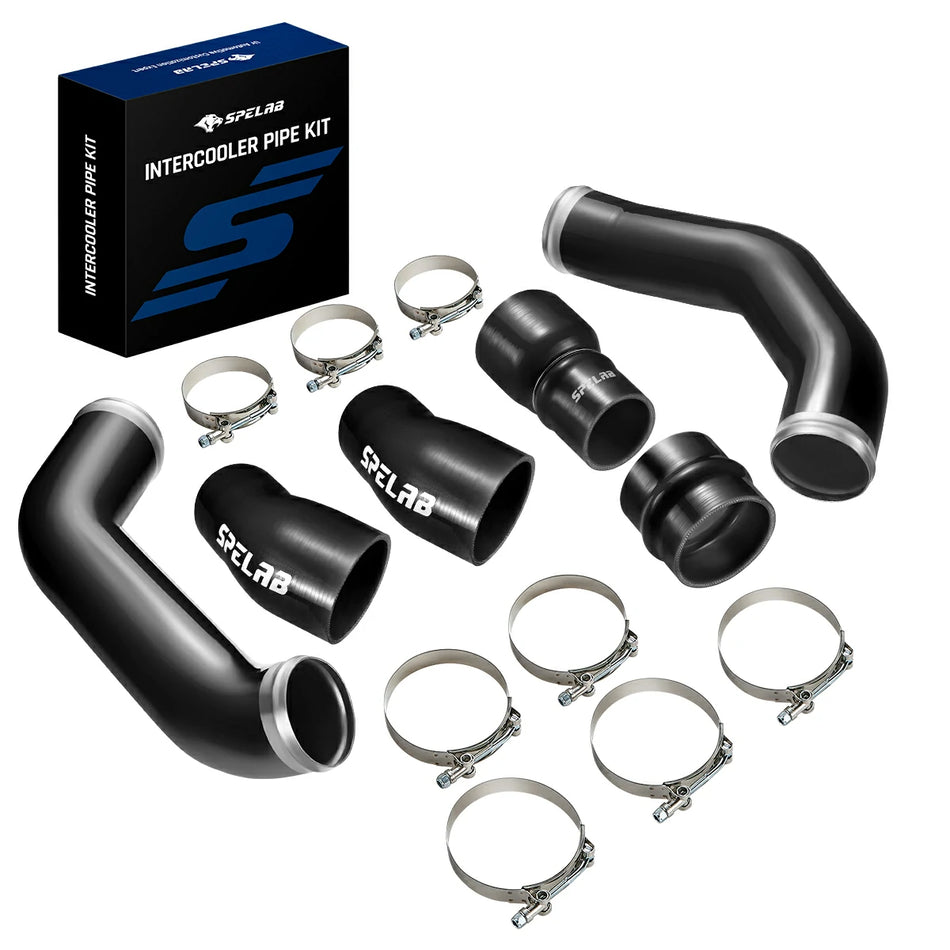
GM Duramax engine codes can be confusing. LB7, LLY, LBZ, LMM, LML, and L5P are not just random letters — they tell you the truck’s generation, emissions system, turbo setup, and which intercooler or pipe kit will actually fit.
This guide helps you identify your Duramax in minutes, then choose the right upgrade path: full intercooler, cold-side pipe kit, hot-side pipe kit, Y-bridge kit, or simple diagnosis before buying parts.
Whether you drive a 2001–2024 Chevy Silverado or GMC Sierra 2500HD/3500HD, the key is simple: identify your engine code first, then match the intercooler system to your truck’s real use case.
Quick Answer: Which Duramax Intercooler Upgrade Do You Need?
If your Duramax has a boost leak, oil residue around pipe joints, a cracked boot, or a loose clamp, start with the intercooler pipes and boots. If the intercooler core is damaged, leaking, heat-soaked, or struggling under towing load, a full intercooler upgrade makes more sense.
| Your Situation | Best First Upgrade |
|---|---|
| Boost leak, hissing under load, oily pipe joint | Intercooler pipe kit |
| LBZ/LMM cold-side leak or Y-bridge issue | Cold-side pipe or Y-bridge kit |
| Cracked factory plastic pipe | Hot-side or cold-side pipe kit |
| Damaged core, cracked end tank, bent fins | Full intercooler |
| High IAT while towing after fixing leaks | Full intercooler |
| Tuned or higher-airflow build | Pipe kit first, then intercooler if heat remains |
| Unsure which Duramax you own | Check VIN / engine code before ordering |
Quick rule: Do not replace the most expensive part first. Find the real weak point: pipe, boot, clamp, Y-bridge, or intercooler core.
Duramax Generations: Quick Identification Guide
The fastest way to identify your Duramax is by checking the engine code or the 8th digit of your VIN. Model years can overlap, especially around 2004.5, 2006, and 2007.5, so always verify before ordering parts.
| 8th VIN Digit | Engine Code | Common Years | Turbo Type | Stock Power Range | DPF? | Intercooler Notes |
|---|---|---|---|---|---|---|
| 1 | LB7 | 2001–2004 | Fixed-geometry turbo | About 300 hp / 520 lb-ft | No | Older trucks; inspect core condition first |
| 2 | LLY | 2004.5–2006 | Variable-geometry turbo | About 310 hp / 605 lb-ft | No | Heat and airflow upgrades are common |
| D | LBZ | 2006–2007 | Variable-geometry turbo | About 360 hp / 650 lb-ft | No | Enthusiast favorite; strong pipe and Y-bridge upgrade demand |
| 6 | LMM | 2007.5–2010 | Variable-geometry turbo | About 365 hp / 660 lb-ft | Yes | Similar upgrade path to LBZ, but DPF-era heat matters |
| 8 | LML | 2011–2016 | Variable-geometry turbo | About 397 hp / 765 lb-ft | Yes | Popular towing platform; pipe and core upgrades both matter |
| Y | L5P | 2017–2024+ | Electronically controlled variable-vane turbo | 445 hp / 910 lb-ft; 2024+ up to 470 hp / 975 lb-ft | Yes | Strong factory system; verify fitment carefully |
Important: LBZ, LMM, LML, and L5P intercooler parts are not universally interchangeable. Pipe routing, Y-bridge design, outlet diameter, brackets, and emissions-era packaging can change by generation.

Why Duramax Engine Codes Matter for Intercooler Fitment
A Duramax intercooler upgrade is not just about buying a bigger core. The engine code affects:
- Turbo outlet routing
- Hot-side pipe shape
- Cold-side pipe layout
- Y-bridge design
- Intercooler inlet and outlet size
- Bracket and mounting location
- Emissions-era packaging
- Sensor and clearance requirements
That is why a part that fits an LBZ or LMM may not fit an LML, and an LML part should not be assumed to fit an L5P.
If you only remember one rule from this guide, remember this:
Choose Duramax intercooler parts by engine code first, then by year, then by truck use case.
Pre-DPF Duramax Platforms: LB7, LLY, and LBZ
LB7, LLY, and LBZ trucks are popular because they are simpler than later emissions-era platforms. For many owners, the upgrade decision comes down to age, boost leaks , towing heat, or performance tuning.
LB7 Duramax Intercooler: 2001–2004
The LB7 is the earliest 6.6L Duramax platform. Today, most LB7 trucks are high-mileage trucks, so intercooler problems are often age-related.
Check for bent fins, corrosion, physical damage, old boots, loose clamps, and reduced cooling under load . If the core is damaged or no longer cooling well, a full intercooler replacement is usually more useful than chasing small pipe upgrades.
Recommended SPELAB option:
SPELAB Intercooler for 2001–2005 LLY/LB7 Duramax
LLY Duramax Intercooler: 2004.5–2006
The LLY introduced important changes, including a variable-geometry turbo setup. These trucks can benefit from stronger charge-air reliability, especially when towing or running performance upgrades.
For LLY trucks, verify fitment carefully because some hot-side pipe products cover 2004.5–2010 applications, while full intercoolers may be grouped with 2001–2005 LB7/LLY applications.
Recommended SPELAB options:
SPELAB Intercooler for 2001–2005 LLY/LB7 Duramax
SPELAB Hot-Side Intercooler Pipe Kit for 2004.5–2010 LLY/LBZ/LMM Duramax
LBZ Duramax Intercooler: 2006–2007
The LBZ is one of the most loved Duramax platforms because it combines strong factory performance, pre-DPF simplicity, and strong aftermarket support.
LBZ owners often look at intercooler upgrades when the truck is tuned, towing heavy, leaking at the cold-side pipe, showing Y-bridge restriction, or seeing IAT rise under load.
For many LBZ owners, the cold-side pipe and Y-bridge upgrade is the smartest first step before replacing the full intercooler.
Recommended SPELAB options:
SPELAB 3.5-Inch Cold-Side Intercooler Pipe Kit for 2006–2010 LBZ/LMM Duramax
SPELAB 3-Inch Y-Bridge and Cold-Side Intercooler Pipe Kit for 2006–2010 LBZ/LMM Duramax
SPELAB Intercooler for 2006–2010 LBZ/LMM Duramax
DPF-Era Duramax Platforms: LMM, LML, and L5P
LMM, LML, and L5P trucks operate with more emissions-related hardware and control strategies than earlier platforms. That does not automatically mean the intercooler is weak, but towing, tuning, heat management, and charge-air leaks deserve more attention.
Monitor IAT, EGT trends, boost behavior, and leak points before assuming the full intercooler is the problem.
LMM Duramax Intercooler: 2007.5–2010
The LMM shares many upgrade patterns with LBZ trucks, but it belongs to the DPF era. That makes heat management and towing conditions more important.
Common LMM upgrade needs include cold-side pipe leak repair, Y-bridge airflow improvement, hot-side pipe replacement, full intercooler upgrades for heat control, and better reliability under towing or tuning.
For most LMM owners, the cold-side pipe or Y-bridge kit is the first high-value upgrade. A full intercooler makes more sense when the core is damaged, leaking, or unable to control intake air temperature under load.
Recommended SPELAB options:
SPELAB 3.5-Inch Cold-Side Intercooler Pipe Kit for 2006–2010 LBZ/LMM Duramax
SPELAB 3-Inch Y-Bridge and Cold-Side Intercooler Pipe Kit for 2006–2010 LBZ/LMM Duramax
SPELAB Intercooler for 2006–2010 LBZ/LMM Duramax
LML Duramax Intercooler: 2011–2016
The LML is one of the most important Duramax platforms for intercooler and pipe kit searches. It is a common towing platform, work-truck platform, and upgrade target.
Unlike the LBZ/LMM layout, the LML uses a different cold-side pipe setup. That means LBZ/LMM cold-side or Y-bridge kits should not be assumed to fit an LML.
LML owners should consider an upgrade when the factory plastic piping is aging or cracked, there are boost leaks under load, the truck tows in hot climates, IAT rises quickly on long grades, or the intercooler core shows damage.
Start with the hot and cold side pipe kit if:
- You have a cracked or aging factory pipe.
- You see oil residue around pipe joints.
- You hear a boost leak under load.
- You find rub marks or tight-clearance contact points.
- The intercooler core is still healthy.
Move to a full intercooler if:
- The core is damaged.
- The end tank area is leaking.
- IAT remains high after fixing pipes and boots.
- The truck tows heavy in hot conditions.
- You want a complete charge-air system refresh.
Mechanic’s Note: On 2011–2016 LML trucks, inspect the hot-side pipe area for rub marks near brackets, lines, or other tight-clearance points. A properly fitted upgraded pipe kit can help reduce weak points, but final clearance should always be checked during installation.
Recommended SPELAB options:
SPELAB Hot & Cold Side Intercooler Pipe Kit for 2011–2016 LML Duramax
SPELAB Intercooler for 2011–2016 LML Duramax
L5P Duramax Intercooler: 2017–2024+
The L5P is a newer and stronger Duramax platform with a more advanced factory system. Stock or lightly modified L5P trucks may not need a full intercooler upgrade immediately.
For 2024+ L5P trucks, factory output increased to 470 hp and 975 lb-ft. That makes towing load, ambient temperature, trailer weight, grade, and driving style more important when judging charge-air performance.
L5P owners should focus on diagnosis first:
- Is IAT actually high under load?
- Is boost lower than expected?
- Are there charge-air leaks?
- Is the truck towing heavy in hot weather?
- Is the truck tuned or used in a higher-airflow setup?
- Does the product page confirm exact L5P fitment?
For L5P trucks, do not assume LML parts will fit. The L5P uses different packaging and should be handled as its own platform.
Recommended action:
Check current SPELAB fitment or contact SPELAB support before ordering L5P-specific intercooler parts.
SPELAB Duramax Product Compatibility Matrix
Use this matrix as a quick shopping guide. Always confirm the product page fitment before ordering.
| Platform | Full Intercooler | Pipe Kit / Y-Bridge | Best Upgrade Path |
|---|---|---|---|
| LB7 / LLY 2001–2005 | Available | LLY hot-side options may apply by exact year | Replace damaged or aging core first |
| LLY / LBZ / LMM 2004.5–2010 | Available for LBZ/LMM, verify LLY fitment | Hot-side pipe available | Good for cracked factory hot-side pipe or high-heat use |
| LBZ / LMM 2006–2010 | Available | Cold-side pipe and Y-bridge available | Pipe/Y-bridge first, then full intercooler if heat remains |
| LML 2011–2016 | Available | Hot & cold side pipe kit available | Pipe kit for leaks, full intercooler for heat control |
| L5P 2017–2024+ | Verify current catalog | Verify current catalog | Diagnose first, then confirm L5P-specific fitment |
Core vs Pipe Kit vs Y-Bridge: Which One Should You Buy?
This is the main buying decision for Duramax owners.
| Upgrade | Best For | Installation Difficulty | When to Choose It |
|---|---|---|---|
| Cold-side pipe kit | Boost leaks, cracked plastic pipe, better airflow | 2/5 | The core is healthy but the cold-side pipe is the weak point |
| Hot-side pipe kit | Heat-damaged pipe, high-pressure side leak | 2–3/5 | You see damage or leakage near the turbo-to-intercooler path |
| Y-bridge kit | LBZ/LMM airflow and leak point improvement | 3/5 | You want to improve the intake-side path on LBZ/LMM trucks |
| Full intercooler | Damaged core, high IAT, towing heat | 4/5 | The core itself is damaged or not cooling well |
| Intercooler + pipe kit | Tuned builds, towing builds, full refresh | 5/5 | You want to remove multiple weak points at once |
Quick rule:
If the truck has a leak, fix the pipe, boot, clamp, or Y-bridge first. If the core is damaged or heat-soaked, upgrade the intercooler.

Common Duramax Intercooler Problems by Generation
Each Duramax generation has its own weak points. Knowing yours helps you avoid buying the wrong upgrade.
| Generation | Common Issue | What to Check First | Recommended Fix |
|---|---|---|---|
| LB7 | Aging core, damaged fins, corrosion | Core condition and boots | Full intercooler if damaged |
| LLY | Heat-related pipe wear, aging boots | Hot-side pipe and clamps | Hot-side pipe or intercooler |
| LBZ | Cold-side leaks, Y-bridge restriction | Cold-side pipe and Y-bridge area | Cold-side pipe or Y-bridge kit |
| LMM | Boost leaks and towing heat | Pipes, Y-bridge, IAT trends | Pipe/Y-bridge first, then intercooler |
| LML | Factory plastic piping, high IAT while towing | Hot/cold pipes, rub marks, and core | Pipe kit or full intercooler |
| L5P | Fitment-specific limitations | Exact product compatibility | Diagnose first, verify L5P fitment |
3-Minute Duramax Boost Leak Self-Check
Before buying a full intercooler, run through this checklist:
- Do you hear a hiss, whistle, or whoosh under acceleration?
- Does boost read lower than usual?
- Does the truck feel weak while towing?
- Is there black smoke under load?
- Do you see oil residue around a boot, clamp, or pipe joint?
- Does IAT climb quickly on long grades?
- Has the truck triggered an underboost-related code?
If you checked two or more boxes, inspect the charge-air pipes, boots, clamps, and Y-bridge area before replacing the intercooler core.

LBZ and LMM: Why the Y-Bridge Matters
The LBZ and LMM platforms are unique because the cold-side path and Y-bridge area are common upgrade points. A Y-bridge kit is not the same thing as a basic intercooler pipe.
A cold-side pipe helps move cooled charge air from the intercooler toward the engine. A Y-bridge helps distribute that air into the intake side more efficiently.
For LBZ/LMM owners, a Y-bridge kit can make sense when:
- The truck is tuned.
- The factory plastic parts are aging.
- You want better airflow consistency.
- You are already upgrading the cold-side pipe.
- You are chasing boost drop or intake-side leaks.
Pro Tip: If you are already working around the intake bridge area, inspect nearby fuel lines, wiring, and hose routing while access is open. Fuel-system upgrades such as a lift pump or CP3-related work should be planned separately based on fueling goals, not simply because you are replacing an intercooler pipe.
Recommended SPELAB option:
SPELAB 3-Inch Y-Bridge and Cold-Side Intercooler Pipe Kit for 2006–2010 LBZ/LMM Duramax
Factory-Style End Tanks vs Upgraded Intercooler Construction
On older, higher-mileage, or higher-boost Duramax trucks, the intercooler core and end tank areas should be inspected carefully. Factory-style construction can become a leak point over time, especially when the truck tows heavy or runs higher airflow demand.
This does not mean every factory intercooler will fail. But if the core is leaking, cracked, corroded, or no longer controlling IAT under load, a stronger upgraded intercooler becomes a reliability upgrade, not just a performance part.
Clamp Torque Reference for Intercooler Pipes
Clamp torque matters because both under-tightening and over-tightening can cause problems. A loose clamp can let a boot blow off under boost, while an overtightened clamp can damage silicone boots or distort the connection.
Always follow the clamp manufacturer’s instructions first. The numbers below are general reference ranges, not universal specs.
| Clamp Type | General Reference Range | Note |
|---|---|---|
| Standard worm-gear clamp | Snug by hand tool, do not overtighten | Avoid cutting into silicone boots |
| Standard T-bolt clamp | Often around 40–75 in-lbs | Depends on clamp size, thread, and material |
| Constant-torque T-bolt clamp | Sometimes higher, around 75–125 in-lbs | Verify the clamp’s rated torque before tightening |
Important: Use inch-pounds, not foot-pounds. Intercooler pipe clamps are usually tightened in in-lbs, and using ft-lbs by mistake can damage the boot, clamp, or pipe connection.
Installation Tips and Boot Blow-Off Prevention
Most Duramax pipe kit installations are manageable for experienced DIY owners, but clamp alignment and boot seating matter.
Before installation:
- Let the engine cool completely.
- Confirm engine code and product fitment.
- Compare new parts with factory parts.
- Clean all mating surfaces.
- Inspect boots, clamps, and mounting points.
- Check for rub marks near brackets, wiring, and nearby lines.
During installation:
- Seat silicone boots evenly.
- Keep pipe alignment natural, not forced.
- Avoid clamp interference with nearby parts.
- Make sure the pipe bead is fully inside the boot.
- Use inch-pound torque references where applicable.
- Recheck clamps after the first heat cycle.
Boot blow-off usually happens when the silicone boot slips off the pipe under boost pressure. Common causes include oil residue, poor boot seating, clamp misalignment, worn clamps, or incorrect clamp torque.
Pro Tip from the shop: Clean the pipe ends and the inside of the silicone boots with brake cleaner or an approved residue-free cleaner, then let everything dry before installation. Do not rely on shortcuts to compensate for poor fitment, worn clamps, or oily surfaces.
Best Upgrade Path by Use Case
| Truck Use | What to Check First | Best Upgrade Path |
|---|---|---|
| Daily driver | Boots, clamps, core condition | Repair leaks before upgrading the core |
| Tow rig | IAT, EGT trends, boost leaks | Pipe kit first, full intercooler if heat remains |
| Tuned truck | Boost leaks, boot slip, clamp condition | Pressure test, then upgrade weak points |
| Big turbo build | Airflow demand and heat soak | Intercooler + pipe kit |
| High-mileage truck | Core damage, corrosion, old boots | Inspect first, replace the weakest part |
Duramax Shopping List Creator
Use this quick list to match your goal with the right upgrade.
| Your Goal | Suggested Shopping List |
|---|---|
| Fix a boost leak | Boots, clamps, and the correct hot-side or cold-side pipe kit |
| Improve LBZ/LMM intake-side airflow | Cold-side pipe kit + Y-bridge kit |
| Improve LML pipe durability | Hot & cold side intercooler pipe kit |
| Control IAT while towing | Full intercooler after confirming there are no pipe leaks |
| Refresh a high-mileage truck | Inspect core, boots, clamps, pipes, and Y-bridge before ordering |
| Build a full charge-air upgrade | Intercooler + hot-side pipe + cold-side pipe + clamps |
| Prepare for higher-airflow tuning | Pressure test first, then upgrade weak pipes and core as needed |
Recommended SPELAB Duramax Upgrade Paths
| Platform | Recommended Starting Point |
|---|---|
| LB7 / LLY | Full intercooler if the factory core is damaged, aging, or inefficient |
| LBZ / LMM | Cold-side pipe or Y-bridge kit first; full intercooler if heat control or core damage is the issue |
| LML | Hot & cold side pipe kit for leaks, rub marks, or aging factory piping; full intercooler for heat control |
| L5P | Diagnose first and verify exact L5P-specific fitment before ordering |
Duramax Intercooler FAQ
Q: How do I know which Duramax engine I have?
A: Check the 8th digit of your VIN or confirm the engine RPO code. Common Duramax VIN digits include 1 for LB7, 2 for LLY, D for LBZ, 6 for LMM, 8 for LML, and Y for L5P.
Q: What years are LBZ, LMM, LML, and L5P Duramax engines?
A: LBZ is generally 2006–2007, LMM is 2007.5–2010, LML is 2011–2016, and L5P is 2017–2024+. Because transition years can overlap, always confirm by VIN before buying parts.
Q: Does an LBZ Duramax need an intercooler upgrade?
A: Not always. If the truck is stock, the core is healthy, and IAT is normal, start with inspection. If the truck is tuned, towing heavy, or showing boost leaks, a cold-side pipe or Y-bridge kit is often the better first upgrade.
Q: What is the difference between a Duramax intercooler and a pipe kit?
A: The intercooler core cools compressed air. A pipe kit replaces the charge-air pipes, boots, and connections that carry air to and from the core. Many boost problems come from pipes and boots, not the core itself.
Q: Is an LBZ cold-side pipe kit the same as an LML pipe kit?
A: No. LBZ/LMM and LML trucks use different layouts. The LBZ/LMM platform commonly uses a Y-bridge cold-side design, while the LML uses a different cold-side pipe configuration.
Q: Can a Duramax boost leak cause black smoke or high EGT?
A: Yes. A boost leak can reduce the amount of air reaching the engine, which may lead to poor combustion, black smoke, lower power, and higher exhaust temperature under load.
Q: Should I upgrade the Y-bridge with the cold-side pipe?
A: For LBZ and LMM owners, it can make sense if you are already upgrading the cold-side path. A Y-bridge kit helps address intake-side airflow and sealing points that a basic pipe alone may not solve.
Q: Does an LML Duramax need a full intercooler or just a pipe kit?
A: If the factory pipes are cracked, leaking, rubbing, or aging, start with the hot and cold side pipe kit. If the intercooler core is damaged or IAT remains high after fixing leaks, choose a full intercooler.
Q: What causes a Duramax intercooler boot to blow off?
A: Boot blow-off is usually caused by oil residue, poor boot seating, clamp misalignment, worn clamps, or incorrect clamp torque. Clean the pipe and boot surfaces, seat the boot over the bead, and tighten the clamp to the correct inch-pound spec.
Q: How tight should Duramax intercooler pipe clamps be?
A: Always follow the clamp manufacturer’s torque spec. As a general reference, some T-bolt clamps are tightened around 40–75 in-lbs, while some constant-torque clamps may be higher. Do not confuse inch-pounds with foot-pounds.
Q: Does an L5P Duramax need a bigger intercooler?
A: Stock and lightly modified L5P trucks often have a strong factory system. If the truck tows heavy, runs higher airflow demand, or shows high IAT, diagnose first and confirm L5P-specific fitment before ordering parts.
Q: Do Duramax intercooler pipe kits require tuning?
A: Most intercooler pipe kits are airflow and reliability upgrades and do not require tuning by themselves. Always follow the product instructions and make sure the part fits your exact engine code and model year.
Final Recommendation
The best Duramax intercooler upgrade starts with engine identification.
If you own an LB7 or LLY, focus on core condition and age-related wear. If you own an LBZ or LMM, pay close attention to the cold-side pipe and Y-bridge. If you own an LML, inspect both the hot and cold side pipes, including rub marks and clearance points. If you own an L5P, diagnose first and verify exact fitment before ordering.
Do not replace the most expensive part first. Find the real weak point: pipe, boot, clamp, Y-bridge, or core.
Best starting point:
Identify your engine code, inspect the charge-air system, then choose the SPELAB intercooler or pipe kit that matches your Duramax generation.
Related Reading

John Lee
Mechanical Engineer | 10+ Years Experience
John has spent the last decade engineering and testing high-performance automotive components. Specializing in drivetrain durability and thermal management across Powerstroke, Cummins, and Duramax applications, he bridges the gap between OEM limitations and aftermarket performance. His philosophy: "Factory parts are just a starting point."