Updated on August 10, 2026.
Summer does not create most diesel-truck failures. Heat, Payload, trailer load, slow airflow, and long grades expose the weak hose, tired fan clutch, loose CAC boot, underinflated tire, contaminated fluid, or marginal electrical connection that was already there.
Quick Answer: What Should a Diesel Truck Pass Before Summer Towing?
A tow-ready Ford Power Stroke, Ram Cummins, or GM Duramax should pass seven checks:
- Tires, wheel ends, Payload, tongue weight, and trailer load
- Cooling-system pressure, airflow, coolant condition, hoses, and fan operation
- Charge-air pipes, CAC boots, clamps, intake restriction, and boost control
- Engine oil, transmission fluid, axle lubricant, and temperature trends
- Truck brakes, trailer brakes, brake fluid, and downhill control
- A/C, batteries, alternator, belts, tensioners, and electrical load
- DPF regeneration, DEF, exhaust heat, fault codes, and derate warnings
Do not call the truck ready after five minutes of unloaded idling. The useful test is a controlled drive with the scan data, load, ambient temperature, speed, gear, and grade recorded.
Model-Year Boundaries Matter Before Any Heat Diagnosis
Power Stroke, Cummins, and Duramax are engine families, not single cooling diagrams. Confirm the VIN, engine code, transmission, axle, emissions configuration, cab/chassis type, and current OEM service information before applying a temperature limit or ordering a Bolt-on part.
| Platform group | Summer systems to identify | Fitment warning |
|---|---|---|
| 2011-2019 Ford Super Duty 6.7L Power Stroke | 6R140 transmission, primary and secondary cooling layouts by generation, CAC pipes, fan drive, dual batteries where equipped | A 6R140 pan does not fit a 2020-and-newer ten-speed just because the engine is still a 6.7L. |
| 2019-2024 Ram 2500/3500 6.7L Cummins | Charge-air plumbing, cooling stack, fan, 68RFE or Aisin application, DPF/SCR/DEF system, trailer configuration | 2018 and 2019 use different truck generations and pipe routing. Stock-location turbo and intercooler connections still need verification. |
| 2017-2019 GM HD 6.6L L5P Duramax | Upper coolant plumbing, low-temperature circuit, Allison application, grille-stack airflow, DEF and aftertreatment | Do not order from the L5P engine name alone; early and later coolant-tube variants use different selections. |
| 2020-2025 GM HD 6.6L L5P Duramax | Revised chassis and transmission application, upper pipe connections, engine and low-temperature cooling circuits | A product page covering 2017-2025 can still contain separate 2017-2019 and 2020-2025 SKUs. |
A modified bumper, winch, snowplow mount, light bar, grille insert, larger intercooler, body lift, or relocated turbo can change airflow and clearance even when the year and engine match.
Baseline Data to Record Before the First Hot Day
| Baseline item | How to record it | Why it matters |
|---|---|---|
| Ambient temperature | Record outside air temperature and whether the truck was heat-soaked | A 95°F restart in traffic is not comparable to a 60°F cold morning. |
| Truck and trailer weight | Use scale weights for steer, drive, and trailer axles when possible | Payload and tongue or pin weight change tire, brake, axle, and cooling load. |
| Engine data | Log coolant temperature, oil temperature where available, rpm, load, boost or MAP, and intake-air data | Trends under the same grade are more useful than one peak number. |
| Transmission data | Record commanded gear, actual gear, converter-clutch state or slip where supported, and fluid temperature | High transmission heat can add load to the cooling stack or signal clutch and converter trouble. |
| Aftertreatment state | Note active regeneration, soot estimate, exhaust temperatures, DEF warnings, and related codes where the scan tool supports them | A regeneration event changes exhaust heat and can confuse an A/B road test. |
| Cooling pressure and level | Mark cold level, inspect cap and bottle, and pressure-test to the vehicle procedure | A small pressure leak may only vent coolant under a loaded climb. |
Save the route and repeat it after repair. If the test uses a different trailer, gear, speed, or ambient temperature, say so instead of presenting the two logs as a clean before-and-after result.
1. Tires, Wheel Ends, and Load: Heat Starts at the Pavement
Check tire pressure cold, meaning the truck has been parked for at least three hours. Use the vehicle Tire and Loading Information label for the OEM configuration, then use actual axle weights and approved tire-manufacturer load tables when non-stock LT tires, DRW configurations, or trailer tires require a different calculation. The number molded into the tire sidewall is a maximum rating, not the truck's universal target pressure.
- Inspect tread, inner duals, sidewalls, valve stems, wheel damage, and the spare.
- Read the full DOT date code and follow the vehicle and tire manufacturer's age guidance.
- Confirm that truck and trailer tires have enough load capacity at the selected pressure.
- Check lug hardware using the correct procedure and calibrated torque wrench; do not invent one torque value for every wheel.
- Trend hub and tire temperatures at fuel stops with the same tool and measurement point. A hand touch is not a calibrated wheel-bearing test.
- Investigate one position that repeatedly runs hotter than its matching axle position.
A Load Range E or F marking cannot rescue an overloaded axle, damaged carcass, wrong wheel rating, leaking valve stem, or old trailer tire. Do the scale math before adding more Jobsite gear.
2. Cooling System: Separate Pressure, Flow, and Airflow
When a diesel only runs hot while towing uphill, the root cause can be on the coolant side, air side, combustion side, or transmission side. Start cold and inspect the entire heat-rejection path.
| Failure path | Real clues | Next test |
|---|---|---|
| Pressure loss | Crust at a quick-connect, wet bottle seam, hose-end staining, sweet odor, falling cold level | Cold pressure test, cap test, UV dye only when compatible, and inspection after a loaded heat cycle |
| Restricted coolant flow | Uneven temperature behavior, heater changes, slow recovery, contamination, repeated local boiling | Verify thermostat operation, pump performance, coolant specification, service history, and circuit-specific procedure |
| Weak air movement | Runs hotter at low road speed, with A/C, or while backing a trailer | Inspect fan command and engagement, shroud, condenser, radiator, CAC, auxiliary coolers, and blocked grille area |
| Combustion pressure entering coolant | Hard hose from cold start, repeated venting, unexplained coolant loss, bubbles, or pressure rising too fast | Use the platform service procedure for pressure behavior, leak-down, gas detection, and cooler isolation |
| Transmission heat load | Temperature climbs while converter is unlocked, backing uphill, or in stop-and-go towing | Log gear and converter behavior, inspect fluid and cooler flow, and verify the transmission cooling circuit |
Clean the cooling stack carefully from the correct side. Bugs, cottonwood, mud, chaff, and bent fins can be trapped between the A/C condenser, charge air cooler, radiator, and auxiliary heat exchangers where a quick front-facing glance misses them.
To separate hard pipe, flexible hose, quick-connect, and sealing failures, use the coolant pipe and hose comparison. Aluminum plumbing can remove an aging plastic failure point, but it cannot fix a weak fan, blocked radiator, bad thermostat, failing pump, combustion leak, or wrong coolant.
A Platform-Specific Temperature Example, Not a Universal Limit
The 2024 Ram 2500/3500 owner's manual gives the 6.7L diesel a specific example: it says engine coolant must not exceed the normal gauge range of 240°F (116°C) with a 21 psi (145 kPa) pressure cap. That is a Ram model-year statement, not a universal Power Stroke or Duramax threshold and not permission to continue towing at the edge of a warning.
If the gauge moves into its warning area, a red temperature warning appears, coolant vents, power is reduced, or the temperature keeps climbing after load is reduced, get out of the throttle and follow the owner's manual. Do not open a hot pressure cap.
Likewise, an engine-oil-to-coolant temperature delta is only meaningful under the platform's specified test conditions. A number used to diagnose one Power Stroke generation should not be copied to every Cummins or Duramax.
3. Charge-Air System: P0299 Is a Result, Not a Parts Order
Hot silicone, oil-softened couplers, loose clamps, cracked plastic pipes, worn turbo control hardware, dirty filters, sensor bias, exhaust leaks before the turbo, and aftertreatment restriction can all reduce delivered boost. P0299 identifies underboost; it does not identify the failed part.
- Inspect both hot- and cold-side pipes, not only the easy coupler at the intake.
- Check pipe beads, clamp position, boot cuts, oil saturation, contact marks, and bracket alignment.
- Pressure- or smoke-test the charge-air system with regulated equipment and the platform's safe procedure.
- Compare commanded and actual boost or MAP while logging rpm, load, gear, intake temperature, and turbo control data.
- Check the intake filter, airbox seal, sensor plausibility, VGT or wastegate control, and pre-turbo exhaust leaks.
- Do not treat visible black tailpipe smoke as a normal boost-leak indicator on a road-driven truck with an intact DPF.
The intercooler and radiator diagnostic guide explains why high intake-air temperature and high engine-coolant temperature need different tests.
Pipe Area Is Not Measured Flow
The 2019-2024 Ram product page lists a 2.75-inch factory hot-side pipe, a 3.1-inch factory cold-side pipe, and 3.5-inch replacements. Using A = pi x r2, the geometric area change is about 62% from 2.75 to 3.5 inches and about 27% from 3.1 to 3.5 inches.
The same page uses several different 55%, 57%, 24%, and 25% flow statements. Diameter math does not measure airflow. A defensible flow claim needs a test fixture, pressure drop, mass flow, temperature, pipe length, bends, couplers, and test method. The practical reason to replace a pipe is verified restriction, leakage, repeated boot movement, or material failure, not the biggest percentage on the page.
4. Oil, Transmission, and Axle Heat
Check fluid level and condition using the correct hot or cold procedure for the specific truck. Smell and color are screening clues, not a laboratory analysis. A normal-looking fluid can still be wrong, oxidized, diluted, contaminated, or overdue under the severe-service schedule.
| System | Log or inspect | What an upgrade cannot do |
|---|---|---|
| Engine oil | Correct specification, level, pressure warning, temperature trend, dilution clues, filter, and service interval | An oil cooler cannot compensate for low oil, wrong viscosity, fuel dilution, bearing wear, or blocked coolant flow. |
| Automatic transmission | Fluid procedure, shift quality, converter slip or lock state, cooler lines, pan seepage, codes, and loaded temperature | A deeper pan does not repair worn clutches, a slipping converter, low line pressure, blocked cooler, or bad calibration. |
| Rear axle | Correct lubricant, level, water contamination, vent, seal leaks, bearing noise, backlash symptoms, and housing temperature trend | A finned cover does not correct wrong preload, damaged gears, low oil, or an overloaded axle. |
Read how load, coolant flow, and heat-exchanger condition affect oil temperature during towing before buying a larger cooler.
5. Brakes and Trailer Control: Heat Fade Is a System Problem
Inspect pad or shoe thickness, rotor or drum condition, caliper movement, hoses, wheel seals, brake fluid, parking brake, ABS warnings, and the trailer system. Test the integrated controller, gain setting, 7-way connection, breakaway battery and cable, magnets or hydraulic actuator, and every light before the grade.
Do not judge brake fluid only by color or use a cheap conductivity pen as a universal boiling-point measurement. Follow the OEM fluid specification and service procedure, and use test equipment approved for the fluid type when condition testing is required.
Use Tow/Haul and the factory exhaust brake as the owner's manual directs. They support speed control but do not increase GVWR, GAWR, GCWR, receiver rating, tire capacity, or available Payload.
6. A/C, Batteries, Belt Drive, and Idle Load
High cabin-cooling demand adds condenser heat in front of the engine cooling stack. At low road speed, the truck depends heavily on fan airflow. If temperature climbs in traffic with the A/C on but recovers at highway speed, inspect fan operation and stacked heat exchangers before blaming the radiator core alone.
- Inspect belt ribs, tensioner travel, pulley bearings, fan drive, and any coolant-pump drive.
- Test dual batteries individually with the pair isolated according to the service procedure.
- Measure voltage drop on positive and ground paths during cranking and high electrical load.
- Check alternator output with A/C, blower, lights, trailer loads, and auxiliary equipment operating.
- Inspect aftermarket winch, inverter, light-bar, and trailer wiring for undersized conductors, loose grounds, and heat damage.
- Never leave a child, dependent adult, or pet alone in a parked truck.
7. DPF Regeneration, DEF, and Exhaust Heat
An active DPF regeneration raises exhaust temperature by design. Note regeneration status during a diagnostic pull so a hot exhaust event is not mistaken for a cooling-system repair result. Follow the truck's messages and owner's manual; do not park over dry grass or other combustible material when the exhaust is hot.
- Use DEF meeting the specification in the owner's manual and keep dirt, fuel, water, and coolant out of the tank.
- Do not top DEF with an unsealed mystery jug that has been stored in direct sun for years.
- Investigate repeated short regeneration intervals with soot-load data, differential-pressure readings, temperature sensors, engine faults, duty cycle, and oil-ash history.
- A DPF warning, DEF quality warning, reduced-power message, or P20EE/P2463 family code needs diagnosis, not a delete shortcut. For the legal and financial side of that decision, read this DPF-delete laws and restoration-cost guide.
- Do not assume a hot smell after towing is only regeneration; inspect leaks, wiring, brakes, hubs, and fluid on hot components.
The GM 2025 6.6L Duramax supplement calls for DEF that meets ISO 22241 or carries the API DEF certification mark, CK-4 or CJ-4 engine oil as specified, and DEX-COOL for the cooling circuits. Specifications vary by platform and model year, so use the manual for the truck in front of you.
Track Towing Fuel Economy and DEF Use Without Guessing
There is no honest universal claim for how many MPG a diesel pickup will lose while towing or how many miles one tank of DEF will last. Trailer frontal area and drag, speed, grade, wind, combined weight, tire setup, axle ratio, regeneration activity, idle time, temperature, and calibration can move both numbers. A tall travel trailer may demand more power than a lower trailer of similar scale weight.
- Start with a full fuel tank, record the odometer, trailer configuration, certified scale weights, route, speed, weather, and regeneration activity.
- Hand-calculate fuel economy over at least two or three comparable fills by dividing miles traveled by gallons added. Use the dash display as a trend, not the only measurement.
- For DEF, record the odometer and exact amount added from a sealed container or pump. Track DEF gallons per 1,000 miles over comparable towing runs.
- Do not confuse DEF consumption with DPF regeneration frequency. DEF is dosed into the SCR system; regeneration manages soot in the DPF.
- Investigate a sudden change with scan data, codes, leaks, duty cycle, fuel economy, and aftertreatment status before blaming one tank, sensor, or fluid.
This log gives the owner a usable range for that truck and trailer. It also shows whether a change followed a heavier load, faster road speed, headwind, frequent regeneration, excessive idle time, or an actual fault.
What Three Current Products Can and Cannot Address
These are fitment examples, not instructions to replace a part before diagnosis. Prices and availability are storefront snapshots checked on August 10, 2026.
| Product | Published fitment and hardware | What it may address | What still needs proof or diagnosis |
|---|---|---|---|
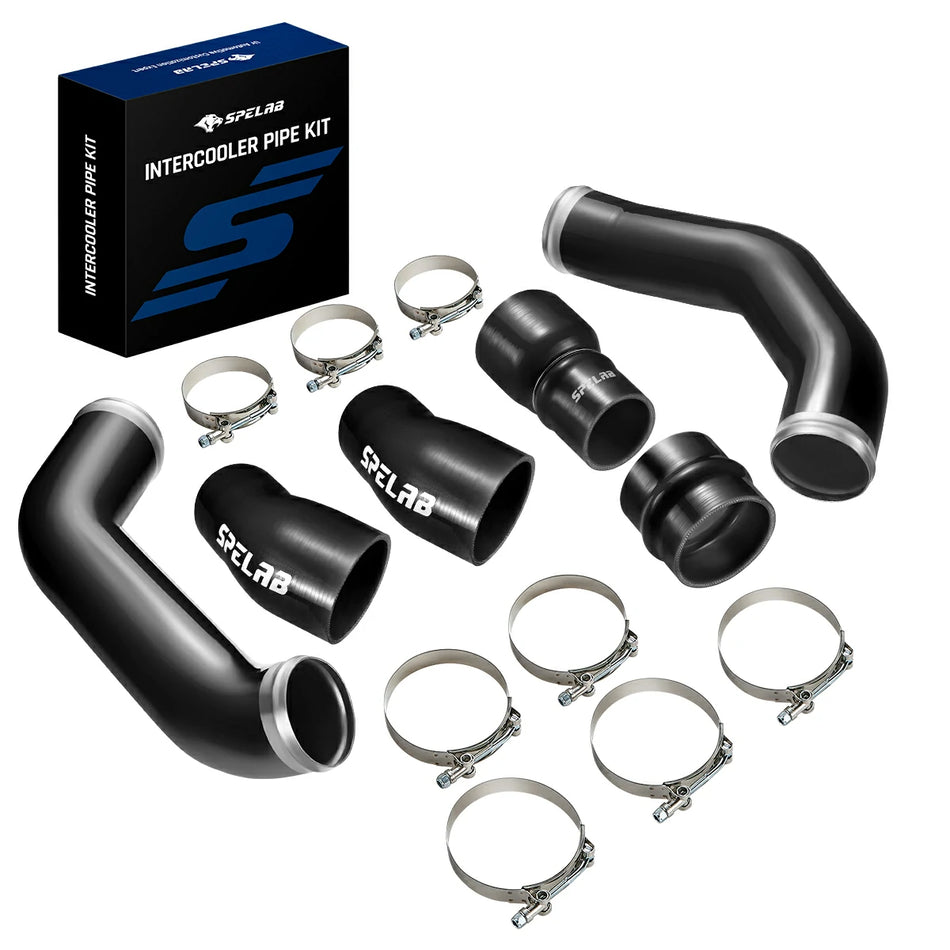
| Intercooler Pipe Kit for 2019-2024 Dodge Ram 2500/3500 6.7L Diesel | SPELAB | 3.5-inch T6061 aluminum hot- and cold-side options, reinforced silicone, spring-loaded T-bolt clamps, stock-location turbo and intercooler interfaces | Verified leaking, split, restrictive, or repeatedly moving factory charge plumbing | Published flow percentages need a real flow and pressure-drop test. The full bundle was unavailable while separate sides displayed at $169 each. |
| 6R140 Transmission Pan for 2011-2019 Ford 6.7L Powerstroke F250 F350 F450 | SPELAB | Cast-aluminum deep pan, fins, baffles, magnetic drain plug, 1/8-inch NPT port, listed factory-filter compatibility | Service access, additional fluid capacity when confirmed, sensor provision, and a more rigid pan | The listed 15-20% temperature reduction, doubled maintenance interval, and impact claims need test data. Confirm fill procedure, ground clearance, gasket, torque sequence, and actual 6R140 application. Displayed price: $299.99. |
| Upper Coolant Tube for 2017-2025 L5P 6.6L Duramax Chevy/GMC 2500HD/3500HD Coolant Pipe Kit | SPELAB | 6061-T6 aluminum pipe, silicone couplers, T-bolt clamps, separate 2017-2019 and 2020-2025 variants | Aging plastic, rubber, coupler, or connection problems in the covered upper plumbing | A pipe alone should not be assumed to lower thermostat-controlled operating temperature by the advertised 20-25°F. Diagnose cap, thermostat, fan, radiator, pump, pressure loss, and combustion leakage. Displayed price: $139. |
Use the diesel cooling-system collection only after identifying the failed circuit and exact fitment.

Conventional, Gooseneck, and Fifth-Wheel Loads Change the Heat Test
Do not compare two tow rigs by trailer weight alone. A conventional bumper-pull places tongue weight behind the rear axle, while a gooseneck or fifth-wheel applies pin weight near the rear axle in the bed. That changes rear-axle load, available Payload, steering feel, tire demand, hitch loading, and how the truck behaves during a hot uphill pull or low-speed backing maneuver.
| Trailer connection | Manufacturer planning example | What to verify on the loaded truck |
|---|---|---|
| Conventional bumper-pull | Chevrolet's 2024 guide uses 10% to 15% of loaded trailer weight as a conventional tongue-weight planning range. | Actual tongue weight, receiver and ball rating, weight-distribution requirements, front and rear axle scale weights, sway control, tire load, and rear suspension clearance |
| Gooseneck or fifth-wheel | The same Chevrolet guide uses 15% to 25% of loaded trailer weight as a kingpin-weight planning range. | Actual pin weight, hitch position and rating, bed clearance, rear GAWR, tire capacity, truck Payload, and total GCWR |
Those percentages are Chevrolet planning examples, not universal loading instructions. Use the exact truck owner's manual, certification labels, hitch documentation, trailer limits, and certified scale readings. A gooseneck may tow steadily, but its higher pin load can consume Payload and rear-axle capacity fast. No intercooler pipe, transmission pan, coolant tube, spring, or air bag raises the truck's certified GVWR, GAWR, GCWR, hitch rating, or tire capacity.
Real-World Summer Scenarios
| Scenario | Data and inspection priority | Common wrong conclusion |
|---|---|---|
| Towing a camper up a long grade | Actual weights, coolant trend, fan operation, transmission gear and converter state, boost, IAT, regeneration status | Every temperature rise means the radiator is too small. |
| Backing a trailer uphill | Low-speed fan airflow, converter slip, transmission temperature, steering load, hitch and tire clearance | A deep transmission pan can repair converter or clutch slip. |
| Jobsite idling with A/C | Fan command, condenser blockage, charging voltage, battery state, coolant temperature, idle hours, regeneration behavior | No warning light means the cooling stack is clean. |
| Off-roading at low speed | Mud-packed fins, fan and shroud damage, pipe contact, underbody clearance, axle vents, water contamination | Highway cooling performance guarantees crawling performance. |
| Desert highway and crosswind | Tire pressure and load, sustained EGT and coolant trends, road debris, A/C demand, fuel and DEF range | One peak temperature without the load and duration proves a failed component. |
| High-mileage tow rig | Service history, pressure leaks, fan performance, belt drive, batteries, cooler cleanliness, fluid analysis, wheel bearings | Replacing the largest visible part is more useful than building baseline data. |
A Three-Stage Summer Test Plan
- Cold inspection: Check fluids, pressure, tires, belts, hoses, batteries, wiring, brakes, CAC pipes, leaks, and scan history before starting.
- Controlled unloaded test: Warm the truck, verify fan and A/C behavior, check shifts, inspect for leaks, and establish a repeatable data log.
- Loaded verification: Stay within every rating, use a known route, log the same channels, stop if warnings appear, and inspect again after full cool-down.
On the 2024 Ram 6.7L diesel, the owner's manual gives post-load idle examples ranging from less than one minute in empty stop-and-go use to five minutes after maximum-GCWR uphill operation. That does not create a five-minute rule for every diesel. Match shutdown practice to the truck's manual, actual load, and turbo temperature.
Official Sources
- NHTSA Summer Driving and Road Trip Tips
- NHTSA TireWise safety guidance
- 2024 Ram 2500/3500 owner's manual
- Ford 2019 Super Duty 6.7L diesel owner information
- 2024 Chevrolet trailering guide
Frequently Asked Questions
Q: What coolant temperature is too hot for every diesel truck?
A: There is no single universal number. Use the exact owner's manual, gauge warnings, scan data, load, and trend for the model year. For example, the 2024 Ram 6.7L manual identifies 240°F as the top of its normal gauge range, but that number should not be copied to every Power Stroke or Duramax.
Q: Does P0299 in hot weather mean the turbo is bad?
A: No. P0299 means the measured boost was below the expected value. Check charge-air leaks, boots, pipes, clamps, intake restriction, sensor accuracy, turbo control, pre-turbo exhaust leaks, EGR-related faults, and aftertreatment restriction before condemning the turbocharger.
Q: Should I bleed air from a hot tire until it matches the cold placard pressure?
A: No. Pressure rises as the tire heats. Check and set pressure cold according to the vehicle label and applicable load data, then investigate abnormal loss or one tire that trends differently. Recheck cold after the truck has been parked.
Q: Should a yellowed coolant reservoir be replaced immediately?
A: Yellowing alone is a warning to inspect closely, not proof of failure. Replace the tank when it is brittle, cracked, distorted, seeping, unable to seal at the cap or connection, or otherwise fails the platform inspection and pressure test.
Q: Will a deeper transmission pan stop overheating while towing?
A: Not by itself. More fluid and external fins may change thermal behavior, but the pan cannot repair converter slip, clutch wear, low pressure, a blocked cooler, wrong fluid, overloading, or a bad calibration. Verify temperature claims with a controlled before-and-after test.
Q: Should I idle a diesel for five minutes after every drive?
A: No. Cool-down time depends on load, turbo temperature, platform, and the owner's manual. The 2024 Ram table reaches five minutes after maximum-GCWR uphill work, while empty stop-and-go use is listed at less than one minute.
Q: How much fuel economy and DEF range should I expect while towing?
A: There is no universal MPG drop or DEF refill interval. Trailer drag, speed, grade, wind, weight, regeneration, idle time, temperature, and calibration all matter. Hand-calculate fuel economy across comparable fills and track DEF gallons added per 1,000 miles for your truck and trailer. Diagnose a sudden unexplained change with scan data instead of treating one trip as the new normal.
About the Author
John Lee, Mechanical Engineer | More Than a Decade of Experience
John Lee writes from a garage-first perspective shaped by diesel cooling, charge-air, drivetrain, towing, and fitment work across Power Stroke, Cummins, and Duramax platforms. His approach is simple: measure the truck under the load that causes the problem, verify the exact model-year service data, and repair the failed system before buying a larger part.