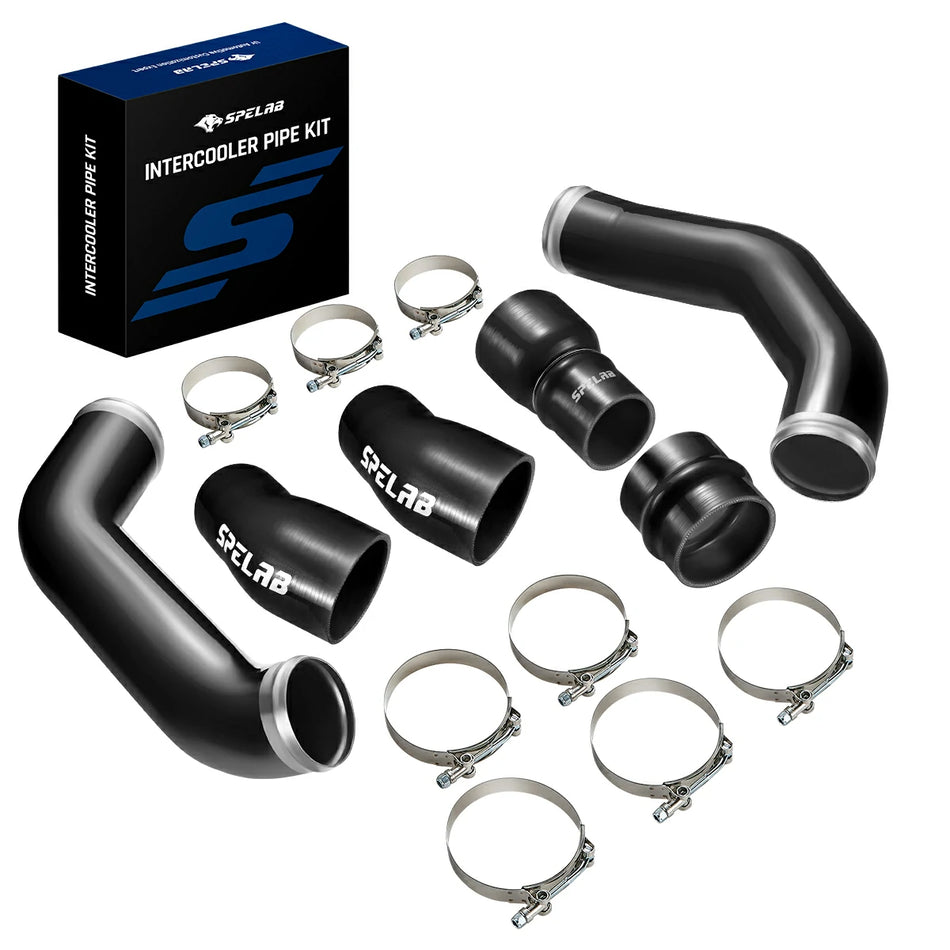
Bar-and-plate and tube-and-fin are two different charge-air-cooler core constructions, not automatic performance grades. Bar-and-plate is usually heavier and more rigid, with more thermal mass; tube-and-fin is usually lighter and can leave less obstruction in front of the rest of the cooling stack. For a stock or mildly tuned daily driver, a healthy tube-and-fin core is often enough. For repeated heavy towing, long hot grades, or higher-airflow builds, a well-tested bar-and-plate core is often the stronger starting point. The real winner still depends on core size, pressure drop, end-tank design, fitment, and how the truck is actually used.
Key Takeaways
No core style wins every job; match the intercooler to the truck's sustained load, airflow demand, available space, and complete cooling stack.
- Choose a tested bar-and-plate core when repeated high-load pulls and heat-soak control matter more than minimum weight.
- Keep tube-and-fin on the list for stock and mild builds that need a lighter core and strong pass-through airflow.
- Compare charge-air temperature and pressure drop at the same mass airflow; a peak temperature claim by itself proves very little.
- Watch coolant and transmission temperature during towing because a thick front-mounted core can change airflow to the heat exchangers behind it.
- Verify model year, engine code, build date, ports, mounts, boots, sensors, and chassis configuration before ordering.
Quick Choice: Which Intercooler Core Fits Your Truck?
Use the truck's duty cycle as the first filter. The engineering sections below explain how to verify the choice with temperature, airflow, and pressure-drop data.
| Your truck | Better starting point | What to verify |
|---|---|---|
| Stock daily driver or light towing | Tube-and-fin | Keep it if the core is clean, leak-free, and holding boost. |
| Mild tune with occasional towing | Either type | Compare sustained temperature, pressure drop, fitment, and stack airflow. |
| Regular heavy towing or long hot grades | Tested bar-and-plate | Check coolant and transmission temperature along with charge-air temperature. |
| Larger turbo or higher-airflow tune | Choose by measured flow data | Use pressure-drop and temperature data at airflow relevant to the build. |
| Jobsite, farm, or rough-road service | Prioritize the complete assembly | Check mounts, welds, isolators, vibration clearance, and cleaning access. |
Do not replace a healthy tube-and-fin intercooler just because bar-and-plate sounds more performance-oriented. Cummins owners who are unsure whether the core is even the first part to replace should check the 6.7 Cummins intercooler inspection signs first.

Bar-and-Plate vs Tube-and-Fin at a Glance
Bar-and-plate generally favors thermal mass and rigidity, while tube-and-fin generally favors lower weight and easier pass-through airflow; actual performance still depends on the complete core and end-tank design.
| Decision point | Tube-and-fin | Bar-and-plate | What the truck owner should verify |
|---|---|---|---|
| Construction priority | Lower mass with formed tubes and external fins | Dense stacked bars, plates, and fins | Core dimensions, end-tank material, welds, and mounts |
| Sustained heat load | Can work well when correctly sized for stock or mild airflow | Often chosen for repeated pulls because added mass can absorb more heat before saturation | Matched-condition temperature trace, not a single advertised drop |
| Charge-air restriction | Often lighter-flowing, but poor tubes and transitions can still create loss | Can flow well, but dense internal fins or tight passages can raise loss | Pressure-drop curve at the truck's actual mass airflow |
| Airflow to radiator | Often leaves a lighter obstruction in the cooling stack | Thickness and dense fins can demand more careful stack testing | Coolant, oil, A/C, and transmission temperature under load |
| Weight and mounting load | Usually lower | Usually higher | Bracket alignment, isolators, fasteners, and vibration clearance |
| Typical starting point | Daily driving, stock turbo, mild tune, weight-sensitive build | Repeated towing, hot grades, higher airflow, rough service | Real duty cycle instead of a generic horsepower label |
Which Intercooler Cools Better: Bar and Plate or Tube and Fin?
A bar-and-plate intercooler does not automatically produce a lower outlet temperature; the better cooler is the one that controls charge-air temperature at the required mass airflow without excessive pressure drop or choking airflow through the truck's cooling stack.
Thermal mass and continuous heat rejection measure different behavior. A heavy core can absorb a hard burst without heating up as quickly, but that stored heat still has to leave through the external fins. Frontal area, core depth, internal and external fin density, vehicle speed, fan pull, ambient temperature, and the temperature difference across the core control what happens on the next hill.
A single full-throttle pull can make a dense core look great. Ten minutes behind a loaded equipment trailer can expose heat soak, weak radiator airflow, or a recovery problem that the short pull never showed. A truck that runs empty across town does not ask the same job from the CAC as a pickup dragging a fifth-wheel through a 100-degree grade.
The basic system function belongs in our intercooler function and boost guide; this comparison stays focused on choosing the core.
Measure Effectiveness Instead of Repeating a Cooling Percentage
Intercooler effectiveness compares the actual charge-air temperature drop with the largest drop the ambient air could theoretically provide under that test condition.
Effectiveness = (compressor outlet temperature − intercooler outlet temperature) ÷ (compressor outlet temperature − ambient temperature)
Temperature sensors must sit in repeatable locations, use the same units, and log at the same time. The generic IAT PID on a scan tool may represent a sensor farther downstream and should not be treated as a pre-core or immediate post-core measurement unless the service data confirms its location.
Use a Matched Test Sheet
A fair A/B test holds the truck, tune, route or dyno load, ambient conditions, sensor positions, and pull duration as close as practical.
| Test channel | Why it matters | Bad shortcut |
|---|---|---|
| Ambient temperature | Sets the cooling-air baseline | Comparing a cool morning with a hot afternoon |
| Compressor outlet temperature | Shows the heat entering the CAC | Judging only by manifold IAT |
| CAC outlet temperature | Shows the heat leaving the core | Moving the sensor between tests |
| Mass airflow or repeatable engine load | Makes pressure and heat data comparable | Comparing runs with different airflow demand |
| Pre-core and post-core pressure | Reveals the cost of moving air through the core | Using manifold boost alone |
| Pull duration and recovery time | Exposes heat soak and cooldown behavior | Publishing one peak number |
| Coolant and transmission temperature | Checks the rest of the cooling stack | Calling a lower IAT a win while other temperatures climb |
Our test rule as a parts manufacturer is simple: no universal cooling percentage gets attached to a core style unless both cores run under the same controlled conditions. Different trucks, tunes, weather, sensors, and pull lengths do not make a clean comparison.
Does a Bar-and-Plate Intercooler Cause More Pressure Drop or Turbo Lag?
Bar-and-plate can create more pressure drop or system volume, but the label alone cannot predict either result; internal passage area, fin design, end-tank transitions, pipe diameter, and total charge volume control the outcome.
Pressure drop is the synchronized difference between pressure immediately before and after the CAC at the same operating point: ΔP = pre-CAC pressure − post-CAC pressure. Two matched transducers tell that story. A dashboard boost gauge does not.
Excessive ΔP makes the compressor produce more outlet pressure to deliver the same pressure at the intake manifold. That extra pressure ratio can add compressor work and heat. A clean core with smooth end-tank transitions may beat a badly designed core of either construction.
Turbo lag describes transient response, not steady-state restriction. A larger core and pipes add volume that must be filled, but turbine size, exhaust energy, gear, engine speed, tune, leaks, and throttle strategy also shape spool. Calling every soft pedal response “intercooler lag” sends owners after the wrong part.
Demand a Pressure-Drop Curve
A useful pressure-drop chart plots ΔP against mass airflow at several test points instead of advertising one pressure rating or one peak boost number.
- Plot pressure drop in psi or kPa against mass airflow in lb/min or kg/s; use CFM only when the air-density test condition is defined.
- Match airflow units before comparing two charts.
- Confirm whether the reported pressure is gauge or absolute pressure.
- Confirm the test includes only the core or the core plus end tanks and pipes.
- Check that both pressure sensors were synchronized and referenced correctly.
- Reject a universal “acceptable psi loss” when the vehicle, airflow, and sensor layout are not defined.

Does Bar-and-Plate Last Longer Than Tube-and-Fin?
Bar-and-plate usually provides a denser, more rigid core, but service life still depends on weld quality, end tanks, mounting alignment, boost cycling, corrosion, debris impact, and the weight carried by the brackets.
Tube-and-fin damage often shows up as crushed external fins, damaged tubes, seam leaks, or worn end-tank joints. Bar-and-plate damage often shows up around welds, ports, or mounts when a heavy core is installed with preload or allowed to shake against surrounding hardware.
Mud, cottonwood, bugs, and oily dust can blanket either design. Dense fins need careful cleaning from the engine side toward the grille with low-pressure water or air. A close-range pressure washer can fold fins and turn a cleaning job into a restriction.
Inspect the Assembly, Not Just the Core Face
A durable core still fails its job when a boot slips, a mounting tab cracks, an end tank leaks, or a pipe rubs through under engine movement.
- Look for dark or oily tracks concentrated at boots, crimps, welds, and tube joints.
- Check lower mounts for sag, missing isolators, elongated holes, and metal-to-metal contact.
- Inspect both charge pipes for witness marks near the battery tray, fan shroud, frame, and accessory brackets.
- Check the core from both sides because the front face can look clean while debris packs between heat exchangers.
- Recheck clamp position after heat cycles; clamp torque does not rescue a boot seated on oil or installed crooked.
Do Not Blame the Core Type Too Fast
High IAT, low boost, smoke under load, or a P0299 underboost code does not prove the intercooler core is too small; leaks, dirty fins, sensor error, charge-pipe damage, and turbo-control faults can produce the same complaint.
| Symptom | Likely areas | Confirmation | Next action |
|---|---|---|---|
| Hiss or whoosh only under boost | Boot, clamp, pipe, end tank, core seam | Visual inspection followed by a controlled smoke or pressure test | Repair the confirmed leak before judging core capacity |
| Oil wetness around one joint | Boot seating, clamp alignment, crankcase-vent oil film | Clean the joint, drive under load, and inspect the fresh track | Reseat or replace the failed joint; do not condemn the core from oil alone |
| High IAT with normal boost retention | Blocked fins, missing air seals, heat soak, undersized core | Inspect airflow path and log a repeatable loaded run | Restore airflow before upsizing the core |
| Low boost plus slow response | Charge-air leak, turbo control, sensor input, exhaust-side problem | Compare commanded and actual data, then leak-test the CAC path | Fix the failed system instead of guessing from pedal feel |
| Coolant loss | Engine cooling system, not a typical air-to-air CAC passage | Cooling-system pressure test and visual inspection | Diagnose radiator, hoses, pump, cooler, heater, or engine paths |
| Repeated mount or weld crack | Bracket preload, missing isolator, collision damage, pipe interference | Loosen and check natural alignment before installing another core | Correct the mechanical load before replacement |
Run the Checks in This Order
A disciplined sequence keeps a $20 boot problem from turning into an unnecessary full-core order.
- Scan codes and save freeze-frame plus loaded-run data.
- Inspect hot-side and cold-side boots, clamps, pipes, end tanks, welds, mounts, and external fins.
- Verify air seals, deflectors, fan shroud, condenser cleanliness, and debris trapped between exchangers.
- Smoke-test or pressure-test the charge-air path with equipment and limits appropriate for the truck; do not hit a capped system with an arbitrary shop-air setting.
- Validate sensor location and plausibility before trusting a temperature or boost PID.
- Repeat a controlled loaded run and compare the same channels.
- Choose a repair or upgrade only after the leak, airflow problem, or capacity limit is identified.
When Is an Intercooler Upgrade Actually Worth It?
Upgrade when the existing CAC is physically failing or when repeatable loaded data shows that it cannot control heat or airflow demand. A dirty fin pack, loose boot, or bad clamp is a repair problem—not proof that the core is undersized.
| What you find | Best next move | Why |
|---|---|---|
| Blocked external fins | Clean | Restore airflow before judging capacity. |
| Loose clamp, split boot, rubbed pipe, or leaking joint | Repair | A boost leak can mimic a weak intercooler. |
| Cracked tank, leaking seam, or damaged core | Replace | Choose stock-equivalent or upgraded construction by duty cycle. |
| Repeat high charge-air temperature under the same heavy load after faults are fixed | Upgrade | The current system may be reaching its sustained thermal limit. |
| Larger turbo or materially higher airflow | Upgrade by data | Match the core to mass airflow, pressure drop, and cooling-stack impact. |
| Healthy stock truck with stable temperatures and no leaks | Keep it | Changing construction type alone is not a reason to buy. |
Why the Thickest Intercooler Is Not Always the Best Upgrade
A thicker intercooler can add face area, internal volume, or thermal mass, but it can also add weight and airflow resistance ahead of the radiator, A/C condenser, and transmission cooler.
The front cooling stack works as one system. Fin density, blocked gaps, missing foam seals, grille guards, winches, auxiliary lights, and bent air deflectors can change how much air reaches every exchanger. Lower post-CAC temperature does not count as a clean win when engine coolant or transmission temperature climbs on the same grade.
A heavy tow test should log charge-air temperature, coolant temperature, engine-oil temperature when available, transmission temperature, boost, load, road speed, and ambient temperature. Stable traffic, wind, gear, trailer weight, and route make the comparison far more useful.
Air-to-air and liquid-cooled systems solve packaging and duty-cycle problems differently; owners comparing those architectures can use our air-to-air versus air-to-water guide without mixing that question into core construction.
Fitment Checks Before Replacing Tube-and-Fin With Bar-and-Plate
A listed year range does not guarantee bolt-on fitment for every pickup, chassis cab, production split, prior repair, or modified front-end package inside that range.
Verify year, make, model, engine code, VIN or RPO information where applicable, build date, pickup versus chassis cab, inlet and outlet position, connection style, port diameter, sensor provisions, mounting tabs, fan-shroud clearance, and pipe routing. A winch bumper, grille guard, auxiliary cooler, or swapped charge pipe can change the answer.
Our current product catalog lists all-aluminum tube-and-fin choices and bar-and-plate choices with aluminum end tanks across the applications below. Core depth, face dimensions, inlet and outlet diameter, tank process, and included hardware vary by SKU, so these ranges describe the catalog choices reviewed for this article rather than replacing a VIN-level product-page check.
| Truck family | Current catalog applications with both paths | Critical fitment checks | Comparison page |
|---|---|---|---|
| Ford Super Duty Power Stroke | 2003–2007 6.0L; 2008–2010 6.4L | Engine, truck configuration, ports, mounts, boots, pipe alignment, front-end clearance | Power Stroke intercooler options |
| Dodge Ram/Ram Cummins | 2003–2009 5.9L/6.7L; 2010–2012 6.7L; 2013–2018 6.7L | Engine transition, build year, pickup or chassis cab, ports, brackets, pipe kit compatibility | Cummins intercooler options |
| GM Duramax 6.6L | 2001–2005 LB7/LLY; 2006–2010 LBZ/LMM; 2011–2016 LML | VIN/RPO, engine-generation split, body configuration, connections, sensors, mounts, pipe diameter | Duramax intercooler options |
Check the Hardware Around the Core
A direct-fit core still needs compatible boots, clamps, pipes, sensors, seals, and supports to hold boost without rubbing or carrying preload.
- Match inlet and outlet diameter to the installed pipes, not an online photo.
- Confirm straight boots, reducers, quick-connects, and clamp widths before teardown.
- Dry-fit all mounts before tightening any bracket.
- Center silicone boots over both beads and keep clamps square behind the bead.
- Restore factory air seals and deflectors because bypass air does no cooling work.
- Check hood, fan, shroud, A/C line, bumper, and grille clearance before the first road test.
Catalog Fitment Examples by Platform
Once the diagnostic data points toward the intercooler itself, match the upgrade to the exact platform. A 2011–2016 LML Duramax bar-and-plate intercooler is a different fitment conversation from a 2013–2018 6.7L Cummins bar-and-plate intercooler, even if both trucks are used for towing and both owners complain about high IAT.
If the build needs the core and piping planned together, a 2013–2018 Dodge Ram 6.7L intercooler kit may make more sense than replacing one part at a time. Still, the same rule applies: verify the truck, the failure, the duty cycle, and the surrounding hardware before ordering.

How to Choose the Right Intercooler Core in Five Steps
Choose from measured need, verified fitment, and total-system performance rather than core thickness, a generic horsepower rating, or the idea that heavier always means better.
- Define the duty cycle. Record whether the truck runs empty, carries payload, pulls a trailer, works on a jobsite, climbs at altitude, or runs repeated high-boost passes.
- Log the baseline. Capture ambient temperature, IAT, boost, engine load, road speed, coolant temperature, and transmission temperature on a repeatable route.
- Fix leaks and airflow faults. Repair boots, clamps, pipes, mounts, seals, sensors, and blocked fins before blaming core capacity.
- Compare real data. Look for matched temperature traces and a pressure-drop curve at relevant mass airflow; ignore an unsupported universal cooling percentage.
- Verify the exact truck. Match year, engine, build date, chassis, ports, mounting, surrounding mods, and included hardware before placing the order.
What That Means by Truck Condition
| Truck condition | Next move |
|---|---|
| Healthy stock daily driver | Clean the stack, inspect boots and mounts, log a baseline, and keep the current core if the data stays healthy. |
| Regular tow rig | Compare sustained IAT, coolant temperature, transmission temperature, and pressure drop on the grade that exposes the problem. |
| Tuned or larger-turbo build | Match the intercooler to real mass airflow and verify the full charge-air path can hold commanded pressure. |
| Jobsite or off-road truck | Prioritize mounts, debris protection, cleaning access, vibration clearance, and repairability along with core construction. |
| Damaged or leaking CAC | Confirm the failure and correct mounting preload or surrounding interference before installing another core. |
Brand selection comes after the engineering choice. Owners ready to compare price, warranty, construction details, and positioning can use our diesel truck intercooler brand comparison after deciding which core behavior fits the truck.
Bar-and-Plate vs Tube-and-Fin Intercooler FAQ
Core construction narrows the choice, but duty cycle, measured temperature, pressure drop, cooling-stack airflow, and exact fitment finish the decision.
Q: Is bar-and-plate better than tube-and-fin?
A: Bar-and-plate is often better for repeated high-load pulls where thermal mass and rigidity matter, while tube-and-fin is often better for a stock or mild truck that values lower weight and pass-through airflow. Neither label proves cooling performance without matched temperature and pressure-drop data.
Q: Does a bar-and-plate intercooler cool better?
A: A properly designed bar-and-plate core can handle sustained heat well, but it does not automatically run cooler. Frontal area, depth, fin density, internal passage area, end tanks, ambient airflow, and pressure drop can let a strong tube-and-fin design outperform a poor bar-and-plate design.
Q: Does a bar-and-plate intercooler cause turbo lag?
A: A larger core can add charge volume, and a restrictive core can add pressure drop, but turbo response also depends on turbine and compressor sizing, exhaust energy, pipes, leaks, gearing, engine speed, and tune. Measure response and ΔP before blaming the construction type.
Q: Is a tube-and-fin intercooler good enough for towing?
A: A healthy, properly sized tube-and-fin core can support many stock and mild tow rigs. Sustained high IAT, repeated heat soak, physical damage, or an airflow increase can justify another design, but trailer load, grade, ambient heat, and cooling-stack temperatures need to support that call.
Q: Is a thicker intercooler always better?
A: A thicker core can add thermal mass and area, but it can also add weight, charge volume, pressure drop, and external airflow restriction. Check coolant and transmission temperature with IAT because the radiator and coolers behind the CAC still need air.
Q: Can I replace tube-and-fin with bar-and-plate without a tune?
A: A true direct-fit core usually does not require tuning just because its construction changed, but the new unit still has to match the truck's ports, sensors, mounts, pipes, boots, and airflow needs. Large changes in airflow hardware should be evaluated as a system.
Q: How can I tell which intercooler core my truck has?
A: Check the product label, part number, service history, side profile, tank construction, and visible core geometry. Do not rely on the front fin face alone because external fin patterns can look similar and a previous owner may have replaced the original assembly.
Q: Does a bar-and-plate intercooler heat soak more than tube-and-fin?
A: Not automatically. More thermal mass can slow the temperature rise during a hard pull, but that heat still has to leave through the external fins. Repeated towing or back-to-back runs reveal recovery better than one short pull.
Q: When is upgrading the stock intercooler actually worth it?
A: Upgrade when the stock unit is damaged, when loaded data still shows a heat or pressure-drop limit after leaks and airflow faults are fixed, or when a higher-airflow build has clearly outgrown the stock system.
Q: Should I replace a leaking intercooler or upgrade to a larger one?
A: A stock truck may only need a correct direct-fit replacement. If the truck tows hard or moves more air than stock, compare a tested upgrade—but fix bracket preload, rubbing, boots, and pipe alignment before installing the new core.