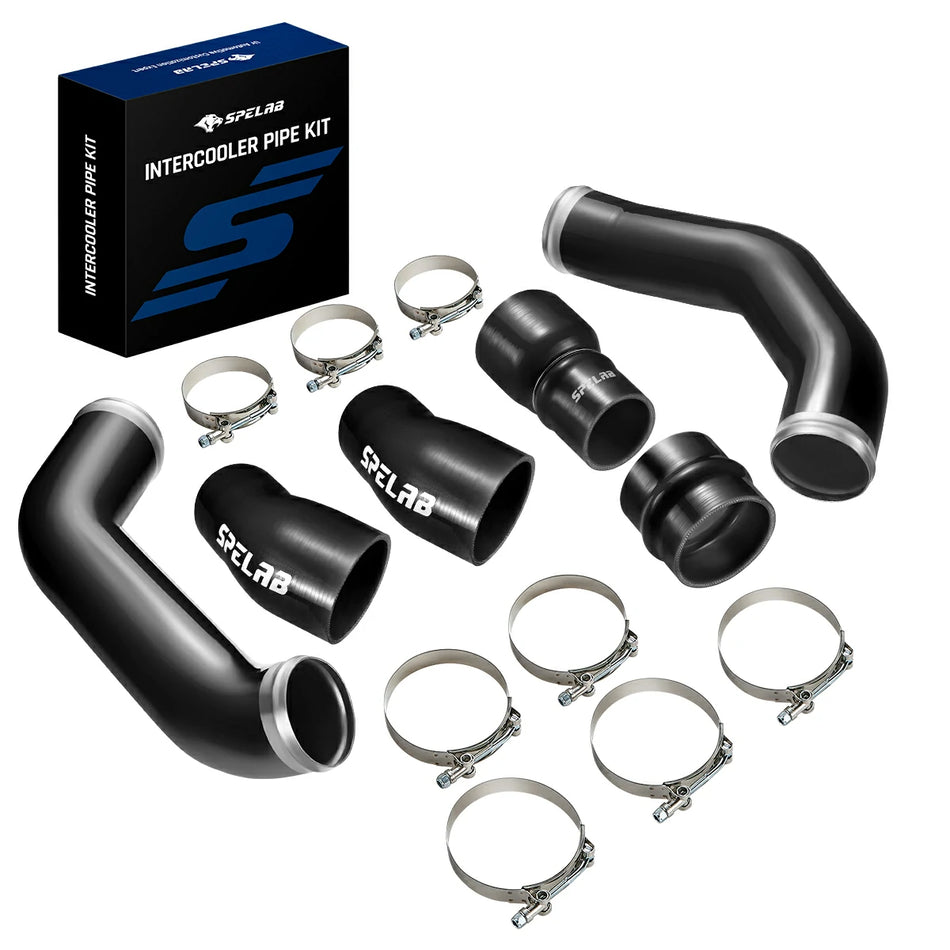
Not automatically. A high-mileage diesel truck needs a cooling-system refresh before towing season only when inspection finds multiple aging or leaking parts, questionable coolant condition, or a repeatable cooling problem under load. Mileage alone is not enough; a truck with stable temperatures and healthy components may need only routine service or one targeted repair. If the radiator, reservoir, and upper coolant tube all need replacement, a complete kit can cost less than buying the three parts separately and allows the work to be handled during one drain-and-refill service.
Key Takeaways
The smart buying decision comes from separating a containment leak from an airflow, circulation, control, or engine problem before the trailer is connected.
- A visible radiator leak does not automatically condemn the reservoir and coolant tube; inspect their condition and service history first.
- Towing-only temperature creep calls for fan, airflow, transmission-cooling, thermostat, pump, and load checks before a parts order.
- Ford, Ram, and GM specify different coolant chemistries and service intervals; color alone is not a safe identification method.
- A multi-part refresh makes the most sense when several covered components show real deterioration and the system is already drained.
- Exact year split, engine, radiator layout, ports, tube routing, drivetrain, and previous modifications must be confirmed before installation.

Which Daily-Use Scenarios Put the Cooling System Under Real Stress?
Summer towing, long grades, jobsite idling, heavy payload, rough-road vibration, and unknown maintenance history expose weak cooling parts that may look fine during an unloaded ten-minute drive.
Summer Towing and Long Grades
A fifth-wheel, horse trailer, or loaded equipment trailer adds sustained engine and transmission heat. Log coolant temperature, transmission-fluid temperature, ambient temperature, road speed, grade, fan response, and trailer weight on the same pull. A single peak temperature without operating context is weak evidence.
Transmission heat belongs in this check. Inspect the transmission cooler, cooler lines, fittings, thermostat or bypass arrangement where fitted, and the airflow path through the stacked heat exchangers. A larger engine radiator cannot repair a restricted transmission cooler or low fluid level.
Jobsite Idling and Low-Speed Work
Long idle time with the A/C running removes much of the natural ram air, leaving the fan, shroud, foam seals, and clean fin area to move heat out of the stack.
Concrete dust, cottonwood, chaff, mud, and bugs often pack the gap between the A/C condenser and radiator while the visible front face still looks passable. Separate and inspect the stack before blaming core capacity.
Farm, Ranch, and Off-Road Use
Washboard roads load radiator mounts, reservoir brackets, rigid tubes, hose ends, and support panels with repeated vibration.
Dried coolant beside a bracket calls for a mount check, not just a new clamp. Look for missing isolators, elongated holes, polished contact marks, rubbed tubes, and hardware that pulls a component sideways when tightened.
A Used Truck With No Service Records
An older diesel with no cooling history needs a maintenance-history baseline before it needs a shopping cart.
Record the cold level, identify the installed coolant specification, inspect every accessible joint, and scan temperature data on a repeatable drive.
A Long Trip Where Downtime Is Expensive
A cross-state tow through hot weather justifies a tighter inspection standard than local empty-bed driving.
Preventive replacement earns its keep when the inspection already shows deterioration and a roadside failure would strand a loaded truck. A long route by itself does not make healthy hardware defective.

What Should You Inspect Before Towing Season?
A useful pre-tow inspection checks heat transfer, coolant containment, pressure control, circulation, airflow, transmission cooling, and believable sensor data instead of staring only at the radiator.
| Component or data point | What to inspect | Warning sign | Next action |
|---|---|---|---|
| Radiator core and tanks | Fins, seams, necks, welds or crimps, mounts, inlet, and outlet | Wet seam, dried residue, corrosion, crushed fins, or loose mount | Clean and pressure-test; repair the mount or replace the confirmed failed unit |
| Reservoir and pressure cap | Cold level, seams, neck, cap seat, sensor area, cap application, and seal | Crack, stain, distorted neck, bad seal, or recurring low-level warning | Verify actual level and test the cap and system to the model-specific service limit |
| Coolant tubes and hoses | Tube wall, O-rings, adapters, hose ends, clamps, routing, and contact points | Corrosion, bulge, seepage, rub mark, hardened seal, or forced alignment | Correct the alignment and replace only the failed tube, seal, adapter, or hose |
| Coolant condition | Specification, service date, level, contamination, and evidence of mixed chemistry | Unknown product, sludge, oil, rust, or unexplained loss | Identify the fill and fault before flushing or topping off |
| Fan, shroud, seals, and cooling stack | Fan response, shroud, foam seals, condenser gap, fin blockage, and bent fins | Weak engagement, missing seal, packed debris, or damaged shroud | Restore airflow before choosing diesel cooling-system upgrades |
| Transmission-cooling circuit | Cooler face, lines, fittings, leaks, fluid level, and loaded temperature trend | Wet fitting, crushed line, blocked fins, or repeatable temperature creep | Diagnose the transmission circuit separately from the engine-coolant circuit |
| Loaded-run data | Ambient temperature, coolant and transmission temperatures, load, speed, grade, and fan response | Repeatable rise or slow recovery under comparable conditions | Test airflow, circulation, pressure control, and engine-side causes |

Which Coolant and Service Interval Apply to These Trucks?
Coolant chemistry and interval must follow the exact model-year manual because the Ford, Ram, and GM applications covered here do not share one fluid or one replacement schedule.
| Platform example | Manufacturer specification | Published normal-service example | Shop-floor decision |
|---|---|---|---|
| 2012 Ford 6.7L Power Stroke | Use the coolant specification listed in the diesel supplement for that truck | Initial change at 6 years or 100,000 miles; then every 3 years or 50,000 miles | Verify build year and installed coolant before using this example on another Super Duty |
| 2017 Ford Super Duty | Interval differs between orange and yellow coolant listings | Orange: 6 years/105,000 miles, then 3 years/45,000; yellow: 10 years/200,000, then 5 years/100,000 | Read the exact owner information; color is not a substitute for specification |
| 2018 Ram 6.7L Cummins | OAT coolant meeting FCA Material Standard MS.90032 | 10 years or 150,000 miles, whichever comes first | Do not mix HOAT and OAT products or identify them by color alone |
| 2011–2016 GM 6.6L LML Duramax | DEX-COOL meeting the applicable GM specification | 5 years or 150,000 miles, whichever comes first | Use the manual for the exact year and correct any contamination before refill |
These are manufacturer schedule examples, not universal flush commands. Severe contamination, a major repair, unknown fluid, or mixed chemistry changes the service decision, while clean fluid does not excuse an active leak.
The Radiator Is Leaking: Replace One Part or Refresh the System?
Replace only the radiator when it is the single confirmed failure and the reservoir, tubes, hoses, cap, coolant, mounts, and airflow hardware remain serviceable; refresh several parts when inspection finds several weak points in the same service window.
| Truck condition | Best next step | Reason | Do not assume |
|---|---|---|---|
| One verified leak; surrounding parts are dry, aligned, and recently serviced | Replace the failed part | Focused work controls cost | Every same-age component is bad |
| Leaking core plus cloudy tank, stained tube joints, brittle fittings, or damaged mounts | Price a multi-part refresh | One drain and teardown may prevent repeat labor | A bundle fixes fan, pump, thermostat, or engine faults |
| Temperature rise under load with no verified leak | Diagnose fan, stack airflow, circulation, transmission cooling, and load | Heat rejection has several control points | A larger core is the automatic cure |
| Coolant disappears without an external trail | Pressure-test cold and check concealed and internal paths | The radiator may not be the source | Low level proves a radiator leak |
| Pressure rises unusually fast from a cold start or coolant is pushed out repeatedly | Test for combustion pressure before replacing external parts | Stronger hardware cannot correct a sealing fault inside the engine | A new cap or tank will contain abnormal pressure |
A cheap seal still does not justify firing the parts cannon; several documented weak points do.
What Can Mimic a Bad Radiator or Refresh-Kit Failure?
A weak fan, stuck thermostat, failing pump, blocked stack, trapped air, wrong coolant, concealed leak, sensor fault, or combustion leak can produce the same heat, odor, low-level, or hard-hose complaints as failed external cooling hardware.
- Pressure cap: A wrong, dirty, weak, or sticking cap changes how the system holds and releases pressure.
- Thermostat: Late opening, sticking, or the wrong application distorts warm-up and loaded-temperature behavior.
- Water pump: Seal leakage, bearing trouble, drive problems, or damaged pumping surfaces require pump-side diagnosis.
- Fan system: Weak clutch engagement, electronic-control faults, damaged blades, or missing shrouding hit hardest at low road speed.
- Cooling-stack blockage: Debris between exchangers starves a good core of air.
- Trapped air: Poor filling or bleeding causes unstable level, weak heater output, hot spots, and misleading readings.
- Concealed plumbing: Heater, EGR-cooler, pump, and underbody leaks can lower the reservoir without leaving a puddle at the radiator.
- Combustion leakage: Rapid cold-start pressure, repeated coolant expulsion, bubbles, or unexplained hard hoses require engine-side testing.
- Sensor or wiring fault: Confirm that a warning or scan value is plausible before ordering parts.
Run This Diagnostic Order
A cold inspection followed by controlled testing finds more truth than opening a catalog after one hot pull.
- Let the engine cool fully and verify the actual coolant level.
- Inspect fresh and dried leak traces at tanks, seams, necks, tubes, hoses, clamps, pump area, heater plumbing, and underbody paths.
- Confirm the coolant specification and look for contamination or mixed chemistry.
- Scan codes and compare sensor readings with actual operating conditions.
- Pressure-test the system and cap at the exact model-year service limit; never improvise with uncontrolled shop air.
- Inspect fan response, shrouding, seals, transmission cooler, and the gaps between stacked heat exchangers.
- Test for combustion gas or abnormal pressure when the symptom pattern points inside the engine.
- Repeat a controlled loaded drive only after the system is safe, full, and properly bled.
No honest cross-platform article can give one cap-test pressure or one “overheating” temperature for every 2011–2019 Ford, 2013–2018 Ram, and 2011–2016 GM configuration. Pull those limits from the service information for the VIN and calibration in front of you.
Which Cooling Hardware Fits the Ford, Ram, and LML Platforms?
Match the exact engine, model year, truck model, radiator layout, port positions, tube routing, drivetrain, transmission, and previous modifications before calling any cooling component bolt-on.
| Platform | Article scope | Refresh-kit foundation | Critical fitment checks |
|---|---|---|---|
| Ford 6.7L Power Stroke | 2011–2019 F-250, F-350, F-450, and F-550 Super Duty | Ford 6.7L Power Stroke radiator, upper coolant tube, and reservoir; selected configuration adds a lower tube | 2011–2016 versus 2017–2019 split, upper versus upper-and-lower selection, ports, mounts, and truck configuration |
| Ram 6.7L Cummins | 2013–2018 Ram 2500 and 3500 | Ram 6.7L Cummins radiator, upper coolant tube, and reservoir | Year, model, core layout, cooler connections, dimensions, mounts, and previous changes |
| GM 6.6L LML Duramax | 2011–2016 Chevrolet Silverado and GMC Sierra 2500HD/3500HD | LML Duramax radiator, upper coolant tube, and reservoir | LML engine, drivetrain, transmission, ports, dimensions, mounts, and tube clearance |

2011–2019 Ford 6.7L Power Stroke
The Ford 6.7L cooling-system upgrade kit application crosses a major 2017 model-year split, so do not order from engine displacement alone.

2013–2018 Ram 6.7L Cummins
The Ram 6.7L cooling-system upgrade kit application requires a 2500/3500 truck-level check even when the engine and year appear correct.

2011–2016 GM 6.6L LML Duramax
The LML Duramax cooling-system upgrade kit application covers Silverado and Sierra 2500HD/3500HD trucks, but transmission, drivetrain, ports, and prior repairs still matter.
Our manufacturing fitment check treats forced alignment as a reject condition. Ports, brackets, isolators, tubes, and hoses should settle into place without prying a rigid component sideways to catch the last bolt.
Is a Complete Cooling-System Upgrade Kit Better Than Buying Parts Separately?
A complete cooling-system upgrade kit offers better value when the radiator, coolant reservoir, and upper coolant tube all need replacement during the same service. The practical gains are a lower combined purchase price, one coordinated parts order, and less risk of paying for repeated draining, bleeding, and teardown—not extra cooling performance beyond installing the same three components separately.
| Decision factor | Buying parts separately | Complete upgrade kit |
|---|---|---|
| Best use case | Only one component has a verified failure | Radiator, reservoir, and coolant tube all show deterioration |
| Parts price | Each component is purchased at its individual listed price | Current bundle pricing is lower than the combined listed price of the three corresponding parts |
| Service planning | Repairs can be spread across separate service visits | All covered components can be handled during one planned drain-and-refill service |
| Repeat labor risk | A second aging component may require another teardown and coolant refill later | Replacing several verified weak points together can reduce repeat access and bleeding work |
| Main tradeoff | Usually costs less when only one part needs replacement | Spends more upfront and makes no financial sense when the other components are still healthy |
Compare the bundle price with the current combined price of the matching radiator, reservoir, and coolant tube before ordering. Ford upper-only and upper-and-lower configurations need separate calculations because their included parts and prices are different.
What Will the Job Cost, and Is It a DIY Repair?
A full radiator, reservoir, and coolant-tube refresh is a high-difficulty driveway job whose real cost includes parts, correct coolant, seals, clamps, filling equipment, disposal, and the risk of repeat labor if diagnosis or bleeding is wrong.
| Decision factor | Focused repair | Multi-part refresh |
|---|---|---|
| Best use | One verified failure with healthy surrounding parts | Several verified weak points during the same drain and teardown |
| DIY difficulty | Moderate to high, depending on access and component | High; front-stack access, rigid-tube alignment, refill, and verification all matter |
| Useful equipment | Correct hand tools, drain equipment, pressure tester, scan tool, torque information | The same tools plus adequate work space and preferably vacuum-fill or platform-approved bleeding equipment |
| Cost traps | Wrong diagnosis, reused damaged seals, incorrect coolant, missed mount damage | Wrong year split, duplicate parts, extra coolant, broken retainers, repeat disassembly |
| Choose a shop when | The leak source is uncertain or pressure behavior suggests an internal fault | The truck cannot tolerate downtime, the cooling stack needs major disassembly, or filling equipment is unavailable |
Quote labor against the VIN and local shop rate instead of trusting a universal hour estimate. Body configuration, added equipment, corrosion, broken hardware, and previous modifications can move the job far outside a generic book-time claim.
How Should You Install and Verify a Multi-Part Cooling Refresh?
A reliable refresh fits without preload, uses the correct coolant and bleeding procedure, and passes cold, hot, unloaded, and controlled loaded checks before the next tow.
Before Disassembly
Cold measurements and photos prevent confusion after the front stack is apart.
- Compare ports, mounts, tube shape, hose sizes, sensor provisions, cooler fittings, and radiator dimensions.
- Record coolant level and condition, stored codes, temperature behavior, and every visible leak trace.
- Photograph hose routing, clamp position, wiring retainers, air seals, shrouds, and exchanger spacing.
- List seals, clamps, coolant, cap, hoses, and filling equipment not included with the selected parts.
During Installation
Natural alignment matters more than forcing the last bolt into a bracket.
- Protect open passages from dirt and old gasket material.
- Inspect mating necks and sealing surfaces before fitting new parts.
- Lubricate compatible O-rings only as directed by the service procedure.
- Start mounts loosely, settle the components, and tighten in the specified sequence.
- Keep clamps square, hoses fully seated, rigid tubes clear of sharp edges, and wiring away from heat or moving parts.
- Restore foam seals, air deflectors, shrouds, isolators, and brackets.
After Refill
Staged verification catches trapped air and installation leaks before the trailer is connected.
- Use the coolant and fill procedure required for the exact model year.
- Never open a hot pressurized system.
- Check heater output, warnings, fan response, and sensor plausibility.
- Inspect every serviced joint during the first full heat cycle and again after complete cool-down.
- Run an unloaded road test before a controlled towing test.
- Recheck cold level, mounts, clamps, tube clearance, and residue after the first several trips.

What Should You Do Next?
Start with a cold inspection and repeatable loaded data, then choose monitoring, a focused repair, or a coordinated refresh according to the failures you can prove.
- Identify the truck by VIN, model year, engine, drivetrain, transmission, and cooling layout.
- Check coolant specification and service history before adding or draining fluid.
- Inspect the stack, fan system, radiator, tank, cap, tubes, hoses, mounts, transmission cooler, and concealed leak paths.
- Use model-specific pressure and temperature information; do not borrow limits from another diesel platform.
- Repair the verified fault, bleed the system correctly, and validate the truck unloaded before towing.
Diesel Truck Cooling-System Refresh FAQ
A refresh is justified by verified condition and service timing, while mileage, one warning light, or a bundled parts list cannot diagnose the truck.
Q: Should I refresh my diesel truck cooling system before towing season?
A: Inspect it before towing season and replace parts when condition, service history, loaded data, or an existing repair supports the work. Stable temperatures and healthy hardware call for maintenance and monitoring.
Q: What should I replace with a leaking radiator?
A: Inspect the reservoir, hoses, coolant tubes, O-rings, adapters, cap, mounts, air seals, and coolant. Replace additional parts only when they show damage, contamination, poor fit, or a strong risk of near-term repeat labor.
Q: Will a cooling-system refresh kit fix overheating while towing?
A: It fixes failed components included in the kit. It does not automatically fix a weak fan, blocked stack, stuck thermostat, failing pump, trapped air, transmission-cooling fault, wrong coolant, EGR-cooler leak, or combustion leak.
Q: What pressure should I use to test the cooling system?
A: Use the pressure specified for the exact model year and cap application. Ford, Ram, and GM systems do not share one safe universal test pressure, and uncontrolled shop air can damage the system.
Q: Can I mix orange, yellow, pink, or purple coolant?
A: Do not decide compatibility by color. Match the written manufacturer specification for the truck and identify unknown fluid before topping off; incompatible chemistry can reduce protection or form deposits.
Q: Does an aluminum radiator guarantee lower towing temperatures?
A: No. Core design, clean airflow, coolant circulation, fan operation, transmission heat, ambient temperature, trailer load, and installation condition determine the measured result.
Q: How do I know whether cooling parts fit my truck?
A: Match year, make, model, engine, production split, radiator configuration, tube routing, ports, dimensions, mounts, drivetrain, transmission, and previous modifications. Compare the physical truck with the product-page fitment before draining coolant.

About the Author
John Lee
Mechanical Engineer | 10+ Years Experience
John has spent the last decade engineering and testing high-performance automotive components. Specializing in drivetrain durability and thermal management across Powerstroke, Cummins, and Duramax applications, he bridges the gap between OEM limitations and aftermarket performance. His philosophy: "Factory parts are just a starting point."