P200C and P200E are exhaust aftertreatment temperature codes on a Ford 6.7 Power Stroke, not intake manifold codes. P200C indicates diesel particulate filter overtemperature, while P200E indicates catalyst system overtemperature. Save the freeze-frame data and diagnose the EGT sensors, wiring, DPF condition, and regeneration event before buying an intake part.[1]
Key Takeaways
P200C or P200E alone does not justify replacing the intake manifold on a 6.7 Power Stroke.
- P200C monitors diesel particulate filter overtemperature on Bank 1.
- P200E monitors catalyst system overtemperature on Bank 1.
- A bad EGT sensor or damaged harness can imitate a real thermal event.
- An intake leak matters only when separate evidence shows low boost, bad MAP data, or a failed pressure test.
- A “Stop Safely Now” message means the driver should move the truck to a safe location instead of continuing a towing pull.
P200C and P200E Code Meanings
Ford assigns P200C and P200E to the exhaust aftertreatment system, while intake and boost faults follow different diagnostic paths.
| Code | System or definition | First data to check | Direct intake manifold code? |
|---|---|---|---|
| P200C | Diesel particulate filter overtemperature, Bank 1 | EGT freeze frame, DPF data, companion codes | No |
| P200E | Catalyst system overtemperature, Bank 1 | EGT freeze frame and regeneration status | No |
| P0299 | Turbocharger underboost | Desired versus actual boost | Possible intake-side connection |
| P0236–P0238 | Boost or MAP sensor performance/circuit fault | MAP, BARO, connector, and reference voltage | Possible intake-side connection |
| P2006 | Generic intake manifold runner control code | Confirm that the system applies to the vehicle | Potentially, but it is not P200C |
The P200C/P200E Action Plan: Do This Before Buying Parts
Clearing P200C or P200E without saving the freeze frame can turn a quick electrical diagnosis into an expensive guessing game.

- Verify the code: Confirm that the scanner shows P200C, not the similar-looking P2006 intake runner code.
- Save every DTC: Record current, pending, and history codes before clearing anything.
- Capture the EGT data: Record EGT11 through EGT14 when those PIDs are available, along with engine load, RPM, and vehicle speed.
- Record DPF conditions: Save differential pressure, soot-loading data, and active or commanded regeneration status.
- Write down the operating condition: Note whether the code set while towing, climbing a grade, idling, or running a regen.
- Check the electrical side: Inspect the code-specific EGT sensor connector and harness for heat damage, corrosion, water intrusion, or chafing.
- Check airflow only when supported: Compare desired and actual boost when P0299, smoke, weak acceleration, or a charge-air leak is also present.
- Give the shop the evidence: Supply the VIN, complete scan report, freeze frame, towing load, recent repairs, and any “Stop Safely Now” event.
How Ford Diagnoses P200C and P200E
Ford service information starts with EGT freeze-frame readings and companion sensor codes rather than intake manifold replacement.
Ford TSB 12-7-1 covers certain 2011–2012 F-Super Duty trucks with P200C, P200E, and a possible “Stop Safely Now” message. The procedure uses 850°C, or 1562°F, as a decision point for an EGT reading captured when the code set; that number belongs to this specific procedure and is not a universal towing limit.[2]
Ford TSB 15-0054 covers certain 2011–2015 trucks built on or before January 30, 2015. It connects P200C/P200E with a larger group of EGT sensor codes and directs the technician to the implicated sensor instead of calling for four new sensors.[3]
Ford’s 2013 OBD summary lists P200C monitor logic that includes pre-DPF temperature above 830°C or post-DPF temperature above 950°C. Those calibration figures apply to that documented model-year monitor, so model-year differences must be checked before applying them to another truck.[1]
Bad EGT Sensor or Real Overtemperature?
A single implausible EGT signal points toward a sensor or circuit fault, while several temperatures rising together under load calls for a real heat investigation.

| Observation | More likely direction | Next check |
|---|---|---|
| One EGT PID jumps while the others remain plausible | Sensor, connector, or wiring | Inspect the corresponding circuit and cold-soak reading |
| One cold engine EGT differs sharply from ambient and the other sensors | Biased sensor signal | Compare all available temperature PIDs before startup |
| Several EGT readings climb together while towing | Actual heat or excessive engine load | Check regen status, DPF pressure, fueling, and airflow |
| P200C appears with an EGT circuit code | Electrical fault deserves priority | Follow the code-specific sensor circuit test |
| High DPF pressure accompanies the event | Aftertreatment restriction or loading | Follow the model-year Ford diagnostic procedure |
Ford’s published procedures do not establish EGT11 or EGT14 as the universally most failure-prone sensor. Heat cycles, connector exposure, harness routing, corrosion, and truck configuration all matter, so diagnose the sensor named by the code and data instead of replacing one based on shop folklore.
Can an Intake or Boost Leak Contribute?
A large charge-air leak can increase engine load and exhaust heat indirectly, but it does not turn P200C or P200E into an intake manifold code.
Start a separate charge-air leak diagnosis when the truck also has low actual boost, P0299, black smoke, lazy acceleration, or a loud rush of air. A cracked upper intake, loose boot, failed cold-side CAC pipe, leaking intercooler, or disconnected MAP sensor can create those symptoms.
As a parts manufacturer, we require physical evidence before calling an intake manifold bad: a visible crack, damaged MAP sensor boss, distorted sealing surface, or a leak isolated during a regulated pressure test. If the scan shows P0299 and inspection confirms a cracked factory plastic manifold, a cast-aluminum intake manifold becomes a relevant repair rather than a guess.
When Should You Inspect or Replace the Intake Manifold?
Inspect the intake manifold when P200C or P200E appears alongside independent evidence of a charge-air leak, MAP fault, or physical manifold damage.
Confirm the truck’s year and configuration against the documented fitment and durability differences before ordering a structural intake repair.
| Truck condition | Buy an intake part? | Best next move |
|---|---|---|
| P200C/P200E only | No | Diagnose EGT and aftertreatment data |
| P200C plus one EGT circuit code | No | Test the implicated sensor and harness |
| P200C plus P0299 and a failed leak test | Maybe | Locate the exact leaking component |
| Broken MAP sensor boss or confirmed manifold crack | Often | Compare verified Power Stroke intake manifold options |
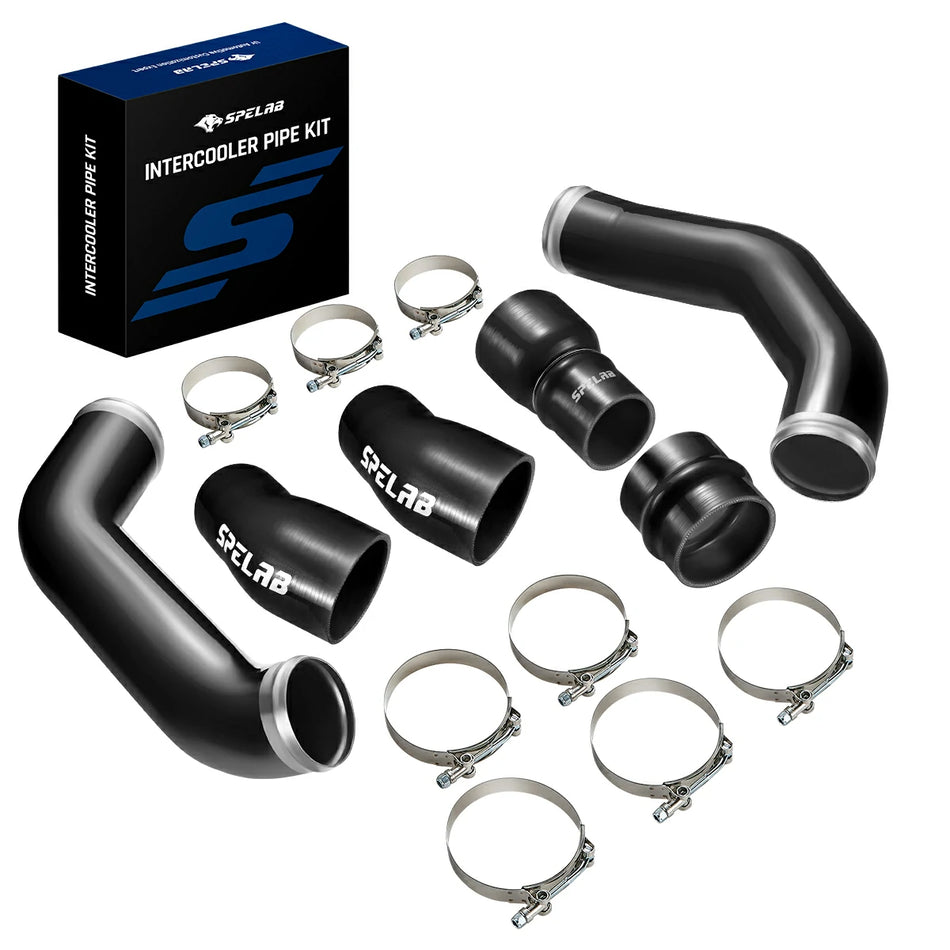
| Cracked cold-side CAC pipe | Yes, but not the manifold | Replace the failed pipe with the correctly fitted cold-side intercooler pipe kit |
| Both the manifold and charge pipe fail inspection | Yes | Use an intake manifold and intercooler pipe bundle after confirming fitment |
Common Misdiagnoses That Waste Money
Most expensive P200C/P200E mistakes begin when the code is cleared too early or matched to a part before the scan data is reviewed.
- Confusing P200C with the generic P2006 intake runner code.
- Calling one high EGT reading a plugged DPF without checking the sensor circuit.
- Replacing an intake manifold without P0299, physical damage, or leak-test evidence.
- Replacing the DPF before verifying EGT accuracy and differential pressure.
- Replacing all four EGT sensors when only one circuit is implicated.
- Applying one model-year temperature threshold to every 6.7 Power Stroke.
- Continuing a heavy towing pull after a “Stop Safely Now” warning.
Frequently Asked Questions
These answers cover the short diagnostic questions most 6.7 Power Stroke owners ask after seeing P200C or P200E.
Is P200C an intake manifold code on a 6.7 Power Stroke?
P200C is not an intake manifold code on a Ford 6.7 Power Stroke. It indicates that the PCM detected a diesel particulate filter overtemperature condition or received data that met the calibrated monitor criteria.
What does P200E mean on a Ford 6.7 diesel?
P200E means Catalyst System Over Temperature—Bank 1. Diagnosis starts with freeze-frame EGT readings, companion sensor codes, regeneration status, and aftertreatment data.
Can an intake manifold indirectly contribute to high EGT?
A leaking intake manifold can indirectly affect exhaust heat if it causes low boost under load, but P200C or P200E alone does not prove that the manifold is leaking.
Can one failed EGT sensor trigger both codes?
A failed or biased EGT sensor can contribute to P200C and P200E when its reported temperature crosses the PCM’s monitor criteria. Compare the sensor with the other EGT readings and test its circuit first.
What should I save before clearing P200C?
Save all current, pending, and history codes plus EGT readings, engine load, vehicle speed, DPF differential pressure, regeneration status, and desired versus actual boost.
When should I replace the intake manifold?
Replace the intake manifold when inspection or a regulated charge-air test confirms a crack, leaking joint, damaged MAP sensor boss, distorted sealing surface, or another physical failure in the manifold itself.
Sources
Ford service and OBD documents provide the code definitions, monitor logic, applicable model years, and diagnostic thresholds used in this article.

About the Author
John Lee
Mechanical Engineer | 10+ Years Experience
John has spent the last decade engineering and testing high-performance automotive components. Specializing in drivetrain durability and thermal management across Powerstroke, Cummins, and Duramax applications, he bridges the gap between OEM limitations and aftermarket performance. His philosophy: "Factory parts are just a starting point."