Updated on August 04, 2026.
The 6.7L Power Stroke is the engine Ford had to get right. By the end of the 6.4L era, Super Duty owners wanted more than another horsepower bump. They wanted an in-house diesel that could tow hard, meet modern emissions requirements, and stay in production long enough for shops to understand it.
Ford answered with a clean-sheet 90-degree V8 for the 2011 Super Duty. The engine used a compacted graphite iron block, aluminum cylinder heads, high-pressure common-rail injection, and reverse-flow heads that put the exhaust ports and turbocharger inside the V. Ford called the development program Scorpion; owners came to know the hardware as the 6.7L Power Stroke.
Key Takeaway: The 6.7L Power Stroke's Hot-V layout shortens the exhaust path to the turbo, improving response and packaging. The tradeoff is concentrated heat and a crowded engine valley. Ford kept the basic architecture while revising the turbo system, fuel injection, pistons, cylinder heads, calibration, and output from 400 hp and 800 lb-ft in the updated 2011 pickup to 500 hp and 1,200 lb-ft in the 2023-2026 High Output version.

Why Ford Built the 6.7L Power Stroke In-House
The 7.3L, 6.0L, and 6.4L Power Stroke engines were tied to Ford's diesel relationship with International/Navistar. The 6.7L marked a break from that model. Ford designed and built the engine, then integrated it with the Super Duty chassis, cooling package, emissions controls, TorqShift transmission, and tow calibration as one system.
That ownership mattered. Ford updated the 2011 pickup calibration to 400 hp and 800 lb-ft, and the basic hardware then supported repeated factory increases for more than a decade without abandoning the reverse-flow architecture. Removing the short-lived launch rating from this guide keeps the comparison focused on the production calibration owners actually used after Ford's update.
Ford's own history identifies 2011 as the year Super Duty received the new Ford-engineered, Ford-built diesel. The company still lists the 6.7L in the 2026 Super Duty, which makes the platform far more than a short production experiment.
How the 6.7L Power Stroke Hot-V Design Works
On a conventional diesel V8, the intake system usually occupies the valley and the exhaust exits from the outside of the cylinder heads. The 6.7L flips that path.
| Flow Area | Conventional V8 Layout | 6.7L Power Stroke Reverse-Flow Layout |
|---|---|---|
| Intake ports | Face inward toward the engine valley | Face outward toward the valve-cover sides |
| Exhaust ports | Exit toward the fenders | Exit inward into the V |
| Turbo location | Outside or behind the engine | High and centered between the cylinder banks |
| Exhaust path to turbine | Longer manifolds and cross-engine routing | Short, compact routing from both banks |
Ford's reverse-flow engineering explanation says the shorter exhaust path improves turbo response and that placing the turbo in the valley helps isolate heat while reducing noise, vibration, and harshness.
From the driver's seat, the useful result is low-rpm response. A loaded gooseneck does not care how clever the plumbing looks; it cares how quickly turbine drive energy becomes boost when the truck rolls into a grade. Short manifolds keep exhaust energy close to the turbine instead of sending it around the outside of the engine bay first.
The Hot-V Advantage Comes With a Service Cost
Compact does not mean simple. The turbocharger, exhaust feed, heat shields, sensors, coolant and oil lines, and emissions-related plumbing occupy a tight area behind and between the cylinder banks. A repair that looks close from above may still require substantial disassembly.
| Engineering Choice | Owner Benefit | Garage Tradeoff |
|---|---|---|
| Turbo mounted in the V | Short exhaust runners and quick response | High heat concentration and crowded access |
| Outboard intake ports | Direct charge-air routing to the heads | More intake and charge-air hardware along both sides |
| Compact exhaust packaging | Efficient turbine drive and room for aftertreatment routing | Heat shielding and fastener condition matter during service |
| Integrated Ford powertrain control | Engine, transmission, exhaust brake, and Tow/Haul calibration work together | Diagnosis needs scan data, not just a mechanical gauge and a guess |
Heat-soaked connectors, brittle hoses, rubbed wiring, coolant residue, and oil collecting in the valley deserve attention on a high-mileage truck. A Hot-V engine can hide a small leak until it spreads across several components, so clean the area before deciding which part failed.
Why the Compacted Graphite Iron Block Matters
The 6.7L uses a compacted graphite iron, or CGI, cylinder block with aluminum heads. CGI gave Ford a rigid foundation for diesel cylinder pressure without making the block as bulky as a comparable gray-iron design. Ford's current 2026 technical specifications still list the CGI block, aluminum heads, 406 cubic inches of displacement, a 3.90-inch bore, a 4.25-inch stroke, and four valves per cylinder.
The long 4.25-inch stroke helps explain the engine's low-rpm character. Peak torque in the 2026 standard and High Output pickup ratings arrives at 1,600 rpm. That is useful when a contractor truck leaves a stop with Payload or a fifth-wheel needs a controlled pull up a steep campground road.
CGI is not magic armor. Dirty oil, fuel dilution, overheating, bad calibration, excessive cylinder pressure, or poor air filtration can still shorten engine life. The block's strength gives Ford room to develop the platform; it does not make maintenance optional.
6.7L Power Stroke Generations and Factory Output
Calling the engine Gen 1, Gen 2, and Gen 3 is useful, but model-year changes inside each generation matter. A 2015 and a 2019 share the second-generation architecture while carrying different factory output.
| Model Year | Owner Shorthand | Pickup Output | Major Change |
|---|---|---|---|
| 2011-2014 | First generation | 2011 updated rating: 400 hp / 800 lb-ft | Clean-sheet Ford diesel, reverse-flow heads, single-sequential turbo, six-speed TorqShift |
| 2015-2016 | Second generation, early | 440 hp / 860 lb-ft | Revised turbo system and airflow, stronger owner reputation than the early turbo arrangement |
| 2017 | Second generation, aluminum-body Super Duty | 440 hp / 925 lb-ft | New truck platform and calibration with substantially higher torque |
| 2018-2019 | Second generation, late | 450 hp / 935 lb-ft | Revised cylinder heads plus fuel and boost calibration |
| 2020-2022 | Third generation | 475 hp / 1,050 lb-ft | Steel pistons, 36,000-psi injection system, new injectors, and ten-speed TorqShift |
| 2023-2026 standard output | Current standard diesel | 475 hp / 1,050 lb-ft | Standard-output choice continues beside the High Output version |
| 2023-2026 High Output | 6.7L HO | 500 hp / 1,200 lb-ft | Unique turbo, upgraded exhaust manifolds, and specific calibration |
Ford's 2015 product sheet confirms 440 hp and 860 lb-ft. Ford documented 450 hp and 935 lb-ft for 2018, then described the 2020 third-generation engine with 475 hp, 1,050 lb-ft, 36,000-psi injection, and steel pistons.
For the current end of the timeline, Ford's 2026 Super Duty technical specifications list 475 hp and 1,050 lb-ft for the standard 6.7L and 500 hp and 1,200 lb-ft for the High Output engine.
Generation Differences That Matter in the Shop
2011-2014: Early Hot-V Hardware
The first-generation truck introduced the core Hot-V layout and gave Ford full control of its heavy-duty diesel. Age, heat cycles, Towing history, and previous repairs now matter more than the original brochure rating.
On a test drive, listen for abnormal turbo noise, watch commanded versus actual boost, check cold-start behavior, scan for stored fuel-pressure and aftertreatment codes, and inspect the charge-air path for oil spray or split couplers. A clean body and a shiny intake do not tell you whether the fuel system has been contaminated.
2015-2019: Revised Turbo Hardware and Higher Torque
Ford's 2015 update delivered 440 hp and 860 lb-ft, and the late second-generation trucks reached 450 hp and 935 lb-ft. The service distinction is the revised turbo hardware, continued six-speed transmission, and the 2017 truck-platform change.
The 2017 body and chassis redesign is a major dividing line even though the engine remains in the second-generation family. That matters for Bolt-on Fitment. Charge pipes, radiators, brackets, intake hardware, and engine-bay clearances should be selected by exact year range, not by the words "6.7 Power Stroke" alone.
2020-2022: More Pressure, Steel Pistons, Ten Speeds
The third-generation engine moved to steel pistons and a 36,000-psi injection system, while the ten-speed TorqShift kept the engine closer to its working rpm. Under Towing load, that means more gear choices and 1,050 lb-ft available low in the rev range.
Higher factory output also raises the cost of casual diagnosis. Rail pressure, low-side supply, injector correction, exhaust-gas temperature, boost, coolant temperature, and transmission behavior need to be read together. Replacing a turbo because the truck feels lazy is not diagnosis.
2023-2026: Standard Output or High Output
Ford now offers two 6.7L pickup calibrations. The standard engine stays at 475 hp and 1,050 lb-ft, while the High Output version makes 500 hp and 1,200 lb-ft. The HO engine uses a unique turbo, upgraded exhaust manifolds, and specific tuning.
The HO badge does not give every truck the same tow or Payload rating. Cab, wheelbase, single- or dual-rear-wheel configuration, axle ratio, GVWR, hitch equipment, tires, and the model-specific towing guide still control the legal and mechanical limit.
Common 6.7L Symptoms and a Better Diagnostic Order
| Driver Complaint | Check First | Do Not Assume |
|---|---|---|
| Low boost or weak pull under load | Charge-air pipes, boots, clamps, MAP readings, exhaust leaks, and turbo command | The turbocharger itself is failed |
| Oil mist near the passenger-side charge pipe | Plastic pipe seam, couplers, crankcase ventilation flow, and clamp position | The engine has excessive blow-by |
| Long crank or low rail-pressure code | Fuel quality, water separator, filters, low-side supply, commanded rail pressure, and metal debris | One injector is the only problem |
| Coolant loss with no obvious puddle | Degas bottle, hose joints, radiator seams, turbo coolant plumbing, EGR cooler, and valley residue | The head gasket is automatically bad |
| Frequent regeneration or reduced power | Drive cycle, soot load, exhaust sensors, boost leaks, injector balance, thermostat operation, and stored codes | The DPF is the root cause |
| High temperature while towing | Trailer weight, grille blockage, fan command, radiator condition, coolant level, CAC restriction, and transmission temperature | A larger radiator alone will solve the full heat load |
A smoke test and scan log often save more money than a cart full of parts. Load the engine only in a safe location, compare commanded and actual values, and fix the first failed link in the system. On a jobsite truck, one loose charge-pipe clamp can feel like a fuel-system problem once the trailer is attached.
DEF and SCR Problems Owners Should Not Ignore
Diesel Exhaust Fluid is not just another fluid reservoir. The SCR system meters DEF into the exhaust so ammonia can react with nitrogen oxides and convert them primarily into nitrogen and water. The DEF solution is 32.5% urea and water, and it freezes at 12°F (-11°C); Ford uses a heated system so cold weather alone does not mean the truck is broken.
For a complete 2026 Super Duty, Ford lists a 7.5-gal (28.4-L) DEF tank and fluid meeting WSS-M99C130-A. The Ford DEF capacity specification is model-year specific; an earlier truck can use a different tank.
| DEF/SCR Symptom | Check First | Shop Note |
|---|---|---|
| Low DEF range warning | Actual fluid level, correct fluid, and whether the gauge updated after filling | A low-level warning is not proof that the injector or SCR catalyst failed. |
| DEF gauge stays full or reads wrong | Overfill, frozen fluid, debris, level-sensor data, and refill recognition | Topping off can interfere with level-sensor operation; the tank needs expansion space. |
| White crystals around the doser | Injector sealing, spray pattern, exhaust leak, and dried DEF deposits | Clean deposits only after finding why fluid leaked or failed to atomize. |
| Frequent SCR or NOx efficiency codes | DEF quality, pump pressure, doser command, NOx-sensor data, exhaust leaks, and DPF operation | Replacing the SCR catalyst before checking sensors and dosing can be an expensive miss. |
| Speed-limit or idle-only countdown | Stored codes and whether the system is empty, contaminated, or inoperative | Do not clear codes and send the truck back to work; the countdown can return. |
Ford's 2026 manual says low-fluid warnings can begin at 500 miles remaining and that contaminated or inoperative SCR systems can progress to speed limitation or idle-only operation. Use sealed, in-spec DEF, do not dilute it, and do not pour diesel, coolant, or water into the blue-cap tank.
Known Service Campaigns and Recall Checks
A common complaint is not automatically a safety recall, and a recall does not automatically cover every truck in that model year. The VIN decides.
- 2020-2022 high-pressure fuel pump: NHTSA recall 24V957, Ford recall 24S78, covers certain 6.7L Super Duty and medium-duty trucks because high-pressure fuel-pump failure can cause loss of motive power. Ford's filing identifies Bosch CP4 RP7 pump concerns and a later RP8 production change. Read the NHTSA fuel-pump recall chronology and verify the VIN before assuming coverage.
- Some 2021 secondary fuel-filter caps: Ford recall 22S01 addressed a possible void that could progress to a fuel leak, fuel odor, or warning lamp on affected trucks. This is separate from high-pressure pump contamination.
- Early 2011 DEF pump codes: Ford TSB 11-12-3 applies to some 2011 6.7L trucks built on or before August 3, 2011 with both P20E8 and P202D. Ford traced that specific combination to a small internal leak in the reductant pump assembly. The Ford service bulletin gives the production-date and code boundary.
Run every used truck through the NHTSA VIN recall lookup and Ford's service-history system. A closed recall proves the campaign was performed; it does not prove the rest of the fuel, turbo, cooling, or aftertreatment system is healthy.
How Long Can a 6.7L Power Stroke Last?
There is no honest universal pickup lifespan such as 250,000 or 500,000 miles. Ford publishes a B10 design life of more than 500,000 miles for the lower-output 6.7L used in 2026 F-650/F-750 commercial trucks, meaning 90% are intended to reach that design-life point under the stated commercial design assumptions. That figure does not transfer directly to a 475-hp or 500-hp Super Duty pickup with different calibration, duty cycle, cooling load, idle time, and maintenance history.
The Ford medium-duty design-life statement is still useful because it shows the architecture can be engineered for long service. For an F-250 or F-350, judge the actual truck by cold-start behavior, blow-by trend, oil and coolant consumption, fuel-system cleanliness, injector balance, turbo data, regeneration history, engine hours, idle hours, and service records.
A 180,000-mile highway tow rig with documented filters and stable scan data can be a better bet than a 90,000-mile jobsite truck that idled all day, short-tripped through incomplete regenerations, and drank fuel from dirty transfer tanks. Mileage is one column, not the diagnosis.
Repair Cost Tiers: What Makes a 6.7L Bill Grow
Labor rates and parts prices vary too much by region and model year for one dollar figure to stay honest. The useful comparison is what the repair touches and how much collateral inspection it requires.
| Cost Tier | Typical Work | Why the Bill Changes |
|---|---|---|
| Lower | Accessible boot, clamp, filter, hose, or confirmed external sensor | Limited disassembly and no contamination spread |
| Moderate | Charge pipe, DEF doser, selected NOx sensor, or accessible cooling component | Parts cost plus diagnosis, relearn, or dosing tests |
| High | Turbocharger, EGR cooler, valley plumbing, or SCR component replacement | Hot-V access, seized fasteners, heat shields, coolant service, and calibration checks |
| Very high | High-pressure pump failure with metal distributed through the fuel system | Pump, rails, injectors, lines, filters, tank cleaning, and proof that debris is gone |
Ask the shop to separate diagnostic time, required parts, while-you-are-there items, fluids, programming, and warranty. The cheapest quote can become the expensive one when it replaces the visible failed part but leaves contamination or the root cause in the truck.
Maintenance Priorities for Towing, Jobsite, and High-Mileage Trucks
- Fuel: Drain the water separator as directed, use the correct filters, and treat any metal found during fuel-system service as a stop-work warning.
- Charge air: Inspect plastic pipes, boots, and clamps before a long Towing trip. Oil mist often marks the leak path.
- Cooling: Pressure-test unexplained loss and clean debris from the cooling stack. A ranch truck can pack the radiator and charge-air cooler with dust without looking overheated around town.
- Hot-V area: Check wiring, heat shields, coolant lines, and oil residue during every major service. Small leaks are easier to see before the valley is wet.
- Aftertreatment: Let the truck complete appropriate regeneration cycles and diagnose frequent regeneration instead of masking the symptom.
- Calibration: Factory torque is already substantial. Aggressive tuning raises cylinder pressure, exhaust heat, transmission load, and driveline stress together.
Owners comparing year groups can use the model-year buying analysis as a second step. For a truck already in the garage, the service history and scan data matter more than internet rankings.
Which Supporting Upgrades Make Mechanical Sense?
A stock, leak-free truck with good data does not need a pile of Mods. Upgrade the weak point that matches the truck's year, workload, and inspection results.
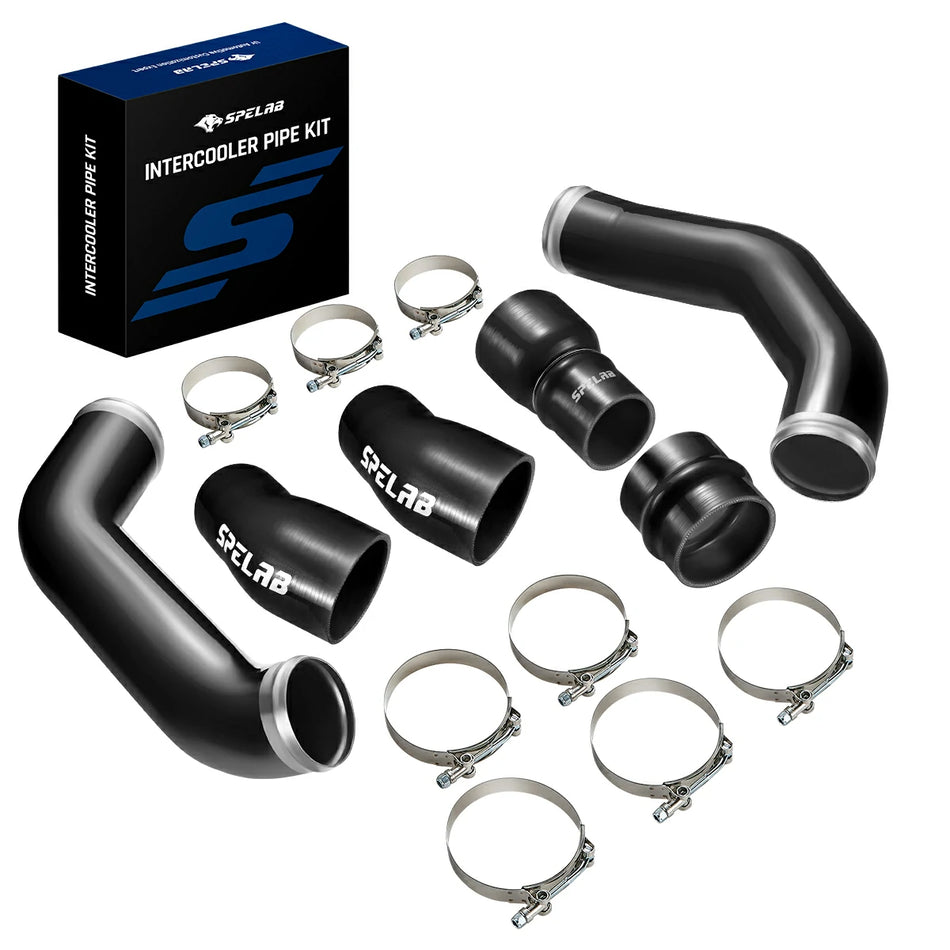
- If a plastic cold-side pipe is cracked, oil-stained, or separating at the connection, a year-correct heavy-duty charge pipe can be a practical replacement. Verify Fitment because the product page spans multiple configurations.
- If intake restriction, runner condition, or related codes point to the manifold on a 2011-2019 truck, read the intake-manifold diagnostic guide before ordering hardware.
- If coolant temperature rises only with a trailer attached, inspect the entire stack before considering a Power Stroke radiator replacement. Fan command, airflow, thermostat operation, coolant level, and charge-air restriction can create the same complaint.
- If oil carryover is coating the charge-air system, understand the factory ventilation path and local road-use requirements before changing it. The crankcase ventilation overview explains the system and service choices.
FAQ
Q: What years use the Ford 6.7L Power Stroke?
A: Ford introduced the 6.7L Power Stroke in the 2011 Super Duty and continues to offer standard-output and High Output versions for the 2026 model year.
Q: How much power does the 2026 6.7L Power Stroke make?
A: Ford rates the standard-output pickup engine at 475 hp and 1,050 lb-ft. The High Output version is rated at 500 hp and 1,200 lb-ft. Chassis-cab ratings and calibrations can differ.
Q: How long can a 6.7L Power Stroke last?
A: Ford does not publish one universal Super Duty pickup lifespan. The engine's condition depends on duty cycle, idle hours, Towing load, fuel quality, regeneration history, calibration, and maintenance. Do not apply the F-650/F-750 commercial B10 design-life claim directly to a high-output pickup.
Q: What causes DEF faults on a 6.7L Power Stroke?
A: Low or contaminated DEF, overfilling, frozen fluid, tank-level errors, pump-pressure faults, crystallized dosing hardware, NOx-sensor problems, exhaust leaks, and SCR efficiency problems can all set warnings. Read the codes and live data before replacing the catalyst.
Q: Which 6.7L Power Stroke years have the high-pressure fuel-pump recall?
A: NHTSA recall 24V957/Ford 24S78 covers certain 2020-2022 6.7L Super Duty and medium-duty trucks, not every truck in those years. Check the 17-character VIN for current eligibility and completion status.
Q: What are the most expensive 6.7L Power Stroke failures?
A: High-pressure fuel-system contamination, turbo or Hot-V repairs with major disassembly, and SCR or cooling repairs performed without correct diagnosis can create the largest bills. The root cause and debris spread matter more than the first code.
Q: Does the High Output engine increase every Super Duty tow rating?
A: No. Engine output is only one part of the rating. Cab, wheelbase, axle ratio, single- or dual-rear-wheel configuration, GVWR, hitch, tires, and the exact towing guide determine the truck's limit.

John Lee
Mechanical Engineer | 10+ Years Experience
John focuses on diesel airflow, thermal management, drivetrain load, and service Fitment. His 6.7L Power Stroke work connects Ford's Hot-V engineering decisions with what Super Duty owners see while towing, hauling Payload, diagnosing boost loss, and maintaining high-mileage work trucks.