
Updated on August 14, 2026.
Every diesel truck guy has heard some version of the same story: a buddy modifies his CCV box, the engine bay looks cleaner for a while, and six months later there's an inspector or a dealer service writer asking questions nobody wants to answer. Before you touch anything on a 6.7 Powerstroke, 6.7 Cummins, or L5P Duramax, it's worth understanding that "CCV reroute" isn't one single design — the aftermarket sells at least three different setups under that name, and they don't carry the same legal exposure. This guide covers how the factory system works, how to tell when it's failing, and what actually separates the different reroute designs on the market.
How the Factory CCV/PCV System Works
Every diesel engine leaks a little combustion gas past the piston rings into the crankcase — that's blow-by, and it happens even on a healthy engine. The factory Closed Crankcase Ventilation (CCV) system, called PCV on some older platforms, captures those gases and routes them back into the intake tract using vacuum pulled from the intake air horn (basic Bernoulli's principle: air moving fast across the CCV port pulls crankcase gases along with it). That's the OEM design on every 6.7 Powerstroke, 6.7 Cummins, and Duramax built since the mid-2000s.
The weak point is the factory filter element and the plastic housing it sits in. Heat cycling, oil vapor, and years of blow-by turn that filter into a sludge trap, and on some platforms the housing itself is prone to cracking with age. Once it clogs or fails, the crankcase can't vent the way it's supposed to, pressure builds, and oil starts finding its way into places it shouldn't — your intake piping, your intercooler, sometimes your turbo inlet.
Signs Your CCV System Is Going Bad
Watch for these, but don't jump straight to blaming the CCV — a few of these overlap with other common failures:
- Oily film or standing oil pooling in the intercooler boots and piping
- A whistling or hissing sound from the CCV box at idle
- Rough idle or a noticeable drop in power under load
- The oil filler cap popping loose or the dipstick pushing up under crankcase pressure
- Oil consumption climbing faster than it should between changes
Pulling the dipstick with the engine idling is a quick field check, not a diagnosis — feel pressure pushing back or hear a hiss, and it's worth a closer look. But rough idle can also point to a boost leak, injector issue, or intake restriction, and rising oil consumption can just as easily come from worn piston rings or a failing turbo seal. Before you order parts, rule those out: check for boost leaks separately, confirm oil level isn't simply overfilled, and only then treat the CCV as the culprit if the symptoms line up with an actual crankcase pressure problem. SPELAB's CCV filter service interval guide walks through the mileage-based checks in more detail.
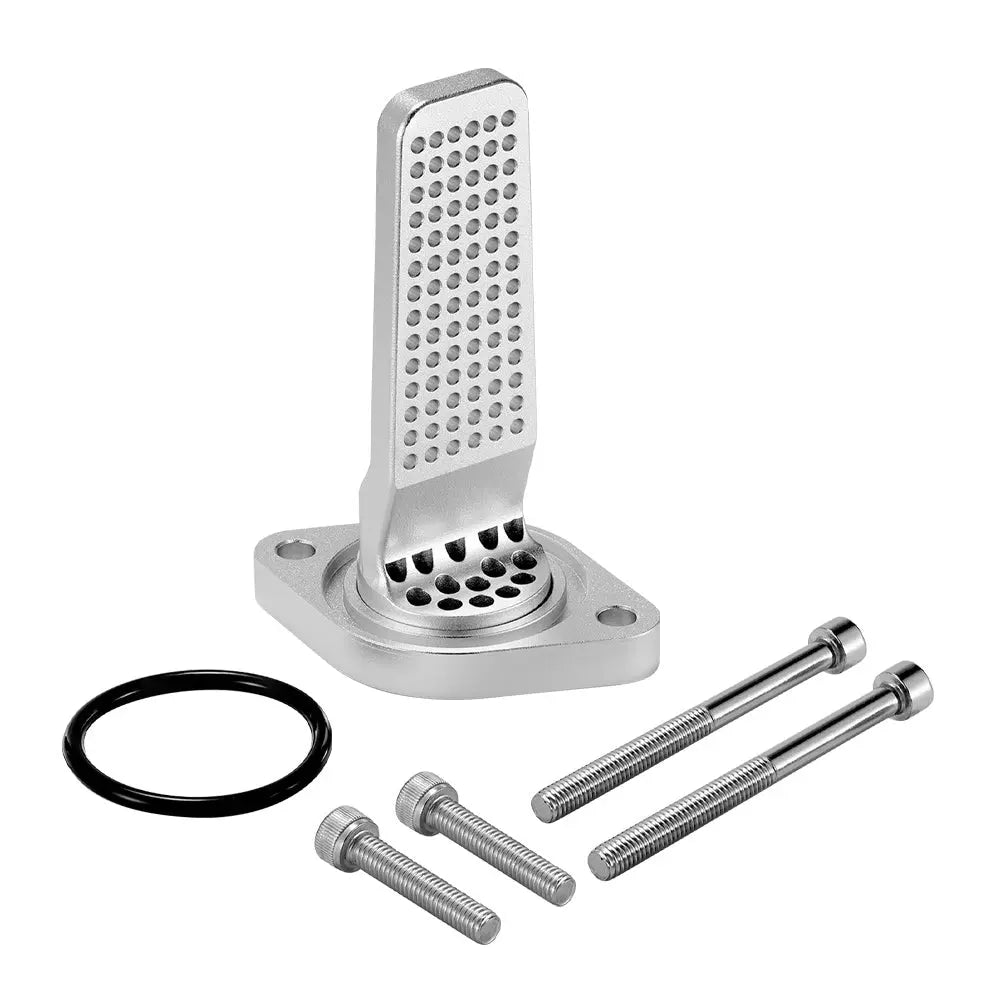
"CCV Reroute" Isn't One Design — Know What You're Buying
This is where a lot of guys get tripped up, because the aftermarket uses "reroute" loosely to describe at least three mechanically different setups:
Closed catch-can systems separate oil from the crankcase vapor inside a can or internal reservoir, drain the oil back to the pan, and still return the cleaned vapor toward the intake side — the control function stays in place, just with better filtration than the factory box.
Exhaust-scavenge (Venturi) systems route crankcase gas into the exhaust stream using vacuum created by exhaust flow, instead of sending it back to the intake at all. Mechanically, this is a different animal from a catch-can reroute, even though it's often sold under the same "reroute" label.
Open-vent systems filter the vapor (or don't) and vent it to atmosphere, often through a hose routed down near the frame — no return path to the intake or exhaust.
The federal Clean Air Act prohibits tampering with, or rendering inoperative, any required emissions control device on a vehicle registered for street use. The EPA's enforcement initiative on aftermarket defeat devices treats crankcase ventilation the same as any other required emissions system under that rule, and EPA's own tampering policy notes it generally won't pursue conduct where there's a documented, reasonable basis to conclude emissions aren't adversely affected — which is a bar an individual truck owner usually can't satisfy on their own. An open-vent design that dumps unfiltered gases to atmosphere is the clearest case of removing a required control. Exhaust-scavenge and catch-can designs sit in less settled territory, and manufacturers of these kits routinely label them for off-road or race use only rather than certifying them street-legal — check the specific product's compliance notice and your state's emissions program before you buy or install anything.
Matching the Kit to Your Platform
Fitment and design aren't universal here — the factory CCV routing is different on every platform, and so is what the aftermarket kit actually does once it's installed.
On the 6.7 Powerstroke, the factory box sits on the driver-side valve cover and is a known weak point for oil-soaking the intake boot, especially on trucks that see a lot of idle time or cold-climate use. A 6.7 Powerstroke CCV reroute kit uses an internal catch can that separates oil and drains it back to the pan — it's a maintenance and reliability upgrade first, not an automatic emissions pass, and the listing itself carries an off-road use notice. Cummins guys running the 6.7L have a different factory layout, and the 6.7 Cummins CCV reroute kit uses a welded Venturi system that scavenges crankcase gas into the exhaust rather than the intake — mechanically different from a catch-can setup, so don't assume it behaves the same way. Duramax owners on the L5P platform have their own factory quirks (a non-serviceable CCV assembly that requires pulling the valve cover to replace), and SPELAB's L5P Duramax CCV kit is explicitly listed for off-road or race use — it's the most aggressive of the three, and street-driven trucks should weigh that before buying.
If you want to compare fitment and available configurations across engine families, the full CCV/PCV reroute lineup breaks it down by engine and model year — but read each listing's design and compliance notice individually rather than assuming they're interchangeable.
Real-World Load: Towing, Cold Weather, and Jobsite Idle
A clogged or marginal CCV system doesn't show its worst side at idle in your driveway — it shows up under real load. Towing near max payload spikes cylinder pressure and blow-by volume, pushing a weak CCV system past its limit faster than daily driving would. Cold climates add a second problem: condensed oil vapor sitting at a low point in the hose routing can freeze solid on a hard winter morning, blocking the vent path until things warm up — that's a routing issue more than a hose-diameter issue, so keep the run free of low sags where moisture can collect and freeze. And if your truck spends hours idling on a jobsite running a PTO or auxiliary equipment, you're racking up blow-by volume without the airflow that would normally help clear it.
None of that means you need to modify anything on a truck that's running fine. But if you're already seeing real symptoms and you tow heavy, work in cold country, or idle a lot, it's worth inspecting the CCV system before you assume it's something else — and worth ruling out ring wear or a turbo seal first on a higher-mileage engine, since a reroute kit won't fix either of those.
What to Look for in a Reroute Kit
Beyond confirming which routing design you're actually buying, look at build quality. Billet aluminum fittings hold up to heat cycling better than factory plastic, and silicone-reinforced hose rated for oil exposure won't harden and crack the way stock rubber does after a few winters. If the kit uses a catch can, check the drain interval and how easy the can is to service — a design you can't easily inspect or drain is one that gets ignored after the first oil change.
Q: Is deleting the CCV system legal on a street-driven truck?
A: Venting crankcase gases straight to atmosphere with no filtration is the clearest form of tampering with a required emissions control under the Clean Air Act. Kits that keep some form of filtration or redirect gas rather than dumping it raw sit in less clear-cut territory, but manufacturers commonly label them off-road or race use only rather than certifying street legality — check the specific product and your state's rules before installing.
Q: What's the real difference between a CCV delete and a CCV reroute?
A: "Reroute" gets used loosely in the aftermarket for at least three different designs: closed catch-can systems that filter and return vapor toward the intake, Venturi systems that scavenge gas into the exhaust, and open kits that vent to atmosphere. Confirm which one you're actually buying before assuming how it behaves.
Q: How often should I change my CCV filter?
A: It depends on the platform. SPELAB's own maintenance data points to roughly 67,500 miles for the 6.7 Cummins CCV filter, while Ford's factory interval for the Powerstroke CCV filter runs closer to 30,000-50,000 miles. Heavy towing, cold climates, and extended idle time can shorten either interval — check sooner if you notice any of the symptoms above.
Q: How do I know if my CCV system is clogged versus another problem?
A: Oily residue in the intercooler piping and a hissing sound at idle point toward the CCV. But rough idle can come from a boost leak or injector issue, and rising oil consumption can come from worn piston rings or a bad turbo seal — rule those out before spending money on a reroute kit that won't fix them.
Q: Will a CCV reroute kit affect my truck's emissions inspection?
A: It depends on the design and your state's test type. A kit that removes filtration and vents to atmosphere is the highest-risk option for a visual or OBD inspection. Several aftermarket CCV kits, including some sold for these platforms, are labeled by their own manufacturers for off-road or race use only — don't assume any reroute kit is inspection-safe without checking the specific product and your local program.
Q: Can the CCV hose freeze up in cold weather?
A: Yes, especially where oil vapor condenses and sits at a low point in the routing. The fix is routing the hose without sagging low spots where moisture can collect and ice over — not simply upsizing the hose or can.
About the Author
John Lee has spent 15 years turning wrenches on diesel pickups, from daily-driven tow rigs to dedicated jobsite trucks. He specializes in emissions-system diagnostics and reliability upgrades for Powerstroke, Cummins, and Duramax platforms, and writes about what actually holds up under real-world towing, cold-weather use, and high-idle jobsite duty.





1 comment
I need a diwnpipe exhaust and exhaust manifold or header. Please help me to choose. my car is 2016 ford mustang.