Updated: July 8, 2026
The cost to remove a DPF depends on what you mean by “remove.” Some owners mean replacing a failed Diesel Particulate Filter with a legal new unit. Others mean professional DPF cleaning. Some mean installing a DPF delete pipe and tuning the truck so the ECU no longer monitors the factory filter. Those are very different jobs, with very different costs, legal risks, and long-term ownership consequences.
Quick answer: A DPF delete pipe may look like a few-hundred-dollar part, but the real DPF removal cost can climb into the thousands once labor, ECU tuning, diagnostics, damaged sensors, inspection failure, warranty risk, resale loss, and return-to-stock repairs are included. For public-road diesel trucks in the United States, removing or disabling a DPF can violate emissions laws.
This guide breaks down DPF removal cost by pipe hardware, labor, tuning, truck platform, hidden fees, legal risk, and alternatives such as DPF cleaning or compliant replacement. It is written for diesel truck owners comparing Cummins, PowerStroke, and Duramax options before spending money.
DPF Removal Cost: Realistic Budget Ranges
If you came here asking “How much does it cost to remove a DPF?”, start with the full budget—not just the pipe. The cheap quote is usually the hardware. The real bill is the system.
| Cost Item | Typical Budget Range | What Drives the Price |
|---|---|---|
| DPF delete pipe / race pipe | $200–$700+ | Material, diameter, muffler section, included clamps, bungs, fitment |
| Basic installation labor | $200–$800+ | Rust, lift access, seized clamps, EGT sensor removal, cutting, fitment quality |
| Flat-rate labor time | 2–3.5 hours for a clean mid-pipe/race-pipe swap | Clean southern truck, lift access, sensors coming out clean, no full EGR work |
| Full all-in-one delete labor time | 5–7.5 hours for DPF/EGR cooler/coolant-routing work | More teardown, coolant handling, EGR cooler access, extra hardware and tuning checks |
| Tuner device / tuning / licenses | $500–$2,000+ | Device, tune file, platform support, ECM unlock, transmission tuning needs |
| Full hardware + tune + labor setup | $1,000–$4,000+ | Truck platform, shop rate, exhaust scope, tuning complexity, sensor condition |
| Diagnostics before removal | $100–$300+ | Scan data, pressure sensor checks, regen history, root-cause diagnosis |
| Replacement EGT sensors | $150–$250+ each | Frozen, stripped, broken, or seized exhaust temperature probes |
| Return-to-stock repair | $2,000–$8,000+ | OEM DPF, DOC/SCR parts, sensors, wiring, brackets, calibration, labor |
| Legal / inspection / resale exposure | Varies heavily | Inspection rules, registration, warranty denial, buyer pool, enforcement risk |
These ranges are planning estimates, not quotes. Current product prices, local labor rates, truck condition, rust, emissions layout, and tuning support can change the real number fast.

Cheap Quote vs Real DPF Removal Cost
A cheap DPF removal quote usually means somebody is only talking about the pipe, not the whole job. The true DPF removal cost includes the parts you can see, the software you cannot see, and the future cost of inspection, resale, warranty, or return-to-stock problems.
That is why one owner says the job was “a few hundred bucks” while another ends up thousands deep. One person may only be counting hardware. Another may be counting pipe, labor, tuner, custom files, seized EGT sensors, and the cost of putting the truck back to stock later.
The pipe is not the budget. The pipe is the first invoice. If you do not budget for tuning, stuck EGT sensors, seized clamps, diagnostic time, inspection risk, and the possibility of returning the truck to stock, you are not pricing the job—you are pricing the easiest daydream version of it.
What Is a DPF and Why Does It Cost So Much to Deal With?
A Diesel Particulate Filter, or DPF, is an emissions-control device that traps soot and particulate matter from diesel exhaust. Instead of letting soot leave the tailpipe, the DPF stores it inside a filter substrate and later burns soot off through regeneration.
A healthy DPF system depends on:
- Correct exhaust temperature
- Accurate differential pressure sensor data
- Good fuel injection control
- Healthy turbo and boost system
- Proper thermostat operation
- Enough drive time for regeneration
- No major EGR, injector, boost leak, or oil-vapor problems upstream
When that system fails, the owner may face three different cost paths: cleaning the DPF, replacing the DPF, or removing/deleting the DPF. Only the first two are usually emissions-compliant repair paths for street-driven vehicles.
Important Legal Note Before You Price the Job
For public-road diesel vehicles in the United States, removing or disabling a DPF can violate the Clean Air Act because the DPF is an emissions-control device. That legal risk is part of the real cost.
Potential consequences include:
- Failed state emissions inspection
- OBD readiness monitor problems
- Warranty denial
- Resale or trade-in issues
- Fines or enforcement exposure
- Cost to reinstall factory emissions parts
- Reduced buyer pool if the truck is sold later
This article is for technical cost education. Confirm federal, state, provincial, and local rules before modifying emissions-related hardware or software.
DPF Removal vs Cleaning vs Replacement Cost
Before pricing a delete pipe, compare every path. If the truck is street-driven, professional cleaning, sensor repair, thermostat repair, injector diagnosis, or compliant DPF replacement may be the better long-term move.
| Option | Typical Cost Pattern | Best For | Main Downside |
|---|---|---|---|
| Forced regeneration | $150–$400+ | Soot-loaded filter that is not ash-packed | Does not remove ash or fix upstream causes |
| Professional DPF cleaning | $300–$700+ | Recoverable filter with soot/ash restriction | May not help cracked, melted, or oil-soaked filters |
| DPF replacement | $1,500–$4,000+ | Street-driven trucks that need emissions compliance | Expensive parts cost |
| DPF removal / delete | $1,000–$4,000+ total setup, plus legal and future-risk exposure | Only legally permitted off-road, competition, or non-road use cases | Legal, inspection, warranty, resale, and tuning risk |
| Return to stock | $2,000–$8,000+ | Inspection, resale, registration, or warranty-related repair | Can cost more than the original removal job |
Parts Cost: DPF Delete Pipe vs Full Exhaust System
The cheapest part of DPF removal is often the pipe itself. But not every pipe is the same. Material, diameter, included clamps, muffler section, sensor bungs, and fitment quality all affect price.
| Part Type | What It Replaces | Cost Level | Notes |
|---|---|---|---|
| DPF delete pipe | DPF section or mid-pipe area | Lower to moderate | Most basic hardware path; may still require tuning |
| DPF/CAT delete pipe | DPF and catalytic converter section | Moderate | Higher emissions risk because multiple components may be removed |
| Race pipe with muffler | Mid-section with sound control | Moderate | Can reduce harsh noise compared with a fully open pipe |
| Downpipe-back system | Large portion of exhaust after downpipe | Moderate to high | More complete hardware replacement |
| Turbo-back system | Exhaust path from turbo outlet rearward | High | Highest hardware and fitment complexity |
If you are researching pipe hardware only for legally permitted off-road or competition use, compare the DPF and CAT delete pipe collection. For Ford-specific fitment, see the PowerStroke DPF delete pipe collection.
John Lee’s Engineered Recommendation: Don’t Piece-Meal the Pipe
Buying a cheap, thin-wall pipe to save a few bucks can invite exhaust leaks, poor hanger alignment, bad sensor angles, and warped flanges. Under heavy towing heat, a sloppy pipe fit can stress the downpipe, hangers, and sensor wiring.
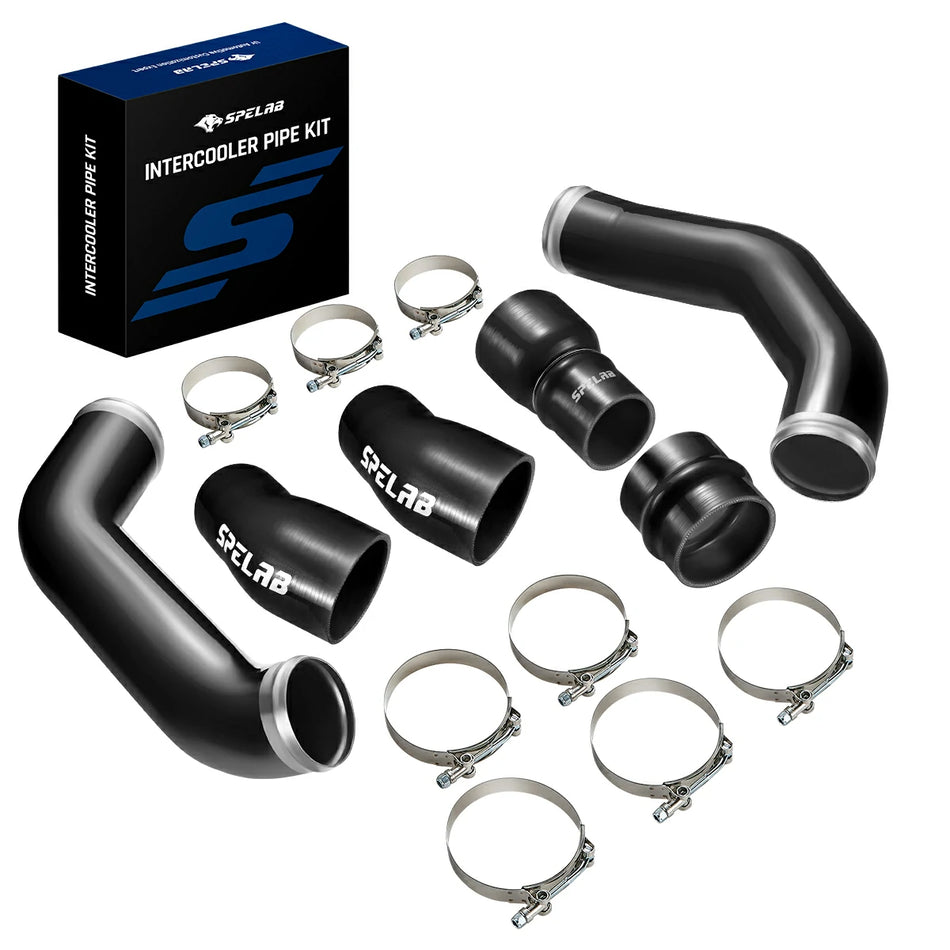
SPELAB heavy-duty DPF and CAT delete race pipes are built for platform-specific fitment, correct routing, and cleaner installation in legally permitted off-road or competition-use applications. The real goal is simple: fewer leaks, cleaner alignment, and less wasted shop time.
View Off-Road Race Pipe OptionsLabor Cost: Why Installation Price Varies So Much
Labor cost depends on the truck, rust level, lift access, sensor condition, pipe size, and whether the original DPF has to be cut out. A clean southern truck on a lift is not the same job as a high-mileage northern truck with seized clamps and corroded hardware.
As a planning range, a simple mid-pipe DPF removal and race-pipe installation may take about 2 to 3.5 flat-rate labor hours on a clean truck with good access. A full all-in-one setup that includes EGR cooler removal, coolant rerouting, tuning checks, and extra teardown can move closer to 5 to 7.5 labor hours. Rust, seized sensors, cab-and-chassis fitment, and damaged hardware can push the job higher.
Labor gets more expensive when:
- Factory clamps are rusted or seized
- EGT sensors are stuck, brittle, or seized in the bung
- DPF pressure sensor tubes are damaged or plugged
- Exhaust hangers need adjustment
- Pipe fitment is poor
- The job requires welding or cutting
- The truck has cab-and-chassis exhaust differences
- The owner wants to keep factory parts intact for return-to-stock
The financial trap under the truck is often the EGT sensors, not the pipe. Modern PowerStroke, Cummins, and Duramax exhaust stacks may use several exhaust temperature probes that have lived through years of regen heat cycles. The threads can gall into the bungs. If a shop tears into them cold with a standard wrench, the sensor can strip, twist, or snap. Budget for at least one stubborn sensor on older trucks, and use heat, penetrant, patience, and the correct wrench before forcing anything.
For official product installation documents, use the SPELAB installation instructions page.
Tuning Cost: The Expense Many Owners Underestimate
On many modern diesel trucks, DPF removal is not just mechanical. The ECU expects to see DPF pressure, exhaust temperature, regeneration behavior, and sensor plausibility. If the DPF is removed without a matching software strategy, the truck can set codes, enter limp mode, or continue trying to regenerate a filter that is no longer present.
| Tuning Item | Why It Matters |
|---|---|
| Tuner device | The hardware or interface used to flash or manage calibration |
| Custom tune file | Calibration support for the truck’s engine, transmission, tires, power level, and use case |
| ECM unlock / licensing | Some newer platforms may require additional unlock or licensing steps |
| Transmission tuning | Can affect shift timing, torque management, towing feel, and drivability |
| Revision support | Poor drivability, smoke, high EGT, or shifting issues may require tune revisions |
Tuning may affect DPF regeneration logic, EGT sensor strategy, differential pressure sensor logic, fuel injection timing, turbo vane control, exhaust brake behavior, readiness monitors, transmission shifts, smoke output, and EGT under load.
For diesel tuning research, compare the diesel tuner collection. Do not assume emissions-related tuning is legal for public-road use.
DPF Removal Cost by Truck Platform
DPF removal cost changes by platform because the hardware layout, sensor count, tuning access, and exhaust routing are not the same. A clean 6.7 Cummins pickup pipe job is not the same cost profile as a newer L5P with SCR/DEF logic or a rusty PowerStroke with seized EGT probes.
| Vehicle Platform | Typical Hardware Type | Cost Difficulty | What to Watch |
|---|---|---|---|
| Chevrolet / GMC L5P 6.6L Duramax | DPF/CAT delete pipe or downpipe-back section | Higher tuning and sensor complexity | NOx, DEF/SCR, EGT sensor, and modern calibration complexity |
| 6.7 Cummins pickup | 4-inch or 5-inch pipe, aluminized or stainless steel | Material and exhaust layout drive price | Fitment differs by year, wheelbase, and emissions layout |
| 6.7 Cummins Cab & Chassis | Cab-and-chassis-specific pipe | Fitment-sensitive | Cab-and-chassis exhaust routing differs from pickup fitment |
| Ford 6.7 PowerStroke | Race pipe, DPF/CAT delete pipe, or muffler-included pipe | Labor and sensor handling can raise the bill | Hot-side packaging, sensor logic, and inspection risk |
For Duramax-specific pipe research, review the L5P Duramax DPF and CAT delete pipe. For Ram cab-and-chassis fitment, compare the 6.7 Cummins Cab and Chassis DPF and CAT delete pipe. For Ford fitment, see the 6.7 PowerStroke DPF and CAT delete pipe.
Before You Price Removal, Confirm the DPF Is Really the Problem
A lot of owners start pricing removal because the truck is in limp mode or keeps regenerating. That does not automatically mean the DPF is the root cause. The DPF may be the victim of another failure upstream.
High DPF pressure or frequent regen can come from:
- Plugged pressure sensor tubes
- Faulty differential pressure sensor
- Failed regeneration due to low exhaust temperature
- Excess soot from injector problems
- Boost leaks causing poor combustion
- Oil vapor contamination from CCV issues
- Thermostat failure preventing proper regen temperature
- Ash load that requires professional cleaning or replacement
For a broader technical explanation, read the deeper DPF delete risk breakdown.
Common DPF Codes Before You Spend Money
Before you buy parts, scan the truck and diagnose the failure. A DPF-related code may point to the filter, but it can also point to sensors, pressure tubes, wiring, air metering, or upstream engine problems.
| Code / Warning | Common Meaning | What to Check First |
|---|---|---|
| P2002 | DPF efficiency below threshold | Exhaust leaks, cracked filter, differential pressure sensor, regen history |
| P242F | DPF restriction or ash accumulation | Ash load, soot load, pressure tubes, cleaning options, replacement need |
| P2452 / P2453 | DPF differential pressure sensor circuit or performance fault | Sensor, wiring, plugged tubes, pressure line damage |
| P0101 | MAF sensor range / performance problem | MAF contamination, intake leaks, EGR data conflict, air-filter restriction, boost leaks |
| Frequent regen | DPF is loading too often or regen is incomplete | Thermostat, injectors, boost leaks, EGR, driving cycle, fuel quality |
| Derate warning | System is protecting itself after unresolved emissions faults | DEF/SCR, DPF, NOx sensors, EGT sensors, wiring, ECM data |
P0101 is not a “DPF delete code,” but it matters because bad air-metering data can lead to poor combustion, higher soot output, failed regeneration, and faster DPF loading. For pressure-sensor diagnosis, read DPF pressure sensor symptoms and diagnosis. For a related failure chain, read why DPF clogging can get worse after EGR delete.
Can DPF Removal Be Detected?
Yes. DPF removal can be detected in multiple ways. Do not assume that because a truck sounds normal or passes a simple smoke check, the modification is invisible.
- Visual inspection: missing DPF canister, altered exhaust pipe, missing sensors, non-factory clamps, or altered hangers.
- OBD readiness checks: missing or disabled emissions monitors can cause inspection failure.
- State emissions inspection: rules vary by state and county.
- Opacity or smoke testing: some diesel inspections use visible smoke or opacity checks, especially for commercial vehicles.
- California Smog Check / CARB context: California and CARB-regulated areas can be especially strict about emissions hardware and approved parts.
- Trade-in inspection: dealers may reduce value or reject a deleted truck because returning it to stock can be expensive.

Hidden Costs After DPF Removal
1. Warranty Risk
Removing emissions equipment or changing emissions-related tuning can affect warranty claims. If a dealer connects a turbo, engine, transmission, emissions, or fuel-system problem to the modification, coverage may be denied.
2. Resale Loss
A deleted truck can be harder to sell. Many buyers, dealers, and lenders avoid modified emissions systems because the truck may not pass inspection or may need costly return-to-stock repairs.
3. Return-to-Stock Cost
If you throw away the factory DPF, catalytic converter, sensors, brackets, and wiring, returning the truck to stock can become very expensive later.
4. Inspection Failure
Even if the truck runs well, it may fail visual inspection, OBD readiness checks, smoke testing, or registration-related emissions review.
5. Poor Tuning Consequences
A bad tune can cause excessive smoke, high EGT, turbo stress, rough shifting, fuel-system strain, or limp-mode issues.
When DPF Removal Might Be Considered
DPF removal may be considered only in specific off-road, competition, or non-road-use applications where the modification is legally permitted and the owner understands the risks.
Before choosing removal, ask:
- Is the truck used on public roads?
- Does it need inspection or registration?
- Is the DPF actually failed, or is an upstream issue causing the symptom?
- Can professional cleaning or replacement solve the problem legally?
- Is the tune safe for EGT, turbo, transmission, and fuel system?
- Will you keep the stock parts?
- What will it cost to return to stock later?
Legal Alternatives Before Removing the DPF
If your truck is a daily driver, tow rig, commercial vehicle, or emissions-inspected vehicle, try lower-risk options first.
| Problem | Lower-Risk First Step | Why It Helps |
|---|---|---|
| Frequent regeneration | Check thermostat, injectors, boost leaks, EGR, and drive cycle | Upstream problems often overload the DPF |
| DPF restriction | Professional DPF cleaning or compliant replacement | Keeps emissions system intact |
| Oil contamination | Service CCV system or install sealed catch can where appropriate | Reduces oil vapor that contributes to sticky soot sludge |
| Sensor codes | Inspect differential pressure sensor, EGT sensors, wiring, MAF data, and tubes | Many DPF codes are sensor or data problems |
| Want better sound | DPF-back exhaust, performance muffler, exhaust tip, or electric cutout where legal | Targets sound without removing emissions hardware |
If the root issue is crankcase oil vapor feeding soot sludge, consider a diesel oil catch can or platform-specific CCV service. A sealed baffled catch can may reduce oil mist entering the intake path, but legality and routing depend on vehicle platform, installation method, and local inspection rules.
Final Verdict: What Does It Really Cost to Remove a DPF?
The visible price may look like a few hundred dollars for the pipe and a few hundred dollars for labor. But the real cost to remove a DPF includes tuning, diagnosis, inspection risk, warranty risk, resale impact, and possible return-to-stock repairs.
For a street-driven truck, the safer long-term choice is usually diagnosis first, then DPF cleaning, sensor repair, thermostat repair, injector diagnosis, CCV service, or compliant DPF replacement. For a dedicated off-road or competition-use vehicle where DPF removal is legally allowed, budget for the full system—not only the pipe.
The better question is not simply “How much does it cost to remove a DPF?” The better question is: what is the true total cost after tuning, legality, inspection, resale, and future repairs are included?
FAQ
Q: What is the average DPF removal cost?
A: A pipe-only job may look like a few hundred dollars, but a realistic full setup can reach $1,000–$4,000+ once labor, tuning, diagnostics, and sensor issues are included. Return-to-stock repairs can cost even more.
Q: How much does a DPF delete pipe cost?
A: Many DPF delete pipes fall in the $200–$700+ planning range, depending on vehicle fitment, material, diameter, muffler section, and included hardware. Always verify the current product page before buying.
Q: How many labor hours does DPF removal take?
A: A clean mid-pipe or race-pipe swap may take about 2–3.5 flat-rate hours. A full all-in-one setup with EGR cooler work and coolant rerouting may take about 5–7.5 hours or more, depending on truck condition and access.
Q: How much is labor to remove a DPF?
A: Labor often ranges from a few hundred dollars to $800+ depending on truck condition, rust, shop rate, access, sensor condition, and whether cutting or fitting is required.
Q: Do I need tuning after removing a DPF?
A: On many modern diesel trucks, yes. The ECU expects DPF pressure, temperature, and regeneration data. Without proper calibration, the truck may set codes, enter limp mode, or continue trying to regenerate.
Q: Is DPF removal legal?
A: For public-road vehicles in the United States, removing or disabling emissions-control equipment can violate the Clean Air Act.
Q: Can DPF removal be detected?
A: Yes. It can be detected through visual inspection, missing hardware, altered sensors, OBD readiness checks, smoke or opacity testing, state emissions inspection, California Smog Check, service records, or trade-in inspection.
Q: Is DPF removal cheaper than DPF replacement?
A: The pipe may be cheaper than replacement, but total ownership cost can become higher if you include tuning, failed inspection, warranty denial, resale loss, and return-to-stock repairs.
Q: What are legal alternatives to DPF removal?
A: Alternatives include forced regeneration, professional DPF cleaning, DPF replacement, differential pressure sensor repair, EGT sensor repair, thermostat repair, injector diagnosis, CCV service, and emissions-intact exhaust upgrades.
Q: Should I keep my stock DPF if I remove it?
A: Yes. Keeping stock parts can reduce future return-to-stock cost for inspection, resale, registration, or warranty-related repairs.
Q: Does SPELAB supply DPF delete pipes for businesses?
A: Yes, View all DPF delete products , or learn how SPELAB supports shops, dealers and fleets with flexible DPF delete pipe supply.
Legal Notes
[1] In the United States, EPA states that tampering with a vehicle’s emissions-control system is illegal under the Clean Air Act, and the Clean Air Act also prohibits manufacturing, selling, offering for sale, or installing aftermarket devices that effectively defeat those controls. Reference: EPA Clean Air Northeast: Tampering and Aftermarket Defeat Devices.
[2] EPA also describes aftermarket defeat devices as an enforcement priority and states that required emission controls often include filters and catalysts in the exhaust system, along with calibrations that manage fueling strategy and engine operation. Reference: EPA: Stopping Aftermarket Defeat Devices for Vehicles and Engines.

John Lee
Mechanical Engineer | 10+ Years Experience
John has spent the last decade engineering and testing high-performance automotive components. Specializing in drivetrain durability and thermal management across Powerstroke, Cummins, and Duramax applications, he bridges the gap between OEM limitations and aftermarket performance. His philosophy: "Factory parts are just a starting point."