Updated on July 31, 2026.
A sale price does not make the wrong diesel part a good buy. Before ordering a mod for a Powerstroke, Duramax, or Cummins truck, identify the exact engine generation, prove what is wrong, and decide whether the truck needs maintenance, monitoring, stronger hardware, better heat control, or more power. That order matters on a daily driver and matters even more when the truck carries payload or pulls a trailer.
The Five-Step Diesel Upgrade Order
- Maintenance and required repairs: Clear overdue service, active faults, fluid leaks, fuel restrictions, cooling problems, battery issues, and worn driveline parts.
- Monitoring: Add the scan data or gauges needed to watch the system you plan to change. A number under load is more useful than a clean-looking part in the driveway.
- Known weak hardware: Replace the pipe, boot, pump-protection component, tank, connector, or service cover that inspection has identified as a real risk.
- Airflow and thermal support: Match intercoolers, charge pipes, intake parts, radiators, oil coolers, and transmission coolers to the truck's duty cycle.
- Calibration and power: Add torque only after the fuel, air, cooling, transmission, driveshaft, U-joints, axle, brakes, and tires can support the intended use.
This sequence keeps a daily-driven work truck dependable and prevents a new tune from hiding an old mechanical problem. It also gives you clean before-and-after data when a bolt-on part changes how the truck runs.
Build a Baseline Before You Build a Shopping Cart
- Scan every module: save current and pending diagnostic trouble codes, freeze-frame data, and monitor status before clearing anything.
- Review service history: verify engine oil, fuel filters, air filter, coolant, transmission fluid, axle fluid, crankcase ventilation service, and known overdue maintenance.
- Inspect for leaks and rub points: check charge-air pipes, boots, intercooler end tanks, exhaust manifolds, up-pipes, coolant connections, fuel lines, wiring, and drivetrain seals.
- Check the truck by VIN: complete open safety recalls before installing a part that could complicate the original symptom. Use the NHTSA recall lookup.
- Record a loaded run: on the same route and with the same payload, log boost, commanded versus actual rail pressure, intake-air temperature, coolant temperature, transmission temperature, EGT if equipped, and battery voltage.
- Weigh the working truck: a certified scale ticket shows actual axle load and payload. Keep every axle, tire, hitch, and combined-weight number within the manufacturer's limits.
For a towing truck, cooling-stack condition, tire pressure, brake condition, fluid service, and actual payload often deserve attention before an airflow part. Work through this summer diesel towing checklist before adding another box to the build sheet.
Let the Symptom Point to the System
| Driver complaint | First checks | Upgrade trigger | Red flag or next direction |
|---|---|---|---|
| Hiss, low power, black smoke, or underboost under load | Charge pipes, boots, clamps, intercooler, MAP/boost sensor, turbo control, and pre-turbo exhaust leaks | A cracked pipe, damaged connection, soft oil-soaked boot, or repeat blow-off is confirmed | Normal pressure test but poor actuator response points back toward turbo control, sensors, or exhaust energy |
| High EGT or heat soak while towing | Trailer weight, grade, road speed, gear, boost stability, cooling stack, fan operation, fuel delivery, and calibration | A leaking charge system, damaged heat exchanger, or documented airflow restriction is found | Fast temperature rise with stable boost calls for load, fueling, cooling, and probe-location review |
| Long crank, low rail pressure, or new fuel-system noise | Fuel quality, filters, low-pressure supply, commanded versus actual rail pressure, wiring, and evidence of debris | A year-specific protection plan is selected while the system is clean, or a diagnosed component is replaced correctly | Metal in the fuel filter means stop running the engine and plan a contamination inspection |
| Coolant loss or rising coolant temperature | Cooling-system pressure test, cap, reservoir, hoses, water pump, thermostat, fan, radiator, and external debris | A leaking plastic tank, damaged tube, restricted core, or inadequate heat exchanger is proven | Combustion gas in the cooling system or unexplained hose pressure needs engine-level diagnosis |
| Transmission or rear-axle heat | Correct fluid and level, actual axle load, converter slip, brake drag, bearings, gear setup, and tire-size match | A pan, cooler, or cover improves service access, protection, or thermal capacity on the verified unit | Debris, burnt fluid, excessive slip, or abnormal gear contact needs repair rather than added fluid capacity |
Platform Checks That Prevent Wrong-Part Orders
| Platform | Generation checks | Practical first priorities | Common fitment mistake |
|---|---|---|---|
| Ford Powerstroke | Separate 7.3L, 6.0L, 6.4L, and each 6.7L generation. On 2023-2025 6.7L trucks, confirm Standard Output versus High Output whenever the listing calls it out. | Fuel-system condition, charge-air sealing, coolant and oil condition, turbo control, and transmission temperature | Ordering one broad 2011-2025 part without selecting the year-specific side, connection, and engine-output variant |
| GM Duramax | Separate LB7, LLY, LBZ, LMM, LML, and L5P. Split model years can change pipe, sensor, turbo, fuel, and emissions layouts. | Fuel supply and injector data where applicable, cooling-stack cleanliness, charge-air sealing, and loaded transmission data | Treating an LML part as L5P-compatible because both engines displace 6.6 liters |
| Ram Cummins | Separate 5.9L from 6.7L, then confirm pickup versus chassis cab, model year, transmission, turbo layout, intake heater, and emissions equipment. | Low-pressure fuel supply, charge-air boots, VGT operation, crankcase ventilation service, cooling, and transmission support | Buying by "6.7 Cummins" alone and missing a 2007-2009, 2010-2012, 2013-2018, or 2019-and-newer routing change |
Use current manufacturer documents for the exact truck. Ford explains VIN- and model-specific document access through its owner-manual support page. GM provides documents through the GM manuals portal. Ram information is available from the Mopar owner-manual page.
Powerstroke Fuel Protection: Inspect Before You Install
On a 2011-2016 6.7L Power Stroke, a CP4 bypass or disaster-prevention kit is meant to limit where debris can travel if the high-pressure pump fails. It does not prevent every pump failure and cannot clean a system that already contains metal.
Before installation, inspect the fuel filter and drained fuel under clean, bright light. Metallic glitter, flakes, active low-rail-pressure faults, or a large commanded-versus-actual pressure gap are reasons to stop running the engine and move to a full fuel-system diagnosis. A CP3 conversion is a different pump-system modification with year, calibration, emissions, and warranty implications; it is not a substitute for confirming whether the current system is already contaminated. The 6.7L Powerstroke CP4 failure guide covers the failure path in more detail.

Charge-Air Leaks: Keep the Screening Test Short
A commercial boost leak tester or correct block-off adapters, a regulator, and a readable pressure gauge are the right tools. Inspect the full hot and cold side for oil tracks, split boots, rubbed pipes, loose quick-connects, and clamp witness marks. Start around 5 psi to expose a large leak, then increase pressure only within the limit stated by the vehicle service procedure and test-tool manufacturer; never apply unregulated shop air. Repair the leak, repeat the same test, and compare boost and EGT on the original loaded route.
For clamp placement, bead condition, soap testing, and repeat blow-off diagnosis, use the dedicated intercooler pipe sealing procedure. Keeping that detailed workflow on one page prevents three articles from competing over the same job.

Cooling and EGT: Use a Range, Then Use Your Baseline
For towing and sustained loaded work, 1,250-1,300 degrees F pre-turbo is a common workshop screening range where many owners back out of the throttle and investigate instead of holding the heat. A long-running Ford Truck Enthusiasts EGT discussion reflects that familiar pre-turbo range. It is a reference, not a substitute for the OEM limit or the calibration and gauge manufacturer's instructions.
Probe location changes the number: a post-turbo probe normally reads materially lower than a pre-turbo probe, so do not compare them as if they were the same measurement. First follow the approved limit for the exact engine and calibration, then compare the truck against its own normal EGT on the same grade, gear, speed, ambient temperature, and payload. A sudden change from that baseline is often more useful than a borrowed number.
If EGT climbs while boost stays stable, inspect load, downshifting strategy, fueling, air restriction, cooling-stack cleanliness, and calibration. If boost falls while EGT rises, look harder at the charge-air system and turbo control. For intake-side thermal planning, this diesel intercooler upgrade guide explains where a larger core can help.

Use This Page as a Diesel Upgrade Hub
Once the weak system is identified, move to the guide that owns the detailed job. Cummins owners considering intake-side airflow can start with the 6.7L Cummins intake upgrade guide. Owners working on rear-axle service, fluid capacity, or towing heat can use the differential cover selection guide. The goal is to diagnose one system, then use one detailed procedure instead of firing the parts cannon across the whole truck.
Match the Mod to Real Truck Use
Towing and Payload
Long grades expose a weak boot, dirty cooling stack, marginal fan, and overloaded axle faster than an unloaded freeway pull. Watch boost stability, EGT trend, coolant temperature, transmission temperature, and gear selection. A power mod does not authorize more trailer weight.
Jobsite and Fleet Work
Dust, vibration, idle time, short trips, and repeated heat cycles punish filters, clamps, batteries, and plastic tanks. Favor serviceable hardware, replaceable seals, accessible connections, and clear fitment labeling. Downtime from a wrong variant costs more than the discount.
Off-Road Use
Check pipe, radiator, intercooler, and wiring clearance as the chassis moves. A rigid pipe needs correctly placed flexible couplers and brackets so vibration is not transferred into an intercooler neck or intake flange. Protect low connections from mud and debris.
Extreme Heat and Cold
In hot weather, clean bugs, seeds, mud, and oil film from the condenser, intercooler, and radiator stack before ordering a larger core. In freezing conditions, check batteries, glow-plug or intake-heater operation, fuel treatment requirements, coolant strength, and silicone condition. Reliable cold starts beat a theoretical airflow gain on a northern jobsite.
Fitment Checklist Before Checkout
- VIN, model year, engine family, engine generation, and output version
- Pickup or chassis cab, cab and bed configuration where relevant, and two-wheel or four-wheel drive if the listing distinguishes them
- Factory or aftermarket turbo, intercooler, intake, radiator, cooler, and sensor layout
- Connection diameter, clocking, quick-connect style, sensor provisions, and bracket locations
- Required emissions hardware and onboard-diagnostic functions retained
- Routing around batteries, fan shroud, coolant lines, AC lines, wiring, steering, and suspension
- Included seals, clamps, hoses, fittings, brackets, filter elements, fluids, and instructions
- Current variant price, stock status, return terms, warranty, and any CARB Executive Order claim
Three Fitment-Specific Parts Across Three Systems
These are examples of fuel protection, charge-air hardware, and cooling support, not guaranteed cures. Prices were checked July 31, 2026 and can change. Diagnose the truck and verify the exact variant before ordering.
| Product | System and listed fitment | Price snapshot | Buying decision |
|---|---|---|---|
| CP4 Bypass/Disaster Prevention Kit For 2011-2016 6.7 Powerstroke Diesel Ford F250/F350/F450 | SPELAB | Fuel-return protection for listed 2011-2016 Ford 6.7L Powerstroke applications; 6061 aluminum components and a serviceable 20-micron return-side filter | $239.00 | Install only after a clean-system inspection. Existing metal calls for contamination diagnosis, not a bypass-only job. |
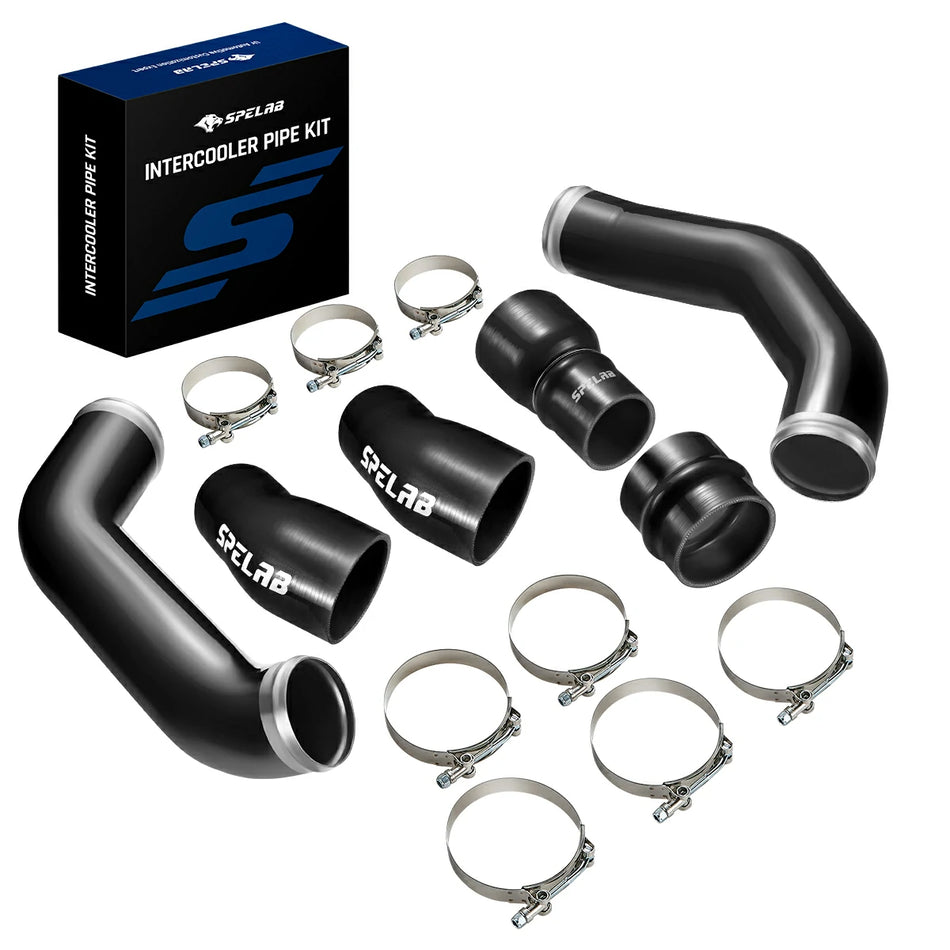
| SPELAB Intercooler Pipe Kit For 2011-2016 GMC 6.6L LML Duramax Diesel | Charge-air kit for listed 2011-2016 LML trucks; mandrel-bent aluminum piping with reinforced silicone boots | $199.99 for the pipe-kit variant | Buy after locating a failed pipe, boot, or connection. Confirm LML layout; displacement alone does not make it an L5P part. |
| Radiator Cool Direct-Fit Performance for 2013-2018 Dodge Ram 2500/3500 6.7L Diesel | SPELAB | Two-row aluminum-core, plastic-tank radiator for listed 2013-2018 Ram 2500/3500 6.7L diesel pickups; includes a 12-inch oil cooler | $309.99 | Pressure-test first and verify pickup fitment, core dimensions, hose fittings, fan clearance, oil-cooler connections, and required coolant. |
For broader system-by-system browsing after diagnosis, use the SPELAB engine parts collection.
Budget the Complete Installed Job
The figures below are planning ranges, not quotes. They use a broad independent diesel-shop labor allowance of $120-$200 per hour and include a modest allowance for normal job supplies. Local rates, corrosion, broken hardware, extra diagnosis, and existing modifications can move the total.
| Example job | Planning labor | Typical extra supplies | Approximate shop-installed total |
|---|---|---|---|
| 2011-2016 Powerstroke CP4 bypass kit | 2-4 hours | $20-$80 for clean fuel-service supplies and incidentals | About $500-$1,120 including the listed $239.00 part |
| 2011-2016 LML hot-and-cold charge pipe kit | 1-3 hours | $20-$80 for cleaner, approved seals, clamps, or minor hardware | About $340-$880 including the listed $199.99 part |
| 2013-2018 Ram 6.7L radiator | 3-5 hours | $50-$120 for correct coolant, distilled water where specified, and incidentals | About $720-$1,430 including the listed $309.99 part |
DIY is reasonable when you have the correct service information, a clean work area, rated lifting equipment where needed, a regulated pressure tester, fluid-capture equipment, and the tools to verify the repair. Use a qualified diesel shop when fuel-system metal is present, rail-pressure faults are active, coolant may contain combustion gas, oil is pooling in the charge system, the turbo has shaft play or heavy smoke, clamps are inaccessible, or a pipe blows off again after a correctly regulated test.
Emissions, California, and Warranty Boundaries
The federal Clean Air Act prohibits tampering with required emissions controls and the manufacture, sale, or installation of defeat devices. EPA enforcement covers hardware and software that bypasses EGR, DPF, SCR, sensors, onboard diagnostics, or certified calibrations. Review the EPA emissions-tampering guidance before changing an emissions-related system.
California adds its own aftermarket-parts requirements. Do not treat "50-state legal" as proof by itself. When a product affects an emissions-controlled system, verify the exact CARB Executive Order number and confirm that the EO covers the truck's model year, engine, and test group. The California Air Resources Board aftermarket-parts program explains how exemptions apply to specific parts and vehicles.
Under the Magnuson-Moss Warranty Act, installing an aftermarket part does not automatically cancel the entire vehicle warranty. A warrantor can still deny a claim when the aftermarket part or its installation caused the failure. Keep the original hardware, instructions, receipts, baseline scan, test results, and installation photos. The FTC vehicle warranty guidance summarizes the federal consumer position.
Frequently Asked Questions
Q: What diesel performance mod should I buy first?
A: Start with the maintenance or repair supported by your baseline. On a healthy truck, useful monitoring and known weak hardware normally come before a tune, larger turbo, or aggressive fuel change.
Q: Which charge pipe fails first on a 6.7 Powerstroke?
A: There is no single answer across every 2011-and-newer configuration. Plastic cold-side pipes and connections are common inspection points, but the hot side, boots, clamps, intercooler necks, and later Standard Output or High Output layouts differ. Pressure-test the exact truck and replace the failed side rather than ordering by engine size alone.
Q: What EGT is too high for towing?
A: A common pre-turbo screening range is 1,250-1,300 degrees F for sustained operation, where backing out and checking load, gear, fueling, boost, and cooling is prudent. Follow the OEM and calibration or gauge manufacturer's limit first. Post-turbo readings are lower, and the truck's repeatable baseline matters.
Q: Does oil inside an intercooler pipe mean the turbo is bad?
A: A light film can enter through the factory crankcase ventilation system. Pooling oil, rapid oil consumption, heavy smoke, shaft play, or a sharp change from the truck's normal condition needs deeper turbo and engine diagnosis.
Q: Is a CP4 bypass kit the same as a CP3 conversion?
A: No. A bypass kit changes the contamination path if a CP4 fails; it does not replace the high-pressure pump or repair existing damage. A CP3 conversion changes the pump system and requires exact fitment, calibration, emissions, and warranty review.
Q: Does a CARB EO number make a part 50-state legal?
A: Only when the Executive Order covers that exact part and the specific vehicle, model year, engine, and test group. Verify the EO document instead of relying only on a product-page phrase.
Q: When should I send the truck to a diesel shop?
A: Stop and get professional help for metal in the fuel, active high-pressure fuel faults, suspected combustion gas in the coolant, heavy oil pooling with smoke or turbo shaft play, lack of a regulated boost tester, inaccessible high-risk connections, or repeat pipe blow-off after correct installation and testing.