Updated: July 21, 2026
An upgraded intercooler can lower charge-air temperature, resist heat soak, reduce restriction when the core is well designed, and help a turbocharged diesel hold more consistent power under load. The real gain is usually repeatable performance during towing, hot-weather driving, and higher-boost use, not a guaranteed peak-horsepower number.
Key Takeaways
An intercooler upgrade is worth buying when logged temperatures, repeated power fade, core damage, or pressure testing shows that the stock charge-air system is the limitation.
- A stock daily driver with stable intake air temperature and no leaks may not need a larger core.
- A towing truck that heat-soaks on long grades can benefit even when the first short pull feels normal.
- A larger core must balance heat rejection, internal flow, charge-air volume, frontal airflow, weight, and fitment.
- Boot blow-off, cracked pipes, loose clamps, and oil-soaked couplers call for a leak repair before a core upgrade.
- Compare before-and-after IAT, EGT, boost, ambient temperature, speed, and load instead of trusting one advertised temperature drop.
What Improves After Upgrading an Intercooler?
A properly matched intercooler improves heat control and consistency across repeated or sustained boost events; it does not make every truck faster in every driving condition.
| Possible Improvement | What Changes on the Truck | Where It Matters Most | How to Verify It |
|---|---|---|---|
| Lower intake air temperature | The charge air leaving the core stays closer to ambient temperature under load. | Summer towing, long grades, repeated pulls | Log the same IAT sensor or PID on the same route |
| Less heat soak | Power and response fade less after several minutes of sustained boost. | Fifth-wheel towing, mountain driving, hot jobsite use | Compare first-pull and late-pull IAT and response |
| Controlled pressure drop | A well-designed core moves the required airflow without excessive inlet-to-outlet loss. | Tuned trucks and upgraded turbo systems | Measure pressure before and after the core under the same load |
| More stable EGT trend | Cooler, denser charge air may slow exhaust-temperature rise when fueling and load stay comparable. | Heavy towing and sustained grades | Log EGT at the same sensor location, speed, load, and gear |
| Improved durability | A sound welded aluminum core can replace leaking crimps, cracked end tanks, or a damaged factory unit. | High-mileage and high-boost trucks | Pressure-test the system and inspect end tanks and welds |
| More tuning headroom | Better heat control can support a calibrated airflow and fueling package. | Larger-turbo or higher-fueling builds | Use controlled logs and professional calibration |
Owners who need the basic thermodynamics first can read the complete charge-air cooling explanation. This page stays focused on the upgrade decision.

Does an Upgraded Intercooler Add Horsepower?
An upgraded intercooler does not carry a universal horsepower gain because the result depends on the stock core, heat-soak condition, turbo efficiency, fueling, calibration, pressure drop, and test method.
A stock truck may show little change on the first cool dyno pull. The same truck can feel more consistent on the fourth pull or halfway up a summer grade because the new core keeps the charge-air temperature from climbing as quickly.
A tuned truck can use that thermal margin only when the turbo, fuel system, transmission strategy, and calibration support the added airflow demand. Advertised horsepower from a package test should not be credited to the intercooler alone when the tune, boost target, intake, or fueling changed at the same time.

How Do You Measure an Intercooler Upgrade?
Measure an intercooler upgrade by comparing repeatable data before and after installation, not by judging one boost number or one cool-weather drive.
Use the same route, trailer weight, gear, road speed, starting coolant temperature, and ambient-temperature range whenever possible. A mountain-grade test from a cold start cannot be fairly compared with a short unloaded pull on a cooler day.
| Measurement | What It Reveals | Common Mistake |
|---|---|---|
| Intercooler inlet and outlet temperature | How much heat the core removes from compressed air | Using different sensor locations before and after |
| Manifold IAT | The temperature the engine sees at the available factory sensor | Ignoring ambient temperature and vehicle speed |
| Pressure drop | The pressure lost through the core and connections | Comparing readings at different engine loads |
| EGT trend | How exhaust temperature builds during sustained work | Changing fueling, gear, or probe location |
| Boost recovery | Whether added system volume or restriction changes response | Blaming core size before checking for leaks |
Cooling effectiveness can be expressed as (T_hot - T_out) / (T_hot - T_ambient). Core pressure drop is P_inlet - P_outlet. These relationships are useful only when the sensors are accurate and the test conditions are controlled.
No single pressure-drop limit fits every Power Stroke, Cummins, Duramax, turbo, and power level. Compare measured results with the vehicle's service information and the core manufacturer's data for the intended airflow range. The guide to how boost pressure behaves across the core covers that relationship in more detail.
When Is an Intercooler Upgrade Worth It?
An intercooler upgrade is worth the money when the truck's current core cannot control charge-air temperature or remain sealed during the work the owner actually asks it to do.
| Truck and Use | Likely Decision | Reason | First Check |
|---|---|---|---|
| Stock daily driver in mild weather | Monitor before buying | The factory core may already control temperature adequately | Scan IAT and inspect for leaks |
| Truck towing a fifth-wheel through long grades | Upgrade may make sense | Sustained boost can expose heat soak that a short pull will not | Log IAT, EGT, speed, gear, and load |
| Tuned truck with a larger turbo or more fuel | Match the core to the build | Airflow and heat-rejection demand are higher than stock | Review compressor flow, boost target, and pressure-drop data |
| High-mileage truck with a leaking end tank | Replace the damaged core | Reliability is the first gain; performance is secondary | Pressure-test and inspect crimps, tanks, and welds |
| Jobsite truck with long idle time and heavy payload | Inspect the whole cooling stack | Low road speed can limit airflow through the condenser, intercooler, and radiator | Check debris, fan operation, coolant temperature, and IAT |
| Truck with a loud pop and instant underboost | Repair the boost path first | A boot, clamp, or pipe failure is more likely than heat soak | Inspect and pressure-test every charge-air joint |
What Changes on Power Stroke, Cummins, and Duramax Trucks?
The upgrade goal is similar across the three diesel platforms, but the weak points, pipe routing, sensor placement, available grille space, and model-year fitment are not interchangeable.
| Platform | Applications to Separate | Common Owner Complaint | Upgrade Focus |
|---|---|---|---|
| Ford Power Stroke | 6.0L, 6.4L, and 6.7L Super Duty | Heat soak, aging end tanks, cold-side pipe or boot failure | Core fitment, sensor provisions, pipe compatibility, grille-stack clearance |
| Ram Cummins | 5.9L and 6.7L Ram diesel generations | Towing EGT, high-boost heat load, oily boots, coupler movement | Flow capacity, boot retention, core construction, radiator airflow |
| GM Duramax | LBZ, LMM, LML, and L5P truck applications | Towing heat, charge-pipe leaks, oily cold-side connections | Engine-code fitment, end-tank integrity, pipe alignment, pressure drop |
Use the exact engine and model year before ordering. Cab-and-chassis models, build-date splits, sensors, active grille shutters, bumper packages, and existing aftermarket piping can change fitment even when the engine badge looks right.
Do You Need an Intercooler Core or a Pipe Kit?
Choose the core for a verified heat-control or core-integrity problem; choose pipes, boots, or clamps for a verified sealing and durability problem.
| Observed Problem | Likely Weak Point | Better First Move |
|---|---|---|
| IAT keeps climbing during a sustained grade, with no leak found | Heat-soaked, undersized, blocked, or damaged core | Evaluate a better-matched intercooler |
| Hissing, oil spray at a joint, or a loose coupler | Boot, clamp, bead, O-ring, or pipe alignment | Repair and pressure-test the connection |
| Cracked plastic charge pipe | Pipe material or fatigue | Replace the pipe and inspect neighboring boots |
| Leaking crimp or cracked intercooler end tank | Intercooler assembly | Replace the core |
| Slow response immediately after installation | Leak, excessive core volume, restriction, or routing issue | Pressure-test and review the system design |
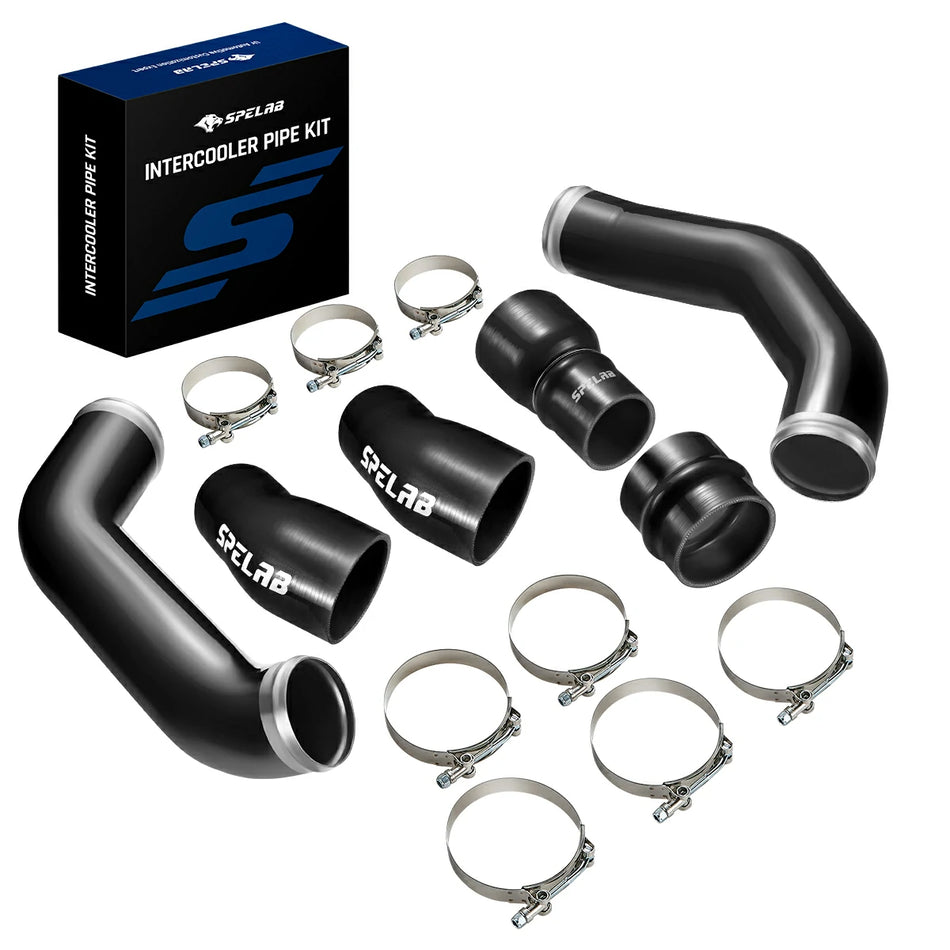
Repeated boot or pipe failures are better served by correctly fitted intercooler pipe kits than by replacing a healthy core. Use this procedure for diagnosing and sealing charge-pipe joints before ordering parts.
Is a Bigger Intercooler Always Better?
A bigger intercooler is not automatically better because excess charge-air volume, restrictive passages, poor end-tank design, blocked grille airflow, extra weight, or bad fitment can trade temperature control for lag and pressure loss.
| Core Design | Typical Strength | Typical Tradeoff | Good Match |
|---|---|---|---|
| Tube-and-fin | Lighter weight and good external airflow | May have less thermal mass or impact resistance than a heavy bar-and-plate core | Daily driving, moderate towing, weight-conscious builds |
| Bar-and-plate | High thermal mass and strong heat-soak resistance | More weight and possible airflow blockage when oversized | Heavy towing, repeated pulls, higher-boost builds |
| Stock-style replacement | Factory-like packaging and predictable fitment | May not add much thermal capacity | Damaged stock core on an otherwise stock truck |
Core thickness is only one specification. Compare frontal area, fin density, internal passage design, end-tank shape, inlet and outlet size, mounting points, weld quality, sensor provisions, and compatibility with the condenser, radiator, shutters, bumper, and charge pipes.

What Should You Check During Installation?
A clean bolt-on installation needs sealed joints, correct pipe alignment, unrestricted grille airflow, protected sensors, and enough clearance for engine movement.
- Pressure-test the original system and record the baseline before removing parts.
- Compare inlet and outlet diameter, mounting points, sensor ports, and pipe orientation.
- With the stock core out, remove trapped leaves, insects, mud, and road debris between the A/C condenser, intercooler, transmission cooler, and radiator. Use low-pressure air or water and avoid folding the fins.
- Clean oil from the pipe beads and inside of the boots with a material-compatible cleaner.
- Center each boot over the pipe bead and place clamps squarely behind the bead.
- Check the condenser, radiator, transmission cooler, fan shroud, shutters, bumper, and grille for contact or blocked airflow.
- Verify that hot-side and cold-side pipes have room for engine movement without rubbing.
- Run a post-install pressure test before the first heavy towing trip.
- Log IAT, boost, and EGT on the same route used for the baseline.
Does Oil Inside the Intercooler Reduce Performance?
A light oil film is common on many closed-crankcase-ventilation diesel systems, while pooling oil or rapidly returning contamination needs diagnosis.
Heavy residue can coat internal surfaces, soften some rubber boots, reduce grip at couplers, contaminate sensors, and combine with EGR soot. Clean the charge-air system before comparing temperatures so old contamination does not distort the result.
Check the crankcase ventilation path, turbo compressor side, engine-oil level, charge-pipe low points, and intercooler drains or service procedure where applicable. A new core will become oily again when the source remains upstream.
How Do You Choose the Right Intercooler Upgrade?
Choose an intercooler by verified fitment, measured need, core design, pressure-drop information, construction quality, and the truck's real duty cycle.
- Fitment: Confirm year, engine, trim, cab-and-chassis status, sensors, active grille shutters, and existing aftermarket pipes.
- Use: Separate a stock commuter from a fifth-wheel hauler, tuned street truck, race build, or high-idle work truck.
- Construction: Review core type, end tanks, welds, mounting brackets, inlet and outlet design, and corrosion protection.
- Data: Look for test conditions, repeated runs, temperature locations, airflow or boost level, and pressure-drop results.
- Serviceability: Check access to clamps, sensors, neighboring coolers, and areas that collect debris.
- System condition: Repair boots, pipes, clamps, turbo faults, cooling-stack blockage, and sensor problems first.
Platform-Specific Intercooler Options
A direct-fit intercooler is worth considering only after the owner confirms the engine, model year, mounting layout, pipe connections, sensors, grille hardware, and actual need for more cooling capacity.
| Platform and Fitment | Core Direction | Product |
|---|---|---|
| 2008-2010 Ford 6.4L Power Stroke F-250/F-350/F-450/F-550 | All-aluminum tube-and-fin replacement | 2008-2010 6.4L Power Stroke tube-and-fin intercooler |
| 2010-2012 Dodge Ram 2500/3500 6.7L Cummins | Bar-and-plate replacement for heavier thermal demand | 2010-2012 6.7L Cummins bar-and-plate intercooler |
| 2011-2016 Chevrolet/GMC 2500HD/3500HD 6.6L LML Duramax | Bar-and-plate replacement with cast-aluminum end tanks | 2011-2016 LML Duramax bar-and-plate intercooler |
Other model years and engine platforms are listed in the performance intercoolers for diesel trucks collection. Confirm the product page fitment before ordering.
Fitment and Road-Use Notice
Intercooler fitment, installation requirements, warranty impact, tuning needs, and road-use rules can vary by vehicle configuration and location.
Intercooler Upgrade FAQ
These answers address the buying and diagnosis questions that matter before replacing the factory charge-air cooler.
Q: What does an upgraded intercooler do?
A: It increases charge-air cooling capacity and can reduce heat soak, stabilize intake temperature, control pressure drop, and improve durability. The result depends on how hard the stock system is being worked.
Q: Does an upgraded intercooler add horsepower?
A: Results vary with the truck and test conditions. The clearest benefit often appears as more consistent performance during repeated pulls or sustained towing.
Q: Can an intercooler lower EGT?
A: Better charge-air cooling may slow EGT rise under comparable load and fueling. Turbo efficiency, calibration, exhaust restriction, trailer weight, grade, and boost leaks can change the result.
Q: Is a bigger intercooler always better?
A: No. An oversized or poorly designed core can add charge-air volume, restrict flow, block radiator airflow, or create fitment problems. Match the core to the turbo, airflow demand, grille area, and use case.
Q: Should I upgrade the intercooler or the pipes first?
A: Upgrade the core for verified heat soak, high IAT, or core damage. Repair or upgrade the pipes when the problem is a cracked tube, loose boot, weak clamp, bad O-ring, or repeated boost leak.
Q: Do I need tuning after an intercooler upgrade?
A: A direct-fit replacement usually does not require tuning by itself. Calibration becomes more relevant when the project also changes turbo size, boost targets, fueling, sensors, or the broader airflow system.
Q: How can I tell whether the stock intercooler is heat-soaking?
A: Log intake temperature through a sustained load. Heat soak is likely when temperature and power fade continue to build even though speed, grade, boost, and ambient conditions remain similar.
Q: What is the biggest intercooler-upgrade mistake?
A: Replacing the core without pressure-testing the whole charge-air system is the most common mistake. A leaking boot, pipe, clamp, O-ring, or sensor port can erase the expected gain.
Q: Is an intercooler upgrade worth it for daily driving?
A: A stock commuter with stable temperatures and a healthy core may see little value. Hot-climate use, towing, repeated acceleration, higher boost, or an aging factory core makes the upgrade easier to justify.