Updated on August 03, 2026.
A 6.7 Cummins intake upgrade should follow the air path and the test data: filter and turbo inlet first, charge-air leaks second, intercooler and pipes third, then the intake horn and heater strategy. Changing every shiny part at once makes it impossible to identify the original fault or prove which Mod helped.

The Correct 6.7 Cummins Intake Upgrade Order
| Stage | System area | Upgrade only when | Verification |
|---|---|---|---|
| 0 | Baseline maintenance and scan | Service is due or a fault is active | Filter condition, codes, freeze-frame data, sensors, battery voltage, fluid temperatures, and regeneration history |
| 1 | Airbox, filter, and turbo-inlet tract | Restriction is excessive, housing is damaged, or the future turbo requires a different inlet | Restriction under load, sealed filter edge, inlet temperature, water separation, and compressor-inlet connection |
| 2 | Boots, clamps, and charge-air leak repair | A pressure test or inspection finds leakage, movement, oil tracking, cracking, or poor bead engagement | Regulated pressure test and repeat inspection after a heat cycle |
| 3 | Hot-side and cold-side pipes | A pipe or joint is failing, or measured pressure loss limits a defined build | Connection dimensions, boot and clamp range, pressure drop, turbo location, and intercooler location |
| 4 | Charge-air cooler | The core leaks, end tank fails, cooling effectiveness is poor, or higher mass flow needs more capacity | Core pressure drop, outlet temperature, cooling-stack cleanliness, radiator airflow, and fan operation |
| 5 | Intake horn, sensors, and grid heater | The horn is a measured restriction, service access is needed, or an inspected heater concern requires a planned solution | Year-specific manifold, fuel lines, sensors, EGR and throttle hardware, heater function, and cold-start behavior |
| 6 | Turbo, fueling, exhaust, and calibration | The complete build has defined power, thermal, towing, and compliance targets | Professional calibration, rail-pressure control, drive pressure, EGT, smoke, transmission limits, and emissions compliance |
The diesel intake-system collection can help identify available component types. It should not replace the staged diagnosis or the individual product's written Fitment.
Understand the Two Sides of the System
The intake system has a low-pressure side before the compressor and a pressurized charge-air side after it. Mixing those two zones leads to bad diagnosis.
Before the Turbo: Airbox, Filter, and Inlet Tube
The compressor draws through the airbox, filter, and inlet tube. Restriction here lowers compressor-inlet absolute pressure, which raises the pressure ratio the compressor must produce for a given outlet pressure:
Compressor pressure ratio = compressor outlet absolute pressure / compressor inlet absolute pressure
A dirty filter, collapsed duct, blocked airbox inlet, snow ingestion, loose lid, or undersized aftermarket filter can matter more than a smooth tube. A larger open filter can also trade filtration, water protection, and stable inlet temperature for more sound. On a work truck, dust-holding capacity and a sealed filter edge are not optional.
After the Turbo: Pipes, Intercooler, Boots, and Horn
Compressed air leaves the turbo hot, travels through the hot-side pipe, crosses the intercooler, then enters the engine through the cold-side pipe and intake horn. A split boot or loose clamp leaks mass flow that the turbo already worked to compress. A restricted or internally damaged cooler can create pressure loss even when no external leak is visible.
System pressure drop under one repeatable operating point can be written as:
Charge-air pressure drop = turbo-outlet absolute pressure - intake-manifold absolute pressure
That number includes the hot-side pipe, intercooler, cold-side pipe, joints, and horn. To isolate one component, place calibrated sensors immediately before and after that component. Compare at the same mass flow, rpm, gear, tune, ambient conditions, and load.
Area Increase Is Not the Same as Flow Increase
A current 2019-2024 pipe listing compares a 3.5-inch aftermarket pipe with published factory diameters of 2.75 inches on the hot side and 3.1 inches on the cold side. If all three numbers were true internal diameters, circular areas would be approximately:
| Published diameter | Calculated circular area | Area change to 3.5 inches | What remains unknown |
|---|---|---|---|
| 2.75 inches | 5.94 square inches | Approximately +62% | Whether the number is inside or outside diameter and whether it is the system's minimum section |
| 3.1 inches | 7.55 square inches | Approximately +27% | Boot, adapter, sensor, bend, and intercooler-outlet restrictions |
| 3.5 inches | 9.62 square inches | Reference | Actual wall thickness, ovality, weld intrusion, bend deformation, and transition loss |
Area follows diameter squared, so the geometry can be calculated. Engine airflow cannot. A 62% larger nominal area does not guarantee 62% more mass flow, because the turbo, engine displacement, volumetric efficiency, pressure ratio, intercooler, valves, fueling, and calibration still set demand. Ask for minimum internal dimensions and same-condition pressure-drop data instead of treating a diameter ratio as a dyno result.
Stage 0: Build a Useful Baseline
- Scan all modules: save current, pending, and history codes plus freeze-frame data.
- Inspect service history: verify filter age, fuel-filter service, coolant condition, battery health, and any recent turbo, EGR, DPF, or sensor work.
- Check the air path cold: inspect the airbox, inlet tube, compressor connection, hot-side pipe, intercooler, cold-side pipe, boots, clamps, horn, and wiring.
- Pressure-test the charge-air system: use secure adapters, a regulator, and a gauge. Starting around 5 psi can expose a large leak; increase only within the tester and vehicle limits.
- Record a loaded run: note commanded and actual boost, MAP, IAT, rpm, gear, speed, rail pressure, fuel rate, coolant temperature, transmission temperature, and EGT when properly instrumented.
- Keep the test repeatable: use the same trailer or Payload, route, grade, speed, gear, ambient range, and starting temperatures.
P0299 underboost does not identify the failed part. Use the baseline to separate charge-air leakage, pre-turbo or exhaust leakage, sensor error, turbo control, filtration, calibration, and fuel delivery.
Stage 1: Airbox and Cold-Air Intake
A good inlet system supplies clean air with low restriction, resists water and dust, seals around the filter, supports the sensor correctly, and does not rub through nearby wiring. Intake sound and polished tubing are secondary.
The 2007.5-2012 Cummins cold-air intake kit was listed at $117.77 when reviewed. Its published application covers Ram 2500, 3500, 4500, and 5500 trucks in that year group, with a T-304 aluminum tube and a washable cone filter.
The listing also claims 7%-10% horsepower and 6%-8% torque gains without publishing the truck, dyno, tune, correction method, filter condition, or repeated runs. Do not budget power from those percentages. Verify filtration efficiency, water management, MAF/IAT provisions where applicable, pipe diameter, under-hood support, and whether the housing isolates the filter from radiator and engine-bay heat.

Stages 2 and 3: Boots, Clamps, and Charge Pipes
Oil mist around a joint often marks a charge-air leak because normal crankcase vapor leaves a light film inside the system. Clean the joint, inspect the bead and boot, then pressure-test. Replace a swollen, cut, hardened, or oil-saturated boot. Check that the clamp range matches the assembled diameter and that the clamp sits behind the retaining bead, not on top of it.
Metal pipe construction removes one plastic or rubber failure mode, but it adds rigid geometry. A pipe that is slightly misaligned can preload the intercooler neck, turbo connection, boot, bracket, or nearby harness. Mandrel bends preserve cross-section better than crushed bends; they do not create laminar flow in a turbulent boosted intake.
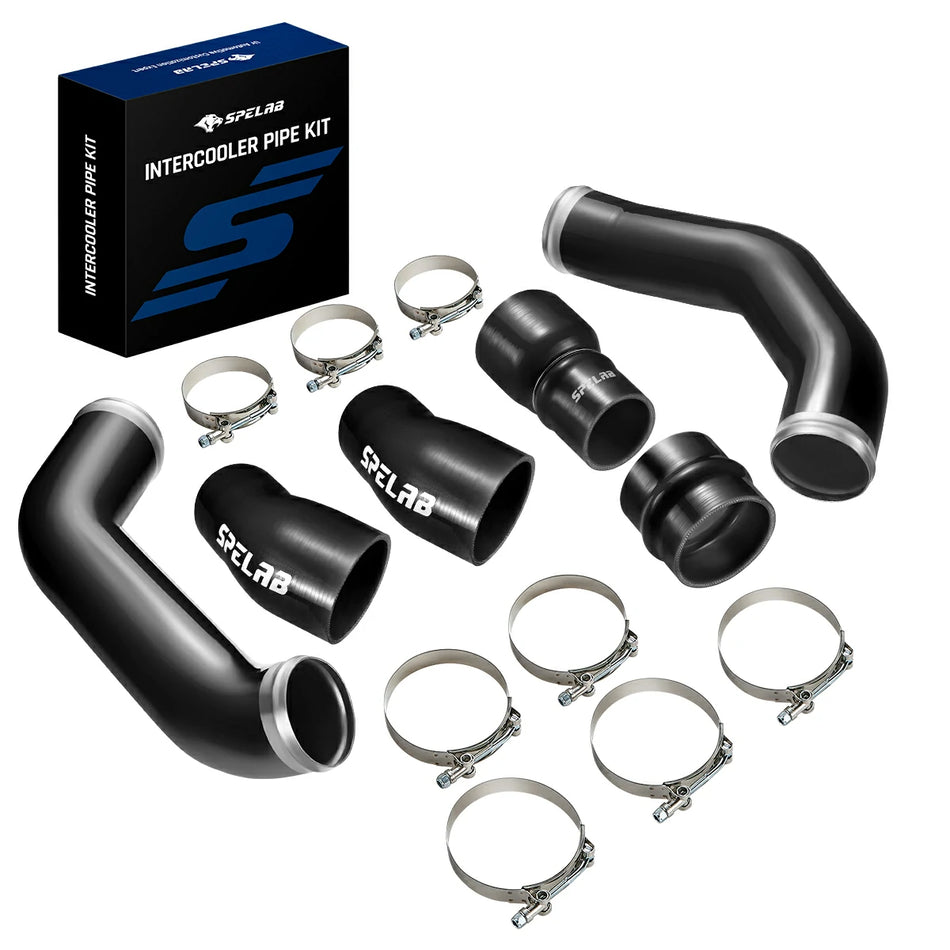
The 2019-2024 Ram intercooler pipe kit was listed at $289 for both sides or $169 for one side when reviewed. Published details include 3.5-inch aluminum tubing, five-ply silicone boots, and spring-loaded T-bolt clamps for Ram 2500/3500 pickups with stock-location turbos and OEM-location intercooler connections.
The listing does not establish 4500/5500 chassis-cab Fitment or 2025-and-newer coverage. It also excludes moved or high-mount turbo layouts. Measure both connections and inspect the installed turbo and intercooler before purchase; registration year alone cannot confirm this kit.

Stage 4: Intercooler Capacity and Cooling-Stack Health
An intercooler must transfer heat without excessive pressure loss. A thicker core is not automatically better if it blocks airflow to the radiator, condenser, transmission cooler, or charge-air cooler behind it. On a tow rig, cooling-stack cleanliness and fan performance can matter more than a larger advertised core.
A useful intercooler evaluation includes:
- Regulated leak test with the cooler and end tanks included
- Pressure immediately before and after the core at the same mass flow
- Charge-air temperature entering and leaving the core
- Ambient temperature and road speed
- Coolant and transmission temperatures before and after the change
- Fin damage, internal oil pooling, external mud, bugs, bent stack spacing, and fan operation
Do not judge cooling from one short unloaded pull. Use the same long grade and Payload, then compare stabilized temperatures. An intercooler can reduce outlet temperature while adding too much pressure drop, or improve charge-air flow while hurting radiator airflow. The complete thermal result matters.
Stage 5: Intake Horn, Sensors, and Grid Heater
The horn transitions the cold-side pipe into the cylinder-head plenum. Minimum internal area, bend radius, transition shape, sensor ports, sealing surface, and the final plenum entry affect local loss. A smoother, larger horn can reduce pressure drop when airflow demand is high, but it does not force the engine to consume more air or guarantee equal cylinder filling.
The configurable 6.7L Cummins intake horn had manifold-only variants at $539 when reviewed. The current page separates 2007-2012, 2013-2018, and 2019-plus groups, and also lists dedicated chassis-cab configurations. Published manifold details include a 3-3/8-inch inlet and four 1/8-inch NPT ports.
Choose the exact manifold, heater, pickup or chassis-cab kit, sensor arrangement, fuel-line routing, alternator clearance, and retained emissions hardware. A title spanning 2007-2024 does not mean one casting fits every truck in that range.

Grid Heater Decisions Need a Cold-Start Plan
The factory heater is not used only in arctic weather. Ram states that the Wait To Start indicator remains active when manifold air temperature is below 66°F (19°C), and the system can cycle after startup. Below 0°F (-18°C), Ram describes a possible second preheat cycle and warns against excessive cycling. Review the official Ram intake-heater procedure before changing the system.
Owners often call the concern the “Killer Grid Heater Bolt,” although the nickname can blur the difference between the electrical stud, terminal, nut, and heater assembly. A degraded or loose connection deserves prompt inspection because hardware entering the intake can damage the valves, piston, or cylinder. One heater-system code does not prove that hardware is loose: P2609 can also involve battery voltage, relays, wiring, connection resistance, the heater element, or control logic.
High-Current Cable Warning: Disconnect both negative battery cables before touching the heater connection. If a heater modification removes the factory feed from its terminal, follow the VIN-specific electrical procedure to de-energize or disconnect that feed at its source, protect the terminal with a properly rated cover, and secure the harness away from the engine, fuel system, heat, and moving parts. Do not leave a battery-connected heavy-gauge cable loose under a layer of tape or heat-shrink; contact with the block can produce severe arcing, fire, and component damage.
A delete plate, supplemental element, and factory heater are not interchangeable without evidence. Compare heater capacity, relay and fuse protection, wire gauge, ground path, control strategy, DTC behavior, post-heat operation, and cold-soak results. Never use ether or another flammable starting fluid in the intake of an engine equipped with an electric intake heater.
Fitment by Model-Year Group
| Ram 6.7L group | System checks | Common ordering error |
|---|---|---|
| 2007.5-2012 | Confirm that the truck is 6.7L, early intake and EGR layout, sensors, heater, turbo inlet, charge pipes, fuel lines, and chassis | Buying by “2007 Ram” without confirming 5.9L versus 6.7L |
| 2013-2018 | Check pickup or chassis cab, cold-side and horn layout, 68RFE or Aisin packaging, sensors, heater, EGR, and intercooler connections | Assuming a 2007-2018 title means the same hardware serves both year groups |
| 2019-2024 | Verify standard-output or high-output engine, pickup-specific pipe layout, turbo and intercooler locations, fuel lines, sensors, and electronics | Extending 2019-2024 coverage to 2025 or to a 4500/5500 without written proof |
| 3500/4500/5500 chassis cab | Use a dedicated configuration and verify dual alternators, commercial accessories, heater capacity, harnesses, fuel lines, and duty cycle | Using pickup photos as Fitment evidence |
Installation Details That Decide Reliability
- Keep debris out: cap the compressor inlet, intercooler openings, plenum, sensors, and any opened fuel fitting with clean purpose-made covers.
- Protect common-rail hardware: if a horn installation requires fuel-line movement, clean the area first and immediately cap both sides of every opened fitting with clean, purpose-made fuel-system caps. Do not use tape or shop rags as plugs. Microscopic contamination can damage an injector. Follow VIN-specific replacement, sequence, torque, and leak-inspection requirements, and never search for a running high-pressure leak by hand.
- Clean boots and beads: remove oil from the pipe's sealing area with a compatible cleaner, seat the boot fully, and place the clamp behind the bead.
- Do not over-tighten: a clamp can cut silicone, distort a pipe, or damage an intercooler neck. Use the hardware supplier's specification.
- Support rigid pipes: brackets, harnesses, fuel lines, coolant hoses, and dipstick tubes must sit without rubbing or side load.
- Handle sensors correctly: inspect the port and connector and use only a cleaner approved for that sensor type. Do not scrape or soak the sensing element.
- Verify after assembly: scan, idle-check, pressure-test, heat-cycle, recheck accessible joints, and repeat the loaded baseline route.
How the Upgrade Order Changes by Use
Towing and Payload
Start with leak-free charge plumbing, a clean cooling stack, correct gear selection, and reliable temperature data. Log EGT, boost, IAT, coolant, and transmission temperature on the same grade. Probe location matters, so pre-turbo and post-turbo EGT values cannot be compared directly.
Jobsite and Fleet Duty
Filtration, water protection, cold starting, parts availability, and service access outrank peak CFM. Long idle time can increase soot and oil deposits, while dust exposes every weak seal. Use maintenance intervals based on actual contamination and restriction, not intake sound.
Off-Roading
A filter needs protection from water and dust. Rigid pipes need clearance through frame twist, and clamps need inspection after washboards and heat cycles. Check for polished rub marks, displaced boots, loose brackets, and pinched wiring after the first trail day.
Extreme Cold
Keep a functional intake-heat plan, healthy batteries, correct winter fuel, appropriate oil viscosity, and block-heater access. Cold-soak the completed truck and verify Wait To Start operation, cranking speed, white smoke, charging voltage, idle quality, and stored codes before relying on it for work.
Emissions and Street-Use Check
A sealed filter, replacement boot, charge pipe, or horn can be evaluated without assuming emissions equipment must be removed. Keep required EGR, intake-throttle, sensors, OBD functions, DPF, SCR, and calibration intact unless the exact configuration has documented legal approval for its intended use. Current EPA guidance supports access to repair information, but parts still cannot bypass, tamper with, or remove required emissions controls. Review the EPA vehicle-repair guidance and applicable state rules before ordering.
Frequently Asked Questions
Q: What should I upgrade first on a 6.7 Cummins intake system?
A: Start with maintenance, scan data, filter and airbox inspection, then pressure-test the charge-air system. Repair leaks and damaged boots before buying larger pipes, an intercooler, or an intake horn.
Q: Does a cold-air intake add horsepower to a stock 6.7 Cummins?
A: Not by a guaranteed percentage. A lower-restriction inlet may help when the stock system is restrictive at the truck's actual mass flow, but filtration, heat isolation, turbo demand, tune, and test conditions determine the result.
Q: Will 3.5-inch intercooler pipes increase airflow by 55%?
A: A diameter comparison can establish nominal cross-sectional area, not engine airflow. Actual mass flow and pressure drop depend on the smallest section, bends, adapters, intercooler, turbo, engine demand, and calibration.
Q: How do I find a boost leak on a 6.7 Cummins?
A: Inspect for oil tracking, displaced boots, loose clamps, cracks, and rubbed pipes, then use secure block-off adapters, a regulator, and a gauge. Start at low pressure and remain within every component's safe test limit.
Q: Should I replace the stock intercooler when I install pipes?
A: Only if it leaks, has damaged end tanks or fins, creates excessive pressure drop, cannot control outlet temperature under the truck's load, or lacks capacity for a defined build. Clean and test the existing cooling stack first.
Q: Should every 6.7 Cummins owner delete the grid heater?
A: No. Inspect and diagnose the system first. Ram uses intake heat below 66°F (19°C) and during post-heat operation, so any replacement strategy must be tested for climate, wiring, control, DTC behavior, and legal requirements.
Q: Do intake-system upgrades require tuning?
A: A correctly fitted filter, boot, pipe, intercooler, or horn that retains required sensors and emissions functions may not require tuning. Turbo, fueling, sensor, heater, or emissions changes can alter calibration needs. Follow the product instructions and current service information for the exact truck.