
Updated on July 31, 2026.
Originally published on January 16, 2025.
If a 6.7L Cummins EGR concern returns after one or two years, do not order another valve, cooler, or block-off kit from age alone. Identify the failed valve, cooler, bypass actuator, sensor, gasket, hose, bracket, or sealing surface with scan data and physical testing.

First, Identify Which EGR Part You Mean
Owners often say "EGR valve" or "delete kit" when they are talking about several different components. That matters because a coolant leak, electrical position fault, restricted passage, and loose block-off plate need different repairs.
| Component | Job on the truck | Failure evidence | Correct response |
|---|---|---|---|
| Factory EGR valve | Meters exhaust flow into the intake under ECM command | Commanded and actual position do not track, the valve sticks, circuit faults return, or flow remains incorrect after upstream checks | Test the circuit and air path; clean only when the current service procedure permits it, otherwise replace the failed valve |
| EGR cooler | Uses engine coolant to reduce recirculated-exhaust temperature | Unexplained coolant loss, white vapor, internal leakage, external seepage, restricted flow, or a verified cooling-performance fault | Pressure-test and isolate the leak; replace a cracked, internally leaking, or restricted cooler |
| Cooler bypass valve and actuator | Routes exhaust according to operating temperature and ECM strategy | Actuator does not complete a bidirectional test, position feedback is implausible, or the mechanism binds | Check power, ground, connector condition, linkage, and commanded movement before replacement |
| EGR temperature and pressure sensors | Report conditions used to calculate and verify EGR flow | Cold-soak readings disagree with ambient and nearby sensors, wiring is damaged, or a signal is fixed or intermittent | Check reference voltage, signal, ground, connector pin fit, harness movement, and response from cold soak through warm-up |
| Gaskets, O-rings, coolant hoses, and fittings | Seal exhaust, intake air, and coolant at their assigned joints | Soot tracks, dried coolant, wet fittings, hardened seals, hose swelling, clamp damage, or pressure-test leakage | Repair the specific joint with the correct seal and hardware, then retest |
| Aftermarket block-off plates and brackets | Disable or replace certified EGR hardware on a non-public-road application | Warped sealing face, cracked weld, loose fastener, fretting, soot track, coolant seepage, corrosion, or contact with nearby parts | Measure sealing-face flatness, correct bracket preload and contact, replace damaged seals and hardware, then inspect again after the next heat cycle |
EGR Replacement Is Based on Condition, Not a Calendar
Ram maintenance plans list scheduled oil, fuel-filter, coolant, crankcase-filter, valve-lash, DEF, and DPF work, but they do not assign a periodic replacement to the complete EGR system. Use the Mopar owner-manual portal to locate the schedule for the exact VIN, model year, engine, transmission, and chassis.
For a stock street truck, review EGR-related data whenever the malfunction indicator lamp comes on, coolant level changes, regeneration frequency increases, or loaded performance changes. A practical garage inspection at every oil service should include coolant level and residue, visible EGR and intake joints, electrical connectors, charge-air boots, and stored codes. That is an inspection interval, not an order to replace parts.
For existing competition-only hardware, inspect fasteners, brackets, plates, hoses, and sealing surfaces at every oil service, after any race weekend with sustained heat, and after work near the intake or cooling system. Replace by condition. Heat cycles can relax gasket compression, but a flat heavy-duty plate with stable preload may remain serviceable for years. A thin warped plate can leak almost immediately.
Fitment Changes by Ram Generation
| Truck group | Fitment checks | Diagnostic concern |
|---|---|---|
| 2007.5-2009 Dodge Ram 2500/3500 | Confirm early 6.7L routing, valve and cooler connections, pickup versus chassis cab, and existing modifications | Do not apply later 2010-2012 or 2013-2018 hose, plate, sensor, or calibration assumptions |
| 2010-2012 Ram 2500/3500 | Verify throttle-valve and cooler layout, harness connectors, coolant routing, transmission, and chassis style | A broad "2010-2014" listing still requires a connection-by-connection comparison |
| 2013-2018 Ram 2500/3500 | Confirm pickup versus 3500/4500/5500 chassis cab, transmission, emissions label, connector style, and recall status | Eligible pickups may have Emissions Recall 67A coverage that should be checked before customer-pay work |
| 2019 and newer Ram HD | Use the VIN, engine serial number, emissions family, and current OEM catalog; do not assume fourth-generation hardware fits | Newer calibration and hardware changes make old diagnostic thresholds and generic kits unreliable |
Before disassembly, run the VIN through the NHTSA recall lookup. Owners of eligible 2013-2018 Ram 2500 and 3500 pickups should also read the December 2024 Cummins 67A special warranty document. It lists the EGR cooler, valve, temperature sensors, bypass valve, and actuator among covered components after the required recall update, subject to its terms and tampering exclusions. Recall and warranty documents can be revised, so confirm eligibility and the latest version with Ram or Cummins before authorizing customer-pay work.
Symptoms That Justify Testing, Not Guessing
| Symptom | Likely systems to test | Shop clue |
|---|---|---|
| P0401 or low-EGR-flow complaint | EGR valve movement, plugged passages, biased pressure or temperature data, intake throttle operation, exhaust leak, and calibration status | A code identifies a failed flow test, not automatically a bad valve |
| P0402 or excessive-flow complaint | Valve stuck open, incorrect feedback, wiring, intake throttle behavior, and modified hardware or software | Rough idle and smoke can overlap with injector, boost, and compression problems |
| P2457-type cooling-performance fault | Coolant level and flow, cooler restriction, bypass operation, temperature-sensor plausibility, thermostat behavior, and wiring | Test temperature inputs before replacing the cooler |
| Coolant loss with no obvious puddle | EGR cooler, head gasket, heater core, radiator, reservoir, water pump, hoses, fittings, and oil contamination | White vapor or a steam-cleaned intake path raises concern for an internal cooler leak |
| Weak power, high EGT, frequent soot loading, repeat regeneration, or derate/limp mode | Charge-air leak, air filter, turbo control, EGR flow, injector balance, exhaust restriction, sensors, and duty cycle | Save freeze-frame data before clearing the derate; heavy towing and long idle hours can expose several faults at once |
| Soot or whistle near an EGR joint | Gasket, plate flatness, fastener preload, pipe crack, bracket alignment, and nearby exhaust joints | A clean path through soot usually points toward the leak source |
For coolant loss, use the more detailed coolant-loss diagnostic workflow. It helps separate an EGR cooler concern from the reservoir, hose, water pump, radiator, heater core, and engine sealing faults.
A Practical 6.7 Cummins EGR Diagnostic Sequence
- Capture the complaint: record ambient temperature, coolant level when cold, mileage, engine hours, idle hours, trailer weight, grade, recent repairs, and when the light or power loss occurs.
- Scan before clearing: save codes from every module, freeze-frame data, monitor status, commanded and actual EGR position, relevant temperature sensors, boost, intake throttle position, rail pressure, and regeneration history supported by the tool.
- Run a cold-soak plausibility check: after an overnight soak, coolant, intake-air, and accessible exhaust-temperature sensors should generally start close to one another and ambient. A difference of roughly 10 degrees F is a useful screening flag, not an automatic sensor verdict.
- Inspect the cooling system cold: mark the correct reservoir level, look for dried coolant and wet joints, inspect the cap and hoses, and check engine oil for contamination. Never open a hot pressurized cooling system.
- Pressure-test to the OEM procedure: use the specified adapter and service-manual pressure limit. Watch for external seepage and pressure decay. If an internal EGR cooler leak is suspected, isolate it using the current model-year procedure instead of raising pressure.
- Command the valve and bypass: with a capable bidirectional scan tool and the truck in the service procedure's required condition, compare commanded movement with actual feedback. A steady difference greater than about 10 percentage points for several seconds is a useful shop screening flag, but the OEM test limit controls the final decision.
- Check the entire air path: inspect the air filter, turbo inlet, hot-side pipe, intercooler, cold-side pipe, intake horn, boots, clamps, and MAP sensor. With correct block-off adapters, a regulator, and a gauge, start around 5 psi to catch a large leak, then increase only within the vehicle and tester limits.
- Retest under the original load: after repair, repeat the same route, gear, trailer or payload, and ambient conditions. Compare coolant temperature, boost, EGT if equipped, EGR data, and regeneration behavior.
If the DPF loads again after an EGR repair, do not automatically blame the filter. Check charge-air sealing, EGR flow, injector correction, temperature and pressure sensor plausibility, idle hours, and whether regeneration is completing. A repaired EGR component will not correct a separate upstream soot source.
Coolant Loss: Do Not Skip the Easy External Leaks
A low reservoir does not prove the EGR cooler is leaking internally. Cold-pressure-test the radiator seams, reservoir, cap neck, water-pump area, heater connections, hose ends, and plastic or aluminum fittings before opening the intake. UV dye can help when the coolant manufacturer and service procedure allow it.
Any unexplained coolant loss deserves action. Stop driving and arrange professional diagnosis if the reservoir empties, the temperature warning appears, the upper hose becomes rock-hard soon after a cold start, coolant enters a cylinder, white vapor is heavy, or the oil level rises. A towing truck can turn a small leak into an overheated engine on one long grade.
Do not assume one coolant standard covers every 2007.5-and-newer Ram. Some 2013-2014 Ram publications identify OAT coolant under MS-12106, while later manuals specify OAT coolant conforming to MS.90032; earlier trucks can call for a different chemistry. Check the exact model-year manual and service label, and never mix OAT, HOAT, or a "universal" coolant based on color alone. The Ram 6.7L diesel fluid specification page shows the later OAT requirement and mixing warning.

If the EGR Cooler Has Already Failed Twice
A second cooler failure is the point where many owners start considering an EGR delete. The frustration is understandable: another repair can mean real downtime and a four-figure bill. The useful response is not to install a third cooler blindly. Build a written root-cause plan first.
- Check 67A coverage before paying: eligible 2013-2018 Ram 2500/3500 pickups may have special warranty coverage for the cooler, valve, temperature sensors, bypass hardware, and related diagnostic scan after the required update. Get the eligibility decision in writing.
- Confirm the current replacement part: ask the dealer or Cummins service provider whether the latest VIN-specific cooler part number supersedes the failed unit. Do not assume an old-stock part and the current service replacement are identical.
- Find the heat or pressure cause: verify coolant chemistry and concentration, cap operation, thermostat and fan behavior, radiator and charge-air-cooler airflow, boost leaks, exhaust restriction, regeneration history, injector performance, and calibration status.
- Compare both failures: an internal coolant leak, external gasket leak, restricted cooler, broken actuator, and biased sensor are different failure modes. Two warning lights do not prove the same part failed twice.
That process gives the owner a path out of repeat replacement instead of another guess. It also creates the documentation needed for a warranty discussion, fleet decision, or second opinion.
High EGT and Low Power Can Be a Boost Leak
An EGR-related code can arrive with a second fault. A split boot, loose constant-tension clamp, leaking intercooler, or rubbed pipe can reduce air mass and raise smoke and EGT under payload. That changes the conditions the ECM uses to validate EGR flow. Inspect the charge-air system before firing the parts cannon at the valve and cooler.
Use a regulator, gauge, and correct block-off adapters. Start around 5 psi to find a large leak, then increase only within the vehicle and tester limits. Clean oil tracks around a boot, a clamp sitting ahead of the bead, or a pipe touching a bracket are useful physical clues.
For towing and sustained loaded work, 1,250-1,300 degrees F pre-turbo is a common workshop screening range where backing out and investigating is prudent. Probe position matters because post-turbo readings are materially lower. Follow the OEM, gauge, and calibration limits first, then compare the truck with its own baseline on the same grade, gear, road speed, ambient temperature, and payload.

Why Plates, Gaskets, and Brackets Fail
On dedicated competition hardware, material grade is only part of the story. A thick CNC-machined aluminum plate can provide a flat sealing face and low weight. Stainless steel handles exhaust-side heat and corrosion well. Either can leak when the sealing face is scratched, the gasket is reused, the bracket pulls the plate sideways, the fastener bottoms out, or the joint is tightened unevenly.
Repeated heating changes bolt preload. Diesel vibration can fret a bracket that is already in a bind. Road salt can accelerate corrosion between unlike metals, especially when moisture sits at the joint. Look for a straight soot trail, polished movement marks, elongated bracket holes, hose abrasion, and contact with wiring or coolant lines. Replacing the same plate without correcting alignment will produce the same failure.
Real-World Duty Cycles Change Inspection Priority
Towing and Payload
Log the truck on the same grade, gear, road speed, and trailer weight. Watch coolant temperature, boost stability, EGT trend, transmission temperature, and regeneration behavior. Extra power does not raise GVWR, GAWR, GCWR, hitch rating, or tire capacity.
Jobsite and High-Idle Trucks
Idle hours can load the intake and aftertreatment without adding many odometer miles. Track engine hours, not mileage alone. Dust around connectors, chafed harnesses, low-speed cooling airflow, and interrupted regeneration deserve more attention than a shiny replacement plate.
Off-Road and Rough-Service Trucks
Inspect brackets, hard lines, charge pipes, and electrical connectors after hard chassis movement. Mud packed into the cooling stack reduces heat rejection. A loose bracket can transfer vibration into a cooler tube or intake flange.
Extreme Heat and Cold
In summer, clean the condenser, charge-air cooler, and radiator stack before condemning an EGR cooler from a loaded-temperature complaint. In winter, weak batteries, grid-heater or intake-heater faults, thick oil, gelled fuel, and a biased cold temperature sensor can imitate poor EGR operation during warm-up.
For 2013-2018 trucks that run hot under load, review these Ram loaded-temperature warning signs before choosing a radiator or other cooling part.

Repair, Clean, or Replace?
| Finding | Reasonable next step | Do not do this |
|---|---|---|
| Light soot with a valve that passes circuit and movement tests | Follow the exact OEM cleaning and relearn procedure if one is provided | Soak the electronic actuator or scrape a coated sealing surface |
| Valve binds or position feedback fails after circuit testing | Replace the verified valve and perform required relearn or adaptation | Install a valve before checking the connector, power, ground, and air path |
| Cooler leaks internally or fails the approved isolation test | Replace the cooler, renew required seals and coolant, and find any overheating cause | Use stop-leak or keep towing while coolant disappears |
| Sensor fails cold-soak and circuit checks | Repair wiring or replace the failed sensor, then verify live data | Skip connector pin tension, reference-voltage, ground, and heat-damaged harness checks |
| Competition-only plate is warped, cracked, or leaking | Replace the damaged part and correct flatness, bracket load, sealing, and fastener problems | Reuse a heat-crushed gasket, bottomed fastener, or bracket that holds the plate in a bind |
DIY Versus Diesel-Shop Work
A visual inspection, cold level check, code capture, and accessible connector inspection are reasonable owner tasks. A cooling-system pressure test is also manageable with the correct adapter, pressure limit, and cold engine. Bidirectional EGR tests, cooler isolation, intake removal, coolant vacuum filling, and fault-specific relearns require better tooling and service information.
| Job | Planning labor | Broad shop-total range | What changes the price |
|---|---|---|---|
| Scan, smoke/boost test, and cooling-system diagnosis | 1-2.5 hours | About $180-$550 | Intermittent faults, loaded road testing, access, and specialty adapters |
| Factory EGR valve replacement after diagnosis | 2-4 hours | About $700-$1,700 | Model year, OEM versus approved replacement part, seized hardware, cleaning, and relearn |
| EGR cooler replacement | 6-10 hours | About $1,800-$4,200 | Pickup versus chassis cab, access, broken fasteners, coolant, related hoses, and intake cleaning |
| Return a modified truck to certified configuration | Inspection required | Written estimate required | Missing factory hardware, wiring changes, software, aftertreatment damage, and VIN-specific parts |
These are planning ranges using typical independent diesel-shop labor, not quotes. Check recall and warranty eligibility first. Stop and use a qualified shop for internal coolant loss, overheating, hydrolock risk, repeated derate, damaged emissions wiring, uncertain calibration, or a truck that must be restored from unknown delete hardware.
Three Adjacent Parts to Consider Only After Diagnosis
None of these parts replaces an EGR valve, EGR cooler, or required emissions control. They are fitment-specific options for a separately confirmed reservoir, radiator, or charge-air fault. Prices were checked July 31, 2026 and may change.
| Product | Listed fitment and specification | Price snapshot | Use only when |
|---|---|---|---|
| Coolant Reservoir for 2013-2018 Dodge Ram 6.7L Diesel Coolant Overflow Tank | SPELAB | 2013-2018 Ram 2500HD/3500HD 6.7L diesel; TIG-welded 6061 aluminum with a sight glass and internal baffles | $199.00 for the available burnished variant | The factory tank is cracked, leaking, cloudy enough to hide level, or has a damaged neck or fitting |
| Radiator Cool Direct-Fit Performance for 2013-2018 Dodge Ram 2500/3500 6.7L Diesel | SPELAB | 2013-2018 Ram 2500/3500 pickup; two-row aluminum core, plastic tanks, 1-13/16-inch hose fittings, and 12-inch plate-type oil cooler | $309.99 | A pressure test, airflow inspection, and temperature diagnosis identify the radiator as the fault |
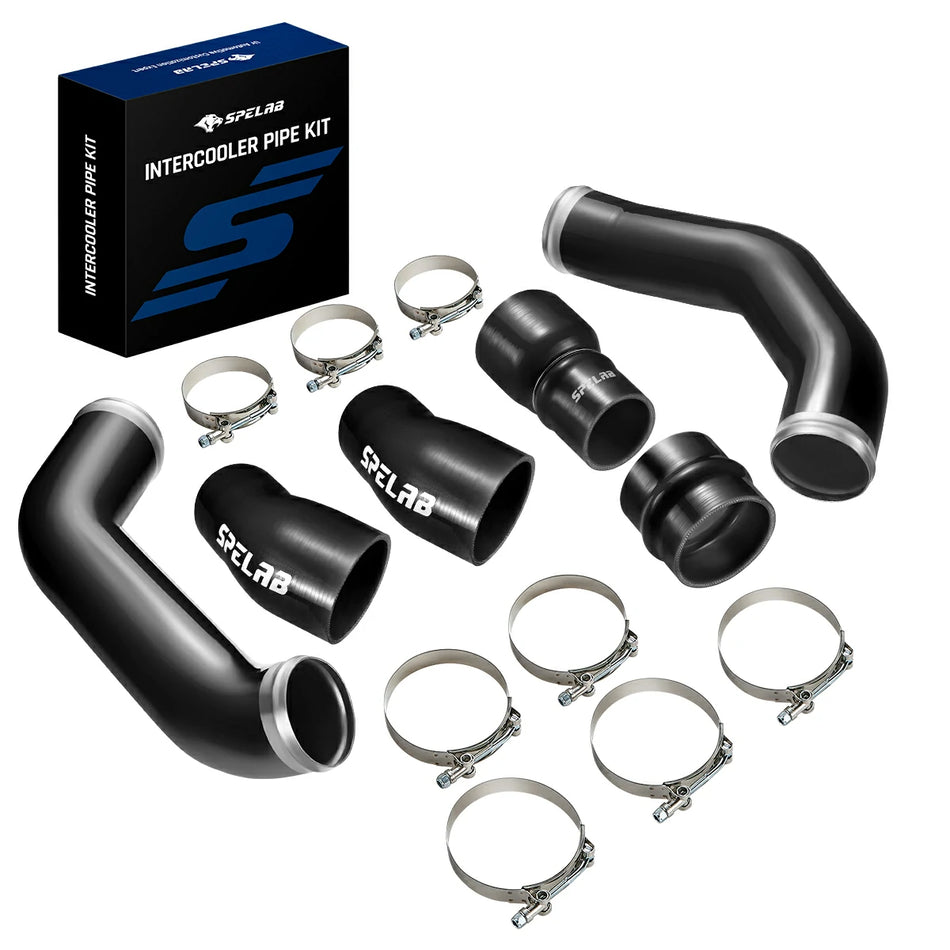
| Intercooler Pipe Kit for 2013-2018 Dodge Ram 2500/3500 6.7L Diesel | SPELAB | 2013-2018 Ram 2500/3500 and listed chassis-cab layouts with stock-size intercooler ports; 3.5-inch hot and cold piping | $238.99 for available pipe variants | A regulated leak test confirms a cracked pipe, damaged connection, weak boot, or repeat pipe blow-off |
For other diagnosed cooling-system repairs, compare fitment in the diesel truck cooling systems collection.
Emissions and Warranty Boundaries
The federal Clean Air Act prohibits removing or rendering inoperative required emissions controls and prohibits manufacturing, selling, or installing defeat devices. The EPA specifically includes EGR systems, sensors, diagnostic trouble codes, and calibrations that affect EGR flow. Read the EPA enforcement guidance on tampering and defeat devices.
A "competition use only" label does not automatically make a public-road truck or its parts legal. EPA guidance says a certified vehicle must be used solely for competition events and no longer driven on public roads for that narrow enforcement treatment. State requirements can be stricter. A daily driver, tow rig, jobsite truck, or off-road recreation truck that travels public roads is not made compliant by a label.
Hardware and software are separate compliance issues. Blocking EGR flow can trigger position, flow, and rationality faults, a malfunction indicator light, or derate/limp mode. A so-called delete tune changes ECM diagnostics or EGR strategy to suppress those results. EPA guidance treats calibrations that alter EGR flow, sensors, onboard diagnostics, or diagnostic trouble codes as emissions-control elements; software does not make the hardware change compliant.
California requires a separate check. A "50-state legal" claim is not enough by itself: verify the CARB Executive Order number and confirm that the EO covers the exact part, model year, engine, and test group. The CARB aftermarket-parts program explains how vehicle-specific exemptions work.
The Magnuson-Moss Warranty Act means an ordinary aftermarket part does not automatically cancel the entire vehicle warranty. It does not protect damage caused by the part, incorrect installation, or illegal emissions tampering. The December 2024 Cummins 67A document also keeps standard exclusions for tampering. Check the VIN, preserve baseline scans and receipts, and obtain a written eligibility decision. The FTC vehicle warranty guidance explains the federal consumer framework.
Frequently Asked Questions
Q: Should I replace a 6.7 Cummins EGR valve every one or two years?
A: No. There is no general one- or two-year replacement interval. Replace the valve when circuit testing, commanded-versus-actual movement, and flow diagnosis identify it as the failed part.
Q: How often should EGR block-off hardware be inspected?
A: On a dedicated competition vehicle, inspect plates, brackets, hoses, seals, and fasteners at every oil service and after sustained high-heat use. Replace damaged parts by condition, then recheck fastener witness marks and sealing after the next full heat cycle.
Q: What are the strongest signs of a leaking EGR cooler?
A: Unexplained coolant loss, white vapor, a steam-cleaned intake path, external cooler seepage, pressure decay, and a failed model-specific isolation test are strong evidence. A low reservoir alone does not identify the cooler.
Q: Does P0401 mean the EGR valve is bad?
A: Not by itself. P0401 reports insufficient EGR flow. A restricted passage, biased sensor, intake-throttle problem, exhaust leak, wiring fault, incorrect calibration, or stuck valve can all produce that result.
Q: Can cleaning fix a 6.7 Cummins EGR valve?
A: Cleaning may help a serviceable soot-loaded valve when the current OEM procedure allows it and the actuator and circuit pass testing. Replace a valve with failed electronics, damaged gears, severe wear, or movement that remains incorrect after approved service.
Q: Can a radiator, reservoir, or intercooler pipe fix an EGR code?
A: Only when diagnosis finds an adjacent cooling or charge-air fault that is affecting the EGR monitor. Those parts do not repair a failed EGR valve circuit, bypass actuator, temperature sensor, or internally leaking cooler.
Q: Is an EGR delete legal for a daily-driven or towing Ram?
A: No. Removing or disabling required EGR hardware or its control strategy on a public-road vehicle is prohibited by federal law, and state rules may add further restrictions. Use compliant repair parts and retain the certified emissions system.





1 comment
there are 3 egr delete kits listed: spes27013-bk $77.77 spes08134 $109.77 spes04077bk-sp $127.77
which one do i need for 2015 cummins 3500 4 door long bed