
Last updated:
A diesel pickup that loses coolant, whistles under load, stalls at a stop, or shows a new warning light after EGR work needs a diagnosis before more parts go on the truck. Exhaust gas recirculation (EGR) returns a controlled portion of exhaust to the intake to help reduce nitrogen oxides. Work around that system can also disturb coolant connections, charge-air joints, or wiring, depending on the engine and the job.
Start with what changed. A symptom that first appeared after EGR cleaning, cooler replacement, or an EGR delete makes the disturbed connections worth checking. The timing does not prove that the EGR valve, cooler, or replacement kit caused the fault.
Key Takeaways
- A lower cold coolant reading after a refill can reflect trapped air or an incomplete fill. A continuing drop or fresh wetness needs investigation.
- A new whistle under load can come from the charge-air or exhaust side. Inspect disturbed connections before ordering parts.
- Save fault codes before clearing them. Do not use towing or hard acceleration to reproduce an unresolved leak, power loss, or stall.
Start With the Work That Was Done
Use the work order or your own notes to identify which connections were opened and which parts are still installed. If the job involved more than one system, use every row that applies rather than trying to explain all the new symptoms with one fault.
| What work was done? | Where to start | What changes the next check? |
|---|---|---|
| EGR valve cleaned or replaced; cooling system not opened | For a new rough idle or warning light, start with the valve connector and any intake joint disturbed during access. | If coolant is falling and there was no recent refill, do not explain the loss as post-refill air purge. Investigate the cooling system separately. |
| Cooler or coolant connection serviced; system drained and refilled | Confirm the specified fill and bleed procedure, then compare fully cold reservoir readings and inspect disturbed joints. | Fresh wetness or a continuing drop shifts the job from checking the fill level to finding a leak. A drip below the cooler does not locate its source. |
| Charge-air pipe or exhaust joint moved for access | With the engine cool and stopped, identify the joints that were moved. Look for an unseated boot or fresh soot at an exhaust flange. | A displaced boot or fresh soot gives the shop a location to test. If neither is visible, keep both paths in play; the pitch of the whistle does not settle it. |
| Previously modified truck; retained parts or recent work uncertain | Confirm whether the cooler and valve are still installed, which coolant connections remain, and what else changed. | If the cooler is absent, it cannot be the current leak source. If a warning appeared, save diagnostic trouble codes (DTCs) and available freeze-frame data before clearing them. |

Coolant Loss: Find the Source Before Ordering Parts
After EGR work that required draining the cooling system, the cold reservoir level can drop as trapped air works out of the system. An incomplete fill or a leak can also leave the level low. One reading cannot distinguish them, and a level that holds for one check does not rule out a leak.
Confirm that the applicable refill and bleed procedure was completed. Compare the reservoir level with the specified cold marks on a level surface, with the engine fully cold. Photograph the level and look for fresh wetness at disturbed hose ends, clamps, fittings, and seals. A continuing drop, fresh wetness, or an overtemperature warning needs investigation rather than repeated topping up.
Coolant on the outside of the tank does not necessarily mean the tank is leaking. Compare a replacement coolant reservoir only after confirming a failed reservoir, such as a cracked seam or damaged port, rather than a leak from a hose or cap.
Coolant can run down from a connection above the drip, so the lowest wet point is not necessarily the source. If the level keeps dropping with no external trace, the repair shop may need to distinguish an internal cooler leak from another cooling-system fault. That cooler diagnosis only applies if the cooler is still installed. A modified truck may still have coolant hoses or fittings in the former cooler area.
Hypothetical example: A 2014 Ram 2500 with a 6.7L Cummins leaves a drip after parking following cooler service. Rather than buying a cooler based on where the drip lands, record the cold coolant level and photograph any fresh wetness at the recently disturbed connection. If the source is unclear, ask the shop to test the system using the correct vehicle procedure.
New Whistle or Low Power: Charge Air vs. Exhaust
A boost leak is a loss of pressurized intake air; an exhaust leak is a loss of exhaust gas at a pipe or joint. Both can produce a new noise, especially under load. A sound recording helps document when it happens, but sound alone cannot tell which path is leaking.
- Charge-air side: On a cool, stopped engine, look for a boot that has shifted off its seat, a clamp that sits crooked, or a damaged pipe near the work area. A new hiss and weak acceleration support checking that path, but oil film alone does not confirm a leak.
- Exhaust side: A fresh soot trail at a disturbed flange or up-pipe joint gives the shop a location to inspect. A sharp whistle or an underboost code can also occur with an exhaust-side fault, so neither identifies the leak by itself.
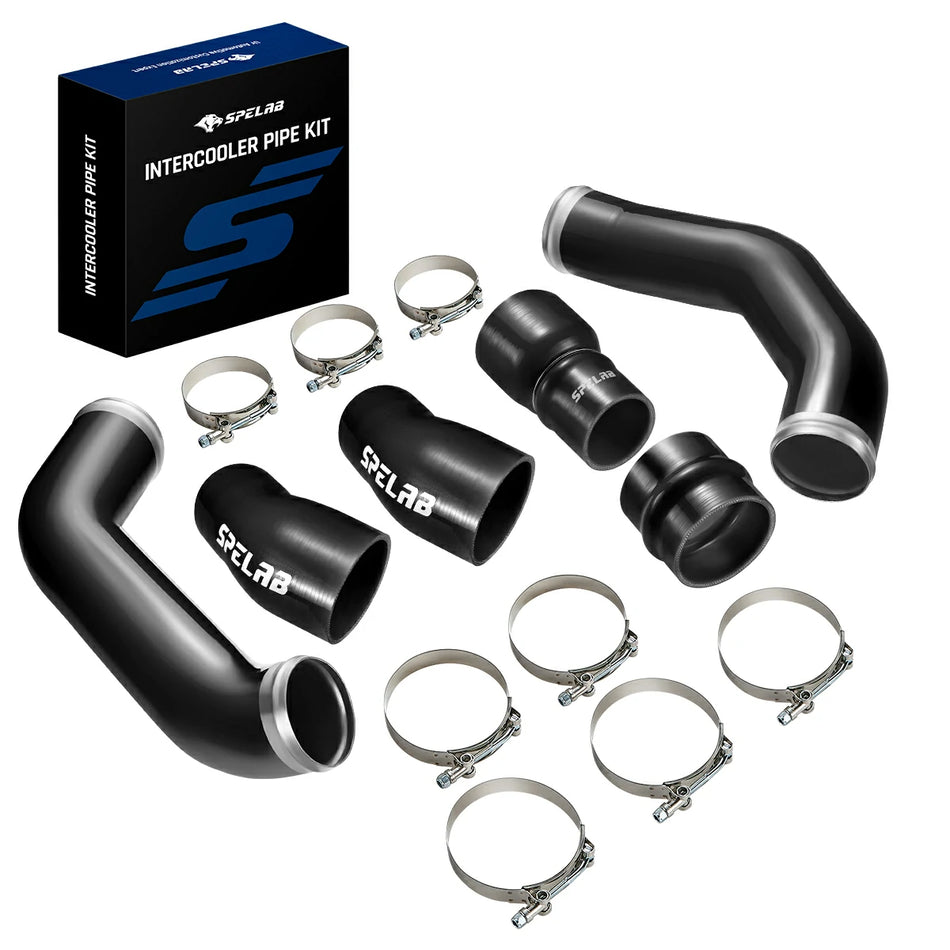
A confirmed cracked or damaged intercooler pipe can justify replacement. A serviceable pipe with an unseated boot or damaged seal may need only the correct connection repair. Use vehicle-specific testing rather than a generic pressure setting.
For example, GM bulletin 17-NA-161 identifies a cracked factory EGR cooler bypass pipe as one possible cause of noise, reduced power, or P0299 on listed 2011-2016 Chevrolet Silverado and GMC Sierra HD trucks with the 6.6L Duramax. That bulletin does not diagnose other model years or establish that the turbocharger has failed.
LMM Duramax Case: One Job, Two Separate Leaks
An LMM Duramax owner reported a loud leak near the cold-side pipe connection and a separate haze in the engine bay after EGR work. An exhaust leak was one possibility discussed. In the follow-up, the owner reported two different findings: the pipe was not seated correctly at the Y-bridge, and a coolant hose had come off, spilling coolant onto the hot downpipe.
The owner reported that reconnecting the hose and reseating the pipe resolved the symptoms. The thread does not document a pressure test or long-term follow-up. The route below shows how to separate the clues on a similar truck; it is not a reconstruction of tests the owner performed.
- Deal with the haze before chasing the noise. If there is active steam, heavy smoke, or rapid coolant loss, stop safely and arrange assistance. Do not restart the engine or drive it under load to identify the haze. Once the engine is cold and stopped, photograph visible wetness and any displaced hose without reaching into an unsafe area.
- Follow the coolant evidence back to its source. A wet downpipe shows where liquid landed, not where the leak began. Check the work record and look for a trail back to a disturbed connection. If the source is not visible or the cold level keeps dropping, have the shop test the cooling system to the applicable vehicle procedure.
- Investigate the whistle on its own. A pipe sitting out of position at the Y-bridge points toward a charge-air joint that needs inspection. Fresh soot at a disturbed exhaust flange points to a different path. If neither clue establishes a source, ask the shop to test the relevant systems separately. Do not order a turbocharger or Y-bridge based on the noise.
- Verify both repairs before returning to load. Once the shop has addressed the confirmed faults, ask it to verify the cold coolant level and check for renewed leakage, then verify the charge-air connection under the conditions specified for the truck. If the haze stops but the whistle remains, the job is not finished.
Case source: DuramaxDiesels, March 11, 2020, thread 84217, posts 1 and 11. Owner-reported outcome, not a SPELAB service record.
Check-Engine Light: Save the Code Before Clearing It
Record the full code number, whether it is pending or confirmed, and any available freeze-frame data. A freeze frame is a snapshot of operating conditions captured when a fault is recorded. On supported vehicles, that snapshot may show engine speed, load, and temperature that help distinguish a cold-start fault from one that appears under load.
A P0401 code points to an EGR flow concern, not a confirmed failed valve. A P0299 underboost code is not proof of a bad turbocharger. Use the exact engine's diagnostic procedure and include any other codes that appeared with the warning. When the truck limits power, separating engine-side and aftertreatment faults starts with the saved codes and operating conditions.
List any hardware or calibration changes and any connectors disturbed during the job. That information helps a technician interpret the warning. Clearing a code or suppressing a monitor does not repair a loose connection, a leak, or a failed component.
Stalling or Rough Idle: Record When It Happens
For a diesel pickup that stalls after EGR work, record whether the symptom appears on the first cold start, at warm idle, when shifting into gear, or while coming to a stop. Note whether it occurred before the work. Repeated stalling in traffic needs diagnosis before the truck is driven again.
Check the work order against the connections that were handled. If the mass airflow (MAF) or manifold absolute pressure (MAP) sensor was unplugged, verify that its connector is fully seated and latched. A connector check is a first step, not a diagnosis of the sensor.
On a truck that still has its EGR valve, new rough idle after cleaning may warrant checking whether the valve moves and seats correctly. A technician can compare commanded and reported position on engines that provide those data. If the checks do not explain the stall, follow the engine's diagnostic procedure rather than assuming that a sensor, valve, or fuel-system part needs replacement.
Slow Warm-Up Is Not the Same as a Hard Cold Start
A truck that starts normally but warms up slowly presents a different complaint from one that struggles to start. Record ambient temperature, cold coolant level, gauge behavior, and cabin heat. If cooling-system work was performed, ask whether the correct fill and air-purge procedure was followed before assuming the EGR change caused the symptom.
Coolant temperature that stays below the engine's specified operating range under the appropriate conditions can justify a thermostat check. Weak cabin heat with a normal coolant reading calls for a separate heater-system check; it does not establish that air is trapped in the heater core. Compare observations at similar ambient temperatures and loads instead of using a fixed warm-up time for every truck.
What to Give the Installer or Repair Shop
A precise description of the job and the symptom helps a shop choose the next test instead of guessing from the vehicle badge. Keep these details together:
- Truck: model year, model, engine, and the relevant vehicle identification details the shop requests.
- Work performed: parts cleaned, repaired, replaced, or removed; hoses, pipes, and connectors moved; any known calibration changes.
- First occurrence: cold start, warm idle, after shutdown, or under load, plus whether the symptom existed before the work.
- Evidence: exact codes, available freeze-frame data, warning messages, cold coolant levels, and safely obtained photos or recordings.
Use the factory service information and the instructions for the exact installed hardware to confirm routing, seals, and fastener requirements. A broken bolt, a damaged thread, or a joint that will not seat needs inspection, not extra force or a torque value borrowed from another engine.

FAQ
Is coolant loss normal after EGR cooler service?
A first lower cold coolant reading after EGR cooler service can reflect air purging after a refill, but it does not rule out a leak. Confirm the specified refill procedure and compare cold readings. Continuing loss or fresh wetness needs inspection.
Should I clear the check-engine light after EGR work?
Save the full diagnostic trouble codes and available freeze-frame data before clearing codes after EGR work. Clearing a warning does not fix its cause and can remove useful evidence for the diagnosis.
Does a whistle after EGR work mean I have a boost leak?
No. A whistle after EGR work can come from a charge-air connection, an exhaust joint, or another source. Identify what was disturbed and have the relevant system checked before replacing a pipe, Y-bridge, or turbocharger.
Can I tow if the truck idles normally but loses power under load?
Postpone towing until an unexplained loss of power under load has been diagnosed. Normal idle does not verify safe operation while towing, and a trailer pull is not an appropriate way to reproduce a suspected fault.
What should I check first if the truck stalls after EGR work?
Record whether the stall occurs at start-up, warm idle, or when shifting or slowing down. Start with the connections disturbed during the job and save available fault data. Repeated stalling needs diagnosis before the truck returns to traffic.
Can a truck still leak coolant if the EGR cooler has already been removed?
Yes. A truck with the EGR cooler removed can still lose coolant from hoses, fittings, seals, or unrelated cooling-system components. Locate the actual leak before buying replacement hardware.





3 comments
I have a 2011 ram 6.7 that I just ordered ERG delete kit spelab # 247061. should i also replace the exhaust system with muffler?
I have a 2011 ram 6.7 that I just ordered ERG delete kit spelab # 247061. should i also replace the exhaust system with muffler?
I have a 2011 ram 6.7 that I just ordered spelab#247061 ERG delete kit 2010-2014 dodge ram diesel throttle valve cooler. I have a tuner. Do I need to replace the exhaust system and muffler?
thanks