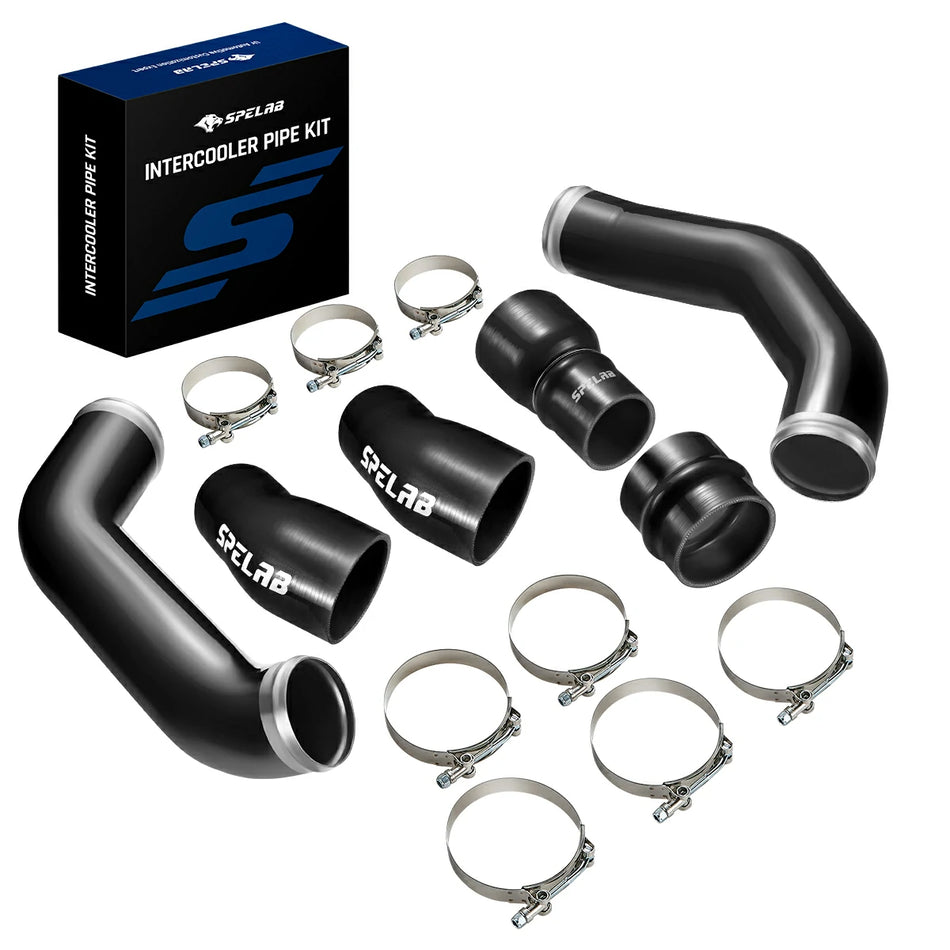
Does a 2003–2007 5.9 Cummins Need an Intercooler Upgrade?
A 2003–2007 Ram 2500 or 3500 with the 5.9L Cummins needs an intercooler upgrade when the original core or crimped end-tank joint leaks, when charge-air temperature fails to recover during repeated loaded pulls, or when added fueling and turbo airflow have moved beyond the useful margin of the stock unit. The intercooler removes heat from compressed turbo air before it enters the engine, but a larger core will not repair a split boot, loose clamp, misaligned charge pipe, tired turbo, dirty air filter, or aggressive tune.
Key Takeaways
The right move on a 5.9 Cummins is to identify the weak part first, match the replacement to the truck's exact fitment, and size the core around the way the truck actually works.
- This guide covers 2003–2007 Ram 2500 and 3500 pickups confirmed to have the 5.9L Cummins.
- A boost leak at a boot, clamp, or pipe does not justify replacing a sealed intercooler core.
- A stock daily driver and a tuned truck pulling a fifth-wheel do not need the same thermal reserve.
- Core thickness, connection diameter, pressure drop, weight, and radiator airflow matter more than a vague “bigger is better” claim.
- A 2007 truck needs an engine and VIN check before any part is ordered.
Which Intercooler Fits a 2003–2007 5.9 Cummins?
The correct application is a third-generation 2003–2007 Dodge Ram 2500 or 3500 pickup confirmed to have the 5.9L common-rail Cummins; earlier 5.9 trucks use a different chassis and should not be grouped into this fitment.
Model year alone is not enough on a 2007 truck. Cummins changed pickup-engine displacement during that model year, so read the emissions label, confirm the VIN or engine identification, and compare the original inlet, outlet, and mounting layout before spending money.
| Truck | Engine required | Coverage | Check before ordering |
|---|---|---|---|
| 2003–2006 Ram 2500 | 5.9L common-rail Cummins | Covered | Existing pipe diameter, boot size, mounting tabs, prior front-end repair |
| 2003–2006 Ram 3500 | 5.9L common-rail Cummins | Covered | Pickup configuration, pipe routing, modified turbo or intake hardware |
| 2007 Ram 2500/3500 | 5.9L Cummins only | Verify first | VIN, engine label, build configuration, original port location |
| 1998.5–2002 Ram | Earlier 5.9L application | Not covered | Use a chassis-specific listing instead of a 2003–2007 part |
Existing mods can change the answer even when the VIN is right. A non-stock turbo outlet, fabricated hot-side pipe, enlarged intake elbow, body repair, or relocated condenser can turn a nominal bolt-on job into a measurement job.
Measure the original connections and compare the old core beside the replacement before removing protective caps. Mounting tabs, port angle, condenser fasteners, pipe engagement, and boot inside diameter all need to agree; paint color and engine displacement printed in a listing do not prove physical compatibility.
What Usually Fails in the 5.9 Cummins Charge-Air System?
Aging third-gen 5.9 trucks commonly lose charge air through a boot, clamp, pipe joint, damaged core, or end-tank seam, and each failure leaves a different trail.
Boot or clamp loses grip under load
A boot that holds around town can still move when the truck is pulling a grade because heat softens the hose and engine movement loads the joint. Look for a polished slip mark, a clamp sitting ahead of the pipe bead, a twisted coupler, torn reinforcement, or a pipe that must be pushed sideways to line up.
Oil on the sealing surface makes the joint harder to hold, but stacking more clamp torque onto a wet or misaligned boot is garage roulette. Clean the mating surfaces, inspect the bead, let the rigid pipes sit naturally, and follow the clamp maker's torque specification.
Core or end-tank joint leaks
A core leak usually produces repeatable pressure loss rather than one dramatic boot blow-off. Check for an oily dirt track at a seam, rubbed tubes, crushed rows, corrosion, or a bracket that is pulling the assembly out of square.
A dark stain is a clue, not a conviction. Wash the area, dry it, run a regulated charge-air leak test, and watch whether bubbles return at the same point.
Charge pipe sits under tension
A rigid pipe that only fits after prying will keep side-loading the coupler after the tools are put away, because correct joint seating and clamp placement require the hard parts to rest naturally before the clamp is tightened. Previous collision work, bent brackets, a different compressor housing, an aftermarket intake elbow, or a mismatched core can all shift the joint far enough to create repeat failures.
Oil collects inside the charge-air path
A light film does not automatically condemn the intercooler, but wet pooling or oil that returns quickly deserves an upstream inspection. Check the turbo compressor side, shaft condition using the correct service procedure, crankcase pressure, and drain any trapped oil before blaming the core for a source problem.

Why Does a 5.9 Cummins Lose Power While Towing?
A 5.9 Cummins that pulls clean when empty but fades with a fifth-wheel on a summer grade needs a loaded-system diagnosis, because heat, airflow demand, fueling, exhaust temperature, and small leaks all rise together.
Start with the easy evidence. Inspect the core face for bugs, chaff, mud, folded fins, and debris packed between the A/C condenser and intercooler; a clean-looking grille does not prove that air can pass through the complete cooling stack.
Check every hot-side and cold-side joint next. A small leak can stay quiet during light throttle and open when cylinder load, compressor discharge pressure, underhood temperature, and engine movement climb together. The same pattern explains why summer heat exposes small diesel boost leaks and why a truck may behave on a cool morning but fall flat after an hour of towing.
Record comparable data before ordering parts. Use the same hill, similar trailer weight, similar ambient temperature, the same gear strategy, and the same tune; log commanded or measured boost, intake-air temperature from the same sensor and location, exhaust gas temperature from a known probe location, engine load, road speed, and temperature-recovery time after the pull.
Save stored and pending diagnostic trouble codes plus freeze-frame data before clearing the check-engine light. An underboost-related code reports that measured boost missed the calibrated expectation; it does not identify the intercooler core as the failed part, and the available code set can vary by model year and ECM calibration.
Different EGT probe locations can show materially different readings, so a universal “safe” number without probe placement, load, tune, and duration is bad shop advice. A pyrometer trend on one truck is more useful than a forum number copied from a different setup.
Blame the core only after checking the air filter, compressor inlet, turbo operation, exhaust restriction, fueling calibration, charge-air leaks, and front-stack airflow. If the charge-air system holds pressure but power still falls under load, verify fuel-supply pressure, lift-pump operation, and commanded versus actual rail pressure with the correct year-specific service procedure.

Which 5.9 Cummins Builds Actually Need More Intercooler?
Core capacity should follow sustained airflow and heat load: a sealed stock daily driver may need nothing, while a tow-tuned truck or larger-turbo build can use additional thermal and structural margin.
| 5.9 Cummins setup | First priority | When a larger core makes sense | Main tradeoff to check |
|---|---|---|---|
| Stock daily driver | Seal integrity and clean fins | Confirmed core failure or poor recovery under repeat load | Cost, weight, and unnecessary complexity |
| Stock-turbo tow rig | Loaded IAT, EGT trend, and leak check | Long grades repeatedly heat-soak a clean, sealed stock core | Pressure drop and radiator airflow |
| Tuned stock-turbo truck | Calibration, boots, clamps, and baseline data | Added fueling creates repeatable loaded temperature rise | Core alone cannot correct a poor tune |
| Larger injectors or upgraded turbo | Air mass, target boost, pipe size, and EGT | The complete combination exceeds stock thermal margin | Port compatibility and system pressure loss |
| Compound-turbo or competition build | Builder-supplied flow and pressure data | Only after application-specific calculation and testing | A catalog pressure rating does not prove flow suitability |
Stock daily driver
A stock truck that commutes, runs unloaded, and holds stable temperature with a sealed original core does not need a heavy-duty unit just to look modified. Spend the first dollar on inspection, boots, clamps, and front-stack cleaning.
Stock-turbo tow rig
A tow rig earns an upgrade when repeat data shows the clean stock core cannot recover between pulls or when a seam has already failed. Low restriction, repeatable cooling, strong mounting, and clean airflow to the radiator matter more than the thickest catalog number.
Tuned stock-turbo truck
A tune that adds fuel raises the heat the turbo and charge-air system must manage under load. Match the core to measured behavior, then make sure the tune, pyrometer trend, transmission strategy, and cooling stack are working together.
Larger injectors or upgraded turbo
A larger turbo or injectors changes air mass, compressor outlet temperature, target boost, and operating duration. Give the parts supplier the actual turbo, pipe diameter, injector or fueling change, trailer use, elevation, and target power instead of asking whether a generic “race intercooler” will fit.
Compound-turbo or competition build
A competition combination needs engineering data from the engine builder or calibrator. Core flow, pressure loss, weld integrity, port size, available frontal area, and the rest of the cooling stack must be evaluated as one system.
Tube-and-Fin or Bar-and-Plate for a 5.9 Cummins?
Among the available Cummins intercooler core options, tube-and-fin is usually the lighter choice for stock or lightly worked trucks, while bar-and-plate generally suits sustained towing, tuned combinations, rough jobsite use, and drivers willing to accept more front-end weight for additional thermal mass and rigid construction.
- Daily driving: Favor clean fitment, low weight, proper sealing, and adequate stock-power cooling.
- Occasional towing: Choose from measured load and climate instead of buying the heaviest core by default.
- Frequent heavy towing: Prioritize repeat-pull temperature recovery, low pressure loss, sound mounting, and radiator airflow.
- Tuned or larger-turbo use: Verify port diameter, pipe compatibility, airflow data, and pressure capability for the complete build.
- Off-roading and jobsite use: Balance core rigidity against added weight, vibration, and debris exposure.
Generic construction theory belongs in a separate technical comparison. This truck-specific decision comes down to duty cycle, tested pressure loss, available cooling-stack airflow, and whether the stock core is already a proven restriction or failure point.
Which Specifications Matter on a 5.9 Cummins Intercooler?
Useful specifications tie directly to fitment and measured performance: core thickness, frontal area, inlet and outlet size, end-tank construction, overall dimensions, mounting position, weight, pressure drop, and verified pressure capability.
| Specification | Why it matters on a third-gen Ram | What to verify |
|---|---|---|
| Core thickness and frontal area | Change thermal mass and airflow through the front stack | Actual dimensions, fin design, condenser and radiator clearance |
| Inlet/outlet diameter | Controls boot and pipe compatibility | Measure both truck connections; never assume stock boots fit a larger port |
| End-tank construction | Affects seam design, rigidity, weight, and repairability | Material, casting or fabrication quality, welds, and joint type |
| Pressure drop | Shows how much pressure is lost across the core at a stated airflow | Test flow, inlet temperature, air density, and measurement points |
| Pressure capability | Describes a component limit or test result | Test method and safety factor; it is not a tuning target |
| Mounting and overall dimensions | Determine whether the part sits without preload or interference | Tabs, isolators, condenser bolts, pipe angle, and cooling-stack gaps |
The current SPELAB bar-and-plate listing for this application specifies cast-aluminum-alloy end tanks, a 3.35-inch-thick core, a 27.36 by 25.57-inch core face, 40.3 by 27.6 by 6.2-inch overall dimensions, and 3.50-inch inlet and outlet connections. The same listing states 100+ PSI capability and includes constant-tension T-bolt clamps, while pipes and silicone boots are sold separately.
The 100+ PSI figure describes the listed component capability; it is not a safe road-test pressure, a recommended tune, or permission to pressurize the assembled truck to that number. Set operating limits with the turbo supplier, engine builder, calibrator, boot ratings, clamp ratings, and service information for the complete system.

How Should You Test a 5.9 Cummins Before Ordering a Core?
A safe pre-order check combines a cold visual inspection, a regulated low-pressure leak test, and a repeatable loaded road log; one oily spot or one hot pull is not enough evidence.
Run the cold inspection
Check the core face, end-tank seams, lower corners, boots, clamp position, pipe beads, mounting isolators, and rub points with the engine off and cool. Remove packed debris carefully without folding fins or forcing dirt deeper into the cooling stack.
Run a controlled leak test
A regulated test should begin near 5 PSI and rise slowly only as the service procedure, test plugs, boots, clamps, and installed parts allow. Use a relief path, keep people clear of plugs and caps, listen for air loss, and apply leak-detection solution at joints and seams.
Never connect unregulated shop air directly to the charge-air system. Stored energy can launch a test cap or split an old boot long before a catalog-rated core reaches its own limit.
Run a comparable road log
Record ambient temperature, trailer weight or payload, road speed, selected gear, engine load, boost, intake-air temperature from the same PID or sensor, EGT from the same probe, and recovery time. Compare before-and-after measurements on the same route with the same tune whenever practical.
Which Installation Checks Prevent Repeat 5.9 Cummins Boost Leaks?
A successful third-gen Ram installation leaves the core square in its mounts and every pipe-to-boot joint naturally aligned before the clamps are tightened.
- Compare the new and old cores side by side before the new part is fully installed.
- Confirm port diameter and boot inside diameter before applying lubricant or sealant.
- Replace cracked, oil-softened, swollen, or delaminated boots instead of reusing them to finish the job.
- Clean oil from the sealing surfaces and keep the joint dry unless the component instructions specify otherwise.
- Seat each boot past the pipe bead and position the clamp squarely behind the bead.
- Let the hot-side and cold-side pipes settle without prying a rigid tube sideways.
- Verify clearance at the A/C condenser, radiator, fan shroud, brackets, and surrounding wiring.
- Restore foam seals, air guides, and isolators so airflow passes through the stack instead of around it.
- Use the supplied fasteners or the documented hardware specification; do not force a wrong thread.
- Leak-test the assembly, run a heat cycle, and re-inspect every joint before hooking up the trailer.
As a parts manufacturer, we treat forced alignment as a reject condition. A mounting tab that needs a pry bar or a pipe that remains spring-loaded will keep working against the boot, clamp, weld, or threaded insert after the truck leaves the bay.
What Should a 5.9 Cummins Owner Replace?
Replace the failed part, upgrade only where the duty cycle or measured data justifies it, and avoid turning a ten-dollar sealing problem into an unnecessary front-end teardown.
| Inspection result | Next action | Do not assume |
|---|---|---|
| Core sealed; temperatures stable | Keep it, clean the stack, and monitor | Age alone requires replacement |
| Boot or clamp leaks | Correct alignment and replace damaged connection hardware | A larger core fixes the joint |
| Pipe rub, crack, or wrong angle | Repair the interference or install compatible pipe hardware | More clamp torque cures side load |
| Core or end-tank seam fails a leak test | Replace the intercooler and correct mounting preload | The old boots automatically fit larger ports |
| Clean, sealed core repeatedly heat-soaks while towing | Compare core options using logged load and temperature data | Every thick core has low pressure drop |
| Turbo, injectors, or tune changed | Size the complete charge-air system with the builder | A pressure rating proves airflow suitability |
| Check-engine light with loaded power loss | Save stored/pending DTCs and freeze-frame data, then follow the year-specific test tree | An underboost-related code names the failed part |
How Much Does a 5.9 Cummins Boost-Leak or Intercooler Repair Cost?
A realistic U.S. planning range runs from about $100 for a simple inspection or clamp correction to roughly $1,500 for a professionally installed intercooler with supporting boots and hardware; diagnosis determines which end of that range belongs to the truck.
| Repair path | Estimated parts cost | Estimated installed cost | What changes the bill |
|---|---|---|---|
| Visual inspection and regulated leak test | $0–$40 in test supplies | $100–$300 | Diagnostic time, access, and whether several leaks must be isolated |
| Clean, reseat, or replace one clamp | $15–$80 | $100–$350 | Damaged pipe bead, seized clamp, oil contamination, or poor alignment |
| Complete boot and clamp set | $140–$220 | $300–$650 | Boot quality, clamp type, and whether rigid pipes need realignment |
| Charge-pipe repair or upgrade | $250–$450 | $450–$1,000 | One pipe versus a full set, intake-elbow work, and modified turbo hardware |
| Intercooler core replacement | $350–$600 for the current aftermarket planning range used here | $700–$1,500 | Core construction, 2.5–4.0 labor hours, replacement boots, broken inserts, rust, or collision damage |
These figures are August 2026 planning estimates, not quotes. SPELAB listings checked in August 2026 place applicable 2003–2009 core options at about $389 at the current sale price, with listed regular pricing reaching $545, while the complete 5.9 charge-pipe/intake kit is about $319. U.S. shop rates and local tax can move the installed total sharply by ZIP code.
A clean bolt-on truck should land near the lower half of the applicable range. Bent core supports, previous front-end repair, damaged condenser threads, rusted hardware, non-stock pipes, or a second leak found after testing can push the bill beyond it.
Fitment and Safety Notice
Vehicle configuration, prior repairs, modified charge pipes, turbo hardware, boot size, installation requirements, and warranty impact can change the job even inside the stated model-year range.
Where Can a 5.9 Cummins Owner Verify Vehicle and Service Information?
Use government and vehicle-manufacturer resources to confirm the truck's identity and retrieve configuration-specific guidance instead of trusting a generic parts listing alone.
- NHTSA VIN Decoder — enter the complete VIN and review the manufacturer-reported vehicle data before ordering for a 2007 truck.
- 2007 Ram Truck Diesel Owner's Manual — use the vehicle-manufacturer publication for operating, maintenance, towing, fluid, warning, and safety guidance that applies to the original truck configuration.
Use the exact model year, VIN, engine identification, ECM calibration, and installed hardware when following a DTC test tree. A procedure written for a different engine generation should not be used to condemn a 2003–2007 5.9 Cummins intercooler.
5.9 Cummins Intercooler FAQ
The most useful short answers come back to exact 2003–2007 fitment, confirmed leak location, and the truck's actual loaded duty cycle.
Q: What intercooler fits a 2003–2007 5.9 Cummins?
A: Use a listing specifically confirmed for a 2003–2007 Dodge Ram 2500 or 3500 with the 5.9L common-rail Cummins. Check the VIN on a 2007 truck, then verify port diameter, mounting tabs, pipe angle, boot size, and any non-stock turbo or intake hardware.
Q: How do I know if my 5.9 Cummins intercooler is leaking?
A: Look for repeat boost loss, a hiss under load, oily dirt tracing one seam, visible impact damage, or pressure that falls during a regulated leak test. Test boots, clamps, pipes, and intake joints at the same time so a nearby leak is not blamed on the core.
Q: Why does my 5.9 Cummins lose boost only while towing?
A: Heavy load raises charge pressure, heat, fueling, and engine movement, which can open a marginal boot or seam that stays sealed during light driving. Inspect the full path and log the truck on the same loaded route before choosing a replacement.
Q: Is an upgraded intercooler worth it on a stock 5.9 Cummins?
A: A stock truck benefits when the original core leaks, is physically damaged, or repeatedly heat-soaks during its real workload. A sealed daily driver with stable loaded temperatures may need cleaning or connection service instead of a larger core.
Q: What intercooler should I use with larger injectors or an upgraded turbo?
A: Match the core to air mass, compressor outlet temperature, target boost, pipe size, fueling, run duration, and acceptable pressure drop. Ask the turbo supplier, calibrator, or engine builder for those inputs before treating a catalog pressure rating as a complete answer.
Q: How much does a 5.9 Cummins intercooler replacement cost?
A: Budget roughly $350–$600 for the aftermarket core planning range used in this guide or about $700–$1,500 for professional installation in the United States. New boots, damaged hardware, prior collision repair, non-stock pipes, and local labor rates can move the final total outside that planning range.
Q: Can oil inside a 5.9 Cummins intercooler indicate a turbo problem?
A: Heavy pooling or oil that returns quickly can point upstream and deserves checks of the turbo compressor side, crankcase pressure, and related plumbing. A light film alone does not prove the turbo or intercooler has failed.

About the Author
John Lee
Mechanical Engineer | 10+ Years Experience
John has spent the last decade engineering and testing high-performance automotive components. Specializing in drivetrain durability and thermal management across Powerstroke, Cummins, and Duramax applications, he bridges the gap between OEM limitations and aftermarket performance. His philosophy: "Factory parts are just a starting point."