Updated on August 03, 2026.
Originally published on April 11, 2025.
An EGR system routes a controlled amount of exhaust back into a diesel engine to lower peak combustion temperature and reduce nitrogen-oxide emissions. An EGR delete physically blocks or removes that calibrated flow path and usually disables its diagnostic logic. The visible hardware becomes simpler, but the change is not a guaranteed horsepower, MPG, EGT, or reliability upgrade.

What a Factory Diesel EGR System Does
Exhaust Gas Recirculation replaces part of the fresh intake charge with inert exhaust gas under selected speed, load, temperature, and altitude conditions. With less oxygen available for the same cylinder volume and more heat capacity in the charge, peak combustion temperature drops. That reduces formation of nitrogen oxides, usually called NOx.
The control module does not simply open one valve by a fixed percentage. It may use engine rpm, torque request, coolant temperature, intake pressure, exhaust pressure, mass airflow, valve position, turbo vane position, throttle position, EGR temperature, and aftertreatment state to calculate and verify flow. Ford's 6.7L Power Stroke technical material describes this modeled control and explains how the intake throttle can help create the pressure ratio needed for EGR flow. See the official Ford 6.7L EGR system training.
| Factory component | Job | Useful data | Common failure evidence |
|---|---|---|---|
| EGR valve and actuator | Meters recirculated exhaust into the intake path | Commanded position, actual position, duty cycle, current, and learned limits | Sticking, binding, position error, soot at the seat, electrical fault, or coolant contamination |
| EGR cooler and bypass | Transfers heat from exhaust to engine coolant when cooling is commanded | Inlet/outlet temperature, coolant temperature, bypass command, pressure, and flow result | Internal coolant leak, external leak, restricted core, thermal fatigue, or failed bypass actuator |
| Feed and delivery pipes | Carry exhaust between manifold, valve, cooler, and intake | Pressure differential, soot pattern, temperature, and physical inspection | Crack, warped flange, failed bellows, loose fastener, plugged passage, or damaged gasket |
| MAF, MAP, exhaust-pressure, and temperature sensors | Allow the control module to model whether commanded EGR flow occurred | Key-on plausibility, response rate, rationality against related sensors, and freeze-frame values | Bias, contamination, blocked pressure tube, wiring damage, poor ground, or implausible response |
| Intake throttle or air-control valve | Manages pressure differential and airflow for EGR and shutdown strategies | Commanded versus actual position and MAF response | Sticking, oil-soot deposits, gear wear, harness fault, or air-path leak |
| Coolant hoses, seals, and routing | Carry heat away from the cooler and maintain the designed coolant circuit | Cooling-system pressure, temperature distribution, level, and leak history | Hardened hose, wrong routing, collapsed line, leaking O-ring, aeration, or low coolant |
| OBD monitors and calibration | Command EGR, verify flow, protect components, and report emissions faults | Monitor status, DTCs, freeze-frame data, service routines, and calibration level | Software mismatch, interrupted programming, disabled monitor, or unresolved root cause |
EGR Flow Is a Measured System, Not a Valve Guess
A position reading of 30% does not mean 30% of the intake mass is exhaust. Actual mass flow depends on valve area, pressure difference, gas density, cooler restriction, pipe geometry, turbo operation, and intake-throttle position. The same commanded valve position can produce different flow at idle, on a towing grade, or at high altitude.
Useful physical checks include:
- Commanded versus actual valve position: a position that does not follow the command points toward binding, actuator, sensor, wiring, or learned-limit trouble. Under a stable commanded test, a difference greater than about 10 percentage points for several seconds is a useful shop screening flag, not a universal pass/fail limit; the current OEM procedure controls.
- MAF response: on systems that infer EGR from fresh-air displacement, MAF should respond in the expected direction when the valve is commanded under valid test conditions.
- Pressure differential: EGR needs the correct exhaust-to-intake pressure relationship. A turbo, throttle, exhaust-pressure sensor, or blocked tube fault can look like a bad valve.
- Cooler temperature change: inlet and outlet readings matter only at a known flow, coolant temperature, bypass state, and load.
- Coolant pressure and loss: an internal cooler leak must be separated from a head gasket, injector-cup, oil cooler, external hose, and combustion-pressure fault.
- EGT location: pre-turbo, post-turbo, DOC inlet, DPF inlet, and tailpipe temperatures are not interchangeable numbers.
Symptoms of an EGR Valve or Cooler Problem
| Symptom | Possible EGR cause | Other causes to test | Priority |
|---|---|---|---|
| Rough idle, stumble, or smoke at low speed | Valve stuck open or excessive EGR flow | Injector balance, fuel pressure, boost leak, MAF bias, intake throttle, compression, or turbo control | Scan and airflow test before removing parts |
| P0401 insufficient EGR flow | Restricted cooler or passage, valve not opening, or insufficient pressure differential | Blocked pressure tube, biased MAF/MAP, exhaust leak, intake leak, throttle fault, or software issue | Save freeze-frame and run the OEM flow test |
| P0402 excessive EGR flow | Valve stuck open, leaking seat, or incorrect control | Sensor bias, intake restriction, throttle problem, wiring, or calibration | Do not condemn the cooler from this code |
| Unexplained coolant loss and white vapor | Internal EGR cooler leak | Head gasket, injector cup, turbo coolant circuit, charge-air cooler on liquid-cooled systems, or external leak | Stop heavy towing and pressure-test promptly |
| Overheating or coolant pushed from reservoir | Restricted or leaking cooler may contribute | Combustion gas, thermostat, radiator, fan, water pump, cap, low coolant, plugged stack, or payload beyond the cooling margin | Do not assume an EGR delete is a cooling repair |
| Low boost or lazy towing response | Valve stuck open or leaking EGR feed path | Charge-air leak, pre-turbo exhaust leak, VGT fault, intake restriction, fuel limitation, or sensor error | Log command and actual data under a repeatable load |
| Heavy intake deposits | EGR soot contributes to deposit formation | CCV oil mist, excessive blow-by, long idle, weak thermostat, injector issue, or poor maintenance | Inspect the whole air path and crankcase ventilation |
What Common EGR Codes Actually Tell You
| Code family | General meaning | Key distinction |
|---|---|---|
| P0401 | Measured or modeled EGR flow is lower than expected under monitor conditions | Verify cooler and passage restriction, pressure differential, sensor plausibility, and valve movement separately |
| P0402 | EGR flow is higher than expected | Separate a valve that leaks or sticks open from sensor bias, throttle restriction, wiring, and calibration |
| P0404 | EGR control range or performance fault | Compare mechanical movement with position feedback before deciding between a valve, circuit, or learned-limit fault |
| P0405 or related circuit codes | Low signal or electrical concern in the monitored EGR circuit | Check reference voltage, signal, ground, connector drag, and harness damage before cleaning hardware |
| P042E on applicable Ford strategies | EGR "A" control is detected stuck open | Confirm the exact Ford strategy, then test whether the valve is mechanically open or the feedback merely reports it open |
| P2457 on applicable platforms | EGR cooling-system performance concern | Validate temperature sensors and bypass operation before pressure-testing the cooler for leakage or restriction |
| P2002 | DPF efficiency below threshold | This is a DPF efficiency code; review soot loading, noncombustible ash, regeneration history, sensors, leaks, and engine-out soot |
Ford's published OBD summary shows that P0401 and P0402 monitoring depends on temperature, operating mode, speed/load region, valve position, desired EGR ratio, and other enabling conditions. That is why a code description is the start of diagnosis, not the replacement instruction. Review the Ford diesel OBD monitor summary as one OEM example.
A 7-Step EGR Diagnostic Order
- Record the complaint under real conditions. Note cold or hot engine, idle or load, trailer weight, grade, ambient temperature, altitude, smoke, coolant loss, and whether the fault began after other work.
- Save all codes and freeze-frame data. Scan every relevant module before clearing anything. Record rpm, load, coolant temperature, MAF, MAP, exhaust pressure, EGR command and position, throttle position, boost, and DPF state when available.
- Inspect cold. Check coolant level, residue, cooler seams, hoses, feed tubes, bellows, soot tracks, connectors, grounds, rubbed harnesses, intake boots, exhaust leaks, and signs of previous sealant or tampering.
- Establish sensor plausibility. Compare key-on engine-off pressure sensors, cold-soak temperatures, battery voltage, and MAF response. Clean or replace a sensor only under the service procedure.
- Command the system with a capable scan tool. Compare commanded and actual EGR position, MAF change, throttle response, turbo response, and temperature data under the manufacturer's enabling conditions.
- Test the cooler and coolant circuit separately. Pressure-test cold with the correct cap adapter and only to the pressure specified for the exact VIN. There is no safe universal pressure value across these platforms. Inspect for internal leakage, verify bypass operation, and evaluate flow or temperature only with the correct tool and procedure. Never open a hot pressurized cooling system.
- Verify the repair. Complete relearns or service routines, clear codes only after saving data, run the specified monitor, recheck coolant level, and repeat the same route or work cycle that produced the fault.
Clean, Repair, Replace, or Delete?
| Option | Makes sense when | Limits and risks | Verification |
|---|---|---|---|
| Clean the valve or passage | Deposits are confirmed, electronics and gears pass testing, surfaces are not worn, and the OEM permits cleaning | Solvent can damage electronics and seals; cleaning cannot repair a failed motor, worn shaft, cracked housing, or bad sensor | Free movement, correct position feedback, restored flow result, and completed monitor |
| Professionally clean the cooler | The core is restricted but not leaking, cracked, distorted, or chemically damaged | Incomplete cleaning leaves hidden restriction; aggressive chemistry can attack brazed joints and coatings | Leak/pressure test, flow result, bypass function, and temperature behavior |
| Repair wiring, sensors, hoses, or fasteners | Testing identifies a circuit, connector, pressure tube, coolant hose, gasket, or mounting fault | A harness repair will not clear a plugged core, and a gasket will not correct a warped flange | Voltage-drop or continuity result, no leak, plausible live data, and monitor completion |
| Replace the EGR valve or cooler | The component fails an electrical, actuator, pressure, flow, or leakage test | Parts swapping without root-cause work can repeat the failure | Correct fitment, torque sequence, coolant bleed, actuator relearn, and loaded verification |
| Restore the wider system | Thermostat, DPF restriction, turbo control, injector, CCV, coolant, or software problems contributed | The EGR repair will not last if the engine remains cold, over-fueled, oil-laden, or unable to regenerate correctly | Stable operating temperature, normal regeneration, balanced airflow, and no repeat deposits or codes |
| Remove or disable EGR | A dedicated vehicle project whose nonroad or competition classification has been established before parts selection | NOx increase, tampering exposure, failed readiness/inspection, calibration dependency, warranty and resale issues, and possible DPF/SCR interaction | Legal documentation and closed-course engineering controls; this is not an on-road repair path |
Why Owners Consider a Delete and What Repair Can Cost
Most owners do not start with a political argument. They start with a cooler that leaked twice, another four-figure estimate, lost jobsite time, repeat soot loading, or a truck that derates with a trailer attached. That frustration is real. The useful next move is to document why the part failed again, check coverage, and compare the complete repair cost against the inspection, calibration, resale, and restoration exposure created by removing the system.
| Job | Planning labor | Broad shop-total range | What changes the price |
|---|---|---|---|
| Scan, air-path test, and cooling-system diagnosis | 1-2.5 hours | About $180-$550 | Intermittent faults, loaded road testing, access, and specialty adapters |
| Factory EGR valve replacement after diagnosis | 2-4 hours | About $700-$1,700 | Platform, model year, part source, seized hardware, cleaning, and relearn |
| EGR cooler replacement | 6-10 hours | About $1,800-$4,200 | Pickup versus chassis cab, access, broken fasteners, coolant, hoses, and intake cleaning |
| Return a modified truck to certified configuration | Inspection required | Written estimate required | Missing factory hardware, cut wiring, unknown software, aftertreatment damage, and VIN-specific parts |
These are planning ranges based on roughly $150-$220 per hour at an independent U.S. diesel shop, not quotes. Dealer rates, local taxes, OEM parts, rust, cab or chassis packaging, and collateral damage can move the total sharply. A cheap block-off plate is not the total project cost when calibration, failed readiness, reduced resale value, and restoring the truck later are included.
Check Recall and Warranty Coverage Before Customer-Pay Work
Eligible U.S. owners and lessees of 2013-2018 Ram 2500 and 3500 pickups with the 6.7L Cummins can receive the Emissions Recall 67A special warranty extension after the required software update. Cummins lists the EGR cooler, valve, temperature sensors, cooler bypass valve, and actuator among covered components, subject to the program terms and tampering exclusions. Coverage is generally the greater of 10 years/120,000 miles from initial sale or 4 years/48,000 miles from recall completion. Check the VIN and current terms in the official Cummins 67A warranty document before approving customer-pay work.
Do not assume the same coverage exists for every Ford or GM diesel. Ask the manufacturer or dealer to check the exact VIN for open recalls, emissions-warranty extensions, service campaigns, and applicable technical service bulletins, then get the coverage decision in writing.
DIY Versus Diesel-Shop Work
An owner can record codes and freeze-frame data, check the cold coolant level, inspect accessible connectors and hoses, photograph residue, and look for soot tracks. A cold pressure test is reasonable only with the correct adapter and OEM pressure limit. Bidirectional EGR commands, cooler isolation, combustion-gas testing, intake removal, vacuum filling, calibration checks, and relearns belong with a properly equipped diesel shop. Stop driving and use a shop for internal coolant loss, overheating, hydrolock risk, repeated derate, damaged emissions wiring, or an unknown prior delete.
What Actually Changes After an EGR Delete?
| System area | Factory EGR intact | After physical and software deletion | Practical consequence |
|---|---|---|---|
| Intake charge | Fresh air plus controlled recirculated exhaust under commanded conditions | More fresh-air fraction where the calibration previously commanded EGR | Less EGR-derived soot enters the intake, but CCV oil and other deposits can remain |
| Combustion and NOx | Lower peak combustion temperature during EGR operation | Different oxygen fraction and combustion temperature | NOx control is reduced unless another validated strategy compensates |
| Coolant path | Coolant flows through the EGR cooler and factory hoses | Cooler may be removed and the circuit rerouted | Wrong hose routing, trapped air, poor clamps, or small fittings can create a new leak or hotspot |
| Turbo and throttle control | Air path is coordinated with commanded EGR flow | Calibration must account for missing EGR flow and hardware | Drive pressure, boost response, smoke, and transient behavior may change |
| DPF and SCR operation | Temperature and emissions models assume a functioning EGR system | Models and monitor logic are altered or disabled | Regeneration, dosing, readiness, and diagnostics can be affected |
| OBD diagnostics | Flow, position, cooler, and rationality monitors remain active | Delete calibration suppresses or rewrites expected monitor behavior | No check-engine light may mean a monitor was disabled, not that the root fault was repaired |
| Inspection and road use | Vehicle can retain its certified emissions configuration | Required hardware or monitoring is rendered inoperative | Registration, inspection, enforcement, warranty, financing, and resale can be affected |
Claims That Need Test Data, Not Marketing Copy
| Common claim | Mechanic's judgment | What a valid test needs |
|---|---|---|
| "Up to 15% better MPG" | Not guaranteed and not attributable to hardware alone | Hand-calculated fuel over repeated matched routes, payload, weather, speed, tires, regeneration frequency, and calibration |
| "100-200°F lower EGT" | No universal direction or amount | Same probe location, load, gear, road speed, ambient condition, fuel rate, timing, boost, and test duration |
| "Up to 100 horsepower" | An EGR block-off does not create that result by itself; fueling and calibration changes drive large gains | Same dyno, correction method, tires, gear, fluid temperature, fuel, and baseline |
| "No more fault codes" | Disabled monitors can hide failures and reduce diagnostic coverage | Readiness status, active monitors, emissions compliance, and full-module scan |
| "Cleaner intake forever" | EGR soot is reduced, but CCV oil mist, dust leaks, and wear products remain possible | CCV function, filtration, blow-by, intake inspection, and operating history |
| "Lower coolant temperature" | Removing cooler heat load changes the circuit, but total engine temperature depends on the entire cooling and calibration system | Coolant and oil temperatures, fan command, radiator delta, ambient temperature, grade, and payload |
Platform and Year Compatibility Traps
| Platform group | Configuration difference | Before ordering any EGR part |
|---|---|---|
| Ford 6.0L Power Stroke, 2003-2007 | Early cooled-EGR layout without the later 6.7L air and aftertreatment architecture | Verify production date, cooler style, oil-cooler health, intake, valve connector, and emissions label |
| Ford 6.4L Power Stroke, 2008-2010 | Dual-turbo packaging, EGR coolers, and DPF-era calibration differ from 6.0L and 6.7L trucks | Confirm cooler arrangement, up-pipes, cab access, sensors, and retained aftertreatment |
| Ford 6.7L Power Stroke, 2011 and newer | 2011-2014, 2015-2016, 2017-2019, and 2020+ hardware groups can differ | Check VIN, pickup or chassis cab, cooler bypass, EGT port, coolant circuit, turbo, and emissions calibration |
| GM 6.6L Duramax | LB7, LLY, LBZ, LMM, LML, and L5P are not one EGR configuration; some early applications and emissions packages differ | Identify engine code, federal or California configuration, 2WD/4WD, pickup/chassis, cooler, valve, intake, and aftertreatment |
| Ram 6.7L Cummins, 2007.5 and newer | 2007.5-2009, 2010-2012, 2013-2018, and 2019+ groups differ; pickup and chassis-cab emissions rollouts also differ | Verify VIN, production year, transmission, pickup or chassis cab, EGR valve/cooler, throttle, intake, turbo, DPF/SCR, and coolant routing |
Installation Details That Decide Whether a Repair Lasts
- Work cold: exhaust and coolant retain heat and pressure. Disconnect batteries when the service information requires it.
- Keep debris out: cap intake openings, exhaust passages, coolant ports, and sensors. Carbon chunks, gasket fragments, and shop towels do not belong in a cylinder or turbo.
- Check flange condition: a fresh gasket will not seal a warped cooler flange, cracked feed pipe, pulled thread, or broken manifold stud.
- Use correct seals and torque: EGR fasteners see severe heat cycling. Reuse only the hardware the manufacturer permits and follow the sequence for the exact engine.
- Restore coolant routing: replace damaged O-rings and hardened hoses, route away from heat and abrasion, vacuum-fill or bleed as specified, and recheck after a full heat cycle.
- Perform relearns: valve position, throttle, airflow, or other service routines may be required after replacement.
- Verify under load: an idle-only check can miss an EGR flow, boost, drive-pressure, or coolant problem that appears while towing.
How the Decision Changes by Truck Use
Tow-Rig and Loaded Work
A tow rig needs repeatable coolant, oil, transmission, boost, drive-pressure, and EGT data from the same grade. For sustained loaded work, 1,250-1,300°F pre-turbo is a common workshop screening range where backing out and investigating is prudent, not a universal engine limit. Probe position matters because post-turbo readings are materially lower; follow the OEM, gauge, and calibration limits first. Repair coolant loss and restore airflow before the next heavy pull. A delete claim based on an unloaded test does not prove lower temperature or better fuel use at 15,000 lb combined weight.
Jobsite and Fleet Duty
Long idle hours, short moves, dust, and interrupted regeneration can load the intake and aftertreatment differently from highway miles. Schedule valve/cooler inspection by hours and duty cycle, verify thermostat operation, and keep freeze-frame records. Commercial use is not a federal tampering exemption.
Off-Roading
Trail vibration, mud, water, and frame twist can damage connectors, coolers, pipes, and brackets. Inspect physical damage before blaming soot. A registered truck driven on public roads does not become emissions-exempt because it also spends weekends off pavement.
Extreme Cold
A weak thermostat, low coolant temperature, short trips, and long idle can change EGR and DPF behavior. Verify the truck reaches its specified operating temperature and that winter fronts, if allowed, are used exactly as the OEM directs. Do not block airflow blindly while towing.
Catalog Reference for Dedicated Competition Builds
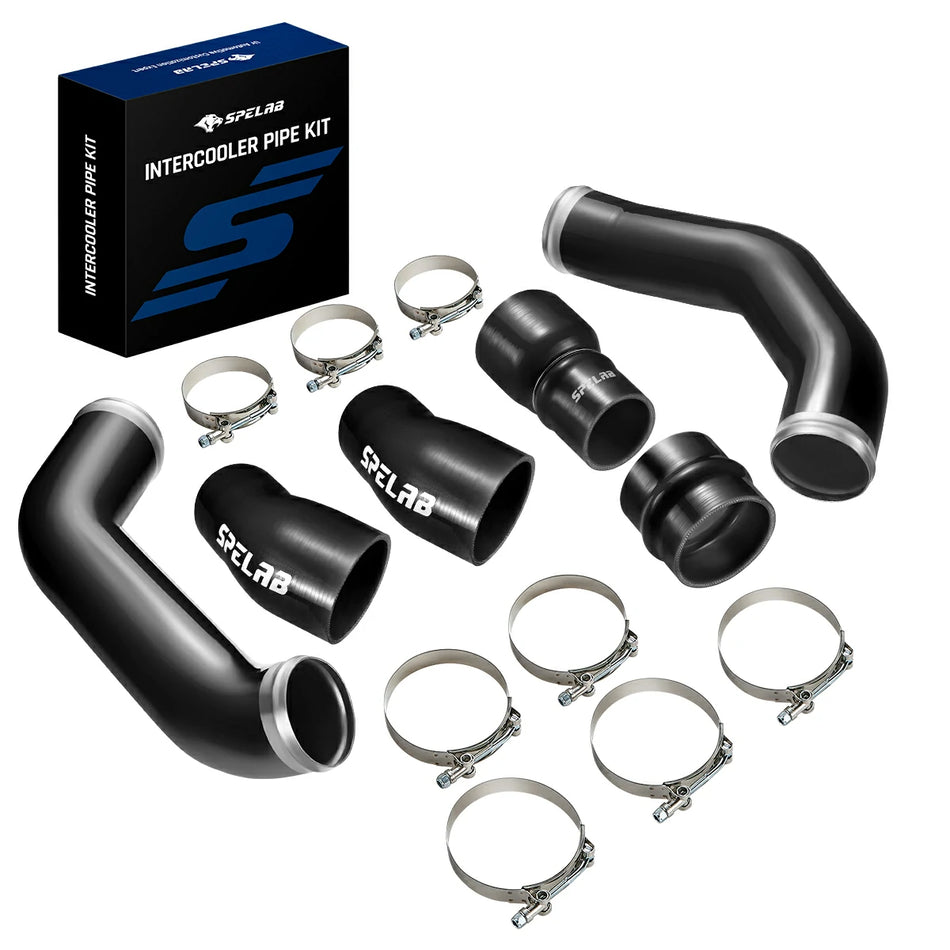
The following SPELAB listings are physical EGR-removal hardware for mass-produced pickup platforms, not street-truck repair recommendations. Their year-and-model fitment does not establish a permitted use. A buyer needs a documented legal basis for the exact dedicated vehicle, location, and duty, plus separate calibration and engineering review. No tuning or removal instructions are provided here.
| Catalog part | Published application | Critical checks |
|---|---|---|
| Ram 6.7L Cummins EGR removal hardware | Product title lists 2009-2025 Ram 2500/3500, with different year-group variants | Exact model year, pickup/chassis cab, coolant route, intake layout, transmission packaging, EGR/DPF/SCR configuration, and documented legal use |
| Ford 6.7L Power Stroke EGR and coolant-bypass hardware | Product title lists 2011-2025 Ford 6.7L applications with separate 2011-2014, 2015-2016, 2017-2019, and 2020+ configurations | F-250 through F-550 fitment, pickup/chassis cab, cooler and bypass layout, EGT provision, coolant fittings, calibration, and legal documentation |
| GM 6.6L Duramax L5P EGR removal hardware | Product title lists 2017-2025 L5P Silverado and Sierra 2500HD/3500HD applications | Model year, 2WD/4WD, pickup/chassis, CAN architecture, cooler and up-pipe layout, material, coolant routing, calibration, and legal basis |
The broader EGR delete hardware catalog groups multiple platforms and year ranges. Treat it as a directory only; confirm the exact VIN, chassis, coolant routing, emissions configuration, and intended duty from primary documentation.
U.S. Emissions and Road-Use Check
The Clean Air Act prohibits knowingly removing or rendering inoperative emissions-control devices and prohibits manufacturing, selling, offering for sale, or installing parts whose principal effect is to bypass or defeat required controls when the legal conditions apply. EPA policy evaluates facts case by case; a disclaimer is not a substitute for a documented reasonable basis.
Current EPA material specifically identifies EGR flow, EGR cooler bypassing, sensors, diagnostic trouble codes, and onboard diagnostics as emissions-related elements. A physical block-off commonly triggers faults or derate, so a so-called delete tune changes ECM strategy or monitor behavior to suppress them. Hardware removal and software changes are separate acts; software does not make the hardware compliant. Review the EPA tampering and defeat-device policy.
California requires a separate vehicle-specific check. A general "50-state legal" statement is not enough: verify the CARB Executive Order number and confirm that it covers the exact part, engine, model year, and test group. Without an applicable EO or another documented exemption, modified readiness monitors and missing EGR hardware can create smog-check and registration problems. The CARB aftermarket-parts program explains the exemption process.
The Magnuson-Moss Warranty Act means an ordinary aftermarket part does not automatically cancel the entire vehicle warranty. It does not force a manufacturer to cover damage caused by a part, incorrect installation, calibration, or tampering. Preserve baseline scans, repair orders, and receipts, and ask for any denial in writing. The FTC vehicle warranty guidance explains the federal consumer framework.
Frequently Asked Questions
Q: What does an EGR system do on a diesel truck?
A: It meters exhaust into the intake under selected conditions to lower peak combustion temperature and reduce NOx. The control module coordinates the valve, cooler, sensors, turbo, throttle, coolant, and aftertreatment strategy.
Q: Does an EGR delete add horsepower?
A: Blocking EGR hardware alone does not prove a horsepower gain. Large advertised gains usually involve added fuel, boost, timing, and calibration changes. A valid comparison needs matched dyno conditions and a separate emissions and durability evaluation.
Q: Will deleting EGR lower EGT by 100 to 200 degrees?
A: No universal temperature drop can be promised. EGT depends on probe location, load, gear, fueling, timing, boost, turbine efficiency, ambient temperature, and calibration. A pre-turbo 1,250-1,300°F workshop screening range is a reason to back out and investigate during sustained loaded work, not a universal limit. Use the OEM and gauge limits for the exact truck.
Q: Can a bad EGR cooler cause coolant loss and white smoke?
A: An internally leaking cooler can send coolant into the intake or exhaust and cause coolant loss or white vapor. Head-gasket, injector-cup, turbo-coolant, hose, and other faults can look similar, so pressure-test and isolate the source before ordering a cooler.
Q: Does P0401 mean the EGR valve is bad?
A: No. P0401 means measured or modeled flow was insufficient under the monitor conditions. The cause can be a restricted cooler or passage, valve, sensor bias, blocked pressure tube, pressure-ratio problem, intake or exhaust leak, throttle, turbo, wiring, or software.
Q: Can an EGR valve or cooler be cleaned instead of replaced?
A: Cleaning may make sense when deposits are confirmed, the OEM permits the process, and the part passes electrical, mechanical, pressure, and leakage checks. Cleaning cannot repair cracked metal, a leaking core, worn gears, a failed actuator, or damaged electronics.
Q: Is an EGR delete legal if the product says off-road use only?
A: A label alone does not create an exemption. Public-road use, vehicle certification, nonroad rules, dedicated competition status, state law, and the exact conduct all matter. Obtain documented legal guidance for the specific vehicle and use; do not treat ordinary towing, farm, jobsite, or trail driving as automatic permission.