A 2004.5–2005 LLY Duramax that runs hot while towing may have a restrictive factory turbo mouthpiece, but the mouthpiece is only one branch of the diagnosis. Cooling-stack blockage, weak fan-clutch engagement, coolant-flow loss, a slipping water-pump impeller, charge-air leakage, poor gear strategy, and combustion pressure entering the cooling system can produce the same complaint.
Separate engine coolant temperature, exhaust gas temperature, intake-air temperature, and transmission temperature before buying parts. Each reading points toward a different part of the truck, and one generic “overheating” diagnosis will miss the expensive failures.
Key Takeaways
The LLY turbo mouthpiece deserves an early inspection, but loaded test data must decide whether it is the root restriction or one problem among several.
- The stock LLY turbo mouthpiece can restrict compressor-inlet airflow under sustained load, especially on tuned or heavily worked trucks.
- A cold-air intake box and a turbo mouthpiece are different parts; replacing the airbox alone does not remove the narrow turbo-inlet transition.
- A weak fan clutch, packed cooling stack, or loss of coolant circulation can overheat an LLY even when intake airflow is acceptable.
- Rapid cooling-system pressure, repeated coolant loss, or a hard upper hose after a cold soak requires head-gasket and EGR-cooler diagnosis.
- Any claimed improvement should be verified with the same trailer, route, load, gear strategy, and comparable ambient conditions.
Should You Upgrade the Intake When an LLY Runs Hot While Towing?
Inspect the factory LLY turbo mouthpiece early, but replace it only as part of a diagnosis that also checks airflow through the cooling stack, fan-clutch operation, coolant circulation, boost leakage, calibration, and cooling-system pressure.
The 2004.5–2005 LLY uses a tight turbo-inlet transition commonly called the turbo mouthpiece, turbo inlet manifold, or compressor inlet elbow. A restriction before the compressor lowers inlet pressure, forcing the turbo to operate at a higher pressure ratio to produce the same manifold pressure. Under sustained Payload or Towing load, that can increase compressor work and discharge-air temperature.
A high-flow mouthpiece or properly planned LBZ-style intake conversion can reduce that restriction. It should not be sold as a guaranteed cure because coolant temperature still depends on fan airflow, radiator condition, coolant flow, trailer weight, gearing, ambient temperature, altitude, fueling, and how long the grade lasts.
| Observed condition | Most useful first check | Likely repair direction |
|---|---|---|
| Coolant temperature rises but boost remains repeatable | Cooling stack, fan clutch, coolant flow, and total load | Cooling-system repair before intake parts |
| Actual boost falls while EGT and load rise | Turbo mouthpiece, air filter, Boots, pipes, intercooler, and exhaust leaks | Repair the confirmed restriction or leak |
| Truck runs hot only after tuning or added fueling | Boost, fuel quantity, timing, selected gear, and inlet restriction | Calibration review plus airflow testing |
| Coolant is pushed out or pressure returns after a cold soak | Combustion-gas intrusion, head gaskets, EGR cooler, and cap | Cooling-system pressure diagnosis |
| Temperature rises despite strong fan engagement and a clean stack | Thermostats, water-pump flow, impeller drive, and internal cooling faults | Mechanical cooling-system diagnosis |
Why the LLY Turbo Mouthpiece Matters Under Load
The LLY factory turbo mouthpiece can become a meaningful airflow restriction when the compressor must sustain boost during a long grade, especially with added fuel, larger tires, high altitude, or a heavy trailer.
The restriction sits between the air-cleaner plumbing and the turbocharger compressor inlet. A 2004.5–2005 LLY cold-air intake may improve the path upstream while leaving the factory mouthpiece in place. That distinction matters because an owner can install a large filter and tube yet retain the tightest section directly in front of the compressor.

Our intake-component testing treats pressure drop, connection geometry, sealing, and repeatable Fitment as separate measurements. A larger-looking pipe does not prove lower restriction if the mouthpiece necks down sharply, the transition enters the compressor at a poor angle, or a coupler collapses under inlet vacuum.
Understanding how upstream airflow changes affect towing performance also prevents the airbox, intake tube, mouthpiece, compressor outlet, and intercooler from being treated as one interchangeable part.
What the Restriction Can Do
A restrictive compressor inlet can increase the pressure ratio the turbo must generate for a given manifold pressure, which may increase shaft-speed demand and compressor-outlet heat under sustained load.
That extra heat does not flow straight into the coolant as a fixed percentage. Intercooler efficiency, EGR heat load, turbine operation, fueling, road speed, fan airflow, and radiator capacity determine whether the added thermal load appears as higher IAT, EGT, coolant temperature, or no visible problem at all.
What an LBZ-Style Mouthpiece Conversion Changes
An LBZ-style intake conversion replaces the restrictive LLY turbo-inlet path with a smoother, higher-flow arrangement, but the required parts depend on the installed intake tube, resonator arrangement, crankcase-ventilation routing, sensor provisions, and previous Mods.
Verify every connection before ordering. A mouthpiece that fits the turbo does not guarantee that the existing airbox tube, PCV plumbing, brackets, or couplers will fit the conversion without additional parts.
When the Mouthpiece Is a Strong Upgrade Candidate
A high-flow turbo mouthpiece becomes a strong candidate when inlet restriction, low actual boost, compressor-inlet collapse, or repeatable high-load heat remains after the filter, charge-air system, cooling stack, and fan operation have been checked.
- The truck carries a towing calibration or added fueling.
- The truck pulls a heavy fifth-wheel, equipment trailer, or livestock trailer on sustained grades.
- Heat-related boost loss remains after downstream leaks and sensor faults have been ruled out.
- The air filter and upstream intake tube are clean and correctly sized.
- The factory mouthpiece remains installed while other airflow parts have already been upgraded.
When the Mouthpiece Is Not the Main Fault
A turbo mouthpiece will not repair coolant loss, rapid cold-start pressure, weak fan engagement, blocked heat exchangers, a slipping pump impeller, failed thermostats, or a transmission that repeatedly unlocks its converter.
Identify Which Temperature Leads the Event
The first temperature to move usually provides more diagnostic value than the highest number visible after the driver has already lifted off the throttle.

| Leading reading | What it suggests | Data needed before buying parts |
|---|---|---|
| Engine coolant temperature | Cooling airflow, coolant circulation, excessive load, or combustion pressure | Ambient temperature, grade, speed, fan behavior, load, coolant loss |
| EGT | Fuel-to-air balance, boost loss, wrong gear, exhaust restriction, or calibration | Probe location, RPM, actual boost, duration, fueling, selected gear |
| IAT | Compressor heat, heat soak, intercooler performance, or airflow restriction | Sensor location, ambient temperature, road speed, load duration |
| Transmission temperature | Converter slip, low gear efficiency, cooler airflow, fluid, or excess weight | Selected gear, lockup state, RPM, speed, Gross Combined Weight |
Document the IAT sensor location before interpreting the number. Depending on the PID and sensor arrangement, the displayed value may represent air before the turbo rather than post-intercooler charge temperature. A pre-turbo reading cannot prove how hot the compressed air is after the intercooler.
Document the EGT probe location for the same reason. Pre-turbo and post-turbo readings are not interchangeable, and a short shift-related spike should not be treated like a sustained value held for several minutes.
Check These LLY-Specific Heat Problems
An LLY that still runs hot after basic maintenance needs targeted checks for the turbo-inlet restriction, fan airflow, water-pump performance, combustion pressure, and EGR-cooler leakage.
Packed Cooling Stack or Weak Fan Clutch
A clean grille does not prove that the radiator stack is clean or that the fan clutch moves enough air during a low-speed climb.
Inspect between the A/C condenser, intercooler, and radiator because a front-mounted heat exchanger changes radiator airflow before the air reaches the core behind it. GM warns that large objects ahead of the radiator and changes to the original grille opening or air baffling can reduce engine and transmission cooling.[1]

A winch, grille guard, snowplow hardware, auxiliary lights, dirt, insects, and folded fins can all reduce effective airflow. Test fan engagement under the operating condition that produces heat because free-spinning the fan by hand in a cold shop is not a complete test.
Slipping Water-Pump Impeller or Loss of Pump Efficiency
A damaged or slipping water-pump impeller can reduce coolant flow even when the system remains full and the fan works correctly.
Suspect the pump when temperature rises rapidly under RPM and load, heater output changes unexpectedly, circulation evidence is weak, or other cooling checks produce no fault. Inspect for leakage, bearing movement, drive damage, impeller-to-shaft slip, erosion, and cavitation damage rather than replacing the pump solely because the truck is old.
Separate pump cavitation from impeller slip. Cavitation damages flow surfaces through vapor-bubble collapse, while a loose impeller or drive problem reduces shaft-to-impeller motion. Both can reduce effective circulation, but they leave different evidence.
Head-Gasket Failure or Combustion Gas in the Cooling System
Head-gasket diagnosis moves up the list when the system builds pressure unusually fast from a cold start, repeatedly pushes coolant out, traps air after correct bleeding, or leaves the upper radiator hose pressurized after a complete cold soak.
A hard hose alone does not prove failed head gaskets. Test cold-start pressure behavior, check for combustion gas, inspect coolant loss, evaluate cylinder contribution, and rule out the cap, external leaks, and EGR cooler before authorizing major engine work.

A truck can show a combustion-pressure problem mainly under towing load because high cylinder pressure exposes a marginal seal more aggressively than unloaded driving. Lack of coolant in the oil does not rule the failure out.
EGR-Cooler Leakage
An EGR-cooler fault can imitate part of the head-gasket symptom set by causing coolant loss, white exhaust vapor, recurring air, or unexplained cooling-system behavior.
Pressure-test and isolate the circuit according to the applicable service procedure. Replacing head gaskets without separating an EGR-cooler leak from combustion-gas intrusion can turn an expensive repair into an expensive misdiagnosis.
| Finding | Most likely direction | Required confirmation |
|---|---|---|
| Low boost, clean charge-air system, stock LLY mouthpiece | Turbo-inlet restriction or turbo-control issue | Inlet inspection, logs, sensor checks, and VGT diagnosis |
| Runs hot at low road speed but improves with speed | Fan airflow or cooling-stack restriction | Loaded fan-engagement and airflow inspection |
| Runs hot despite clean stack and strong fan | Coolant-flow or internal cooling fault | Thermostat, pump, pressure, and circulation testing |
| Pressure rises soon after a cold start | Combustion-gas intrusion or another pressure source | Cold pressure test, gas test, leak-down, and EGR-cooler checks |
| Coolant disappears without an obvious external leak | Internal leak, EGR cooler, cap venting, or intermittent external leak | Cold and hot pressure testing plus complete inspection |
Use This Diagnostic Order on an LLY Tow Rig
The shortest path to the fault starts with a loaded data log, checks the mouthpiece and air path, verifies cooling airflow, tests coolant circulation, and escalates to head-gasket diagnosis only when the evidence supports it.
- Record the failure condition. Log trailer weight, Payload, ambient temperature, grade, elevation, road speed, engine RPM, selected gear, Tow/Haul status, coolant temperature, transmission temperature, boost, EGT, and the relevant intake-temperature PID.
- Inspect the complete inlet path. Check the filter, airbox, intake tube, LLY turbo mouthpiece, PCV connections, couplers, and signs of inlet collapse or rubbing.
- Pressure-test the charge-air system. Begin around 5 psi and raise pressure only within the service procedure, tester instructions, and lowest-rated component. Roughly 10–15 psi often exposes smaller static leaks without using unregulated shop air.
- Inspect the cooling stack and fan system. Check every heat-exchanger face, the gaps between cores, air seals, fan shroud, grille obstruction, and fan-clutch engagement.
- Test coolant circulation. Check the correct 50/50 DEX-COOL mixture, cap, thermostats, hoses, external leakage, pump condition, and evidence of impeller or drive failure.[2]
- Test for abnormal cooling-system pressure. Investigate cold-start pressure, retained pressure after a cold soak, coolant expulsion, combustion gas, cylinder leakage, and EGR-cooler leakage.
- Review VGT operation, fueling, and calibration. Compare requested and actual boost, inspect exhaust leaks, and return questionable tuning to a known towing-safe baseline.
- Repeat the same loaded test. Use a comparable trailer, route, speed, gear strategy, and ambient range before crediting the repair.
| Confirmed failure | Correct repair direction | Part that should wait |
|---|---|---|
| Restrictive factory mouthpiece with otherwise sound systems | High-flow LLY mouthpiece or verified LBZ-style conversion | Radiator replacement without cooling evidence |
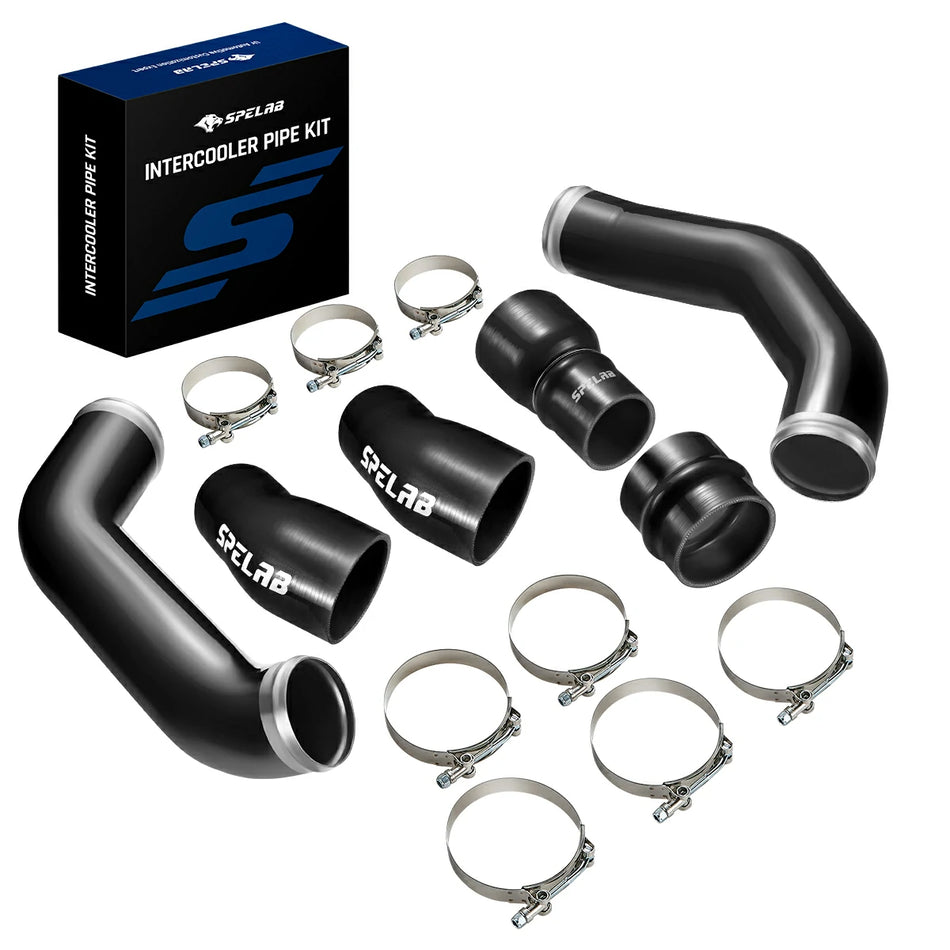
| Hot-side pipe or Boot leaks under load | Use a correctly fitted 2004.5–2010 LLY hot-side intercooler pipe kit when the pipe or connection is damaged | Unrelated cold-air intake |
| Intercooler core or end-tank leak | Replace the failed core with a compatible 2001–2005 LLY bar-and-plate intercooler | Turbo mouthpiece as the only repair |
| Blocked stack or weak fan engagement | Restore airflow and fan operation | Turbo mouthpiece as the only repair |
| Water-pump or thermostat fault | Restore coolant circulation | Intercooler upgrade |
| Combustion pressure entering coolant | Confirm the failed sealing path and repair it | Airflow Mods |
| Transmission heat leads the event | Correct converter, gear, fluid, load, or cooler problem | Engine intake hardware |
What Should You Check When Buying LLY Airflow Parts?
When comparing 2004.5–2005 LLY Duramax parts, judge the mouthpiece, intake tube, charge pipe, and intercooler by verified Fitment, internal geometry, sealing design, material quality, and compatibility with the existing turbo and PCV routing.
| Specification | What to inspect | Why it matters |
|---|---|---|
| Turbo fitment | Correct compressor-inlet connection for the installed turbo | A similar-looking mouthpiece can misalign or leak |
| Minimum internal area | Smallest section rather than advertised outside diameter | The tightest section controls the restriction |
| Transition shape | Smooth entry without abrupt steps or weld intrusion | A rough transition can create separation and added pressure loss |
| Material and wall quality | Rigid, heat-resistant construction with clean welds or casting | Heat cycles and inlet vacuum expose thin or distorted parts |
| Coupler support | Correct length, reinforcement, clamp land, and alignment | A coupler must resist collapse and movement under load |
| PCV compatibility | Required fittings, hose routing, and sealing provisions | An open or poorly sealed connection creates unmetered airflow |
| LBZ-style conversion contents | Mouthpiece, intake tube, couplers, fittings, brackets, and instructions | The mouthpiece alone may not complete the conversion |
| Testing evidence | Matched-flow pressure drop or documented loaded logs | Pipe diameter alone does not prove lower restriction |
Avoid fixed temperature-drop or horsepower promises without matched testing. Trailer weight, tune, turbo efficiency, fan airflow, radiator condition, altitude, ambient temperature, probe location, and selected gear can change the result more than one airflow part alone.
How Should You Verify the Repair?
A repair counts only when the truck completes a comparable loaded pull without reproducing the original boost loss, pressure behavior, or temperature trend.
Record level-road cruise, the beginning of the grade, the middle of the sustained pull, the top of the grade, and recovery after the driver lifts. Match trailer weight, Payload, speed, selected gear, Tow/Haul use, A/C use, and ambient conditions as closely as practical.
Our internal comparison standard changes one major variable whenever possible and keeps the raw logs. A lower reading from an empty truck on a colder day does not establish that a mouthpiece, radiator, or intercooler solved the towing complaint.
| Measurement | Before-and-after requirement |
|---|---|
| Coolant temperature | Compare the rate of rise, peak behavior, and recovery under similar load |
| EGT | Use the same probe and document whether it is pre-turbo or post-turbo |
| Intake temperature | Use the same PID and document the sensor location |
| Boost | Compare actual and requested values at matched RPM and load |
| Cooling-system pressure | Compare cold-start buildup, loaded behavior, and cold-soak retention |
| Transmission temperature | Match gear strategy and converter-lockup behavior |
Sources
Official GM and Chevrolet documents support the cooling-airflow, fan-clutch, coolant-mixture, and vehicle-specific service guidance used in this article.
Frequently Asked Questions
These answers address the LLY-specific failures and upgrade decisions that require more than a generic overheating checklist.
How much does a turbo mouthpiece upgrade lower LLY towing temperatures?
No defensible fixed temperature drop applies to every LLY. The result depends on the original restriction, turbo and tune, trailer weight, altitude, fan airflow, radiator condition, ambient temperature, sensor location, and duration of the grade.
Is the LLY turbo mouthpiece upgrade mandatory?
A high-flow mouthpiece is a strong upgrade for an LLY that tows heavily or has verified inlet restriction, but it is not proof that the cooling stack, fan clutch, water pump, thermostats, and head gaskets are healthy.
Will an LBZ mouthpiece fit an LLY Duramax?
An LBZ-style conversion can be used on an LLY when the mouthpiece, intake tube, couplers, PCV connections, brackets, and installed turbo configuration are compatible; the mouthpiece alone may not complete the conversion.
Can a slipping water-pump impeller make an LLY overheat only while towing?
A slipping or damaged impeller can move enough coolant for unloaded driving yet fail to maintain flow under sustained load, so pump inspection becomes important when the fan, cooling stack, coolant level, and thermostats check out.
Can failed head gaskets overheat an LLY only under heavy load?
A marginal head-gasket seal can leak combustion pressure more aggressively at high cylinder load, producing coolant pressure, coolant expulsion, trapped air, or overheating during towing while the truck appears normal when unloaded.
Does a hard upper radiator hose prove an LLY has blown head gaskets?
A hard hose after a complete cold soak is a warning sign rather than proof. Confirm cold-start pressure behavior, combustion gas, coolant loss, cap operation, EGR-cooler integrity, and cylinder leakage before authorizing head-gasket work.
Can a cold-air intake replace the LLY turbo mouthpiece?
A cold-air intake replaces or modifies the path upstream of the turbo, but many systems leave the restrictive factory mouthpiece in place; verify which components the kit includes before assuming it changes the compressor inlet.

About the Author
John Lee
Mechanical Engineer | 10+ Years Experience
John has spent the last decade engineering and testing high-performance automotive components. Specializing in drivetrain durability and thermal management across Powerstroke, Cummins, and Duramax applications, he bridges the gap between OEM limitations and aftermarket performance. His philosophy: "Factory parts are just a starting point."