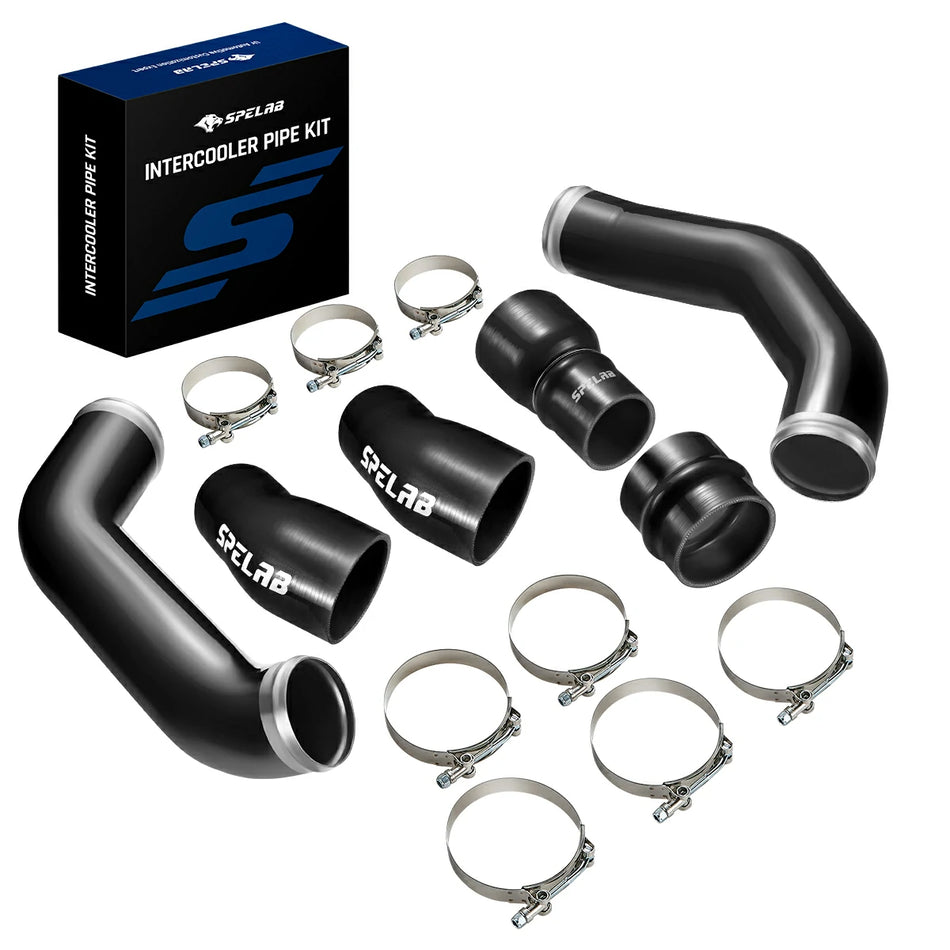
A downpipe usually makes a turbo gasoline car more noticeable during cold start, spool, and hard acceleration, while a modern diesel truck with its DOC, DPF, and SCR intact may show little tailpipe-volume change and only a clearer turbo sound near the firewall. A catted gasoline downpipe with the stock rear exhaust often lands in a mild range, while a catless, non-resonated combination can become sharply louder, raspy, or tiring under steady load.
Key Takeaways
A downpipe changes a gasoline vehicle most clearly during cold start and hard acceleration, while diesel results depend first on whether the factory aftertreatment remains intact.
- A catted downpipe with the stock rear exhaust commonly falls around 1–4 dB(A) above baseline in comparable gasoline-vehicle recordings, so the change is usually noticeable without dominating the cabin.
- A catless downpipe with a stock rear exhaust can land roughly 3–8 dB(A) above baseline during cold start or hard acceleration; a non-resonated full system can reach roughly 7–12 dB(A) or more.
- A modern Power Stroke, Duramax, or Cummins with its DOC, DPF, and SCR intact will often show only about 0–3 dB(A) of tailpipe change from the downpipe alone, with the clearer difference heard as turbo hiss near the cab.
- Exhaust drone is a narrow low-frequency cabin resonance, while rasp is a sharper metallic sound and turbo whistle comes from airflow through the turbocharger and exhaust path.
- A new tick, rattle, whistle, or cabin exhaust smell after installation should be diagnosed as a possible leak or fitment problem before it is accepted as normal downpipe sound.
How Much Louder Does a Downpipe Make a Car or Truck?
A gasoline downpipe commonly adds roughly 1–8 dB(A) when the stock rear exhaust remains, while a downpipe combined with catalyst removal and a non-resonated cat-back can add roughly 7–12 dB(A) or more; an emissions-intact modern diesel truck usually stays near the low end at the tailpipe.
These figures are broad planning ranges drawn from common shop and owner comparison patterns, not controlled SPELAB test results or a guarantee for any part. Microphone distance, automatic gain, cold-start strategy, engine load, catalyst, resonator, muffler, exhaust valves, cab construction, and the measurement environment can move the result outside the range.
| Exhaust configuration | Rough change from stock | Cold start | Acceleration and WOT | Highway drone risk | Suitable use |
|---|---|---|---|---|---|
| Stock downpipe and stock exhaust | Baseline, 0 dB(A) | Factory baseline | Factory baseline | Usually lowest | Quiet daily use and long highway trips |
| Catted downpipe with stock exhaust | Often about +1 to +4 dB(A) | Typically mild to moderate increase | More turbo spool and exhaust tone under load | Usually lower than a non-resonated full exhaust | Daily driver that wants a noticeable but controlled change |
| Catless downpipe with stock exhaust | Often about +3 to +8 dB(A) | Often louder and sharper | More volume, turbine sound, and possible rasp | Platform-dependent | Track or lawful non-road context where emissions rules permit |
| Downpipe with resonated cat-back | Often about +4 to +9 dB(A) | Moderate to strong increase | Fuller tone with some high-frequency control | Depends on resonator tuning and cruising rpm | Performance build that still sees highway miles |
| Downpipe with non-resonated cat-back or muffler delete | Often about +7 to +12 dB(A), sometimes more | Usually strongest | Highest risk of harshness and rasp | Often highest under steady load | Owner who accepts cabin noise and a more aggressive sound |
| Modern diesel downpipe with factory DOC, DPF, and SCR intact | Often about 0 to +3 dB(A) at the tailpipe | Usually a small tailpipe change; cab-side turbo hiss may be clearer | More turbine sound under load without a gasoline-style exhaust bark | Usually driven by cab resonance, pipe contact, or the remaining exhaust | Emissions-intact towing, work, and daily-use truck |
Read those ranges on a logarithmic scale: a 3 dB increase represents twice the sound energy, while an increase around 8–10 dB can feel roughly twice as loud under comparable conditions.[8] A 3-inch catted pipe feeding a stock resonator can still be quieter inside the cabin than a smaller non-resonated system on another chassis.
What Changes When You Keep the Stock Exhaust?
A stock resonator and muffler usually keep overall volume under control after a downpipe installation, but they cannot completely hide the stronger cold-start pulse, clearer turbo spool, and added sound under heavy throttle.
Gasoline Cold Start
Gasoline cold start is usually the loudest part of the day because many modern turbo engines raise idle speed and alter ignition, injection, exhaust-valve, or valve-timing behavior to heat the catalyst quickly. A freer-flowing downpipe makes those first seconds more obvious, especially inside a garage, between houses, or beside an apartment wall.
BMW B58 owner reports provide a clear example: a catless 2025 M340i was described as loud immediately after startup and noticeably calmer once engine speed dropped.[1] That report describes one vehicle and one hardware combination, so it should guide expectations rather than serve as a universal sound measurement.
Warm Idle and Normal Driving
Warm idle often stays close to stock when the factory resonator, muffler, and exhaust valves remain in place. Light throttle may add a deeper edge or more audible turbine sound without making normal conversation difficult.
Small throttle changes can sound larger from outside the vehicle than they do from the driver's seat. Floor insulation, rear-seat structure, bed length, trunk volume, and exhaust outlet position all filter different frequencies before they reach the cabin.
Wide-Open Throttle
Wide-open throttle creates the largest sound change because exhaust mass flow and turbo speed rise together. A stock rear exhaust can still mute the peak volume, but it cannot fully remove the sharper turbine outlet sound or the stronger exhaust pulses created upstream.
A louder pull does not prove that the vehicle gained a specific amount of power. ECU torque targets, boost control, fuel quality, catalyst restriction, charge-air temperature, and calibration determine performance; the driver's ear cannot separate those variables.
Highway Cruising
Highway drone appears when the engine holds a narrow rpm band under steady load and the exhaust frequency excites the cabin or body structure. Many passenger vehicles and trucks cruise roughly between 1,500 and 2,500 rpm at 65 to 75 mph, but axle ratio, tire size, transmission gear, trailer weight, grade, and cylinder-deactivation strategy can move the problem band.
Ford EcoBoost owners have repeatedly focused on cabin drone around 2,000 rpm under load, while other owners report quiet cruising with a different resonator and muffler combination.[3] Those conflicting reports are useful: the downpipe alone does not determine highway comfort.

Does a Catted Downpipe Sound Different From a Catless Downpipe?
A catted downpipe typically smooths some high-frequency exhaust energy and controls odor better, while a catless pipe often produces a louder cold start, a sharper top-end note, more audible turbo sound, and a greater chance of rasp.
| Sound factor | Stock catalyst | High-flow catted downpipe | Catless downpipe |
|---|---|---|---|
| Cold-start volume | Factory baseline | Typically louder but still filtered by the substrate | Often loudest and sharpest |
| Warm idle | Usually most subdued | Often slightly deeper or more present | May sound only moderately louder with a stock rear exhaust |
| Turbo spool | Most filtered | Usually more audible | Usually clearest |
| High-rpm rasp | Usually lowest | Depends on substrate, resonator, engine, and transitions | Usually highest risk, especially on non-resonated systems |
| Exhaust odor | Factory-controlled when healthy | May be more noticeable during cold start or rich operation | Raw exhaust odor is commonly more noticeable |
| Street-use decision | Clearest compliance path | Requires exact application and emissions-document review | Removal of required emissions hardware creates legal and inspection risk |
Use the catted-versus-catless decision guide when catalyst construction, smell, check engine light risk, and emissions compliance matter alongside sound.
A 200-CPSI label does not tell a buyer how a catted downpipe will sound. Substrate material, brick length, catalyst volume, shell construction, distance from the turbine, transition shape, resonator design, and the remaining exhaust system all affect the final result.

How Much Louder Is a Downpipe on a Diesel Truck?
A downpipe alone usually changes tailpipe volume by only about 0–3 dB(A) on a modern diesel truck when the factory DOC, DPF, and SCR remain intact, although turbo hiss and turbine sound near the firewall may become easier to hear.
The aftertreatment system is the dividing line. The porous DOC and DPF assemblies, long exhaust path, muffler, and tailpipe continue to break up combustion pulses after a larger pipe is installed upstream, so a 2011-and-newer 6.7L Power Stroke, 2017-and-newer L5P Duramax, or 2007.5-and-newer 6.7L Cummins should not be judged from a catless gasoline-car sound clip.
Older Diesel Platforms Without a Factory DPF
An older diesel platform without a factory DPF can show a clearer change in turbo whistle, exhaust pulse, and cab-side rumble because less sound-control hardware remains downstream. A 2003–2007 6.0L Power Stroke or an early LB7, LLY, or LBZ Duramax still needs engine-code and exhaust-layout verification because the muffler, cab, transmission, and full pipe routing can outweigh diameter alone.
Diesel Cold Start and Exhaust Brake Sound
A diesel cold start does not use gasoline-style spark retard because a diesel engine has no spark-ignition event to retard. Depending on the platform and temperature, high idle, variable-geometry turbo vane position, intake-air control, injection timing, and aftertreatment heat management can create a duller high-idle note and a stronger turbo hiss; Ford documentation confirms that a more closed VGT position raises exhaust-manifold pressure and assists low-temperature warm-up on the 6.7L Power Stroke.[7]
Exhaust-brake sound also changes with commanded vane position and load, but the control system does not hold one universal fully closed position. A new squeal, flutter, metal contact, or exhaust smell during braking should trigger a hardware and diagnostic check instead of being labeled normal sound.
Heavy Towing and Cabin Boom
A diesel truck pulling roughly 10,000 lb or more may spend a long grade near 1,800–2,200 rpm, depending on gearing, road speed, slope, transmission strategy, and trailer weight. That sustained load can expose a narrow cabin-boom band, a firewall contact point, or an upstream leak that never appears during an unloaded parking-lot rev.
Judge towing comfort with the truck in its real gear and load range, then inspect V-band seating, firewall clearance, flex movement, heat shields, and exhaust-brake operation if the new sound is sharp, metallic, or accompanied by unusual EGT, boost, or drivability behavior.
Will a Downpipe Cause Drone, Rasp, or Turbo Whistle?
A downpipe may expose drone, rasp, or turbo whistle, but each sound comes from a different physical condition and requires a different diagnosis or hardware decision.
What Is Exhaust Drone?
Exhaust drone is a steady low-frequency pressure variation that becomes loud inside the cabin at a particular engine speed and load. The objectionable band is often roughly 80 to 200 Hz, depending on firing frequency, rpm, cylinder count, exhaust length, and cabin resonance.
Drone usually matters more during a 30-minute interstate pull than during a parking-lot rev. A truck may sound clean at idle and become tiring while towing in top gear because the added load holds the engine inside the same resonance band.
What Is Exhaust Rasp?
Exhaust rasp is a higher-frequency metallic or tearing edge that usually becomes more obvious as rpm and gas velocity rise. Cat removal, non-resonated tubing, abrupt diameter steps, thin shells, certain V6 firing patterns, and mismatched collectors can all contribute.
VR30DDTT-powered Infiniti Q50 and Q60 models provide the correct Nissan-family comparison because the 3.0L V6 uses two turbochargers and close-coupled catalysts.[4] Lower-downpipe design, catalyst retention, collector transitions, and the rear exhaust determine whether the twin-turbo V6 gains a clean spool note or a metallic edge at higher rpm.
What Is Normal Turbo Whistle?
Normal turbo whistle rises and falls with turbo speed and load, while a leak whistle, siren-like bearing noise, or high-pitched squeal may continue under conditions that do not match normal boost behavior. A freer turbine outlet can make healthy turbo sound easier to hear without changing the turbocharger itself.
Power Stroke reports show how platform-specific that sound can be: some 6.0L trucks gain a deeper exhaust note and more noticeable whistle, yet the change inside the cab may remain modest with a muffled system.[5] A 7.3L, 6.0L, 6.4L, and 6.7L Power Stroke should not be expected to produce the same whistle or turbine note.

Do Not Blame Every New Noise on the Downpipe
A new cold-start tick, metallic rattle, sharp whistle, or exhaust smell after installation should be treated as a possible sealing or clearance problem until the hardware passes a cold and hot inspection.
| Sound or symptom | Likely area to inspect | Practical check | Action |
|---|---|---|---|
| Cold-start tick that slows as the engine warms | V-band, flange, gasket, flex section, or sensor bung | Look for soot traces and listen from a safe distance before the pipe heats up | Reseat or replace the failed sealing part |
| Metallic rattle at idle or during launch | Heat shield, crossmember, firewall, brace, or exhaust hanger preload | Check clearance cold, then repeat after a heat cycle | Realign the system instead of tightening it against the chassis |
| Whistle that appeared immediately after installation | Turbo outlet connection, clamp seating, cracked flex, or sensor port | Compare sound with boost and load; perform a smoke or low-pressure leak check when appropriate | Repair the leak before judging tone |
| Rasp only in a narrow rpm range | Collector transition, resonator, catalyst shell, or pipe contact | Reproduce the sound in gear under controlled load rather than free-revving alone | Correct contact or tune the resonator to the problem band |
| Exhaust odor inside the cabin | Upstream joint, floor opening, hatch seal, rear outlet position, or missing catalyst | Stop using the vehicle in an enclosed space and inspect for leakage | Repair the leak and restore required emissions hardware |
| Flashing check engine light with rough sound | Active misfire or fuel-control fault | Stop the pull and scan the vehicle before continuing | Diagnose the engine fault; the downpipe is not the first assumption |
Our installation checks start with V-band seating, flange alignment, flex preload, oxygen-sensor clearance, heat shielding, and full drivetrain movement. A pipe that clears the firewall on a lift may touch the body when engine torque rolls the powertrain under load.
Use the downpipe installation checklist when seized fasteners, sensor removal, gasket choice, lift access, or post-install leaks are still unresolved.
How Does the Engine Platform Change Downpipe Sound?
Engine layout changes the answer because cylinder count, firing order, turbo arrangement, catalyst position, wastegate path, exhaust valve strategy, and chassis insulation shape the sound before pipe diameter enters the discussion.
| Platform examples | Layout that matters | Common owner concern | What to verify before buying |
|---|---|---|---|
| 2007-2010 BMW 335i and 2008-2010 135i with N54; later N55, B58, S55, and S58 applications | Single- or twin-turbo outlet, one or two downpipes, close-coupled catalyst, exhaust valves | Loud cold start, sharper high rpm, turbo spool, and possible rasp with catless hardware[1] | Engine code, chassis, downpipe count, catalyst type, stock or modified midpipe, and valve operation |
| VW and Audi 1.8T, 2.0T, and 2.7T applications | Engine-code-specific turbo outlet, catalyst package, front-wheel-drive or AWD routing, resonator | Cold-start bark, DSG shift sound, rear oxygen-sensor location, and cruise resonance | Engine code and drivetrain rather than body style alone |
| 2002-2014 Subaru WRX, 2004-2021 STI, and 2015-2021 WRX turbo applications | EJ20, EJ25, or FA20DIT turbine outlet, wastegate path, catalyst, unequal- or equal-length header | Boxer tone, high-load volume, drone near common cruise speeds, and boost-control behavior | Turbo outlet style, catted or catless design, header layout, tune requirement, and remaining cat-back; owners report that a stock rear exhaust can keep a downpipe change relatively restrained[2] |
| 2011-and-newer 3.5L and 2015-and-newer 2.7L Ford F-150 EcoBoost examples | Single- or dual-bank turbo plumbing, close-coupled catalysts, long truck exhaust, resonator and muffler | V6 rasp, turbo whistle, and drone near roughly 2,000 rpm under load[3] | Engine displacement, cab and bed configuration, axle ratio, resonator, muffler, and trailer use |
| 2016-and-newer Infiniti Q50 and 2017-and-newer Q60 3.0t applications with VR30DDTT | Twin turbochargers, two lower downpipes, close-coupled catalysts, collector transitions, and dual rear exhaust | Cold-start bark, twin-turbo spool, metallic rasp, and cruise resonance when catalyst or resonator volume is reduced | VR30DDTT engine, upper or lower downpipe position, catalyst type, AWD or RWD routing, and rear exhaust |
| 2003–2007 6.0L Power Stroke and early LB7, LLY, or LBZ Duramax examples without a factory DPF | Turbo outlet, variable-geometry or fixed-geometry turbo behavior, long pipe routing, muffler, and cab insulation | More noticeable turbo whistle, diesel pulse, low-load rumble, and possible cab drone | Exact engine code, factory emissions layout, cab style, muffler, pipe clearance, and transmission |
| 2011-and-newer 6.7L Power Stroke, 2017-and-newer L5P Duramax, and 2007.5-and-newer 6.7L Cummins examples | Turbo outlet followed by platform-specific DOC, DPF, SCR, long truck exhaust, and model-specific heat shielding | Usually a modest tailpipe change with intact aftertreatment; clearer turbo hiss, exhaust-brake tone, or firewall-side noise may be more noticeable | Engine code, sensor and aftertreatment layout, cab configuration, firewall clearance, exhaust-brake strategy, and towing rpm |
These model years identify common U.S. platform examples, not universal product fitment. Confirm the exact engine, emissions family, sensor layout, drivetrain, and part number before treating a forum sound clip or product title as a match.
Does a Bigger Downpipe Sound Deeper?
A larger downpipe may change volume and low-frequency character, but diameter alone cannot guarantee a deeper tone because catalyst construction, transitions, wall thickness, resonators, mufflers, and exhaust length can outweigh the nominal tube size.
Common aftermarket sizes include roughly 2.5, 3.0, 3.5, and 4.0 inches, depending on the platform. A sudden step from a smaller outlet into a large tube can sound different from a smooth tapered transition, and a rigid oversized pipe can create a new chassis-contact point even when the flange bolts up.
Material also changes durability and ringing behavior without deciding the whole sound. A 304 stainless pipe generally resists road salt better than mild steel, but a thin stainless shell, a cracked weld, or a loose heat shield can still produce a metallic noise that has nothing to do with the intended exhaust note.
Judge the turbine outlet, catalyst, flex section, pipe transitions, hanger position, resonator, muffler, and tailpipe outlet as one system. A diameter badge by itself is not a sound specification, and a larger tube cannot promise a deeper tone.
Can You Reduce Drone or Rasp After Installing a Downpipe?
Most objectionable drone or rasp should be handled by identifying the exact rpm band, checking for leaks and contact, then changing resonator or muffler behavior instead of blindly installing a larger pipe.
| Owner complaint | First inspection | Possible correction | Poor first move |
|---|---|---|---|
| Low-frequency highway drone | Record speed, gear, rpm, load, and whether an exhaust valve is open | Restore or retune a resonator, change muffler design, or adjust the cruising gear when safe | Assume a larger tube will move the drone out of range |
| High-rpm rasp | Check catalyst, collector steps, leaks, pipe contact, and resonator condition | Use a properly sized resonator or smoother transition and repair leakage | Use software to hide a mechanical sound |
| Cold start is too loud | Confirm catalyst, exhaust valve, cold-start calibration, and rear exhaust configuration | Retain more catalyst and resonator volume or restore the stock rear section | Judge the entire setup from warm idle alone |
| Metal rattle over bumps or during launch | Check firewall, crossmember, brace, heat shield, flex preload, and hangers | Realign the downpipe and restore working clearance through drivetrain movement | Add a resonator before correcting physical contact |
| Too quiet with a stock rear exhaust | Confirm that the system is sealed and any exhaust valves work correctly | Change one rear component at a time and record the result | Delete the catalyst, resonator, and muffler at the same time |
A welded resonator change commonly requires roughly one to three labor hours depending on access, pipe routing, fabrication, and whether existing hardware must be removed. Ask the shop to identify the problem rpm and available straight-pipe length before buying a universal resonator.
Which Downpipe Sound Setup Fits Your Driving?
The right setup depends on where the vehicle spends its time because a weekend pull, a 70-mph commute, and an eight-hour towing day place very different demands on cabin noise and exhaust tone.
Daily Driver
A daily driver is usually better served by an application-appropriate catted downpipe and the stock exhaust or a properly sized resonated cat-back. This combination typically preserves conversation-level comfort while making cold start, spool, and full-throttle sound more noticeable.
Weekend Performance Car
A weekend car can tolerate a louder cold start and sharper high-rpm note, but the owner should still decide whether the goal is more turbo sound, a deeper exhaust tone, or maximum volume. Removing every sound-control component often creates rasp rather than the clean aggressive note the buyer expected.
Long-Distance Highway Car
A highway car should be judged at its real cruising rpm with the windows closed and the transmission in the gear normally used. A 20-second exterior rev clip cannot reveal the low-frequency pressure that becomes tiring after an hour on the interstate.
Towing and Payload
A truck pulling roughly 10,000 lb or more can sit near 1,800–2,200 rpm for minutes on a grade, depending on axle ratio, tire size, transmission strategy, road speed, and slope. That operating window can expose low-frequency cabin boom, a firewall contact point, or a leaking joint that an unloaded rev never reveals.
Test the system on a controlled grade only after checking clamps, heat shields, sensor wiring, flex travel, transmission temperature, EGT behavior when available, and exhaust clearance near the cab. Listen again during exhaust-brake operation because the commanded VGT position can change turbine pitch and cabin-side pressure without producing the same sound as acceleration.
Jobsite and Cold-Weather Use
A jobsite truck may idle for long periods, collect mud around shields, and see repeated frame twist on rough access roads. Cold weather can make the first startup sharper, while road salt can expose weak clamps and welds that later create a tick or rattle.
Browse available downpipe applications only after confirming engine, model year, catalyst requirement, sensor layout, remaining exhaust hardware, and the amount of cabin noise you are willing to accept.
How Should You Record a Before-and-After Sound Test?
A useful 30-second before-and-after comparison keeps the same phone, position, distance, engine temperature, rpm, gear, and road condition so automatic microphone gain does not create a fake improvement.
- List the vehicle, engine, catalyst, resonator, muffler, exhaust valve, pipe diameter, and tune status.
- Fix the phone at the same safe distance and angle for both recordings; do not hold it closer after installation.
- Compare a fully cold start with a fully cold start, then repeat warm idle and one fixed-rpm sample.
- Record the real cruise gear and rpm from inside the cabin when drone matters, or the same towing load and grade when testing a truck.
- Treat phone dB(A) readings as comparison estimates, not certified measurements, and keep the raw clips with the stated conditions.
A single peak number cannot describe tone or drone, but a repeated dB(A) comparison gives buyers a useful anchor when the full hardware list and test conditions are published beside it.
Downpipe Sound FAQ
These answers cover the short sound questions owners ask before installing a downpipe or changing the rest of the exhaust.
Q: How many decibels does a downpipe add?
A: A catted downpipe with the stock rear exhaust often adds roughly 1–4 dB(A), a catless downpipe with the stock rear exhaust can add roughly 3–8 dB(A), and a catless non-resonated system can add roughly 7–12 dB(A) or more. These are broad comparison ranges rather than SPELAB test results, and the same hardware can measure outside them when the microphone, load, engine strategy, or remaining exhaust changes.
Q: Will a downpipe be loud with a stock exhaust?
A: A downpipe paired with the stock exhaust is usually louder during cold start and hard acceleration, while the factory resonator and muffler often keep warm idle and highway volume relatively controlled. The result still depends on the catalyst, engine platform, exhaust valves, and cabin.
Q: Is a catted downpipe quieter than a catless downpipe?
A: A catted downpipe is typically quieter and smoother than a catless downpipe on the same vehicle because the catalyst substrate absorbs and disrupts some exhaust energy. Catalyst volume, CPSI, material, location, and the remaining exhaust determine how large the difference becomes.
Q: Will a downpipe make a diesel truck louder with the DPF installed?
A: A downpipe alone often adds only about 0–3 dB(A) at the tailpipe of a modern diesel truck when the DOC, DPF, and SCR remain intact. The more noticeable change is usually turbo hiss near the firewall or under load, while a large new cabin boom points toward resonance, contact, leakage, or another exhaust change.
Q: Does a downpipe cause highway drone?
A: A downpipe can expose or increase highway drone, but the resonator, muffler, exhaust length, cabin structure, gear, load, and cruising rpm usually determine whether the low-frequency resonance becomes objectionable.
Q: Why does my downpipe sound raspy?
A: Downpipe rasp can come from catalyst removal, a non-resonated exhaust, an abrupt collector transition, certain V6 firing patterns, pipe contact, or a leaking joint. Inspect the hardware before buying another muffler or assuming the sound is normal.
Q: Is ticking after a downpipe installation normal?
A: Light cooling pings after shutdown can be normal thermal contraction, but a repeating cold-start tick that follows engine speed may indicate a V-band, flange, gasket, flex, weld, or sensor-bung leak. Look for soot and verify sealing before driving under heavy load.
Sources
Forum sources below document platform-specific owner experiences rather than controlled acoustic tests. Manufacturer sources verify engine and turbo-system facts, the EPA source supports the emissions warning, and the NIOSH source explains the logarithmic decibel scale; the downpipe-specific dB(A) ranges in this article remain conservative planning estimates rather than certified product measurements.
- Bimmerpost: Gen 3 B58 Downpipe Sound Discussion
- NASIOC: WRX Downpipe and Stock Exhaust Discussion
- F150forum: EcoBoost Exhaust Drone Discussion
- INFINITI: 2017 Q50 VR30DDTT Engine Specifications
- Ford Truck Enthusiasts: 6.0L Power Stroke Exhaust Discussion
- U.S. EPA: Vehicle and Engine Tampering and Aftermarket Defeat Devices Policy
- Ford Motor Company: 6.7L Power Stroke Variable-Geometry Turbocharger Operation
- NIOSH: Industrial Noise Control Manual

About the Author
John Lee
Mechanical Engineer | 10+ Years Experience
John has spent the last decade engineering and testing high-performance automotive components. Specializing in drivetrain durability and thermal management across Powerstroke, Cummins, and Duramax applications, he bridges the gap between OEM limitations and aftermarket performance. His philosophy: "Factory parts are just a starting point."