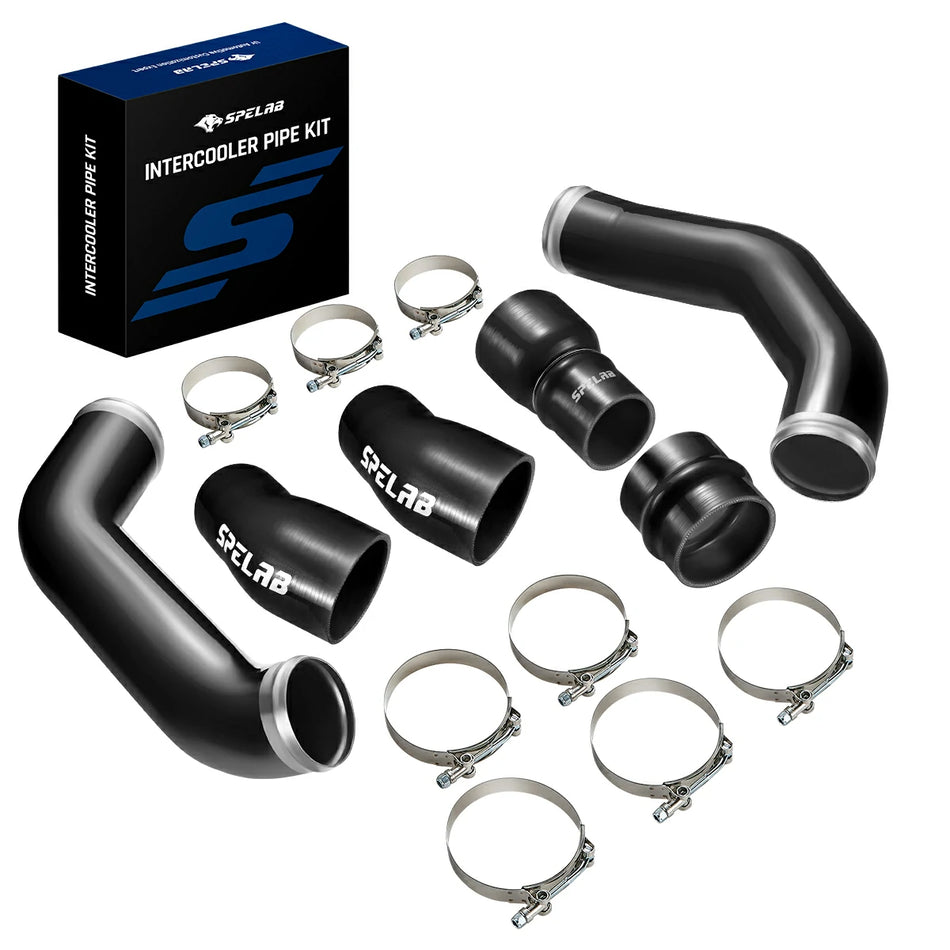
A downpipe does not automatically require an ECU tune, but the right answer changes with the engine platform, catalyst layout, pipe size, ECU strategy, and how hard the vehicle will be used. A car that starts and idles on the stock calibration is not automatically ready for full boost, a track session, a loaded mountain pull, or an emissions inspection.
Key Takeaways
The safe decision comes from the exact vehicle and hardware combination, not from the word “downpipe” on the box.
- A stock-style replacement that keeps every catalyst and sensor in the original working arrangement often does not need a performance tune.
- A high-flow catted downpipe may run on the stock calibration, but check engine light and readiness behavior remain platform-specific.
- A larger turbo, higher boost target, changed fuel, or altered airflow model requires a calibration written for the complete hardware package.
- Subaru turbo platforms deserve extra caution because downpipe flow can affect boost control; treat the matching calibration as required before full-load driving.
- Treat hardware faults and calibration decisions as separate jobs; diagnose the car before changing the map.
Does Installing a Downpipe Require a Tune?
A downpipe requires a tune when the replacement changes a control input or operating target that the stock ECU cannot safely or correctly accommodate; it does not require a tune merely because the pipe is shiny, larger, or sold as a bolt-on part.
Separate five questions before ordering parts: Will the engine start? Can it drive gently? Is full-load boost control validated? Will the catalyst monitor set a code? Is the configuration approved for road use where the vehicle is registered? Those answers can be different on the same truck or car.
| Configuration | Stock-calibration operation | Tune call | Check engine light/readiness risk | Next action |
|---|---|---|---|---|
| Stock-style replacement with the original catalyst and sensors retained | Often operates normally when fitment is correct | Often not required | Usually low unless there is a leak or sensor problem | Leak-check, scan, and follow the service procedure |
| High-flow catted downpipe on otherwise stock hardware | May start and drive normally | Application-specific; often recommended for performance | Variable because catalyst-monitor thresholds differ | Confirm the exact engine, ECU software, and catalyst approval |
| Larger downpipe paired with higher boost | Stock behavior does not validate the new load target | Required for the stated performance setup | Separate from boost and fueling risk | Get the map before the first full-load pull |
| Pipe that removes or renders a catalyst or aftertreatment device inoperative | The engine may run, but that proves neither compliance nor correct diagnostics | No road-use recommendation | High risk of catalyst or aftertreatment faults | Choose a compliant configuration and verify local requirements |
| Any setup with a leak, O2 fault, misfire, or boost deviation | Do not judge it by idle quality alone | Diagnose before tuning | High | Fix the mechanical or electrical fault first |
Downpipe Tune Requirements by Engine Platform
Platform ratings should guide the first decision, but the exact year, engine code, ECU software, catalyst, transmission, and supporting mods still control the final answer.
As a parts manufacturer, we treat fitment and calibration as two separate sign-offs. A pipe can bolt into place and still need a different calibration for full-load use. When no logged test exists for the exact ECU and hardware combination, the honest label is “application-specific,” not a hard yes or no.
How to Read the Tune Ratings
“Required” means the configuration should not be used at full load without a matching calibration; “strongly recommended” means stock operation may be possible but the performance and control strategy remain unverified.
- Required: match the calibration before full boost or sustained heavy load.
- Strongly recommended: confirm stock-operation limits and log the vehicle before leaning on it.
- Often not required: applies only to the described stock-style or emissions-retaining configuration.
- Application-specific: verify the ECU generation, catalyst, sensor layout, and calibration-provider requirements.

SPELAB Gasoline Turbo Platforms
SPELAB’s current gasoline-turbo catalog spans several ECU generations, so no single tune rule covers every product URL or vehicle in the fitment list.
| Engine platform | Common applications | Stock-calibration behavior | Tune decision | CEL/readiness risk | Shop judgment |
|---|---|---|---|---|---|
| BMW N54 | BMW 135i and 335i applications; verify model year and DME | A downpipe-only car may start and drive on the stock map | Strongly recommended for the downpipe performance package | High with catalyst removal; variable with a high-flow catalyst | Match the map to fuel, intercooler, boost target, and the exact BMW N54 downpipe configuration. N54 community stage charts commonly pair high-flow downpipes with Stage 2 calibrations.[5] |
| BMW S55 | F80 M3 and F82/F83 M4 | Physical operation does not validate full-load control | Strongly recommended; required when boost or fuel targets change | Configuration-dependent | Check DME software, catalyst design, fuel, and the complete map specification before choosing an S55 downpipe for the F80 M3 or F82/F83 M4 |
| BMW N63B44 | Selected X5, X6, 5 Series, and 7 Series applications | Generation and chassis differences prevent one stock-map answer | Application-specific | Configuration-dependent | Confirm the exact N63 variant, bank-specific sensor layout, and ECU version |
| MINI N14/N18 1.6T | R55-R61 Cooper S and JCW applications; verify engine split | May run, but high-flow catalyst behavior varies | Strongly recommended for a performance downpipe | Common concern on non-stock catalysts | N14 and N18 support paths differ; confirm the engine split before choosing a MINI R55-R61 1.6L downpipe. MINI owner discussions document CEL and inspection concerns even with sport-cat parts.[6] |
| VW/Audi 1.8T 20V | Selected Audi TT, A4, VW Beetle, and Passat applications | Older ME7 applications may drive on the stock map | Recommended for performance; exact file must match engine code | High when catalyst efficiency falls below the calibrated threshold | Verify transverse versus longitudinal fitment, engine code, O2 layout, and fuel |
| VW/Audi 2.0T | A3, GTI, Golf, and Jetta applications | No universal answer across EA113 and EA888 generations | Application-specific; strongly recommended for performance use | Variable with a high-flow catalyst; high without one | Do not buy by “2.0T” alone; confirm EA113/EA888, drivetrain, flange, sensor placement, and product application |
| Audi/VW 2.7T Biturbo | B5 S4 and selected C5 A6/Allroad applications | May operate at stock load targets | Recommended as part of a matched performance package | Depends on catalyst and rear-O2 strategy | Transmission clearance and K03/K04 hardware matter; long-running owner references pair downpipes with staged software.[7] |
| Subaru EJ205 | Selected WRX applications; do not infer STI fitment from engine family alone | Idle or gentle driving is not a safe full-load test | Required before full-load use | Variable with catted pipes; high without an effective catalyst | Log boost control and use a map written for the downpipe; established Subaru owner guidance consistently treats a downpipe as a tuned setup.[8] |
| Subaru GT35/GT35R listing | Turbo model is named, but the engine platform is not | Cannot be rated from the product name | Required to verify the full build and custom calibration | Unknown until engine, ECU, and catalyst layout are known | A turbocharger name is not an engine fitment; obtain the engine code and build sheet first |
Mainstream U.S. Gasoline Turbo Platforms
Mainstream platforms belong in the guide only when each row states its limits; a long table of unsupported yes/no claims creates more risk than value.
View mainstream gasoline-turbo platform ratings
| Platform | Representative U.S. applications | Baseline tune call | What must be verified |
|---|---|---|---|
| BMW N55 | Selected 135i, 335i, 435i, and M Performance models | Strongly recommended for a performance downpipe | DME generation, catalyst, fuel, charge-air hardware, and map requirements |
| BMW/Toyota B58 | Selected BMW models and GR Supra | Application-specific; required when the selected calibration calls for the hardware | DME unlock status, model-specific calibration, catalyst approval, and fuel |
| BMW S58 | Selected BMW M applications | Strongly recommended; required with raised load targets | DME version, fuel system, catalyst, and torque strategy |
| VW/Audi EA888 Gen 3/4 | GTI, Golf R, A3, S3, and related applications | Application-specific | Generation, ECU box code, turbo, GPF/OPF where fitted, catalyst, and software support |
| Audi EA839 2.9T/3.0T | Selected Audi S and RS applications | Application-specific | Engine variant, catalyst location, thermal management, transmission calibration, and fuel |
| Ford 2.3L/2.7L/3.5L EcoBoost | Mustang, Ranger, Bronco, and F-150 applications | Often drives on the stock map; tune strongly recommended for claimed power | Truck/car ECU strategy, turbo layout, catalyst, tow load, octane, and model year |
| Subaru FA20DIT/FA24F | WRX and selected turbo Subaru applications | Treat as required before full load when the J-pipe/downpipe changes | Exact map support, boost control, catalyst, intake configuration, and fuel |
| Nissan VR30DDTT | Infiniti Q50/Q60 and Nissan Z applications | Strongly recommended for performance use | ECU generation, turbine outlet, catalyst, heat management, and fuel system |
| Honda K20C1 | Civic Type R | Application-specific; tune recommended for performance | Downpipe/front-pipe combination, catalyst, rear-O2 behavior, fuel, and calibration support. Civic owner discussions show that “runs without a tune” and “avoids a CEL” are separate questions.[9] |
| Mercedes-Benz M276/M177 | Selected AMG and Mercedes turbo applications | Application-specific | Engine version, bank layout, catalyst, ECU access, transmission limits, and fuel |
| Hyundai/Kia 2.0T and 2.5T | Selected N and performance applications | Application-specific | Engine family, catalyst package, ECU software, octane, and warranty status |
Ford’s current lineup alone includes several different EcoBoost displacements and vehicle jobs, so “EcoBoost downpipe” is not a complete fitment description. F-150 owner discussions also point out that load-based torque control can limit the power value of bolt-ons until the requested load changes in the calibration.[10] A grocery run in a 2.3L Mustang and a summer tow in a 3.5L F-150 do not put the same heat or sustained load into the hardware.
Diesel Downpipes Need a Separate Tune Decision
A diesel downpipe that retains every original DOC, DPF, SCR component, pressure line, temperature sensor, and NOx sensor in its working location is a different job from a pipe that alters the certified aftertreatment system.
| Diesel platform | Catalog years represented | When a performance tune is often not required | Stop-and-verify point |
|---|---|---|---|
| Ford 6.0L Power Stroke | 2003-2007 | A pipe-only replacement that preserves the original emissions layout and sensor function | Confirm turbo flange, transmission clearance, catalyst configuration, and exact chassis |
| Ford 6.7L Power Stroke | 2015-2019 product application | A correctly fitted turbo downpipe upstream of fully retained aftertreatment normally does not need a tune just to bolt on | Do not disturb DOC/DPF/SCR components or sensors; verify fitment by cab, chassis, and exhaust layout |
| Duramax LB7 | 2001-2004 | A turbo-outlet pipe change alone generally does not require recalibration | Inspect the turbo connection, firewall clearance, heat shielding, and downstream exhaust match |
| Duramax LLY/LBZ | 2004.5-2007 family represented | A correctly fitted pipe that does not disable emissions hardware | Separate engine-code fitment and confirm the downstream catalyst/exhaust arrangement |
| Duramax LMM | 2007.5-2010 family represented | Only when the original aftertreatment system and sensors remain intact | DPF-related hardware and software changes fall outside a normal downpipe-only answer |
| Duramax LML | 2011-2015 product application | Only when the complete factory aftertreatment system remains operational | Verify DOC/DPF/SCR, EGT sensors, differential-pressure sensing, and NOx monitoring |
| Duramax L5P | 2017-2023 product application | Only for an emissions-retaining, correctly fitted pipe change | Do not treat an aftertreatment change as a bolt-on downpipe question |
| BMW M57 diesel | E90/E91/E92 and E60/E61 applications represented | Only when the exact market vehicle retains its original emissions system and sensor operation | U.S. and non-U.S. emissions packages differ; verify VIN, market, DPF/SCR layout, and ECU |
Heavy towing, long grades, payload, and jobsite idle time make a diesel validation run more demanding than a quick unloaded drive around the block. Watch exhaust temperature sensors, boost deviation, regeneration status, and stored or pending aftertreatment codes through a complete heat cycle.

Some “Downpipe” Products Are Not Turbo-Downpipe Tune Cases
A naturally aspirated Y-pipe, front pipe, header-downpipe, or motorcycle mid-pipe may use the same catalog word, but it does not create the same turbo boost-control question.
| Platform family | Typical product description | Useful tune answer |
|---|---|---|
| Nissan VQ35 | 350Z/G35 front pipe or downpipe listing | A pipe-only change often does not require a tune; catalyst and O2 changes can still set a fault |
| Nissan VQ37 | 370Z/G37 Y-pipe or dual front-pipe listing | Judge sensor and catalyst changes separately from performance calibration |
| Porsche M96 | Boxster 986 exhaust pipe application | Verify catalyst and O2 layout; do not apply turbo-stage terminology |
| Jeep Pentastar 3.6L | Wrangler JK dual-to-single Y-pipe | Fitment, clearance, leaks, and catalyst retention matter more than a turbo tune |
| Nissan S13 2.4L | Header/downpipe assembly | Confirm KA24 engine and O2/catalyst arrangement before deciding |
| Yamaha R6 and Honda CBR600RR | Motorcycle middle-pipe or race exhaust listing | Motorcycle fueling and road-use requirements need a separate guide |
What Changes the Tune Requirement on the Same Engine?
The same engine code can produce two different answers when the ECU version, catalyst, pipe diameter, turbo, fuel, transmission, or requested load changes.
Catted Versus Catless Configuration
A high-flow catalyst may reduce restriction while preserving emissions conversion, but its location, volume, precious-metal loading, substrate, and light-off performance determine whether the rear O2 pattern stays inside the ECU’s threshold.
CPSI alone does not prove conversion efficiency or guarantee a clean readiness result. Owners choosing between the two layouts should review the practical differences in the catted versus catless downpipe guide before selecting hardware.

Pipe Diameter and Turbo Outlet Design
Nominal diameter changes cross-sectional area, but wall thickness, bends, transitions, turbine outlet geometry, flex sections, and the rest of the exhaust decide the usable flow path.
| Nominal diameter | Ideal circular area | Increase versus 3.0 inches | What the number does not prove |
|---|---|---|---|
| 3.0 in | 7.07 in² | Baseline | Actual inside diameter or power |
| 3.5 in | 9.62 in² | About 36% | Chassis clearance, catalyst flow, or torque gain |
| 4.0 in | 12.57 in² | About 78% | Whether the turbo or engine needs that area |
The areas above use πr² and nominal outside dimensions. A 4-inch pipe does not create 78% more power, and a tight reducer or poorly aligned flange can erase much of the paper advantage.
Boost Target, Fuel, and Supporting Mods
A larger turbo, higher requested load, ethanol blend, intake, intercooler, injectors, high-pressure fuel pump, or electronic boost-control change can move the setup beyond any downpipe-only calibration.

Daily Driving, Track Use, and Towing
A low-load commute may never expose the boost error, heat soak, or fuel-pressure drop that appears during a long pull, repeated lap, or loaded grade.
A tuned F-150 pulling a trailer in 100°F heat needs sustained-load logs and transmission-temperature awareness. A weekend BMW that sees one short highway pull needs a different validation plan. Neither one is cleared by a clean idle.
Does a Catted Downpipe Need a Tune?
A catted downpipe may not need a tune for basic operation, but the word “catted” does not guarantee stock-ECU compatibility, full-load validation, emissions approval, or freedom from a check engine light.
| Hardware choice | Stock-like drivability | Performance calibration | CEL/readiness expectation | Best fit |
|---|---|---|---|---|
| OEM-style replacement catalyst | Most likely when correctly matched | Usually unnecessary for replacement alone | Lowest risk when the system is healthy | Daily driver, inspection-sensitive vehicle, stock power target |
| Approved high-flow catted downpipe | Platform-specific | Often recommended for power | Depends on approval, catalyst performance, and ECU threshold | Owner who has verified vehicle-specific legality and calibration support |
| Unverified high-flow catted downpipe | May feel normal | Cannot be decided from marketing copy | Unknown until tested through drive cycles | Not a sound choice for inspection-dependent use without evidence |
| Pipe without an effective catalyst | Engine may still run | No road-use recommendation | High catalyst-monitor risk | Not presented here as a public-road solution |
Can You Drive After Installing a Downpipe Before Tuning?
Drive before tuning only when the platform documentation allows it, the vehicle passes a leak and wiring inspection, the scanner shows no serious fault, and the trip stays short and out of boost.
- Save the pre-install stored, pending, and permanent codes plus freeze-frame and readiness data.
- Seat every flange and V-band squarely; inspect gaskets, hangers, braces, and chassis clearance.
- Confirm that upstream and downstream O2 sensors are in the correct bungs and that no harness touches the hot pipe.
- Cold-start the engine, listen for a sharp tick, and check for soot or escaping gas at every joint.
- Complete one heat cycle, let the system cool, and recheck fasteners using the vehicle or hardware manufacturer’s torque procedure.
- Scan again and review fuel trims, misfire counters, commanded versus actual boost, lambda, ignition correction, and fuel pressure where the platform exposes those channels.
- Load the hardware-matched calibration before any full-throttle pull when the platform table calls it required.
Stop the test if the check engine light flashes, the engine misfires, boost overshoots the target, fuel pressure falls away, the exhaust hits the body, or a sensor harness starts to melt. Limping a bad install to the tuner only turns a small job into a parts cannon.
Will a Tune Prevent the Check Engine Light?
A proper performance tune can match load, boost, fueling, and torque control to supported hardware, but it cannot repair a leak, dead catalyst, failed O2 heater, damaged wire, or incorrect part.
| Symptom or code family | Likely first checks | Can a tune repair it? | Next move |
|---|---|---|---|
| P0420/P0430 catalyst efficiency | Leaks, catalyst condition, front/rear sensor data, fuel control | No; diagnose the cause | Save freeze-frame data and test the system |
| O2 heater or circuit code | Connector, fuse, wire routing, heater resistance, correct sensor | No | Repair the electrical fault |
| Positive or negative fuel-trim shift | Exhaust leak near the front sensor, intake leak, MAF/MAP data, fuel pressure | Not until the hardware is proven healthy | Smoke-test or leak-test and compare sensor data |
| Underboost or overboost | Wastegate, boost leak, control solenoid, target versus actual load | Sometimes calibration-related, sometimes mechanical | Do not increase load until diagnosed |
| Misfire under load | Plug gap, coil, injector, fuel pressure, compression, calibration | Not safely by assumption | Identify the affected cylinder and cause |
| Exhaust tick or soot mark | Flange, gasket, V-band, weld, flex section | No | Repair and retest the joint |
An O2 spacer or defouler is not a dependable diagnostic repair. It can delay or distort rear-sensor feedback without proving catalyst efficiency, and a monitor that stays “not ready” can still block an inspection. EPA guidance treats readiness as the completion state of OBD self-checks, not as proof that the vehicle passed an inspection.[2]
Does a Downpipe Add Power Without a Tune?
A downpipe may reduce exhaust restriction on the stock tune, but the ECU can continue targeting the same load or torque, so a universal horsepower claim is not credible.
Use before-and-after data from the same vehicle, fuel, dyno, gear, tire setup, and similar ambient conditions. Record boost target, actual boost, lambda, ignition correction, intake-air temperature, fuel pressure, wheel torque, and wheel horsepower. Three repeat pulls reveal heat soak and run-to-run spread better than one hero graph.
| Test field | Minimum information to publish | Why it matters |
|---|---|---|
| Vehicle | Year, model, engine code, transmission, mileage | Prevents false platform comparisons |
| Hardware | Turbo, downpipe, catalyst, intake, intercooler, cat-back | Shows what actually changed |
| Calibration | Stock or named hardware-specific map; revision date | Separates pipe gain from tune gain |
| Fuel and environment | Octane/ethanol content, temperature, pressure, correction method | Explains large swings between tests |
| Results | All repeat runs, not only the highest pull | Shows repeatability and heat behavior |
Should You Install the Tune Before or After the Downpipe?
Confirm tune support before buying the pipe, preserve the stock file and baseline scan, install the hardware, verify the mechanical work, and then load the exact supported calibration before full-load testing.
- Record the VIN, engine code, ECU ID, transmission, fuel, and current mods.
- Send the exact downpipe part number and catalyst configuration to the calibration provider.
- Confirm whether the map is approved for that hardware and intended road or competition use.
- Save the stock file, baseline scan, readiness status, and a healthy stock log.
- Install the pipe with the specified gaskets, hardware, heat shielding, and torque procedure.
- Complete the leak, clearance, and sensor checks before blaming software.
- Load the supported map and record a controlled verification log.
Do not use calibration changes to hide a crooked flange, crushed gasket, stretched harness, wrong O2 sensor, or pipe that bangs the transmission crossmember. Those are wrenching problems.
How Much Does a Downpipe Tune Cost?
A usable downpipe budget equals the pipe, installation, flashing hardware or license, calibration, logging revisions, diagnosis, and any cost required to keep or restore a compliant exhaust configuration.
| Budget item | Planning range | Main variables |
|---|---|---|
| Installation labor | Roughly 1.5-8 labor hours | Platform access, corrosion, broken studs, subframe work, AWD layout, and heat shields |
| Flashing hardware/license | Obtain a current platform-specific quote | Locked ECU, cable or device, credits, VIN licensing, and transfer rules |
| OTS or custom calibration | Obtain a written quote tied to the hardware | Fuel, turbo, remote revisions, dyno time, transmission tune, and support period |
| Post-install diagnosis | Plan roughly 0.5-2 labor hours before parts replacement | Smoke testing, scan depth, wiring access, and intermittent faults |
| Unexpected hardware | Add a contingency rather than a fake universal dollar figure | Gaskets, studs, clamps, O2 sensors, seized fasteners, and damaged heat shields |
The labor-hour ranges are planning estimates, not flat-rate promises. An accessible Subaru J-pipe and a rusted twin-turbo BMW downpipe job do not belong on the same quote.
Emissions, Inspection, and Warranty Limits
No check engine light does not prove emissions compliance, and an aftermarket part does not automatically erase an entire vehicle warranty.
Federal Clean Air Act rules prohibit removing or rendering required emissions controls inoperative, and EPA specifically identifies catalyst removal and software that overrides required OBD operation as potential tampering or defeat-device conduct.[1] California requires vehicle-specific approval for applicable aftermarket catalytic converters, searchable by vehicle or Executive Order number.[3] Do not call a product “50-state legal” without documentation covering the exact part and application.
FTC consumer guidance says using an aftermarket part alone does not cancel warranty coverage, but coverage for damage caused by a defective part or incorrect installation can be denied.[4] Keep the original parts, invoices, pre-install scan, installation photos, and post-install logs if warranty exposure matters.
What Should You Verify Before Buying a Downpipe?
Verify the vehicle, hardware, tune, and legal-use path before ordering; engine displacement and model name alone are not enough for reliable fitment.
- VIN, model year, make, model, trim, engine code, ECU ID, transmission, and two-wheel-drive or four-wheel-drive layout
- Factory or upgraded turbo, current boost target, intake, intercooler, fueling changes, and cat-back connection
- Downpipe outside diameter, wall thickness, catalyst type, flange clocking, V-band size, flex section, and O2 bung locations
- Material and construction, including 304 or 409 stainless steel, mandrel bends, TIG weld quality, support brackets, and heat shielding
- Calibration-provider support for the exact hardware, fuel, ECU version, and intended load
- Vehicle-specific emissions approval and local inspection requirements
Copy-and-Send Fitment Request
Send this complete request to the seller and calibration provider: “My vehicle is a [year/make/model/trim] with [engine code], [transmission], [drivetrain], ECU ID [number], fuel [octane/ethanol], turbo [stock/part number], and current mods [list]. I am considering downpipe part number [number] with [catalyst description]. Please confirm physical fitment, required calibration, supported fuel, O2-sensor locations, included hardware, emissions approval for my application, and whether full-load driving is allowed before tuning.”
Choose the Downpipe Around the Platform and Use Case
The right downpipe is the one supported by the exact engine, ECU, catalyst requirement, tune, and intended workload—not automatically the largest or loudest pipe.
- Stock-calibration daily driver: favor a documented, vehicle-specific, emissions-retaining replacement and keep the original power target.
- Higher-boost build: choose the tuner and complete hardware plan before ordering the pipe.
- Sound-only goal: compare a legal cat-back or resonator change before disturbing the close-coupled catalyst.
- Existing check engine light: scan, save freeze-frame data, and repair leaks or sensor faults before buying software.
- Diesel tow rig: preserve the certified aftertreatment system and validate the truck through the sustained load it actually sees.
Our manufacturer-side rule stays simple: do not label a combination “validated” until the part fits without preload, the exhaust is leak-free, every sensor works, and the logged engine data agrees with the calibration target.
Owners who have already confirmed their platform, calibration path, and intended use can compare the available downpipe exhaust applications by engine and vehicle fitment.
Frequently Asked Questions
These short answers cover the questions owners usually need settled before buying, driving, or diagnosing a downpipe setup.
Q: Will a downpipe or ECU tune void the entire vehicle warranty?
A: Installing an aftermarket part does not automatically cancel the entire warranty, but a manufacturer or dealer may deny coverage for damage it can show was caused by the part, calibration, or incorrect installation. Keep the stock file, original parts, invoices, pre-install scan, installation photos, and post-install logs.
Q: Will flashing the ECU back to stock make OBD readiness pass immediately?
A: No. Reflashing the ECU or clearing codes often resets one or more readiness monitors to “not ready,” and the vehicle must complete the required operating conditions before those monitors can run. Stock software also cannot make noncompliant or faulty hardware compliant.
Q: Can the same downpipe tune be reused after changing the pipe, catalyst, turbo, or fuel?
A: Do not assume an old map still matches the vehicle after changing the downpipe diameter, catalyst, turbocharger, boost-control hardware, octane, or ethanol content. Send the updated build sheet to the calibration provider and obtain confirmation before full-load driving.
Q: Can I drive to the tuner after installing a downpipe?
A: Drive only if the platform provider permits it, the exhaust is leak-free, no serious code or misfire is present, and the trip can stay short and out of boost. Tow the vehicle when the platform requires a matching map before operation or when any stop-driving symptom appears.
Q: Does an automatic transmission need a separate tune after a downpipe?
A: A downpipe alone does not automatically require a transmission tune, but higher engine-torque targets can exceed the stock shift-pressure, clutch-capacity, or torque-management strategy. Confirm the engine and transmission calibration as one package when the build raises torque.
Q: Is a stronger exhaust smell normal after a downpipe installation?
A: A mild change can occur when catalyst design or location changes, but raw-fuel odor in the cabin, visible soot around a joint, eye irritation, or a sharp ticking sound should trigger an immediate leak inspection. Do not treat a cabin exhaust smell as normal.
Q: Is a diesel downpipe tune the same as a gasoline tune?
A: No. Modern diesel trucks coordinate turbo control with DOC, DPF, SCR, EGT, differential-pressure, and NOx monitoring, while gasoline applications commonly focus on catalyst monitoring, lambda control, boost, ignition, and torque targets.
Sources
The regulatory statements use government sources, while the platform examples use long-running owner communities to show why exact hardware and calibration combinations must be verified.
- U.S. EPA: Frequent Questions Related to Transportation, Air Pollution, and Climate Change
- U.S. EPA: Vehicle Emissions Inspection and Maintenance Policy and Technical Guidance
- California Air Resources Board: Aftermarket Catalytic Converter Database
- Federal Trade Commission: Auto Warranties and Auto Service Contracts
- E90Post: N54/N55 Stage Calibration and High-Flow Downpipe Discussion
- North American Motoring: Second-Generation MINI Modification Guide
- Audizine: Audi 2.7T Staged Hardware Discussion
- NASIOC: Subaru Downpipe and Tune Discussion
- CivicX: K20C1 Downpipe Tune and CEL Discussion
- F150Forum: 3.5L EcoBoost Bolt-Ons and Load-Based Tuning Discussion

About the Author
John Lee
Mechanical Engineer | 10+ Years Experience
John has spent the last decade engineering and testing high-performance automotive components. Specializing in drivetrain durability and thermal management across Powerstroke, Cummins, and Duramax applications, he bridges the gap between OEM limitations and aftermarket performance. His philosophy: "Factory parts are just a starting point."