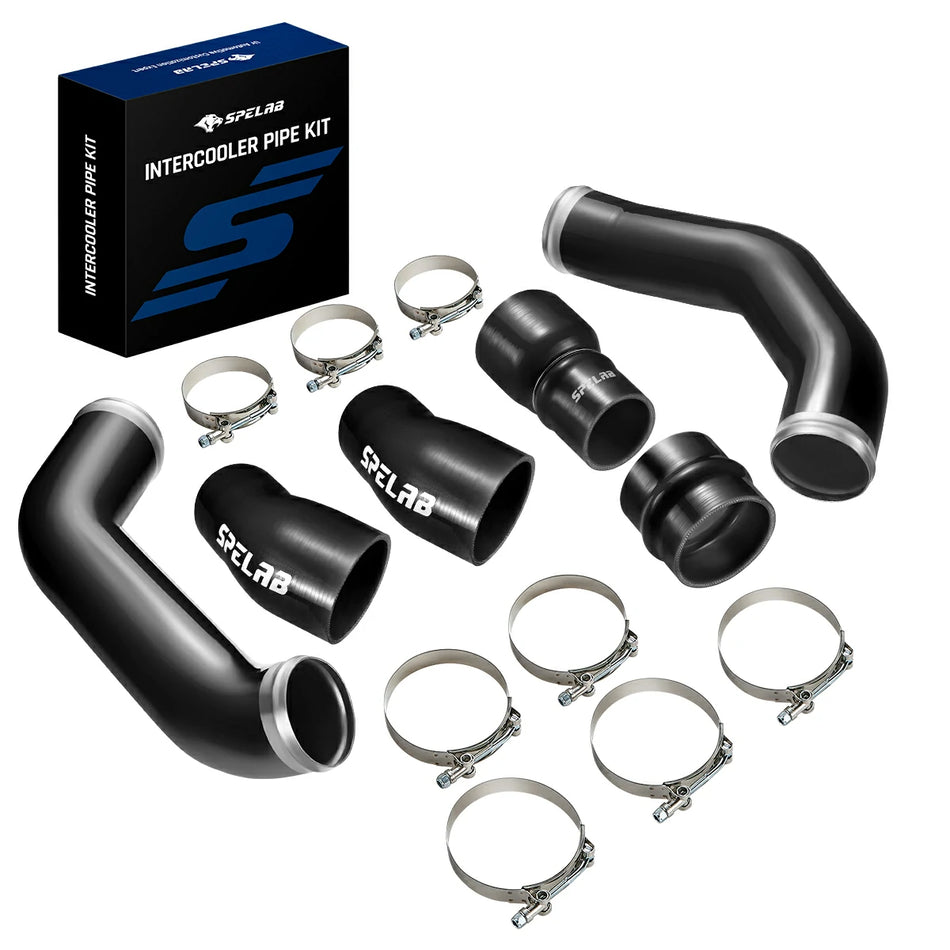
A premium downpipe does not automatically make more horsepower than a cheaper pipe; the extra money should buy measurable improvements in fitment, turbo-outlet geometry, weld quality, catalyst documentation, thermal control, production consistency, or support.
Key Takeaways
The useful comparison is not cheap versus expensive; it is unverified construction versus evidence-backed construction at a total installed cost that fits the vehicle's job.
- A verified value-tier pipe can make more financial sense than either an unverified bargain part or a premium part whose added cost cannot be tied to usable features.
- A catted gasoline downpipe should be judged by catalyst volume, substrate, washcoat, placement, test coverage, and emissions documentation—not CPSI alone.
- A diesel truck downpipe is generally a non-catalyst tube on the Power Stroke, Duramax, and Cummins platforms covered here; its value comes mainly from geometry, clearance, joints, shielding, and durability.
- Cast bellmouths, back-purged welds, accurate V-bands, relaxed flex sections, and traceable fixtures can add real manufacturing cost when the seller can document them.
- Part price matters less after cutting, welding, extra labor, replacement hardware, calibration, rework, and downtime are added to the bill.

Is an Expensive Downpipe Actually Worth It?
An expensive downpipe is worth considering when its higher price buys evidence that matters to the vehicle—such as repeatable bolt-on fitment, a documented catalyst, a smoother turbo transition, better heat control, or lower rework risk—while a properly verified mid-tier pipe may deliver the strongest value for many street and work builds.
Retail prices can range from a few hundred dollars to well into four figures, depending on platform, catalyst, material, testing, included hardware, production volume, and certification path. Price alone does not reveal which costs are built into the part.
A weekend track project may place flow and serviceability ahead of cold-start odor. A daily-driven BMW B58, Volkswagen EA888, Ford EcoBoost, Subaru WRX, or Infiniti VR30DDTT needs a harder look at catalyst performance, OBD behavior, ground clearance, and cabin comfort. A Power Stroke, Duramax, or Cummins truck working a heavy trailer needs firewall clearance, joint alignment, thermal protection, and compatibility with the original aftertreatment system.
| Evidence tier | What the buyer receives | What still needs verification | Best fit |
|---|---|---|---|
| Basic / unverified | Material and diameter claims with broad fitment language | All dimensions, hardware, catalyst details, revision control, and support | Fabrication-capable owners who can inspect and correct the part |
| Verified value tier | Exact application data, material and wall specification, fixture QC, complete hardware, and a clear claim process | Any emissions, no-CEL, power, or coating claim not supported by part-specific evidence | Daily drivers, DIY installs, and work vehicles that need predictable fitment without paying for unused features |
| Documented premium | Value-tier evidence plus features such as a well-designed cast inlet, advanced shielding, platform testing, catalyst validation, or application-specific compliance documents | Whether those added features benefit this vehicle and use case | Emissions-sensitive street builds, repeated high-load use, and vehicles with expensive labor access |
A product belongs in the verified value tier only when the manufacturer can support the claim with dimensions, material information, fixture or test-fit records, complete application data, and usable after-sales procedures. A mid-tier price by itself proves nothing.
Which Manufacturing Details Create Real Value?
The most useful construction differences appear at the turbo outlet, internal weld roots, catalyst transitions, V-bands, brackets, sensor bungs, and minimum internal diameter—not in the most visible straight section.
Investment-Cast Bellmouth vs. Fabricated Inlet
A well-designed investment-cast bellmouth can create a smoother, more repeatable turbo-outlet transition than a poorly fabricated multi-piece inlet, but casting alone does not prove flow, strength, or fitment.
An integrated casting can reduce the number of seams near the hottest end of the pipe and can package a complex outlet shape more consistently. A fabricated inlet can still work well when its pieces are accurately formed, fully supported, smoothly blended, and welded without narrowing the passage.
Inspect a cast inlet for porosity, uneven wall sections, machining quality, concentricity, and the weld where the casting joins the tube. Inspect a fabricated inlet for abrupt steps, pie-cut mismatch, excessive internal bead, incomplete penetration, and a flange that has pulled out of plane during welding.
Back-Purged TIG and Weld Sugaring
Back purging protects the root side of a full-penetration stainless weld from oxygen, reducing heavy oxidation known as sugaring and preserving a cleaner internal surface.
Dark, rough granulation inside a stainless tube can indicate poor backside shielding or excessive heat input. Sugaring can reduce corrosion resistance and joint quality, but its presence does not justify a made-up horsepower-loss percentage or prove that the pipe will fail immediately.
Use a borescope or bright inspection light before installation. Clean, consistent internal roots are stronger evidence than a decorative external fish-scale pattern because the outside bead does not reveal backside oxidation or internal protrusion.
Flange Flatness and V-Band Geometry
A V-band joint can leak even when its nut feels tight because the clamp only works correctly when both mating flanges are concentric, undamaged, and seated without forced alignment.
Check the male and female locating features for dents, weld spatter, uneven machining, and shipping damage. Check a flat flange with a straightedge before the pipe goes under the vehicle. Any visible rocking, daylight, or unexplained gap deserves investigation against the manufacturer's specification.
Stainless T-bolts can gall during dry assembly and produce false torque before the clamp has fully seated. Use only the lubricant, fastener procedure, and torque sequence specified for that joint; a generic torque number is not safe across different clamp diameters, thread pitches, and materials.

Pipe Transitions and Effective Diameter
The smallest internal section often matters more than the largest advertised tube diameter because an offset catalyst, abrupt reducer, heavy weld intrusion, or undersized outlet can become the real restriction.
A 3.5-inch circle has roughly 36% more geometric area than a 3.0-inch circle, while a 4.0-inch circle has roughly 78% more area than a 3.0-inch circle. Those figures describe ideal cross-sectional area only; they do not predict actual flow through bends, welds, catalysts, or necked-down flanges.
Sensor Bungs, Flex Sections, and Brackets
Correct sensor-bung angle and depth protect the sensor tip, connector, and harness while keeping the sensor in the exhaust stream intended by the vehicle's control strategy.
Many gasoline oxygen sensors use an M18 × 1.5 thread, but thread size alone does not confirm correct depth or clocking. Confirm that the harness reaches without stretching, touching a hot housing, or twisting as the engine moves.
A flex section should sit near its neutral position after every flange and bracket is loosely assembled. A flex joint pulled sideways to make a bracket hole line up is already carrying preload before the first cold start.
Our fixture checks treat forced alignment as a failed fitment condition because a pipe that needs a pry bar to reach its mount can transfer engine movement into a weld, flange, or flex section after repeated heat cycles.
| Inspection point | Useful measurement or evidence | Why it matters |
|---|---|---|
| Turbo inlet | Cast or fabricated construction, minimum area, concentricity, and transition profile | Controls the first major change in exhaust direction and area |
| Tube | Outside diameter, minimum inside diameter, wall thickness, and bend condition | Separates the advertised size from the actual flow path |
| Flange | Flatness, locating-lip condition, machining, and thickness | Controls sealing and alignment |
| Weld | Continuity, root oxidation, penetration, undercut, and internal protrusion | Affects durability, corrosion resistance, and local restriction |
| Flex section | Length, liner, braid condition, and installed preload | Controls movement without making the joint a hinge |
| Quality control | Revision number, fixture record, first-pass fitment rate, and warranty data | Shows whether one good sample represents the production batch |
Does 304 Stainless Steel Automatically Mean Premium Quality?
304 stainless steel can provide strong corrosion resistance, but the material label does not prove wall thickness, weld quality, flange stability, dimensional accuracy, or the quality of the finished assembly.
409 stainless steel often develops visible surface discoloration or rust while remaining structurally serviceable, which is one reason it appears in many original-equipment exhaust systems. 304 stainless generally maintains a cleaner appearance and stronger corrosion resistance, but poor welding or bad fitment can still shorten the life of a 304 assembly.
A magnet test is not a complete alloy test because stainless response can change with composition and cold working. Request a material specification when the alloy is part of the price justification, and measure wall thickness on the delivered part instead of assuming that heavier always means stronger.
A listed wall thickness around 1.2–1.5 mm may appear on many fabricated exhaust products, but no single thickness is correct for every diameter, alloy, bend process, bracket layout, or duty cycle. Treat any range as a product specification to verify, not a universal engineering requirement.
Why Does a Gasoline Catalyst Create Such a Large Price Difference?
A gasoline catted downpipe can cost substantially more because catalyst performance depends on substrate volume, cell structure, washcoat, precious-metal formulation, thermal aging, location, and platform-specific validation rather than the stainless shell alone.
CPSI means cells per square inch. A 200-CPSI core may have fewer, larger passages than a 400-CPSI core, but CPSI does not reveal core length, diameter, foil thickness, washcoat loading, precious-metal content, durability, or conversion efficiency.
Modern three-way catalysts become highly efficient only after reaching an operating window that commonly falls around 250–400°C, depending on catalyst formulation and aging.[1] Core placement near the turbo can speed light-off, while heat, vibration, and repeated thermal expansion create a harder durability job.
California's aftermarket-catalyst evaluation procedure uses emissions-performance criteria and application requirements rather than treating cell density as proof of compliance.[2] A seller claiming that “400 cell means street legal” or “200 cell means no CEL” is skipping the evidence that matters.
| Catalyst information | What it proves | What it does not prove |
|---|---|---|
| CPSI | Nominal passage density | Conversion efficiency, durability, legal status, or no-CEL performance |
| Metallic or ceramic substrate | Basic substrate construction | Washcoat quality or precious-metal loading |
| Core dimensions | Approximate substrate volume | Actual emissions conversion after aging |
| Vehicle test data | Performance under the listed test conditions | Automatic coverage for untested engines, model years, or calibrations |
| CARB Executive Order number | Exemption coverage for the listed part and applications | Coverage for a different part number or unlisted vehicle |

Do Expensive Downpipes Make More Horsepower?
Two downpipes with similar effective diameter, catalyst restriction, bend geometry, sealing, and outlet transition may produce similar peak power even when their prices differ substantially.
Log boost target, wastegate duty, ignition correction, lambda, exhaust pressure when available, and torque through the useful rpm range. Repeat the pulls under the same fuel, tune, gear, tire condition, coolant temperature, charge-air temperature, and ambient conditions.
A result smaller than the vehicle's observed run-to-run spread is not proof that one pipe flows better. Report every pull or at least the average and spread instead of publishing one favorable graph from each product.
A larger nominal tube may help a high-output build, but a stock-turbo daily driver may never use the theoretical area. A reduced flange, protruding weld, small catalyst, or restrictive outlet can also erase the advantage of a large center tube.
When Are Ceramic Coating and Thermal Shielding Worth Paying For?
Ceramic coating or application-specific shielding can be worth the added cost when the downpipe runs close to wiring, boots, hoses, the firewall, the floor, or temperature-sensitive components, but the coating label alone does not prove a controlled underhood temperature reduction.
Ask whether the coating covers the inside, outside, or both; which temperature range and preparation process the coating supplier specifies; and whether coating changes the part warranty. Inspect rigid heat shields for clearance because a shield touching the body can trade radiant heat for a new rattle.
Use exhaust wrap only when the pipe manufacturer permits it. Wrap changes how heat and moisture remain in the tube, can conceal cracks, and may affect material life or warranty depending on alloy, coating, road salt, and operating temperature.
A diesel truck working long grades or exhaust-brake events places a different thermal cycle into the turbo-side pipe than a gasoline commuter. Select heat protection around the actual vehicle layout instead of treating ceramic coating as a universal premium badge.
Can Fitment Cost More Than the Price Difference?
A budget downpipe can become the more expensive option when installation requires cutting, rewelding, repeated alignment, replacement sensor wiring, additional hardware, or a second shop visit.
Assemble the system loosely from the turbo toward the rear connection before final tightening. Center the V-band, seat flat flanges evenly, align brackets without prying, confirm the flex section is relaxed, and check clearance around the firewall, heat shields, subframe, transmission, steering components, and driveshaft.
A rigid pipe may look fine on a lift but strike the chassis when the powertrain rolls under load. Leave the clearance required by the platform and inspect witness marks after the first controlled road test.
| Installation problem | Likely added work | Possible result if ignored |
|---|---|---|
| Misaligned V-band | Loosen, recenter, inspect, and reseal | Ticking, soot, fumes, or catalyst-monitor faults |
| Incorrect bracket position | Realignment or fabrication | Flex-joint preload or cracked weld |
| Sensor bung clocked poorly | Harness rerouting or bung correction | Heat damage, stretched wiring, or sensor faults |
| Outlet angle mismatch | Adapter work, cutting, or rewelding | Leak, contact, or crooked exhaust alignment |
| Insufficient chassis clearance | Repositioning or bracket correction | Rattle, cabin boom, or contact under torque |

What Should You Inspect Before Blaming the Downpipe?
A noise, smell, fault code, or weak-boost complaint after installation should be traced to the exact joint or system before the new downpipe, catalyst, turbocharger, or oxygen sensor is condemned.
Perform the first inspection on a cold vehicle. Confirm that every gasket, clamp, reducer, plug, sensor, bracket, and heat shield matches the installation instructions before starting the engine.
| Symptom | Check first | Do not assume |
|---|---|---|
| Fast tick during cold start | Turbo flange, V-band lip, gasket face, sensor bung, and soot trace | The engine has valvetrain damage |
| Hiss or rush under boost | Exhaust joint, charge pipe, intercooler connection, and wastegate area | The downpipe is the only possible leak |
| Metallic rattle | Firewall, heat shield, bracket, subframe, and catalyst substrate | Every new noise is an exhaust leak |
| P0420 or P0430 | Leak location, sensor signals, wiring, catalyst temperature, and monitor data | The catalyst is automatically defective |
| Positive fuel trim after installation | Upstream leak, intake leak, sensor connection, and freeze-frame conditions | A tune should be used to hide the reading |
| Fumes inside the cabin | Turbo-side joints, firewall openings, HVAC intake area, and nearby pipes | Cabin fumes are normal for a modified vehicle |
Stop driving and ventilate the vehicle if exhaust enters the cabin. A small external odor during a gasoline cold start is not the same condition as exhaust reaching the occupants.
Should Gasoline and Diesel Downpipes Be Judged the Same Way?
Gasoline turbo platforms usually place more buying weight on catalyst and OBD behavior, while diesel trucks place more weight on pipe geometry, firewall clearance, turbo-outlet alignment, up-pipe condition, heat control, and compatibility with downstream DOC, DPF, and SCR hardware.
| Platform examples | Approximate model context | Primary buying checks |
|---|---|---|
| BMW N54 downpipe and B58 applications | Selected 2007–2010 N54 335i/135i applications and selected 2016+ B58 “40i” applications | Turbo flange, bank or pipe layout, O2 sensor position, catalyst data, chassis clearance, and ECU strategy |
| Volkswagen/Audi EA888 | Multiple 2009+ generations across GTI, Golf R, Jetta GLI, A3, S3, and related models | Engine generation, AWD/FWD outlet fitment, catalyst location, sensor count, and transmission-area clearance |
| Subaru WRX/STI | EJ turbo applications, 2015–2021 FA20DIT WRX, and 2022+ FA24DIT WRX | Turbo outlet style, wastegate behavior, boost-control compatibility, heat shielding, and tune requirements |
| Ford EcoBoost | Selected 2011+ 3.5L F-150, 2015+ 2.7L F-150, and 2015+ 2.3L Mustang applications | Single- or twin-turbo layout, sensor placement, chassis clearance, calibration, and towing heat load |
| Infiniti VR30DDTT | Selected 2016+ Q50 and 2017–2022 Q60 applications | Upper/lower downpipe definition, twin-bank alignment, catalyst layout, and heat management |
| 6.7L Power Stroke downpipe and earlier Power Stroke applications | 2003–2007 6.0L and 2011+ 6.7L Super Duty platform groups | Engine and chassis generation, turbo connection, firewall clearance, up-pipe condition, shielding, and retained aftertreatment |
| L5P Duramax downpipe and earlier Duramax applications | LB7 through LMM, 2011–2016 LML, and 2017+ L5P platform groups | Engine code, cab/chassis split, V-band alignment, firewall clearance, heat protection, and DOC/DPF/SCR configuration |
| Ram Cummins | Selected 5.9L applications and 2007.5+ 6.7L platform groups | Turbo outlet, transmission and firewall clearance, exhaust-brake use, shielding, and aftertreatment compatibility |
Model-year ranges in this table identify platform families, not guaranteed product fitment. Verify the VIN, build date, engine code, drivetrain, cab/chassis status, emissions label, turbo configuration, and existing exhaust before ordering.
Gasoline Turbo Cars and Trucks
A gasoline daily driver should prioritize verified catalyst behavior, sealing, sensor placement, heat control, and compatibility with the exact ECU and emissions package.
A low-cost catless pipe may have a simple flow path, but removing an original catalyst changes odor, emissions, OBD behavior, inspection readiness, and road-use risk. A high-flow catted pipe adds cost because the catalyst must balance flow, heat, durability, and conversion performance.
Diesel Pickups
The Power Stroke, Duramax, and Cummins turbo downpipes covered here are generally non-catalyst pipes, so their price differences should be judged by bends, transitions, clearance, brackets, joints, material, shielding, and heat-cycle durability rather than gasoline-style CPSI.
DOC, DPF, SCR, NOx sensors, exhaust-temperature sensors, and regeneration strategy sit in the downstream diesel aftertreatment system. A retained-DPF truck may show little tailpipe sound change from a downpipe alone because that aftertreatment remains a strong acoustic restriction.
Inspect old up-pipe bellows and turbo-side hardware when a diesel truck develops a whistle, tick, or exhaust smell after downpipe work. Tight engine-bay access can transfer installation force into an aging pre-turbo component even when the new pipe itself is sealed.
Which Downpipe Tier Fits Your Actual Use?
The correct tier depends on how expensive poor fitment, fumes, repeat labor, compliance trouble, or downtime would be for that vehicle—not on whether the product carries a budget or premium label.
| Real use case | Highest-priority evidence | When a basic pipe may work | When stronger documentation makes sense |
|---|---|---|---|
| Gasoline track project | Effective diameter, welds, flange fit, heat control, and event rules | The owner can inspect, fabricate, and service the system | Repeated heat cycles and track downtime make consistency valuable |
| Gasoline daily driver | Catalyst evidence, OBD behavior, odor, fitment, and road-use status | The exact platform has credible data and the tradeoffs are accepted | Low odor, lower diagnostic risk, and one-time installation matter |
| High-output build | Minimum internal diameter, pressure data, transitions, and weld durability | Measured construction supports the target airflow | Data logging, thermal control, and production consistency are documented |
| DIY weekend install | Complete hardware, clear instructions, and verified fitment | The owner can correct minor hardware or alignment issues safely | Cutting, welding, or repeated disassembly is not available |
| Towing diesel pickup | Firewall clearance, brackets, shielding, heat cycling, turbo joint, and retained emissions compatibility | Fitment is confirmed and downtime carries little cost | The truck cannot afford jobsite or roadside downtime |
| Vehicle under warranty | Written fitment, emissions documentation, installation record, and warranty terms | The owner understands the documented risk and can restore the vehicle correctly | Traceable part numbers, testing, and support are required |
How Should You Calculate the Real Cost?
The real downpipe cost equals the part price plus hardware, labor, calibration, inspection or compliance work, rework, downtime, and any parts damaged during installation.
Total Installed Cost = Part Price + Shipping and Tax + Hardware + Labor + Calibration + Inspection or Compliance Cost + Rework + Downtime
A hypothetical example shows why checkout price can mislead: a $350 pipe requiring five labor hours at $150 per hour plus $100 in added hardware reaches $1,200 installed, while an $800 pipe requiring three labor hours plus $50 in hardware reaches $1,300. The example is not a market-average quote, but it shows how a $450 parts-price gap can shrink to $100 after fitment work.
| Cost item | Option A | Option B | Evidence to use |
|---|---|---|---|
| Part, shipping, and tax | Current quote | Current quote | Delivered price and included components |
| Clamps, gaskets, and bolts | Hardware quote | Hardware quote | Exact installation list |
| Installation | Hours × shop rate | Hours × shop rate | Platform-specific written estimate |
| Cutting or welding | Add if expected | Add if expected | Installer's written scope |
| Calibration | Tuner quote | Tuner quote | Requirements for the exact configuration |
| Rework and downtime | Risk-adjusted estimate | Risk-adjusted estimate | Return policy, labor warranty, and vehicle use |
What Should You Ask the Seller Before Buying?
A useful seller inquiry should identify the vehicle and request measurable answers about fitment, construction, catalyst configuration, included hardware, testing, and claim handling in one message.
Copy-and-paste seller message:
Hello, I am considering this downpipe for my [YEAR] [MAKE] [MODEL] with the [ENGINE CODE / ENGINE SIZE], [TRANSMISSION], [DRIVETRAIN], and [FEDERAL / CALIFORNIA / OTHER] emissions configuration. The vehicle currently has [STOCK OR MODIFIED TURBO], [STOCK OR AFTERMARKET CAT-BACK], and [STOCK ECU OR TUNE DETAILS].
Please confirm the exact part number and whether this configuration was physically test-fitted. Please also confirm the tube material and wall thickness, minimum internal diameter, flange or bellmouth construction, welding and internal back-purge process, included clamps/gaskets/bolts/brackets, O2 sensor locations, and whether cutting or welding is expected.
If the part contains a catalyst, please provide the substrate type, CPSI, core dimensions, test conditions, applicable emissions documentation, and the exact vehicles covered by that documentation. Please do not treat CPSI alone as proof of no-CEL performance or legality.
Please explain the procedure if the pipe arrives with a flange, bracket, sensor bung, or outlet that does not align without force, including who covers return shipping and whether any installation labor is reimbursed. Please identify the current product revision so I can match your answer to the part I will receive.
A seller who cannot answer every laboratory-level question may still offer a usable part, but unclear application data, missing dimensions, changing product revisions, and no fitment-claim process should be priced into the risk.
Does a Higher Price Make a Downpipe Street Legal?
A higher price, catted construction, or absence of a check engine light does not by itself establish federal or state emissions compliance.
The U.S. Environmental Protection Agency states that the Clean Air Act prohibits knowingly removing or rendering emissions controls inoperative and prohibits parts whose principal effect is to bypass or defeat those controls.[3] EPA policy also distinguishes unsupported marketing claims from a documented reasonable basis that a modification will not adversely affect emissions.
California grants Executive Order exemptions to specific aftermarket parts and listed vehicle applications after evaluation; the EO number and application coverage can be checked in CARB's official database.[4] A document covering one part number, engine family, or model year does not automatically cover a visually similar part.
Frequently Asked Questions
These answers cover the remaining construction, catalyst, heat, and emissions questions that a price tag cannot resolve.
Q: What makes a downpipe a verified value-tier product?
A: A verified value-tier downpipe has exact application data, identifiable materials and dimensions, repeatable fixture or test-fit control, complete hardware information, and a written process for resolving fitment problems; price alone cannot place a product in this tier.
Q: Does 304 stainless steel make a downpipe high quality?
A: 304 stainless steel identifies an alloy family, but it does not prove the pipe has correct wall thickness, accurate flanges, back-purged weld roots, smooth transitions, or vehicle-specific fitment.
Q: Is a cast bellmouth always better than a fabricated inlet?
A: A properly designed and machined cast bellmouth can create a smooth, repeatable transition, but a defective casting can still have porosity, uneven walls, poor machining, or bad fitment, while a well-made fabricated inlet can perform reliably.
Q: Is a 200-cell catalyst always worse than a 400-cell catalyst?
A: A 200-CPSI catalyst is not automatically worse because catalyst volume, substrate, washcoat, precious-metal formulation, thermal aging, and placement can matter more than cell density alone.
Q: Can a premium catted downpipe still trigger a check engine light?
A: A premium catted downpipe can still trigger a check engine light when the catalyst does not match the vehicle's monitoring threshold or when a leak, sensor, wiring, installation, or calibration problem affects the catalyst monitor.
Q: Is a ceramic-coated downpipe worth the extra cost?
A: Ceramic coating may be worth paying for when the pipe runs close to temperature-sensitive components, but the buyer should request coating-process details or temperature data instead of assuming every coating produces the same result.
Q: Will an O2 spacer or defouler fix a cheap catted downpipe?
A: An O2 spacer or defouler cannot repair a leak, improve catalyst conversion, prove emissions compliance, or guarantee inspection readiness, and altering sensor behavior can create additional diagnostic and legal problems.
Sources
The external references below are government sources used for catalyst-temperature, emissions-testing, and regulatory statements; construction and buying guidance elsewhere in the article is presented as general engineering practice rather than certified product test data.
- U.S. Department of Energy — Next Generation Three-Way Catalysts for Future, Highly Efficient Gasoline Engines.
- California Air Resources Board — California Evaluation Procedures for New Aftermarket Catalytic Converters.
- U.S. Environmental Protection Agency — Vehicle and Engine Tampering and Aftermarket Defeat Devices Policy.
- California Air Resources Board — Aftermarket, Performance, and Add-On Parts Database.

About the Author
John Lee
Mechanical Engineer | 10+ Years Experience
John has spent the last decade engineering and testing high-performance automotive components. Specializing in drivetrain durability and thermal management across Powerstroke, Cummins, and Duramax applications, he bridges the gap between OEM limitations and aftermarket performance. His philosophy: "Factory parts are just a starting point."