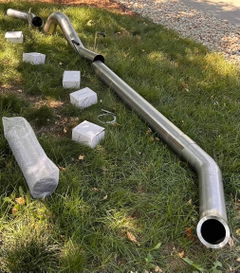
Shop vehicle-specific air intake kits for diesel trucks and select gas vehicles to improve airflow, response, intake sound, and filter serviceability.
What Is an Air Intake Kit?
An air intake kit routes filtered air into the engine through an intake tube, pipe, or manifold. Depending on the product, a kit may include an air filter, heat shield, clamps, couplers, sensor fittings, or intake manifold components.
This collection includes more than full cold air intake kits. It also covers intake pipes, heat-shield kits, replacement filters, intake elbow or bridge kits, and selected 6.7L Cummins intake manifolds with grid heater delete components. Included parts vary, so compare the product description before ordering.
Air Intake Kit Types
Cold air intake kit: normally includes an intake tube and performance air filter for a less restrictive airflow path.
Heat-shield intake kit: adds a barrier around the filter to reduce exposure to radiant engine-bay heat.
Intake pipe or manifold: replaces a specific factory airflow component rather than the entire intake system.
Intake manifold and grid heater delete kit: available for selected 6.7L Cummins applications and should be checked carefully for year and included hardware.
Replacement air filter: services an existing compatible intake system without replacing the complete assembly.
What Can an Air Intake Kit Improve?
A correctly fitted air intake kit can reduce unnecessary inlet restriction, add a more noticeable intake sound, and make filter access easier. Cooler air is denser, but actual intake air temperature depends on filter location, heat shielding, vehicle speed, ambient temperature, and engine-bay airflow.
A stock daily driver may mainly gain easier filter service and stronger intake sound. A tuned diesel truck that tows under load may benefit more from reduced restriction, steadier airflow, and improved turbo response. Results vary with engine condition, calibration, intake temperature, exhaust flow, and supporting upgrades.
Best For
Cummins, Powerstroke, and Duramax owners upgrading a diesel cold air intake kit.
Stock truck owners who want improved intake sound and easier filter service.
Tuned or modified diesel trucks that need additional airflow support under load.
Drivers comparing open-filter, heat-shield, intake pipe, and manifold-style upgrades.
Gas truck and performance car owners replacing restrictive or aging intake parts.
DIY installers looking for vehicle-specific parts instead of universal intake tubing.
Check the Full Airflow System First
Weak acceleration, low boost, unusual intake noise, or a check engine light does not automatically mean the factory intake needs replacement. Inspect the air filter, MAF or intake temperature sensor, clamps, couplers, intercooler boots, charge pipes, turbo inlet, and vacuum or boost connections first.
An intake upgrade cannot repair a damaged turbocharger, failed sensor, boost leak, or excessive engine wear. Correct diagnosis protects the new parts and helps avoid spending money on an upgrade that will not address the original problem.
How to Choose the Right Air Intake Kit
Confirm fitment: match the year, make, model, engine size, and engine platform.
Identify the product type: determine whether you need a full cold air intake, intake pipe, manifold, heat shield, or replacement filter.
Check sensor compatibility: verify MAF and intake temperature sensor locations, fittings, and tube diameter.
Review included hardware: check for filters, clamps, couplers, brackets, shields, gaskets, and sensor fittings.
Consider driving conditions: towing, dusty roads, off-road use, heavy rain, and jobsite driving affect filter and heat-shield choices.
Review tuning requirements: most stock-style kits are designed for factory calibration, but larger tubes or modified sensor housings may require tuning.
Air Intake Kit Applications
The following table summarizes key applications represented in this collection. Product availability and fitment can change, so confirm the individual product page before purchasing.
Vehicle Platform
Engine
Applicable Years
Product Types
Dodge Ram 2500/3500
5.9L Cummins Diesel
1994-2002
Cold air intake and heat-shield kits
Dodge Ram 2500/3500
5.9L Cummins Diesel
2003-2007
Cold air intake kits
Dodge Ram 2500/3500/4500/5500
6.7L Cummins Diesel
2007.5-2012
Cold air intake kits
Dodge Ram 2500/3500
6.7L Cummins Diesel
2007-2018
Intake manifolds and grid heater delete components
Dodge Ram 1500/2500
4.7L/5.7L V8
2002-2008
Air intake and dual intake kits
Dodge Ram 2500/3500
6.4L HEMI V8
2014-2018
Cold air intake kits
Ford F-250/F-350
7.3L Powerstroke Diesel
1999-2003
Cold air intake kits
Ford Super Duty
6.0L Powerstroke Diesel
2003-2007
4-inch cold air intake kits
Ford F-250/F-350/F-450
6.4L Powerstroke Diesel
2008-2010
Cold air intake and heat-shield kits
Ford F-250/F-350/F-450/F-550
6.7L Powerstroke Diesel
2011-2016
Cold air intake kits
Ford F-250/F-350/F-450/F-550
6.7L Powerstroke Diesel
2017-2019
Cold air intake kits
Ford F-150
3.5L V6 EcoBoost
2012-2014
Cold air intake kits
Chevrolet/GMC Silverado and Sierra
6.6L Duramax LB7
2001-2004
Cold air intake kits
Chevrolet/GMC Silverado and Sierra
6.6L Duramax LLY
2004-2005
Cold air intake kits
Chevrolet/GMC Silverado and Sierra
6.6L Duramax LML
2011-2015
Intake elbow and bridge kits
Chevrolet/GMC trucks
4.8L/5.3L/6.0L/6.2L V8
2009-2013
Cold air intake kits
Dodge Charger, Challenger, Magnum and Chrysler 300C
5.7L/6.1L HEMI V8
2005-2010
Cold air intake kits
Nissan 370Z and Infiniti G37
3.7L V6
2008-2019
Cold air intake kits
Volkswagen Golf/Jetta
2.8L VR6
1999-2004
Cold air intake kits
Honda Accord
2.2L/2.3L
1998-2002
Air intake kits
Materials and Finishes
Materials and surface treatments vary by product rather than applying to every kit in the collection. Available constructions may include:
Aluminum alloy with a black coating.
Stainless steel with a polished finish.
Aluminum alloy with a powder-coated finish.
Review the individual product specifications for tube material, finish, filter type, included hardware, and care requirements.
Installation and Maintenance
Before installation, inspect the factory intake path and confirm that all sensors, clamps, couplers, brackets, and breather connections have a matching location on the new kit. Keep debris out of the turbo inlet or throttle body and check for air leaks before driving.
Follow the product-specific directions or visit the SPELAB installation instructions. Inspect the filter regularly, especially after dusty, off-road, towing, or jobsite use.
Intake modifications may affect warranty coverage, emissions inspection, sensor calibration, or local compliance depending on the vehicle and product. Customers in the United States and Canada should confirm fitment and local requirements before installation.
There is no fixed horsepower gain for every vehicle. A stock truck may see only a modest change, while a tuned engine with a restrictive factory intake may respond more noticeably. Results depend on intake temperature, tube design, engine condition, tuning, and supporting airflow upgrades.
It may produce a small change when it replaces a restrictive or poorly maintained factory intake, but fuel economy depends more heavily on driving style, towing load, gearing, tuning, tire size, and engine condition. It should not be treated as a guaranteed MPG upgrade.
Most direct-fit, stock-style intake kits are intended to work with the factory calibration. Tuning may be needed when a kit significantly changes tube diameter, MAF sensor housing size, sensor placement, or airflow beyond the factory calibration range.
It can make sense for owners who want more intake sound, easier filter access, or a reusable filter. A mostly stock daily driver may notice less performance change than a tuned truck that tows or operates under sustained load.
A properly matched and sealed kit should not normally cause a warning light. Loose clamps, air leaks after the MAF sensor, incorrect sensor placement, disconnected wiring, or an incompatible tube diameter can trigger airflow-related codes.
Oiled filters can be cleaned and reused but must be re-oiled correctly; excess oil may contaminate some MAF sensors. Dry filters are simpler to service and avoid re-oiling mistakes. Choose according to the kit requirements, driving environment, and maintenance preference.
An exposed filter can encounter more water, dirt, and engine-bay debris than a sealed factory airbox. Avoid deep water and direct water spray, keep splash guards in place, and inspect the filter after heavy rain, off-road use, or engine-bay cleaning.
Inspect the filter at every oil change. Many filters may need service around 15,000-20,000 miles and replacement between 50,000-100,000 miles, but the product instructions take priority. Dusty roads, construction sites, towing, and off-road use can shorten the interval.
Jordan Sidney
Rear diff cover.
The product was delivered sooner than expected and the product is very well made and added a nice touch to my truck.
Differential Cover For Ford 9.75″ 12 Bolts Rear Axle | SPELAB
Chase Lee
Chase
Surprisingly fast shipping and decent quality with half of big brands price... will come back!
Cooling System Refresh Kit For 2011-2016 LML Chevrolet/GMC 2500HD 3500HD 6.6L Duramax | SPELAB
Johnatan Ruiz
Good Quality and Great Value
I was already planning to replace the radiator and coolant tube, so getting the reservoir included made this a great value. Parts arrived well packaged and everything looked good out of the box.
Cooling System Refresh Kit For 2013-2018 6.7L Dodge Ram 2500/3500 | SPELAB
Brandon
Looks and Feels More Durable
The aluminum upper coolant tube is a huge improvement over the factory plastic piece. The whole kit looks great under the hood and everything went together without any major issues.
Cooling System Refresh Kit For 2011-2019 6.7L Ford Powerstroke | SPELAB
Anonymous
Sounds great, had all the hardware good quality metal and was easy to install only con was had to take off the spare tire to install.