Author: John Lee
Mechanical Engineer | 10+ Years Drivetrain Experience
I’ve spent the last decade designing and testing high-load automotive components. Factory parts are rarely “bad,” but they are built to cost compromises—usually using thin stamped steel that traps heat. This guide explains the engineering behind upgrading to A380 aluminum covers and how features like internal flow channels protect your F-150's 9.75" axle.
TL;DR
To choose the correct differential cover for Ford F-150, identify the rear axle model (8.8, Super 8.8, or 9.75). For 2015+ models, identify the axle by the door jamb code (e.g., L9), as bolt counts can be misleading. From an engineering standpoint, upgrading to a finned aluminum cover is recommended for towing and longevity. High-quality covers utilize A380 aluminum alloy for heat dissipation and feature internal diversion grooves to assist gear lubrication.
1. Quick Reference by Model Year & Generation
Ford has changed axle suppliers and specifications over the years. Find your year below to narrow down your search.
2015 - 2021+ F-150 (13th & 14th Gen)
- Common Axles: Super 8.8" (12-Bolt) OR 9.75" (12-Bolt).
- The Confusion: Cannot identify by bolt count alone. See section 3.
- Typical Usage: 2.7L EcoBoost usually Super 8.8; 3.5L EcoBoost and 5.0L V8 may use Super 8.8 or 9.75.
2009 - 2014 F-150 (12th Gen)
- Common Axles: 8.8" (10-Bolt) OR 9.75" (12-Bolt).
- Identification: 10 bolts = 8.8; 12 bolts = 9.75.
2004 - 2008 F-150 (11th Gen)
- Common Axles: 8.8" (10-Bolt) OR 9.75" (12-Bolt).
1997 - 2003 F-150 (10th Gen)
- Common Axles: 8.8" (10-Bolt) OR 9.75" (12-Bolt).
2. The "Bolt Count Trap": 8.8 vs 9.75 Identification
Housing geometry, not just bolt count, dictates which cover seals correctly.
Both Super 8.8 and 9.75 have 12 bolts, but bolt spacing and housing shape differ. Covers are NOT interchangeable.
Visual Identification Guide
- Standard 8.8 (Pre-2015): Square-ish shape, rounded corners, 10 bolts.
- Super 8.8 (2015+): Angular, hexagonal shape, 12 bolts.
- 9.75 (All Years): Larger, "pear" shape, 12 bolts.
3. 100% Accurate Method: Door Jamb Axle Codes
Check the white certification sticker on the driver’s door jamb. Match your code:
| Axle Code | Ratio & Type | Likely Axle Housing |
|---|---|---|
| 15, 19 | 3.15 / 3.55 Non-LSD | Usually 8.8 / Super 8.8 |
| 26, 27 | 3.73 / 3.31 Non-LSD | Usually 9.75 (Heavy Payload) |
| H9 | 3.55 Limited Slip | Commonly 9.75 (Older) or Super 8.8 (Newer) |
| L9 | 3.55 Electronic Locking | Check Engine: Super 8.8 (2.7L/Base) OR 9.75 (3.5L/V8) |
| L6 | 3.73 Electronic Locking | 9.75 (Common on FX4 / Off-Road) |
4. Rear Differential Covers: Engineering Differences That Matter
Many truck owners view a differential cover as a cosmetic upgrade. However, for the Ford 9.75" axle—which handles the bulk of the F-150's towing load—the cover is a critical component for thermal management.
1. Material Science: Stamped Steel vs. Aluminum
The OEM cover is stamped steel. Steel is durable, but it is a poor thermal conductor. It acts like an insulator, trapping heat inside the housing.
- The Upgrade: Look for covers made from Aluminum Alloy. This specific alloy is used in aerospace and automotive casting for its superior thermal conductivity. It pulls heat away from the gear oil and rejects it into the atmosphere.

2. The "Radiator Effect": External Cooling Fins
Simply being aluminum isn't enough. Effective engineering requires surface area. High-performance covers feature deep external cooling fins. As your truck moves, air passes through these fins, actively cooling the oil similar to how a radiator cools your engine.
3. Internal Fluid Dynamics (The Hidden Feature)
This is what separates "dress-up parts" from "performance parts." The ring gear in your differential spins at high speed, flinging oil everywhere.
- The Problem: Without guidance, this oil can foam up or fail to reach critical bearings.
- The Engineering Solution: Advanced covers feature Internal Diversion Grooves (Flow Channels). These channels align with the rotation of the gear to direct fluid flow back toward the pinion and axle bearings, ensuring consistent lubrication even under heavy load.

4. Maintenance & Visibility
Traditional covers require prying off the seal to check fluid condition. Modern engineering solves this with:
- Magnetic Drain Plugs: To capture metallic wear particles before they damage bearings.
- Sight Glasses with Floating Balls: The "floating ball" design is crucial because it allows you to see the oil level clearly, even if the glass gets slightly stained over years of use.
If you tow heavy loads or drive off-road, replacing the stock steel cover with a F150 finned aluminum rear differential cover is one of the most cost-effective durability upgrades you can make. The drop in fluid temperature directly correlates to longer gear and seal life.
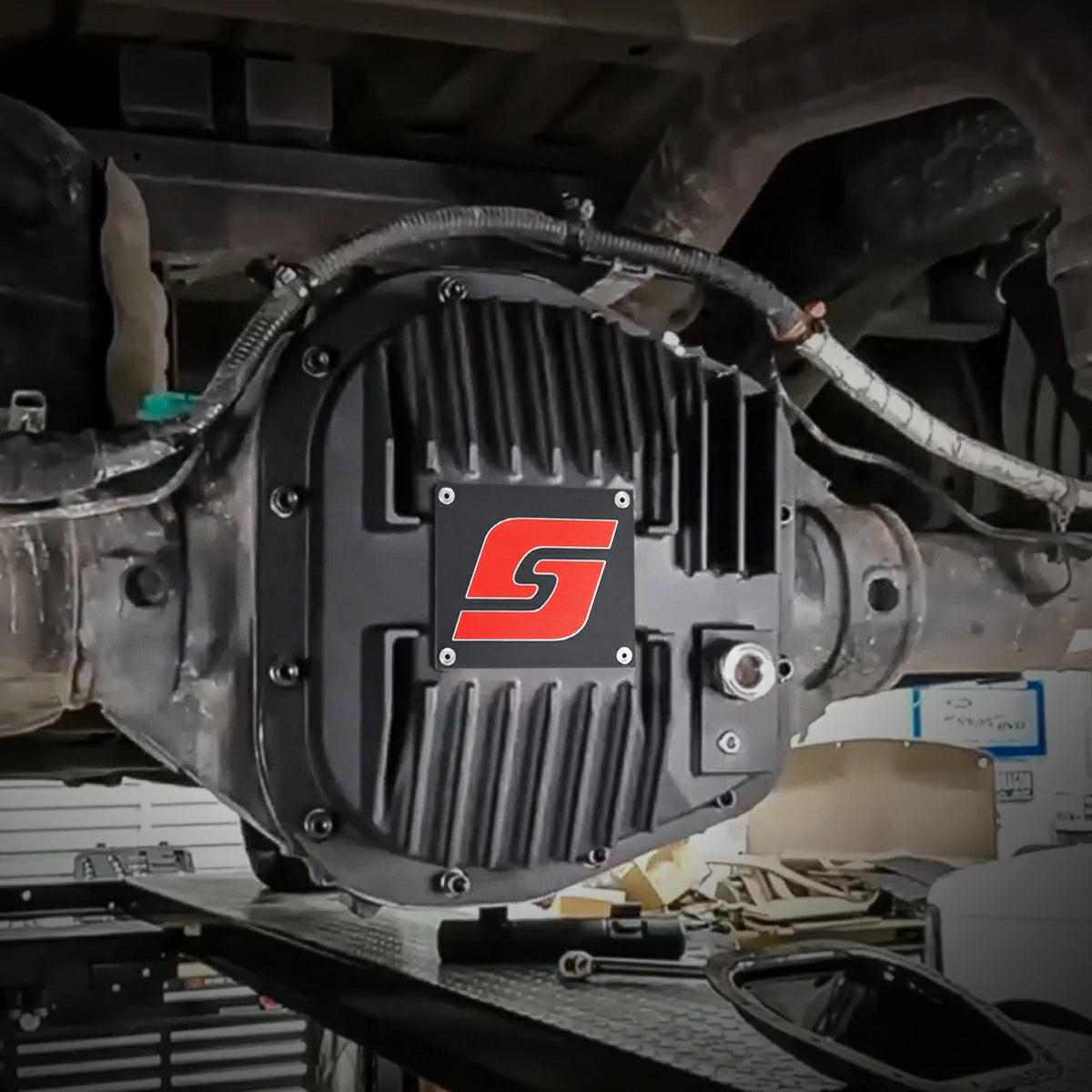
Enhanced Cooling Performance
Upgrade Your F150 rear differential cover5. Front Differential Covers (4×4 Only)
For 4×4 owners, the front differential is an independent suspension unit (IFS). The cover is often difficult to access due to the steering rack.
- 1997-2014: Ford 8.8" IFS (Reverse Cut) - 10 Bolt Cover.
- 2015-Present: Ford Super 8.8" IFS - 10 Bolt Cover.
6. OEM vs. Engineered Covers: The Final Verdict
| Feature | OEM Cover (Stamped Steel) | Performance Cover (Aluminum) |
|---|---|---|
| Material | Thin Steel (Heat Trap) | Aluminum Alloy (Heat Conductor) |
| Cooling | Passive / None | Active Dissipation via External Fins |
| Lubrication | Random Splash | Internal Diversion Grooves (Guided Flow) |
| Oil Monitoring | Remove Fill Plug | Sight Glass with Floating Ball |
| Fluid Service | Messy (Must remove cover) | Magnetic Drain Plug |
| Corrosion | Painted (Rusts over time) | Powder Coated / Rust Resistant |
Final Installation Tip
Most leaks are due to installation errors. Always check the torque specs in your manual for your specific year and ensure mating surfaces are clean before installing O-ring style covers.
Frequently Asked Questions
Q: How do I visually tell the difference between a Super 8.8 and a 9.75 rear axle on a 2015+ F-150?
A: Since both axles have 12 bolts, you must look at the shape of the housing. The Super 8.8" has a flat top and bottom with angular sides, resembling a stop sign or hexagon. The 9.75" is larger and has a distinct "pear" shape that is wider on one side and more rounded. The covers are not interchangeable.
Q: Why is an aluminum differential cover better than the stock steel one?
A: The stock cover is made of thin stamped steel, which acts as an insulator and traps heat inside the differential. Upgraded covers made from materials like A380 aluminum alloy are superior thermal conductors. When combined with external cooling fins, they actively dissipate heat away from the gear oil, which is critical for preventing fluid breakdown during towing.
Q: What is the purpose of internal diversion grooves in a differential cover?
A: Internal diversion grooves (or flow channels) are engineered pathways machined into the inside of the cover. They catch oil flung by the ring gear and direct it specifically toward the pinion bearing and axle tubes. This ensures continuous lubrication to critical components and helps prevent oil foaming at high speeds.
Q: My F-150 is 2WD; do I need a front differential cover?
A: No. Two-wheel drive (2WD) F-150s utilize a solid beam or independent front suspension without a differential unit. You only need to purchase a rear differential cover. Front covers are only applicable to 4×4 models which have an Independent Front Suspension (IFS) differential.
Q: Do I need to use a gasket with an upgraded differential cover?
A: It depends on the cover design. High-quality aftermarket covers often feature a machined groove for a reusable O-ring or come with a high-performance gasket, eliminating the need for messy RTV silicone. However, always check the specific installation instructions for your chosen cover to ensure a leak-free seal.
Q: How does a magnetic drain plug help extend the life of my differential?
A: Gears naturally produce microscopic metal particles as they wear. A magnetic drain plug attracts and holds these ferrous shavings, preventing them from circulating in the oil and damaging bearings or seals. It also allows you to inspect the "fuzz" on the magnet during oil changes to catch potential internal issues early.