
Updated on Sep 14, 2026.
A differential cover upgrade makes sense when the factory cover is damaged, service access is poor, or an axle-specific design solves a real towing or trail-use problem. A sound, leak-free factory cover does not need replacing just because an aftermarket cover promises cooler oil or more horsepower.
Key Takeaways
Buy a differential cover for a verified axle and a specific service or protection need, not for an unverified temperature claim.
- Reseal or replace a bent, corroded, or leaking cover before treating a cover upgrade as a performance mod.
- Confirm the axle model, bolt count, housing shape, and underbody clearance; a truck's year and badge alone do not establish fitment.
- Aluminum, steel, cast construction, and billet construction have different trade-offs, but material alone does not determine oil temperature.
- Extra cover capacity, a higher fill port, and load bolts require the correct axle-specific installation procedure.
- A cover cannot repair worn bearings, incorrect gear oil, an overloaded axle, or an existing ring-and-pinion problem.
What the Factory Cover Already Does
A factory differential cover seals the axle housing and protects the gear oil from contamination; a cover in good condition can do that job for years without an upgrade.
Stamped-steel covers can bend at the flange after an impact or careless removal, but steel thickness and durability vary by axle. A leak at the cover is not automatically proof that the metal is too thin. Old sealant, a damaged gasket surface, loose fasteners, and a blocked axle vent can also put oil on the housing.
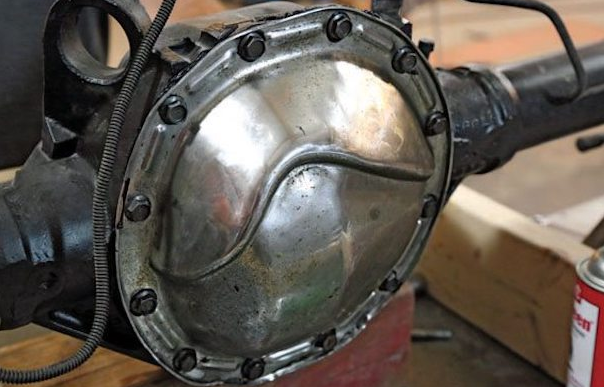
Clean the housing first, then trace fresh oil. If oil starts above the cover, check the pinion seal, axle seals, and vent before buying another cover.
When an Upgrade Makes Sense
An upgraded cover earns its place when it addresses a problem the stock cover does not: damage resistance, easier fluid service, or a documented axle-specific feature.
| Owner's situation | First decision | What a new cover can and cannot do |
|---|---|---|
| Daily driver; dry, undamaged factory cover | Keep the factory cover and maintain the specified gear oil. | Appearance or easier service may justify an upgrade; a power or cooling gain is not assured. |
| Oil leak after a cover impact or removal | Inspect flange flatness, housing threads, gasket surface, and axle vent. | A sound replacement may restore sealing; it will not fix a pinion or axle-seal leak. |
| Frequent towing near the truck's rated limits | Check axle condition, lubricant specification, load, and service interval first. | A suitable cover may improve service access or protection; it does not raise the vehicle's tow or payload rating. |
| Trail driving with rear-axle contact | Check cover profile, ground clearance, and contact with suspension parts. | A stronger design may resist damage; a protruding cover can create a new clearance problem. |
Compare differential covers only after identifying the axle and the reason the factory part falls short.
Cooling and Oil Capacity: What the Numbers Do Not Prove
A differential cover's material, shape, and oil capacity can change heat transfer, but no cover guarantees a specific gear-oil temperature drop on every truck.
A blanket claim of 20–30°F cooler oil needs a controlled comparison: the same axle, oil, load, speed, route, ambient temperature, sensor location, and warm-up state. A thicker aluminum cover can move heat through its wall differently from stamped steel, while its surface area and airflow also affect the result. Those variables matter more than the word “aluminum” on a product page.
Extra oil capacity is not automatically better. A higher cover fill hole can lead to overfilling if the owner treats that hole as the factory level reference. Excess oil may churn or escape through the vent, depending on axle design and operating conditions. Follow the axle maker's specified lubricant, quantity, and level-check procedure.
Choose Construction for the Job
Choose a cover by verified fitment, sealing design, clearance, and intended use; neither billet aluminum nor cast aluminum is automatically the strongest or coolest choice.
Stamped steel is often inexpensive and easy to replace. Cast or machined aluminum may add stiffness, service features, or a different cover shape, depending on the design. Billet describes how a part is manufactured, not a guaranteed temperature or leak result. The steel-versus-aluminum trade-offs matter most when corrosion exposure, impact risk, service access, and available clearance are known.
Do not assume a painted or powder-coated cover loses all cooling ability. Coating thickness, exposed area, airflow, and operating conditions all matter. Keep coating and sealant off the gasket face, threaded holes, and any surface the installation instructions require to remain bare.
Verify the Axle Before Ordering
Match the cover to the axle assembly, not merely the truck's make, model, or model year.
Check the axle tag or identification marks, bolt count, cover outline, fill-plug arrangement, and nearby steering or suspension clearance. That axle identification step matters because one vehicle name can span several axle configurations.
| Verified axle | Cover to evaluate | Final check |
|---|---|---|
| Ford 8.8-inch, 10-bolt rear axle | Ford 8.8-inch cover | Confirm housing shape, vehicle clearance, and the exact kit contents. |
| AAM 11.5/11.8-inch, 14-bolt rear axle | AAM 11.5/11.8-inch 14-bolt rear cover | Confirm the axle and selected variant; the listed GM and Ram year ranges do not replace an axle check. |
| Dana 44, 10-bolt rear axle | Dana 44 10-bolt rear cover | Confirm rear-axle configuration, cover shape, and available clearance before ordering. |
Ford 8.8: A Practical Example
A Ford 8.8-inch 10-bolt cover is a fitment decision first and an appearance or service upgrade second.
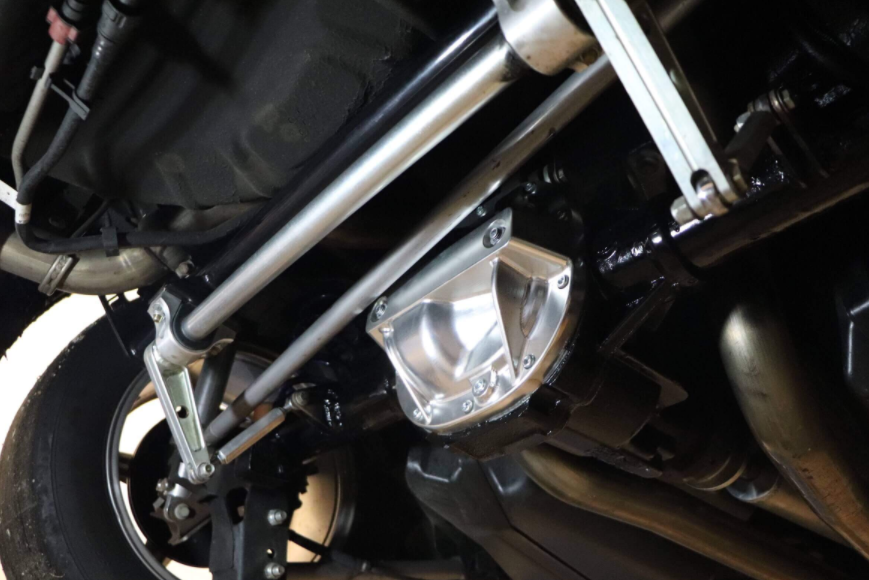
The current Ford 8.8 listing describes an aluminum-alloy cover and lists installation bolts and washers. Do not assume every color or variant is billet, includes a gasket, or has functional load bolts without checking the selected kit and its instructions.
Install and Fill It Correctly
A careful installation depends on clean mating surfaces, the specified seal method and fasteners, and the axle maker's oil-level procedure.
- Support the vehicle safely, drain the axle, and inspect the old cover, housing flange, threads, and vent.
- Remove old gasket material without gouging the housing. Keep debris out of the axle.
- Use the cover or axle maker's specified gasket or sealant procedure; the gasket-or-RTV choice depends on the mating surfaces and kit instructions.
- Install the supplied bolts and washers where specified. Tighten in the prescribed sequence to the correct torque for that particular cover and axle.
- Fill with the axle maker's specified gear oil and any required additive. Use the factory level reference when available; do not fill to a higher aftermarket port simply because oil has not reached it.
- Check for leaks after the first drive and follow the kit's inspection or re-torque instructions, if supplied.
If the cover includes load bolts, set them only by that kit's instructions. Load-bolt adjustment is not the same as cover-bolt torque, and excessive preload can damage the assembly.
Frequently Asked Questions
The most useful questions are whether the cover fits the axle, solves a real problem, and can be installed without changing the factory oil level or load limits.
Q: Will a differential cover add horsepower?
A: A differential cover does not directly add engine horsepower. A cover may provide protection or easier service, but a measurable power gain should not be assumed.
Q: Will an aluminum cover lower gear-oil temperature?
A: An aluminum cover can change heat transfer, but any temperature difference depends on cover geometry, oil volume, airflow, load, ambient conditions, and test method. No universal 20–30°F reduction is established by material alone.
Q: Can I fill the axle to the new cover's fill hole?
A: Not unless the axle and cover instructions identify that hole as the correct level reference. A raised aftermarket fill hole can overfill some axles; use the specified quantity and factory level-check method when available.
Q: Do load bolts make every differential stronger?
A: Load bolts can support bearing caps in a cover designed for that axle, but benefit and adjustment are design-specific. Do not improvise a preload or assume that every aluminum cover includes load bolts.
Q: Is a gasket always required?
A: No. Some covers use a gasket, while other installations specify RTV or another seal method. Follow the selected cover and axle instructions rather than stacking seal methods without approval.
Q: Does a thicker cover increase towing capacity?
A: No. A differential cover does not change the vehicle manufacturer's tow rating, payload rating, axle rating, or required maintenance schedule.
Q: How do I know whether a cover fits my truck?
A: Identify the installed axle, confirm bolt count and housing shape, then check clearance and the selected product variant. A matching model year alone is not enough.

About the Author
John Lee
Mechanical Engineer | 10+ Years Experience
John has spent the last decade engineering and testing high-performance automotive components. Specializing in drivetrain durability and thermal management across Powerstroke, Cummins, and Duramax applications, he bridges the gap between OEM limitations and aftermarket performance. His philosophy: "Factory parts are just a starting point."





1 comment
I purchased a rear differential cover for a 2005 Ram 2500 rwd. It would be nice if I had installation instructions such as, reusing the stock gasket, what do I coat it with? Using the supplied gasket, what do I coat that with? What is the recommended torque? 29 ft lbs stock seems high for aluminum. Is there a recommended torque pattern?