Updated on August 11, 2026.
Turbocharged engines make power by compressing more air into the engine. The problem is simple: compressed air gets hot. Hot air is less dense, harder to control, and more likely to cause power fade under load. That is where an intercooler kit becomes important.
Quick answer: An intercooler kit helps a turbo engine by cooling compressed charge air before it enters the intake manifold. Cooler air is denser, which can help the engine maintain power, reduce heat soak, stabilize boost, and protect charge-air components under load. On diesel trucks, a better intercooler and pipe kit can also help control intake air temperature, slow EGT rise, reduce boost leaks, and improve towing consistency.
This guide explains what an intercooler kit does, when it is worth upgrading, how to choose the right size, and what to check during installation.

How a Turbocharger and Intercooler Work Together
A turbocharger uses exhaust energy to compress incoming air. That compressed air allows the engine to burn fuel more effectively and produce more torque. But compression also raises air temperature. If that heat is not managed, the engine may lose power, intake air temperature may climb, and the ECU may reduce output to protect the system.
An intercooler works as a heat exchanger. It removes heat from the compressed air before the air reaches the intake manifold. The result is cooler, denser charge air with more oxygen available for combustion.
For basic upgrades, compare performance intercoolers by platform, core style, boost level, and towing or racing use case.
What Does an Intercooler Kit Include?
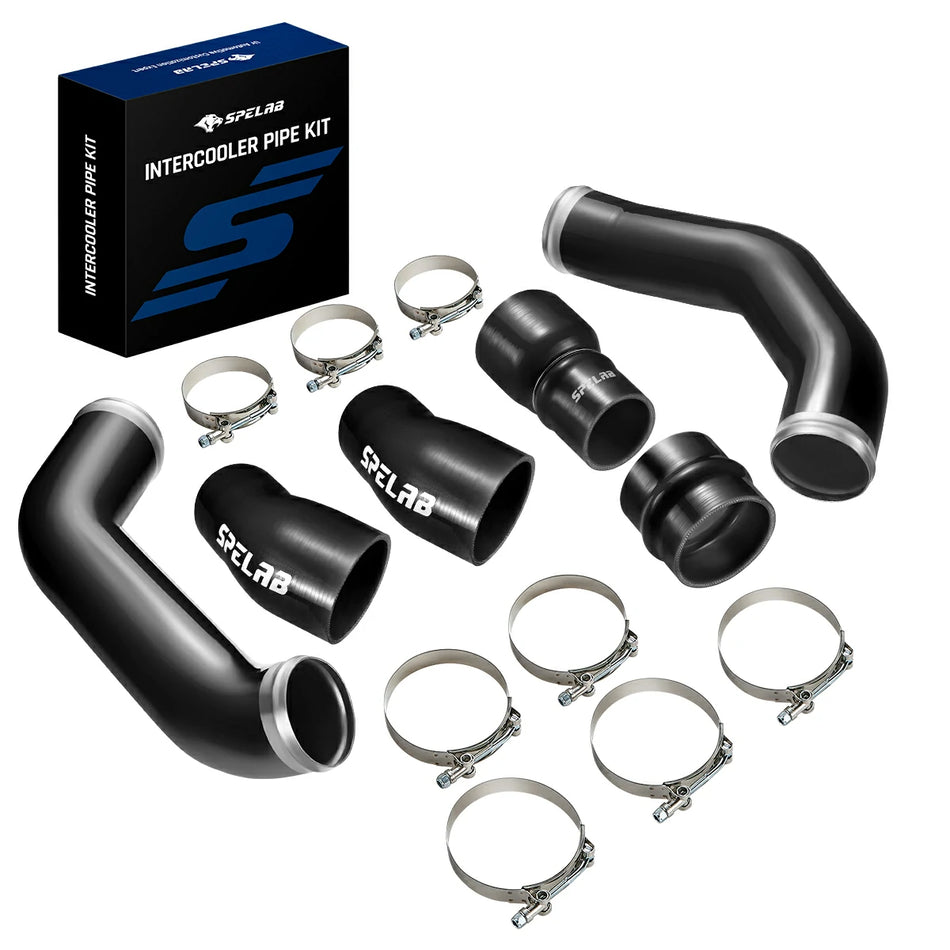
An intercooler kit is more than just the core. Depending on the vehicle and kit design, it may include the intercooler core, hot-side pipe, cold-side pipe, silicone boots, clamps, brackets, couplers, and hardware.
| Component | What It Does | Why It Matters |
|---|---|---|
| Intercooler core | Cools compressed air from the turbocharger. | Controls intake temperature and heat soak. |
| Hot-side pipe | Moves hot compressed air from the turbo to the intercooler. | Must handle heat, boost pressure, and vibration. |
| Cold-side pipe | Moves cooled charge air from the intercooler to the intake. | Supports stable airflow into the engine. |
| Silicone boots | Connect pipes and absorb engine movement. | Weak boots can swell, slip, or blow off under boost. |
| T-bolt clamps | Hold couplers and boots under pressure. | Important for preventing boost leaks. |
| Mounting hardware | Secures the intercooler and pipes. | Poor mounting can cause rubbing, vibration, or leaks. |
If your issue is mainly cracked pipes, weak boots, or hissing under boost, inspect the intercooler pipe kit side of the system before replacing only the core.
Main Benefits of an Intercooler Kit
A good intercooler kit improves the charge-air system as a whole. The biggest benefit is not always a peak horsepower number. For many turbocharged vehicles, the real value is consistency: lower intake air temperature, reduced heat soak, and fewer boost leaks under real driving conditions.
| Benefit | What It Means | Best Use Case |
|---|---|---|
| Lower intake air temperature | Cools compressed turbo air before it enters the engine. | Hot climates, towing, repeated pulls, tuned engines. |
| Denser charge air | Cooler air carries more mass per volume at a given manifold pressure. | Better combustion consistency; actual torque still depends on fueling, calibration, and protection strategy. |
| Less heat soak | The engine is less likely to lose power after long load periods. | Diesel towing, hill climbs, racing, heavy traffic. |
| Reduced boost leaks | Sealed pipes, boots, and clamps hold boost pressure instead of leaking it; a lower-pressure-drop core also reduces how hard the turbo has to work to hit target boost. | High-boost trucks and tuned turbo builds. |
| Slower EGT rise tendency | Under comparable load, speed, fueling, and ambient conditions, cooler charge air can help slow exhaust temperature rise. If fueling increases to use the extra air, EGT may not drop at all - it depends on tuning, not the intercooler alone. | Powerstroke, Cummins, and Duramax towing setups. |
| Improved durability | Aluminum pipes and stronger cores can replace aging factory plastic parts. | High-mileage trucks and performance builds. |

Does an Intercooler Kit Add Horsepower?
An intercooler kit does not create horsepower by itself in the same way a turbocharger, fuel system upgrade, or tune can. Instead, it helps the engine maintain power by controlling heat. On gas turbo engines, high intake air temperature typically pushes the ECU to pull ignition timing to protect against knock. On diesel engines, there's no spark timing to protect - instead, high IAT and EGT more commonly trigger fueling limits, boost/VGT target adjustments, torque request reductions, or thermal protection strategies depending on the platform and calibration. Either way, the result feels similar to the driver: reduced power under sustained heat.
On a stock daily driver, the improvement may feel like better consistency instead of a dramatic peak power gain. On a tuned diesel truck or high-boost turbo engine, the difference can be more noticeable because the factory charge-air system is under greater heat and pressure load.
The most realistic expectation is this: a properly matched intercooler kit can help the engine hold power longer, recover faster after heat soak, and support future tuning more safely.
How to Choose the Right Intercooler Kit
The right intercooler kit is not always the largest kit available. It should match the vehicle platform, turbo setup, boost level, cooling stack, and installation space.
| Factor | What to Check | Why It Matters |
|---|---|---|
| Vehicle compatibility | Year, make, model, engine, trim, and turbo layout. | A wrong-fit kit can cause leaks, rubbing, or installation issues. |
| Core size | Frontal area, thickness, fin density, and pressure drop. | Oversized cores can hurt response or radiator airflow; undersized cores may heat soak. |
| Material | Aluminum core, cast or welded end tanks, pipe wall thickness. | Durability matters under high boost and vibration. |
| Piping design | Mandrel bends, bead rolls, coupler quality, and clamp placement. | Smooth and sealed airflow reduces pressure loss and boot blow-off. |
| Cooling stack balance | Radiator airflow, fan shroud, condenser spacing, and ducting. | A big intercooler should not create overheating problems. |
| Installation complexity | Direct-fit vs. cutting, trimming, fabrication, or tuning support. | Some kits are bolt-on; others require more labor and inspection. |
Platform-Specific Intercooler Kit Considerations
Different turbo platforms fail in different ways. A diesel truck used for towing has different charge-air needs than a small turbo gasoline car or weekend track build. Year and engine coverage on any specific kit varies and changes over time - confirm current fitment on the product listing itself rather than assuming a collection covers every model year.
| Platform | Common Issue | Upgrade Focus |
|---|---|---|
| Ford Powerstroke | Heat soak, aging pipes, boot failures, towing EGT control. | Powerstroke intercooler upgrades and stronger charge-air piping. |
| Ram Cummins | High boost, heavy towing, boot blow-off, intake heat under load. | Cummins performance intercooler and pipe kit matching. |
| Chevy / GMC Duramax | Charge-air restriction, heat management, pipe and boot fatigue. | Duramax intercooler and intake path inspection. |
| Gas turbo performance cars | Heat soak after repeated pulls, front-mount airflow balance. | Balanced core size, ducting, low pressure drop, and stable IAT recovery. |
Intercooler Core vs. Intercooler Pipe Kit: Which Matters More?
The intercooler core and pipes solve different problems. If intake air temperature is high and the factory core is heat-soaked, the core may be the limitation. If boost pressure drops, couplers are oily, or the truck makes a hissing sound under load, the piping and boots may be the first problem to fix.
| Symptom | Likely Area to Inspect | Recommended Direction |
|---|---|---|
| High IAT during towing | Intercooler core, cooling stack, airflow path. | Compare a higher-efficiency core. |
| Boot blows off under boost | Couplers, clamps, pipe bead rolls, oil contamination. | Upgrade pipes, boots, and clamps. |
| Hissing or underboost | Hot-side pipe, cold-side pipe, boots, end tanks. | Pressure test the charge-air system. |
| Power fades after repeated pulls | Heat soak, undersized core, poor airflow. | Improve charge-air cooling and test IAT recovery. |
| Oily pipes and soft boots | CCV vapor, turbo seals, old rubber boots. | Inspect oil source and consider stronger pipe kit components. |
Installation Tips for an Intercooler Kit
A clean installation matters as much as the parts themselves. Many intercooler problems come from leaks, bad clamp placement, poor pipe routing, overtightened hardware, or missing clearance after the first heat cycle.
- Read the manual first: Confirm all brackets, boots, clamps, and hardware before removing the factory parts.
- Do not overtighten: Overtightening clamps, brackets, or sensor fittings can damage couplers, threads, or mounting points.
- Seat clamps correctly: T-bolt clamps should sit behind bead rolls, not on tapered edges.
- Leave movement allowance: Turbo diesel engines move under torque, so pipes and boots need room to flex.
- Check for rubbing: Keep pipes away from fan blades, belts, pulleys, steering components, radiator tanks, and A/C lines.
- Inspect the cooling stack: Make sure the intercooler does not block radiator airflow more than the system can handle.
- Pressure test after installation: A small boost leak can ruin the result of a good intercooler kit.
- Recheck after heat cycling: Drive the vehicle, let it cool, then recheck clamps and couplers.
For cooling stack concerns, read how a front mount intercooler affects radiator airflow.
Oil Film, CCV Vapor, and Intercooler Efficiency
If you pull off your cold-side charge pipe and find heavy oil residue, that's worth investigating - a real oil film can act as an insulating layer inside the tubes and reduce heat transfer. A light film or occasional trace of oil mist is common on many diesel platforms and isn't automatically a sign of lost efficiency; heavy, recurring buildup is the actual concern.
On many diesel trucks, crankcase ventilation vapor is routed back into the intake, and over time that oil mist can coat pipes, sensors, and the intercooler. On platforms where EGR is also routed into the intake, EGR soot mixes with that oil mist downstream of where the EGR flow joins the intake path, and the combination can turn into a sticky sludge that narrows airflow and softens rubber boots.
If oil contamination keeps returning after cleaning, inspect the CCV system, turbo compressor seal, crankcase pressure, and whether the truck runs mostly light-load or short-trip cycles. A baffled, closed-loop diesel oil catch can designed for your specific platform may help reduce recurring oil mist without venting crankcase gases to atmosphere - confirm the product keeps the system closed and check local rules before installing one.
How to Test the Results After Installing an Intercooler Kit
A good intercooler kit should be verified with data, not just appearance. After installation, monitor the same route and similar load conditions before and after the upgrade. Note which PID and sensor location you're reading - IAT before the turbo, IAT2 after the intercooler, and manifold temperature are different readings, and comparing numbers from different sensor locations across different trucks is not a fair comparison. If you want to quantify the actual improvement rather than just eyeballing a lower number, intercooler effectiveness is calculated as:
Effectiveness = (Hot-side temp − Cold-side temp) ÷ (Hot-side temp − Ambient temp)
| Data Point | What to Watch | Why It Matters |
|---|---|---|
| IAT / IAT2 | Temperature before and after pulls, and confirm which sensor (pre-turbo vs. post-intercooler) you're reading. | Shows charge-air cooling improvement - only comparable to other data from the same sensor location. |
| Boost pressure | Target boost vs. actual boost. | Helps detect leaks or pressure drop. |
| EGT | Exhaust temperature during towing or long grades; note whether your reading is pre-turbo or post-turbo. | Important for diesel trucks under load - pre- and post-turbo EGT numbers aren't interchangeable. |
| Coolant temperature | Temperature creep after a larger front-mounted core. | Confirms radiator airflow is still balanced. |
| Heat-soak recovery | How fast IAT drops after load is reduced. | Shows whether the core recovers quickly. |
One more diagnostic note: a P0299 underboost code doesn't automatically mean a charge-air leak. VGT actuator faults, vacuum issues, exhaust leaks upstream of the turbo, and a faulty MAP sensor can all trigger it - pressure-test the charge-air system to confirm a physical leak before replacing intercooler parts.
For a more detailed testing process, read intercooler efficiency testing before and after cleaning. For boost behavior, read how adding an intercooler affects boost pressure.
Note: this guide explains what to check and how to interpret it, but does not include SPELAB-specific flow, pressure-drop, or temperature-delta test data for individual SKUs. Check the specific product listing for available test data before comparing cores.
When Is an Intercooler Kit Worth It?
An intercooler kit is worth it when the factory charge-air system can no longer control heat, pressure, or durability under your actual driving conditions.
Consider upgrading if you notice:
- Rising intake air temperature under load
- Power fade after repeated acceleration
- High EGT while towing
- Boot blow-off or chronic boost leaks
- Cracked plastic end tanks
- Oily or softened factory boots
- Higher boost from tuning or turbo upgrades
- Weak throttle response in hot weather
If your goal is a complete system upgrade, compare intercooler kits and piping by vehicle platform instead of buying a universal core blindly.

Final Verdict
An intercooler kit can improve a turbo engine by lowering intake air temperature, reducing heat soak, stabilizing boost delivery, and improving charge-air durability. For diesel trucks, the biggest value often appears during towing, long grades, hot-weather driving, and tuned high-boost operation.
The smartest upgrade is not always the largest intercooler. The best choice is a matched system: the right core size, strong piping, quality boots, correct clamps, clean installation, and real post-install testing. When all of those pieces work together, an intercooler kit can help your turbo engine stay cooler, more consistent, and more reliable under load.
FAQ
Q: How do I know if my turbocharged engine needs an intercooler kit?
A: You may need an intercooler kit if intake temperatures rise quickly, power fades under load, boost leaks appear, boots blow off, or the engine feels weaker during hot-weather driving or towing.
Q: Are intercooler kits universal?
A: No. Intercooler kits must match the vehicle platform, engine, turbo layout, mounting space, pipe routing, and sensor locations. Universal cores often require fabrication.
Q: Will I need tuning after installing an intercooler kit?
A: Not always. A direct-fit replacement may work with stock tuning. Tuning becomes more important when the intercooler kit is part of a larger turbo, fueling, or high-boost setup.
Q: Does a bigger intercooler always perform better?
A: No. An oversized core can increase pressure drop, slow response, or reduce radiator airflow. The best intercooler is properly matched to the engine and cooling stack.
Q: Can an intercooler kit reduce EGT?
A: It may help slow EGT rise under load by delivering cooler, denser charge air. Actual results depend on boost leaks, tuning, fueling, exhaust restriction, towing weight, and ambient temperature.
Q: Should I upgrade the intercooler core or piping first?
A: If the issue is heat soak or high IAT, inspect the core. If the issue is hissing, underboost, boot blow-off, or oily couplers, inspect the piping and boots first.
Q: Is an intercooler kit worth it for a daily driver?
A: For a stock daily driver with normal temperatures, it may not be urgent. For towing, hot climates, high mileage, tuning, or repeated boost leaks, the upgrade becomes more useful.

About the Author
John Lee
Mechanical Engineer | 10+ Years Experience
John has spent the last decade engineering and testing high-performance automotive components. Specializing in drivetrain durability and thermal management across Powerstroke, Cummins, and Duramax applications, he bridges the gap between OEM limitations and aftermarket performance. His philosophy: "Factory parts are just a starting point."