A 3.5-inch fabricated intake manifold and a cast-aluminum 6.7 Cummins intake horn solve different fitment problems. The better choice depends on model year, EGR status, grid-heater strategy, chassis type, installation requirements, and the amount of airflow the complete engine can actually use.
Last updated:
Key Takeaways
The cast-aluminum manifold is the more flexible choice for most owners because the correct manifold-only configuration can retain the factory EGR system, while the fabricated 3.5-inch versions are aimed at narrower 2007-2018 applications and modified intake layouts.
- The fabricated option uses 3.5-inch T-201 stainless-steel tubing that divides into two 3-inch mandrel-bent runners and provides two 1/8-inch NPT ports.
- The cast-aluminum option uses a 3-3/8-inch inlet, provides four 1/8-inch NPT ports, and is sold in separate 2007-2012, 2013-2018, 2019+, and Chassis Cab configurations.
- SPELAB internal data lists 487 CFM for the fabricated manifold and 897 CFM for the cast manifold, but component flow does not equal guaranteed horsepower, MPG, EGT, or towing improvement.
- Cold-climate owners should retain a verified intake-air heating strategy instead of treating grid-heater removal as a universal upgrade.
- Any manifold should be selected by exact configuration before color, advertised flow, or price.
What Are the Two Intake Manifolds?
The two products differ in construction, application range, emissions compatibility, heater strategy, sensor capacity, and installation layout; the comparison is not simply a budget part versus a premium version of the same part.
The 3.5-inch stainless-steel intake manifold uses fabricated tubing with a 3.5-inch entry that divides into two 3-inch mandrel-bent runners. The current product data lists an older 2007-2018 version and a newer 2013-2018 version, so the product title alone is not enough to select the correct SKU.
The cast-aluminum 6.7 Cummins intake horn uses a larger plenum-style body, a 3-3/8-inch inlet, and four 1/8-inch NPT ports. The current listing separates 2007-2012, 2013-2018, and 2019+ applications and includes a dedicated Chassis Cab configuration for listed Ram 3500/4500/5500 trucks.
3.5-Inch Fabricated Manifold vs Cast-Aluminum Intake Horn
The fabricated manifold favors a simpler tube path and lower entry price, while the cast manifold offers broader configuration support, more accessory ports, and an emissions-intact manifold-only option.
| Feature | 3.5-Inch Fabricated Manifold | Cast-Aluminum Intake Horn |
|---|---|---|
| Construction | T-201 stainless-steel fabricated tubing | Cast aluminum alloy |
| Inlet and flow path | 3.5-inch inlet dividing into two 3-inch mandrel-bent runners | 3-3/8-inch inlet feeding a cast plenum |
| Accessory ports | Two 1/8-inch NPT ports | Four 1/8-inch NPT ports |
| Current fitment groups | Older 2007-2018 and newer 2013-2018 configurations | 2007-2012, 2013-2018, 2019+, plus listed Chassis Cab configurations |
| EGR configuration | Current product comparison marks the fabricated versions as requiring an EGR-delete layout | The correct manifold-only configuration can retain the factory EGR system |
| Internal airflow listing | 487 CFM and 43.5 lb/min | 897 CFM and 72.7 lb/min |
| Typical buyer | Modified 2007-2018 owner who has verified the required intake and EGR layout | Owner needing broader year, emissions-intact, accessory-port, or Chassis Cab options |
| Current price position | Manifold variants are listed around $249; bundles can cost more | Manifold-only variants are listed around $539; heater, plate, and Chassis Cab bundles can cost more |
Prices and package contents can change by year, color, heater option, and bundle. Confirm the selected variant and included hardware on the product page before ordering.
What Do the 487 CFM and 897 CFM Numbers Mean?
If both manifolds were measured on the same fixture at the same pressure and air conditions, 897 CFM would be roughly 84% higher than 487 CFM; the result would still describe component flow rather than complete-truck power.
The listed mass-flow values tell a different story: 72.7 lb/min is roughly 67% higher than 43.5 lb/min. Pressure, temperature, air density, fixture design, port transitions, and test repeatability must be known before CFM and mass-flow numbers are used as an engineering comparison.
A flow bench cannot account for turbocharger efficiency, boost control, cylinder-head flow, cam timing, fueling, ECM torque management, transmission behavior, or charge-air temperature. Those variables determine how component airflow relates to horsepower after the manifold is installed.
Will Either Manifold Add Horsepower, MPG, or Lower EGT?
Neither manifold should be assigned a universal horsepower, fuel-economy, or exhaust-gas-temperature gain without repeatable vehicle-level testing on the same truck.
A mostly stock daily driver may show little seat-of-the-pants change because factory fueling, turbo airflow, torque management, and emissions controls still define the operating limit. A higher-output truck moving more air may benefit more from reduced local restriction, depending on the turbocharger, head flow, tune, boost target, and charge-air system.
The original 0.5-1 MPG and 50-200°F EGT claims should not be treated as expected results. MPG varies with payload, trailer weight, road speed, wind, gearing, tire size, idle time, regeneration frequency, and driving style. EGT comparisons require the same probe location, grade, speed, ambient temperature, load, fuel rate, and calibration.
Does Aluminum Automatically Run Cooler Than Stainless Steel?
No. Material thermal conductivity affects how quickly heat moves through the manifold wall, but it does not guarantee a lower intake-air temperature or EGT on the truck.
Cast aluminum generally conducts heat faster than stainless steel, while stainless tubing can use thinner walls and expose less material mass to the engine bay. The actual intake temperature depends on underhood temperature, engine heat transfer, airflow speed, boost pressure, wall thickness, surface area, and how long the truck sits heat-soaked before moving.
Choose between fabricated stainless steel and cast aluminum for fitment, sealing, port layout, heater compatibility, manufacturing quality, and service access before treating material alone as a power feature.
How Should the Grid Heater Affect the Decision?
A truck that regularly cold-soaks below freezing should retain a verified intake-air heating strategy, while a warm-climate or competition build still needs its heater circuit, fault-code behavior, and exact hardware configuration checked before parts are removed.
The factory grid-heater connection has generated legitimate owner concern, but the risk should not be used to claim that every intake manifold automatically removes the failure path. A manifold-only SKU, a grid-heater plate, and an intake manifold with heating element are different configurations.
Choose the heater strategy by cranking time, battery condition, white smoke, rough idle, post-heat operation, and cold-start behavior and P2609 diagnostics, not by whether the engine started once in mild weather.
Which Intake Manifold Fits the Truck's Real Use?
The right manifold is the one that matches the truck's year, chassis, emissions status, climate, workload, and planned modifications without creating avoidable installation or diagnostic problems.
| Truck and use case | Better starting point | Reason |
|---|---|---|
| Street-driven truck with factory EGR | Cast-aluminum manifold-only configuration | Current product data supports an EGR-intact installation without mandatory tuning |
| Modified 2007-2018 pickup with a verified EGR-delete layout | 3.5-inch fabricated manifold | Lower listed entry price and a direct fabricated tube path |
| Cold-climate daily driver or work truck | Factory heat retained or a proven replacement-heater configuration | Cold-soak starting, post-heat behavior, smoke, battery load, and fault codes remain important |
| Ram 3500/4500/5500 Chassis Cab | Dedicated Chassis Cab configuration | Accessory layout and dual-alternator clearance can differ from a pickup |
| High-output competition build | Choose after logging airflow demand and confirming the complete combination | The turbo, head, fueling, charge-air system, and tune determine whether added manifold flow is useful |
The available 6.7 Cummins intake manifold configurations include different year ranges, materials, colors, heater strategies, and bundles. Product-family fitment does not replace exact SKU verification.
Installation Time and Checks That Matter
A direct-fit manifold installation often takes roughly three to six labor hours, while a first-time DIY installation can take most of a day depending on model year, corrosion, fuel-line access, sensor relocation, EGR configuration, heater hardware, and available tools.
Do not assume the fabricated manifold always requires drilling or that the cast manifold never requires supporting changes. The exact instructions for the selected year and SKU should determine whether brackets, sensors, lines, plugs, or heater components must be moved.
Before the First Start
- Disconnect both batteries and let the engine cool before opening the intake or working near fuel-system components.
- Cover every open intake passage so a fastener, gasket fragment, or shop towel cannot enter the engine.
- Inspect the manifold sealing surface, gasket, NPT plugs, charge-air connection, clamps, and unused ports.
- Confirm MAP/IAT, EGR, throttle-valve, fuel-rail-pressure, and nearby shared-reference connectors are fully seated.
- Route fuel lines and wiring away from sharp edges, hot surfaces, and moving parts.
- Use the factory service information for the exact model year rather than applying one universal torque value to manifold bolts, sensor threads, and tapered NPT fittings.
What If the Truck Sets Codes or Loses Power?
An intake manifold should not be expected to clear an existing check-engine light unless testing proves that the original fault was caused by the component being replaced.
Low boost, rough idle, hard starting, white smoke, or reduced-power operation after installation can come from an unplugged sensor, bent terminal, pinched harness, shorted 5-volt reference, loose ground, boost leak, incorrect plug, disturbed fuel line, heater-circuit fault, or incompatible calibration.
Record the fault codes and freeze-frame data before clearing memory. Recheck every part of the work area before replacing the MAP sensor, fuel-rail-pressure sensor, throttle valve, EGR component, or turbocharger actuator.
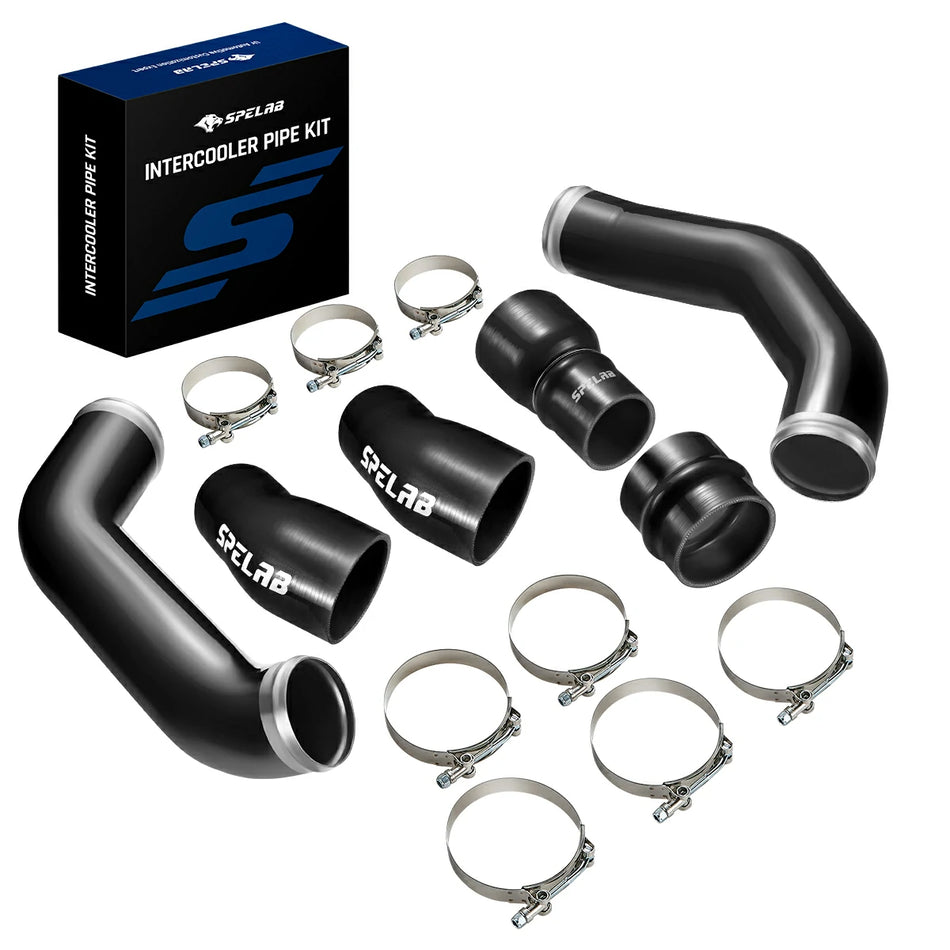
Should the Cold-Side Intercooler Pipe Be Replaced Too?
The cold-side pipe should be inspected while the intake connection is accessible, but it should be replaced only when its year-specific construction, condition, sealing joints, or planned boost level justify the additional work.
Look for oil tracking around couplers, split plastic, soft hose sections, clamp movement, rubbed-through spots, damaged O-rings, and stored or active underboost codes. Pressure-test the charge-air system when a leak is suspected instead of replacing every neighboring part as a package.
Do Not Blame the Intake Manifold Too Fast
Neither intake manifold will repair a plugged air filter, charge-air leak, sticking turbo actuator, leaking EGR cooler, contaminated MAP sensor, weak batteries, fuel-pressure problem, restricted DPF, injector fault, or incorrect calibration.
A towing complaint should be reproduced under controlled load while boost, rail pressure, intake-air temperature, EGT where properly measured, coolant temperature, transmission temperature, and engine codes are logged. An unloaded throttle snap cannot prove a manifold solved a heavy-load problem.
Frequently Asked Questions
The most useful answers separate component flow from vehicle performance and separate product-family fitment from the exact SKU required by the truck.
Q: Which intake manifold is better for a stock daily-driven 6.7 Cummins?
A: The cast-aluminum manifold-only configuration is usually the more practical starting point for a compatible stock truck because the current product data supports retaining the factory EGR system without mandatory tuning. Exact year, chassis, grid-heater, sensor, and fuel-line fitment must still be confirmed.
Q: Is the 3.5-inch fabricated manifold made from aluminum?
A: No. The current product data identifies the basic fabricated 3.5-inch version as T-201 stainless steel, while the larger plenum-style intake horn is cast aluminum. Material, port count, flow path, and fitment all differ.
Q: Does 897 CFM mean the cast manifold makes almost twice the horsepower?
A: No. The internal CFM figure describes component flow under a particular test setup. Horsepower depends on the turbocharger, boost, cylinder-head flow, fueling, calibration, temperatures, transmission behavior, and whether the engine can use the additional flow.
Q: Will either intake manifold lower EGT by 50-200°F?
A: No universal EGT reduction can be promised. A valid comparison requires the same probe position, trailer or load, grade, road speed, ambient temperature, fuel rate, boost, tune, and test procedure before and after installation.
Q: Does the 3.5-inch fabricated manifold fit every 2007-2018 truck?
A: No. The current listing separates an older 2007-2018 configuration from a newer 2013-2018 configuration and pairs the fabricated design with a modified EGR layout. Verify the exact SKU and truck configuration before ordering.
Q: Does the cast-aluminum intake horn fit a 2022 Ram 2500?
A: A 2022 Ram 2500 falls within the current 2019+ product group, but year range alone does not confirm the selected heater, EGR, sensor, color, or bundle configuration. Match the full truck setup to the variant description.
Q: Do I need tuning after an intake manifold installation?
A: The correct cast-aluminum manifold-only configuration does not require mandatory tuning according to the current product data. An EGR change, grid-heater strategy, sensor relocation, or other emissions and calibration modification can create separate requirements.
Q: Are gaskets and hardware included?
A: Included parts vary by SKU and bundle. Confirm the current package list rather than assuming every manifold-only, heater, plate, or Chassis Cab option includes the same gaskets, plugs, brackets, fasteners, and electrical parts.
Sources and Data Notes
This comparison separates current product specifications, manufacturer operating guidance, internal component data, and editorial estimates so readers can see what each conclusion is based on.
- Product specifications and fitment: Current SPELAB Shopify product records for the 3.5-inch fabricated manifold and cast-aluminum intake horn, reviewed September 7, 2026.
- Cold-weather operation: Ram 2024 2500/3500 Owner's Manual guidance for intake-air heating and extremely cold starting. Detailed temperature thresholds are intentionally kept in the dedicated grid-heater article instead of repeated here.
- Internal airflow data: SPELAB listings report 487 CFM and 43.5 lb/min for the fabricated manifold and 897 CFM and 72.7 lb/min for the cast manifold. The current source material does not publish enough fixture and test-pressure detail to convert those figures into guaranteed vehicle performance.
- Installation time: The roughly three-to-six-hour range is a conservative service estimate, not an official flat-rate time. Model year, corrosion, tool access, fuel-line routing, sensors, EGR layout, and heater hardware can change the labor required.
The Practical Decision
The 3.5-inch fabricated manifold is the narrower, lower-cost choice for a verified modified 2007-2018 setup; the cast-aluminum manifold is the broader choice for owners who need EGR-intact compatibility, four accessory ports, later-model coverage, or a dedicated Chassis Cab option.
Choose the year group, chassis, EGR configuration, heater strategy, and included hardware first. Treat CFM as component data and judge vehicle performance with repeatable logs or dyno testing.