Author: John Lee, SPELAB Mechanical Engineer. Updated on May 12, 2026.
Quick Answer
The stock 6.7 Powerstroke intake manifold is made from composite plastic. In normal stock use, it can work as intended, but as mileage, heat cycles, boost pressure, vibration, and soot/oil contamination increase, it can become a higher-risk component. Common problems include cracks, boost leaks, restricted airflow, soot buildup, and underboost-related drivability issues.
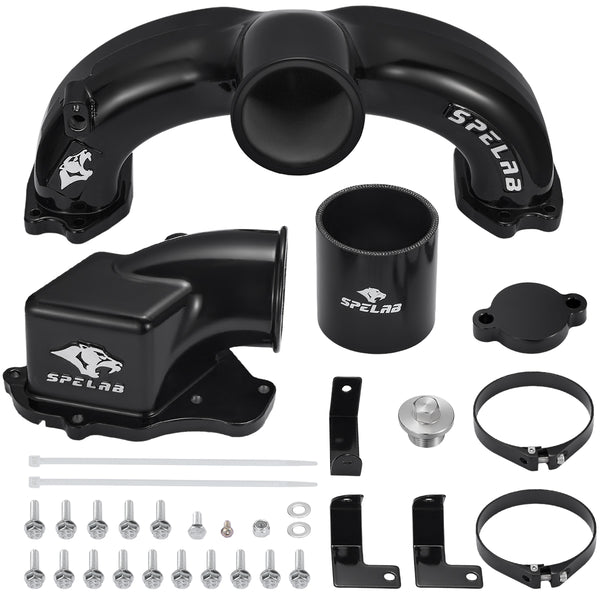
Upgrading to a 6.7 Powerstroke intake manifold upgrade made from cast aluminum can improve long-term durability, reduce the risk of plastic cracking, and support smoother airflow on 2011–2019 Ford Super Duty trucks.
Fitment note: 2011–2014 and 2017–2019 6.7 Powerstroke trucks are standard-fit applications. 2015–2016 trucks require an external oil feed line relocation hose because of GT37 turbo oil line routing.
Why the Stock 6.7 Powerstroke Intake Manifold Fails
Ford’s 6.7L Powerstroke is a strong diesel platform, but the factory composite intake manifold can become a weak point over time. The issue is not that composite plastic is automatically bad. OEM engineers use it for weight, cost, noise control, and manufacturing efficiency. The problem is that working diesel trucks often live in harsher conditions than a light-duty commuter vehicle.
For high-mileage trucks, towing rigs, tuned trucks, or engines exposed to repeated heat cycles, the stock plastic manifold becomes more vulnerable to stress. The main failure factors are heat aging, boost pressure, vibration, and contamination inside the intake path.
The Failure Triangle: Heat, Pressure, and Vibration
The stock manifold usually does not fail because of one single factor. It fails when multiple stressors work together over time. On a 6.7 Powerstroke, the three biggest stressors are thermal aging, internal boost pressure, and diesel vibration fatigue.
1. Thermal Aging
Repeated heat cycles can make plastic less flexible over time. As the engine moves from cold start to full operating temperature again and again, the manifold material may gradually lose toughness. Once the plastic becomes more brittle, it is more likely to crack near seams, flanges, or high-stress areas.
Anyone who has worked under the hood of a 6.7 Powerstroke knows how easy it is to bump, lean on, or stress old plastic parts while reaching for rear bolts, fuel lines, or electrical connectors. Aluminum gives the intake path a more durable structure during both driving and service work.

2. Boost Pressure and Hoop Stress
Turbocharger boost creates outward pressure inside the intake manifold. This outward load is often described as hoop stress, or the force trying to expand the manifold from the inside. A healthy factory manifold can handle stock use, but as material ages and boost increases, stress becomes more important.
Tuned trucks, towing applications, or engines running higher boost can place more load on an already aged plastic manifold. Once the material is brittle, pressure stress may contribute to seam cracks, flange leaks, or boost loss.
3. Diesel Vibration and Fatigue
The 6.7 Powerstroke produces strong low-frequency vibration. Over time, vibration can contribute to fatigue around mounting flanges, seams, and stress concentration points. When aging plastic, boost pressure, and vibration work together, cracking and boost leaks become more likely.
4. Soot and Oil Contamination
Inside the intake path, oil vapor can mix with EGR soot and create sticky buildup. That buildup can collect around passages, sensors, and internal surfaces. Over time, it may restrict airflow and make the intake system harder to keep clean.
Symptoms of a Failing 6.7 Powerstroke Intake Manifold
A bad or restricted intake manifold does not always fail suddenly. Many owners first notice underboost symptoms, hissing under load, reduced throttle response, or soot and oil buildup before they find the actual source.
| Symptom | Possible Cause | What to Check |
|---|---|---|
| P0299 underboost code | Boost leak from cracked manifold, pipe, boot, clamp, or connection | Pressure test the intake system and inspect manifold seams |
| P0106 MAP sensor-related code | Manifold pressure signal may be out of expected range | Inspect MAP sensor area, wiring, soot buildup, and boost leaks |
| Hissing under boost | Air escaping from a crack, gasket, O-ring, or boot | Check manifold, intercooler pipe, clamps, and O-rings |
| Reduced throttle response | Airflow restriction or boost leak | Inspect intake path, MAP sensor area, and boost pressure |
| Higher EGT under load | Restricted or leaking intake path may reduce air delivery | Inspect manifold, cold side pipe, and charge air system |
| Soot/oil buildup inside intake | EGR soot mixed with oil vapor | Inspect manifold interior, MAP sensor, and EGR path |
| Visible crack or oil residue near seams | Manifold material or gasket area may be failing | Inspect seams, bolt flanges, and gasket surfaces |
Codes such as P0299 underboost or MAP-sensor-related codes like P0106 should not be blamed on the manifold automatically. They are warning signs to inspect the full intake path, including the manifold, MAP sensor area, boots, clamps, cold side pipe, and charge-air leaks.
Stock Plastic vs Aluminum Intake Manifold
The main reason to upgrade is reliability. Replacing a failed plastic manifold with another plastic manifold may solve the immediate issue, but it can reset the clock on the same long-term failure pattern. A cast aluminum manifold is designed to handle heat cycling, vibration, and boost stress more reliably over the life of the truck.
| Feature | Stock Plastic Manifold | SPELAB Aluminum Manifold | Benefit |
|---|---|---|---|
| Material | Composite plastic | Cast aluminum | Better resistance to heat-cycle brittleness and cracking |
| Long-term durability | Can become brittle with age and heat | Built for high-heat diesel use | More reliable for towing, tuned, or high-mileage trucks |
| Internal design | Baffled and more restrictive | 3.5-inch smooth bore design | Smoother airflow path with fewer sharp transitions |
| Serviceability | Factory-style sealed structure | Two-piece bridge design | Designed for improved access and larger runner volume |
| Best for | Stock replacement and normal use | Reliability upgrade and airflow support | Owners who want a stronger long-term solution |
Instead of treating the manifold as only a replacement part, it is better to view it as part of the full air delivery system. The manifold, cold side pipe, boots, clamps, sensors, and EGR path all affect how well the truck delivers clean, pressurized air to the engine.
Why SPELAB Uses Cast Aluminum and a 3.5-Inch Smooth Bore
The SPELAB manifold is designed around two goals: durability and smoother airflow. Cast aluminum addresses the material weakness of aging plastic, while the 3.5-inch smooth bore helps reduce restriction compared with a baffled factory-style design.
The goal is not pure laminar flow in a textbook sense. In a boosted diesel intake system, airflow is pulsed, pressurized, and constantly changing. The practical goal is smoother, less restricted airflow with fewer sharp transitions and less pressure drop.

For trucks that tow, haul, or run higher boost, a stronger intake manifold helps reduce one of the common weak points in the factory intake path. It should still be installed with correct gaskets, clean sealing surfaces, proper torque specs, and a full inspection of connected pipes and boots.
View SPELAB 6.7 Powerstroke Aluminum Intake Manifold >
2011–2019 Fitment: What You Need to Know
Fitment is one of the most important parts of this upgrade. The 2011–2019 6.7 Powerstroke platform changed over the years, especially around turbocharger configuration and oil feed line routing. Choosing the wrong kit can create installation interference.
| Model Year | Fitment Type | What You Need |
|---|---|---|
| 2011–2014 | Standard fitment | Direct bolt-on manifold installation with provided hardware |
| 2015–2016 | Oil line relocation required | Kit option with external oil feed line relocation hose |
| 2017–2019 | Standard fitment | Direct bolt-on manifold installation with provided hardware |
| 2020+ | Not compatible | Different lower-profile manifold design; not interchangeable with 2011–2019 |
Fitment Warning: 2015–2016 Powerstroke Requires Oil Line Relocation
If you own a 2015 or 2016 6.7 Powerstroke, pay close attention before ordering. These trucks use a GT37 turbo setup where the factory oil feed line runs through the space occupied by a larger aftermarket manifold.
For 2015–2016 trucks, you should choose the SPELAB kit option that includes the External Oil Feed Line Relocation Hose. This reroutes the oil supply around the manifold and prevents interference during installation.
2015–2016 owner? Do not order based on engine size alone. Confirm the model year and select the kit option with the oil feed line relocation hose to avoid interference with the larger aluminum manifold.
Do not assume all 2011–2019 trucks install the same way. The 2015–2016 fitment difference is one of the most important details for avoiding installation delays, oil line interference, or incorrect parts selection.
Check the detailed installation guide for the 6.7 Powerstroke intake manifold.
What Else Should You Upgrade with the Intake Manifold?
An engine is a system. Upgrading the manifold while ignoring the rest of the air path can leave other weak points in place. If your goal is to improve reliability, inspect the cold side pipe, boots, clamps, MAP sensor area, and soot/oil buildup at the same time.
Cold Side Intercooler Pipe
The cold side pipe connects the intercooler to the intake manifold. On many 6.7 Powerstroke trucks, the factory pipe is also plastic, making it another common failure point in the intake system. If you are already replacing the manifold, upgrading to a metal 6.7 Powerstroke cold side pipe can help complete a stronger metal air path.
Don’t leave a plastic weak link. If you are already replacing the intake manifold, inspect the factory cold side pipe at the same time. Once the manifold is upgraded to aluminum, the aging plastic intercooler pipe may become the next weak point in the charge-air path.

Soot and Oil Vapor Control
Soot buildup can become a problem when EGR soot mixes with oil vapor inside the intake tract. This sticky buildup may collect around the manifold, MAP sensor, and intake passages. If you are seeing heavy buildup, inspect related systems instead of assuming the manifold alone is the only issue.
For off-road or competition-only trucks where emissions changes are legally allowed, some owners address EGR-related soot buildup as part of a larger intake cleanup plan. For street-driven trucks, keep emissions compliance and local regulations in mind before considering any emissions-related modification.
Related reading: why oil appears around the intake and how EGR soot affects the intake path.
Cold Air Intake
A manifold upgrade helps the engine receive air more efficiently after the intercooler. A cold air intake kit may also support the broader airflow path, especially when combined with a healthy turbo system, clean filters, and leak-free charge pipes.
Installation Tips and Torque Specs
This is a moderate-level job for owners with intermediate mechanical skill. Many installations take about 2–4 hours, but time can vary based on model year, rust, workspace, and whether the 2015–2016 oil line relocation is required.
Essential Tool List
- 1/4-inch and 3/8-inch drive ratchets with extensions
- Torque wrench that measures in inch-pounds
- 7mm, 8mm, 10mm, and 13mm sockets
- Deep and shallow sockets as needed
- Pick tool for electrical connectors and clips
- Assembly lube or Vaseline to prevent O-ring pinch
- Clean rags and sensor-safe cleaner for intake area cleanup
Use New O-Rings and Gaskets
Use the supplied new O-rings and gaskets instead of reusing compressed factory seals. Fresh seals help prevent boost leaks after installation. Apply a light coat of assembly lube or Vaseline where appropriate to reduce the chance of O-ring pinch during assembly.
Critical Torque Specifications
Do not guess on torque. You are working around aluminum components, sealing surfaces, sensors, and small fasteners. Over-tightening can damage threads or sealing surfaces.
Torque conversion note: 12 lb-in equals 1 lb-ft. Do not confuse inch-pounds with foot-pounds when tightening small intake manifold bolts.
| Component | Torque Spec | Installation Note |
|---|---|---|
| Manifold to head bolts | 89 in-lbs / approx. 10 Nm | Use the correct sequence and avoid over-tightening |
| Dipstick bracket | 106 in-lbs | Confirm bracket alignment before tightening |
| MAP sensor bolt | 35 in-lbs | Hand-tight feel; do not crack the sensor mount |
Note: After one full heat cycle, bring the engine up to operating temperature, let it fully cool, and recheck the manifold bolts if recommended by the installation guide.
For the tightening sequence diagram and detailed steps, read: 6.7 Powerstroke intake manifold torque specs and sequence.
Is a 6.7 Powerstroke Intake Manifold Upgrade Worth It?
For a low-mileage, fully stock truck with no boost leaks, the stock manifold may continue to work as intended. But for high-mileage trucks, towing rigs, tuned trucks, or engines already showing underboost symptoms, an aluminum intake manifold upgrade becomes a stronger long-term solution.
The main value is reliability. A cast aluminum manifold reduces the risk of heat-cycle brittleness and plastic cracking, while the smoother 3.5-inch bore supports a cleaner airflow path. It is not a magic horsepower part by itself, but it can remove a known weak point and support the rest of the intake system.
If your truck already has a cracked manifold, leaking cold side pipe, soot-heavy intake path, or P0299 underboost symptoms, upgrading the manifold while inspecting the rest of the intake system is usually more effective than replacing one isolated part and ignoring the surrounding components.
FAQ
Q: Are there any common issues with the stock 6.7 Powerstroke intake manifold?
A: Yes. Common issues include plastic aging from heat cycles, cracking near seams or flanges, boost leaks, restricted airflow, soot/oil buildup, and underboost-related symptoms such as P0299. The risk increases with mileage, towing, higher boost, and repeated heat exposure.
Q: What are the symptoms of a bad 6.7 Powerstroke intake manifold?
A: Common symptoms include P0299 underboost codes, hissing under boost, reduced throttle response, higher EGTs under load, visible cracks, boost leaks, or soot and oil buildup inside the intake path.
Q: Can a 6.7 Powerstroke intake manifold cause P0106?
A: It may be related, but P0106 should not be blamed on the manifold automatically. P0106 is associated with manifold pressure signal range or performance. Inspect the MAP sensor area, wiring, soot buildup, charge-air leaks, and intake path before replacing parts.
Q: Is an aluminum intake manifold better than the stock plastic manifold?
A: For long-term durability, yes. Aluminum resists heat-cycle brittleness and cracking better than aging composite plastic, especially on tuned, towing, or high-mileage trucks.
Q: Will an aluminum intake manifold add horsepower?
A: Do not expect a huge horsepower gain from the manifold alone. The main benefits are durability, smoother airflow support, and reduced risk of boost leaks. Power gains depend on the full intake, turbo, tuning, exhaust, and fuel setup.
Q: Why do 2015–2016 6.7 Powerstroke trucks need an oil line relocation kit?
A: The 2015–2016 GT37 turbo oil feed line routes through the space used by larger aftermarket intake manifolds. These model years need an external oil feed line relocation hose to avoid interference.
Q: Will this manifold fit a 2020+ Powerstroke?
A: No. The 2011–2019 generation uses a different manifold design and port layout. The 2020+ 6.7 Powerstroke has a lower-profile manifold design that is not interchangeable with the 2011–2019 application.
Q: Can I install a 6.7 Powerstroke intake manifold myself?
A: Yes, if you have intermediate mechanical experience, basic hand tools, and a torque wrench that reads inch-pounds. Expect the job to take a few hours. If you are not comfortable working around diesel fuel lines, sensors, and tight rear bolts, professional installation is recommended.
Q: Can I reuse the factory gaskets?
A: It is not recommended. Once rubber gaskets and O-rings have been compressed and heat-cycled, they may not seal as well. Use the new gaskets and O-rings supplied with the kit to reduce the chance of boost leaks.
Q: Should I upgrade the cold side pipe at the same time?
A: It is a smart idea, especially if the factory plastic cold side pipe is old, cracked, or leaking. Upgrading the manifold and cold side pipe together helps create a stronger metal intake path.
Q: Does an aluminum manifold heat soak?
A: Aluminum does conduct heat, but it also dissipates heat quickly. In real-world use, charge air temperature depends on the intercooler, airflow, engine load, turbo efficiency, and surrounding components. The manifold upgrade should be viewed mainly as a durability and airflow-path improvement.

John Lee
Mechanical Engineer | 10+ Years Experience
John has spent the last decade engineering and testing high-performance automotive components. Specializing in drivetrain durability and thermal management across Powerstroke, Cummins, and Duramax applications, he bridges the gap between OEM limitations and aftermarket performance. His philosophy: "Factory parts are just a starting point."