
Author: John Lee, SPELAB Mechanical Engineer. Updated on May 14, 2026.
Quick Answer
Deleting the EGR system on a 6.7 Cummins means removing, blocking, or bypassing the exhaust gas recirculation system so exhaust gas no longer returns to the intake. In an off-road or competition setup, this usually involves EGR block-off plates, cooler-related hardware, coolant reroute parts, gaskets, throttle valve-related parts on some years, and proper tuning support.
However, an EGR delete is not a normal maintenance repair. It changes the emissions system, airflow path, coolant routing, sensor feedback, and engine calibration. For public-road trucks, removing or disabling EGR, DPF, SCR, DEF, or related emissions equipment can violate emissions laws, fail inspection, void warranty coverage, and create resale problems.
This article is for technical and educational purposes only. EGR delete parts are generally intended for off-road, race, competition, or closed-course applications only. This article does not encourage illegal public-road emissions tampering. Always check federal, state, and local laws before modifying any emissions-control system.
What Is the EGR System on a 6.7 Cummins?
EGR stands for Exhaust Gas Recirculation. On a 6.7 Cummins, the system recirculates a controlled amount of exhaust gas back into the intake stream. This helps reduce combustion temperature and lower NOx emissions.
From an engineering point of view, EGR is an emissions-control strategy. From a long-term maintenance point of view, it can also introduce soot, heat, and oily residue into the intake tract, especially on trucks that idle often, tow heavy, or run many heat cycles.
Common EGR-related parts include:
- EGR valve
- EGR cooler
- EGR crossover tube or related piping
- Throttle valve / intake air control components on some setups
- Coolant lines connected to the EGR cooler
- Gaskets, clamps, and mounting hardware
If you are comparing off-road EGR hardware, start with SPELAB’s 6.7 Cummins EGR delete kit collection and confirm your exact year before ordering.
What Comes in a 6.7 Cummins EGR Delete Kit?
A 6.7 Cummins EGR delete kit can vary by year range, emissions layout, and how complete the kit is. A basic kit may only include block-off hardware, while a more complete kit may include coolant reroute parts, throttle valve-related components, gaskets, clamps, and installation hardware.
| Component | Purpose | What to Check |
|---|---|---|
| EGR block-off plates | Seal the exhaust and intake-side EGR ports | Flatness, gasket quality, bolt fitment, and leak-free sealing |
| EGR cooler delete / bypass parts | Remove or bypass the EGR cooler in off-road setups | Coolant routing, hose quality, clamps, and clearance |
| #6 cylinder coolant bypass hose | Helps maintain coolant flow toward the rear of the cylinder head | Use high-grade hose and proper routing to reduce localized hot spots |
| Throttle valve delete or related hardware | Addresses intake air control hardware on certain year ranges | Year-specific fitment and tuning compatibility |
| Gaskets and hardware | Seal joints and secure modified components | Do not reuse crushed or heat-damaged gaskets |
| Tuning support | Prevents fault codes and limp mode in off-road applications | Required when emissions logic is changed |

6.7 Cummins EGR Delete Fitment by Year Range
Do not buy an EGR delete kit only because the listing says “6.7 Cummins.” The engine name is not enough. EGR cooler shape, throttle valve configuration, brackets, coolant routing, and emissions layout can change by year range.
| Year Range | Typical Platform | EGR / Intake Notes | Fitment Advice |
|---|---|---|---|
| 2007.5–2009 | Early 6.7 Cummins, late 3rd gen style | Earlier EGR layout and different hardware arrangement | Use a kit specifically listed for 2007.5–2009 |
| 2010–2012 | Early 4th gen Ram 2500 / 3500 | Different routing and mounting details than later trucks | Do not assume 2013–2018 parts fit |
| 2013–2018 | Late 4th gen Ram 2500 / 3500 | Commonly includes EGR cooler and throttle valve-related parts | Use the correct 2013–2018 kit and confirm tuning support |
| 2019+ | 5th gen Ram 2500 / 3500 | Different emissions layout and calibration strategy | Requires 2019+ specific parts and professional verification |
The product example later in this guide is for 2013–2018 Ram 2500 / 3500 trucks. If your truck is not in that year range, use the correct year-specific product page instead of forcing fitment.
Why 6.7 Cummins Owners Consider EGR Delete
Most owners do not start researching EGR delete because they enjoy removing parts. They usually start because the truck has drivability issues, repeated EGR-related faults, soot buildup, coolant loss, or expensive emissions-system repair quotes.
Common reasons include:
- Soot buildup in the intake path
- EGR cooler leaks or coolant loss concerns
- EGR valve sticking or flow-related fault codes
- Reduced throttle response
- High exhaust and intake heat under heavy load
- Off-road competition performance goals
- Desire to simplify the engine bay on dedicated off-road builds
If your real problem is coolant loss or EGR cooler failure rather than performance, read SPELAB’s guide on why EGR coolant leaks happen before replacing parts blindly.
EGR Delete vs DPF Delete: They Are Not the Same
EGR delete and DPF delete are often discussed together, but they affect different systems.
| Modification | System Affected | Main Function of Original System | Key Risk |
|---|---|---|---|
| EGR delete | Intake and exhaust recirculation system | Recirculates exhaust gas to reduce NOx formation | Requires correct sealing, coolant routing, and calibration |
| DPF delete | Exhaust aftertreatment system | Filters soot from diesel exhaust | High emissions-compliance risk on public roads |
| DEF / SCR delete | NOx aftertreatment system | Uses DEF to reduce NOx emissions downstream | Legal, inspection, and calibration risk |
For off-road exhaust configuration examples, see SPELAB’s DPF delete pipe collection. Do not assume EGR, DPF, and DEF modifications have the same legal or tuning requirements.
Engineer-Level View: What Changes After EGR Delete?
From an airflow and thermal-management standpoint, removing EGR changes more than one pipe. It affects combustion temperature, soot recirculation, coolant routing, intake contamination, and sensor strategy.
| Area | What Changes | Why It Matters |
|---|---|---|
| Intake cleanliness | Less exhaust soot enters the intake path | Can reduce soot/oil sludge buildup in off-road setups |
| Coolant routing | EGR cooler coolant paths may be removed or rerouted | Poor routing can cause leaks, air pockets, or hot spots |
| #6 cylinder heat control | Rear cylinder-head cooling becomes more important after reroute work | A proper coolant bypass hose helps reduce localized rear-head hot spots |
| ECU logic | Factory EGR monitoring no longer matches hardware | Tuning support is needed in off-road configurations |
| Exhaust temperature behavior | Combustion and exhaust conditions may change | Tune quality and monitoring become more important |
| Inspection and compliance | Emissions hardware is altered | Not appropriate for public-road emissions compliance |
#6 Cylinder Coolant Bypass: The Detail Many Buyers Miss
On a 6.7 Cummins, the rear of the cylinder head works in a harsh thermal environment. When EGR cooler hardware is removed or coolant routing is changed, you do not want to create a dead zone or localized hot spot near the rear cylinders.
A proper off-road EGR setup should use a high-grade coolant bypass hose and routing strategy that helps maintain coolant movement toward the rear of the cylinder head. This is why the bypass hose is not just an accessory. It is part of thermal management.
Always ensure the kit uses a high-grade coolant bypass hose to maintain proper coolant flow to the rear of the cylinder head. Poor coolant rerouting can create localized hot spots near the #6 cylinder area.
If your truck already shows coolant loss, white smoke, or suspected EGR cooler failure, diagnose the original issue first. For cooling-system context, see SPELAB’s EGR coolant leak diagnosis guide.
General Off-Road Installation Overview
Because EGR delete can affect emissions compliance, this guide should not be treated as a public-road installation manual. The high-level process below is for understanding what is typically involved in an off-road or competition setup.
- Confirm intended use: Verify that the truck is used only where this modification is legal.
- Confirm exact year and fitment: 6.7 Cummins EGR layouts vary by model year.
- Disconnect battery power: Protect electrical systems before working around sensors and control hardware.
- Remove or block EGR-related hardware: This may involve EGR valve, cooler, crossover piping, or throttle valve components depending on the kit.
- Seal EGR ports: Block-off plates and gaskets must seal properly to prevent exhaust or boost leaks.
- Reroute coolant correctly: Use the supplied bypass hose and verify coolant flow toward the rear of the cylinder head to help avoid localized hot spots near the #6 cylinder.
- Apply off-road calibration: The ECU must match the hardware configuration to avoid fault codes and limp mode.
- Pressure-check and inspect: Check coolant leaks, exhaust leaks, boost leaks, and sensor-related warnings before hard use.
Most bad EGR delete outcomes come from poor sealing, incorrect coolant routing, low-quality gaskets, unsupported tuning, or mixing parts from the wrong year range.

Product Example: 2013–2018 Ram 6.7 Cummins EGR Kit
For 2013–2018 Ram 2500 and 3500 trucks, SPELAB offers a model-specific EGR cooler and throttle valve delete kit for off-road applications. Always confirm emissions legality, model year, included hardware, tuning requirements, and intended use before ordering.
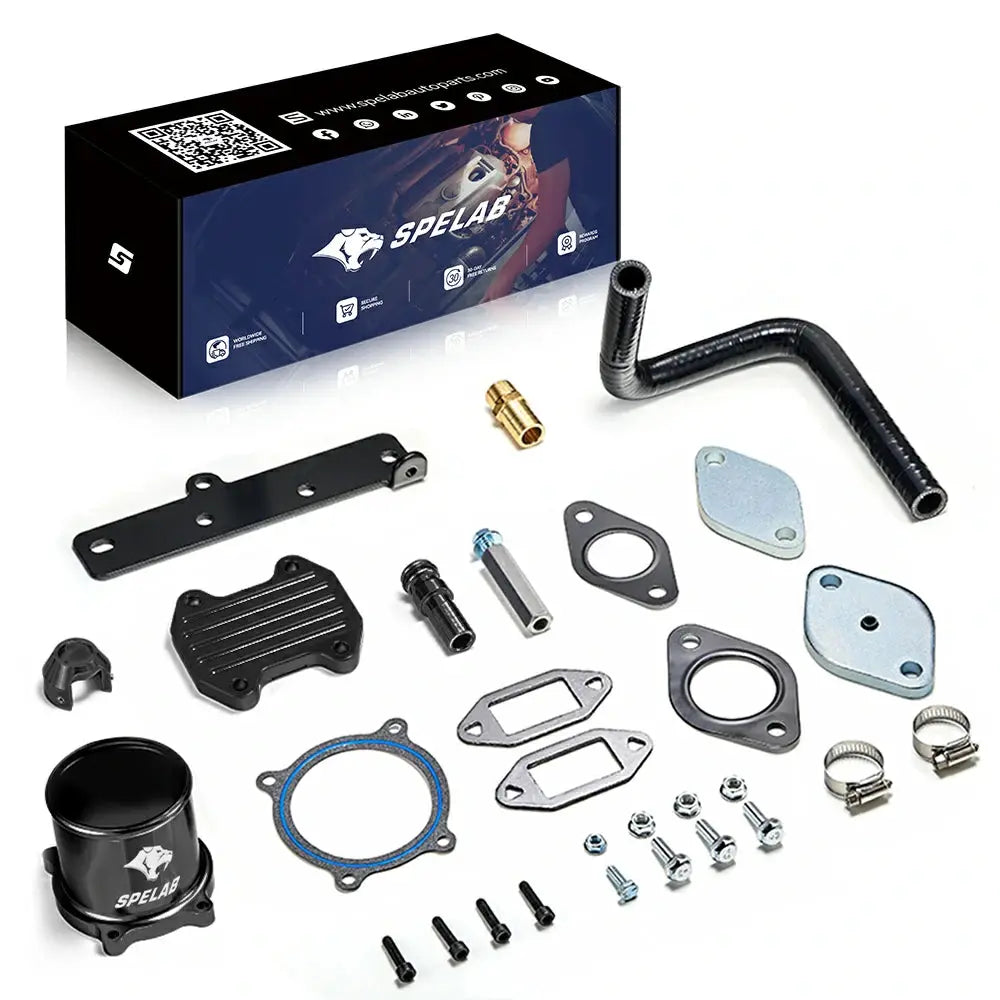
Fitment:
2013 Dodge Ram 2500 / 3500 6.7L Cummins Diesel
2014 Dodge Ram 2500 / 3500 6.7L Cummins Diesel
2015 Dodge Ram 2500 / 3500 6.7L Cummins Diesel
2016 Dodge Ram 2500 / 3500 6.7L Cummins Diesel
2017 Dodge Ram 2500 / 3500 6.7L Cummins Diesel
2018 Dodge Ram 2500 / 3500 6.7L Cummins Diesel
Upgrading the 6.7 Cummins: Parts Checklist
When comparing EGR removal parts for a 6.7 Cummins, do not shop by price alone. Fitment, gasket quality, coolant routing, and tuning support matter more than the number of parts in the box.
- Block-off plates: Should be flat, durable, and matched to the correct port shape.
- Coolant bypass hose: Should be high-grade and routed to support rear cylinder-head coolant movement.
- Coolant reroute hardware: Must handle heat and pressure without leaks.
- Gaskets: Should seal exhaust and intake ports without crushing or shifting.
- Bolts and clamps: Must match the application and resist vibration.
- Throttle valve-related parts: Must match your year range and configuration.
- Tuning support: Required when emissions hardware and ECU logic no longer match.
For broader platform planning, browse SPELAB’s Cummins applicable products collection.
Should You Add a DPF Delete Pipe?
Some off-road builds combine EGR and DPF-related changes, but these are separate systems and should not be treated as one simple upgrade. A DPF delete pipe replaces or bypasses the diesel particulate filter section of the exhaust system. That means it directly affects exhaust aftertreatment, soot filtration, emissions compliance, and tuning requirements.
Before considering any DPF-related part, evaluate:
- whether the truck is used on public roads
- state and local emissions rules
- inspection requirements
- tuning compatibility
- exhaust diameter and fitment
- noise and smell changes
- warranty and resale impact

Common Mistakes to Avoid
| Mistake | Why It Causes Problems | Better Approach |
|---|---|---|
| Buying the wrong year kit | Ports, cooler layout, and throttle valve components may not match | Confirm exact model year and engine configuration |
| Ignoring #6 cylinder coolant bypass | Rear cylinder-head hot spots can become a durability concern | Use correct bypass hose routing and inspect coolant flow strategy |
| Ignoring coolant routing | Can cause leaks, air pockets, or hot spots | Use correct reroute hardware and pressure-check after installation |
| Skipping tuning | Can trigger fault codes, limp mode, or drivability issues | Use proper off-road calibration matched to the hardware |
| Reusing damaged gaskets | Can create exhaust, coolant, or boost leaks | Use fresh gaskets and inspect sealing surfaces |
| Assuming EGR and DPF are the same job | They affect different systems and legal risks | Plan each system separately |
Related Reading
For more context before modifying a 6.7 Cummins, these guides may help:
- how an EGR delete kit affects Dodge Cummins performance
- what deleting EGR on a 6.7 Cummins involves
- 6.7 Cummins oil capacity and maintenance tips
Final Recommendation
Deleting the EGR on a 6.7 Cummins is not just removing a valve or installing plates. It affects emissions hardware, coolant routing, intake airflow, ECU logic, diagnostics, and legal compliance. For a public-road truck, emissions-compliant repair is usually the safer path. For a dedicated off-road or competition build, the correct parts, year-specific fitment, careful sealing, #6 cylinder coolant bypass routing, coolant pressure checks, and proper tuning are all critical.
If you are still comparing parts, use the dedicated 6.7 Cummins EGR delete kit collection for product fitment and availability rather than relying only on a general blog article.
FAQ
Q: What does deleting EGR on a 6.7 Cummins mean?
A: It means removing, blocking, or bypassing the exhaust gas recirculation system so exhaust gases no longer recirculate into the intake. In off-road setups, this usually requires block-off plates, cooler-related hardware, coolant rerouting, gaskets, and tuning support.
Q: Is EGR delete legal on a 6.7 Cummins?
A: EGR delete is generally not legal for public-road emissions-compliant vehicles. It is usually sold or discussed for off-road, race, competition, or closed-course applications only. Always check federal, state, and local laws before modifying emissions equipment.
Q: Can I delete EGR without tuning?
A: No, not in a proper off-road configuration. The ECM expects EGR hardware and sensors to function. Removing or blocking EGR without matching calibration can cause check engine lights, limp mode, poor drivability, or fault codes.
Q: Why does the #6 cylinder coolant bypass matter?
A: The rear of the 6.7 Cummins cylinder head is exposed to high heat. If coolant routing is handled poorly after EGR cooler removal, localized hot spots near the #6 cylinder area may become a durability concern. A proper bypass hose helps maintain rear-head coolant movement.
Q: What parts are usually included in a 6.7 Cummins EGR delete kit?
A: Common parts include EGR block-off plates, coolant bypass or reroute hardware, gaskets, bolts, clamps, and sometimes throttle valve-related components depending on the year range and kit design.
Q: Is EGR delete the same as DPF delete?
A: No. EGR delete affects exhaust gas recirculation into the intake. DPF delete affects the exhaust aftertreatment system that filters soot. They are different systems with different parts, tuning needs, and compliance risks.
Q: Will deleting EGR improve horsepower?
A: The hardware mainly changes airflow and reduces EGR-related soot recirculation. Any power change depends on tuning, supporting parts, turbo behavior, fuel system health, and overall engine condition. Do not expect the plates alone to create a major power gain.
Q: Can EGR delete fix coolant loss?
A: If the coolant loss is caused by a leaking EGR cooler in an off-road build, removing or bypassing that cooler may address that source. However, coolant loss can also come from radiator seams, hoses, water pump, head gasket, or other issues. Diagnose before replacing parts.
Q: Which years does the SPELAB 6.7 Cummins EGR kit fit?
A: The product example in this guide is for 2013–2018 Dodge Ram 2500 / 3500 6.7L Cummins Diesel. Always verify the exact product page and your truck’s configuration before ordering.
Q: Can I install a 6.7 Cummins EGR delete kit myself?
A: Mechanically experienced owners may understand the hardware side, but the job involves coolant routing, sealing, electrical systems, and tuning. Professional installation is recommended if you are not experienced with diesel emissions systems.
Q: What should I check after an off-road EGR delete installation?
A: Check for coolant leaks, exhaust leaks, boost leaks, loose clamps, warning lights, abnormal temperatures, and drivability issues. Also verify that the tuning matches the exact hardware configuration.

John Lee
Mechanical Engineer | 10+ Years Experience
John has spent the last decade engineering and testing high-performance automotive components. Specializing in drivetrain durability and thermal management across Powerstroke, Cummins, and Duramax applications, he bridges the gap between OEM limitations and aftermarket performance. His philosophy: "Factory parts are just a starting point."



3 comments
Same question as John- Nov 28, 2023
I also have a 2012 Ram 2500. Thank you
Do I need to order a delete kit code reader before I strip my truck