Updated on August 10, 2026.
A used Ford F-250 or F-350 can feel solid empty and still fall apart under trailer tongue weight, sustained boost, and a long grade. Before heavy towing, treat the truck as an unknown system: identify the exact configuration, verify its ratings, scan every module, measure wear, pressure-test the cooling and charge-air systems, and run a loaded shake-down. A clean cab and a strong cold start do not prove tow readiness.
This checklist focuses on 2011-2024 Super Duty pickups with the 6.7L Power Stroke, while calling out the year, transmission, fuel-system, axle, SRW/DRW, and Fitment differences that matter. The same inspection order also helps gasoline-powered F-250 and F-350 owners, but product examples and diesel diagnostics in this guide are engine-specific.
Quick Answer: What Should You Check First?
Start with the VIN, door-jamb labels, open recalls, service records, previous calibrations, emissions hardware, and actual loaded weight. Then inspect brakes, tires, steering, suspension, hitch structure, wheel ends, axle seals, transmission behavior, fuel pressure, cooling-system pressure, charge-air leaks, batteries, and trailer wiring. Repair failed measurements before buying a tune, exhaust, lift, or airflow Mod.
Key Takeaways
- F-250 and F-350 badges do not establish Payload or towing capacity. Cab, bed, 4x2/4x4, SRW/DRW, axle ratio, GVWR package, hitch, tires, passengers, and installed equipment all matter.
- 2011-2019 6.7L trucks use a six-speed TorqShift generation, while 2020+ trucks moved to a ten-speed TorqShift. Diagnostic data and service parts must match the transmission family.
- Do not assume every 6.7L model year uses the same CP4 variant or recall status. Certain 2020-2022 trucks fall under NHTSA 24V-957 for the Bosch CP4 RP7 pump; verify the VIN, build date, installed pump, and completed recall work.
- P0299 does not automatically mean the cold-side pipe failed, and P0087 does not automatically condemn the high-pressure pump.
- A radiator, charge pipe, or transmission pan can address a verified weak component or service need. None of them increases GVWR, GAWR, GCWR, hitch rating, or Payload.
- Complete the work early enough for a cold check, heat cycle, hot reinspection, and loaded road test before the real trip.
Identify the Exact Super Duty Before Inspecting or Ordering
| Model years | Configuration checkpoint | Why it matters before towing |
|---|---|---|
| 2011-2016 | Early 6.7L platform with six-speed TorqShift; verify CP4.2 fuel-system history, cooling service, turbo and charge-air repairs, and axle ID | Age, unknown calibration history, fuel contamination, brittle connections, and deferred driveline service can stack risk |
| 2017-2019 | Revised Super Duty chassis/body generation with six-speed TorqShift; verify cold-side plumbing, radiator condition, CP4.2 history, and exact SRW/DRW axle | Parts that fit 2011-2016 may not fit this engine-bay and connection layout |
| 2020-2022 | Third-generation 6.7L and ten-speed TorqShift; verify transmission calibration, shift behavior, VIN-specific towing data, and NHTSA 24V-957/Ford 24S78 recall status where applicable | Certain trucks used a Bosch CP4 RP7 pump and later production moved to an RP8 variant; VIN and build data matter more than a blanket “2020+” claim |
| 2023-2024 | Newer Super Duty generation with ten-speed TorqShift; distinguish standard-output and high-output engine configuration and verify installed towing equipment | Advertised maximum ratings do not describe every trim, engine, axle, wheel, or hitch combination |
Use the VIN, certification label, tire-and-loading label, axle tag, transmission identification, and current Ford documentation. Never order by a marketplace title that says only “fits F-250/F-350.” Cab-and-chassis trucks, pickup boxes, dual-rear-wheel trucks, snowplow packages, and previous swaps can change routing and hardware.
Audit Records, Recalls, and Previous-Owner Work
Run the 17-character VIN through the NHTSA recall lookup and Ford's owner resources. Ask for invoices, not verbal promises. A handwritten “all fluids done” note does not tell you which fluid was used, whether filters were replaced, or whether the correct procedure was followed.
- Compare engine hours and idle hours with odometer mileage when the cluster provides them.
- Check for a mismatched PCM, TCM, body module, instrument cluster, or replacement engine history.
- Scan all modules before clearing codes; save DTCs, pending codes, permanent codes, readiness status, freeze-frame data, and calibration information.
- Inspect for nonfactory wiring, tuner hardware, spliced sensors, missing heat shields, unplugged exhaust sensors, altered CCV routing, and removed DPF, SCR, DEF, EGR, or catalyst hardware.
- Confirm that outstanding recall work was completed and that the VIN matches every label and title document.
A used truck with altered emissions hardware or an unknown tune can create registration, inspection, insurance, warranty, and diagnostic problems. “Off-road only” wording on a part or receipt does not make a registered road truck exempt.
For certain 2020-2022 Super Duty trucks with the 6.7L diesel, check NHTSA Campaign 24V-957, also identified by Ford as 24S78. The official recall describes aged biodiesel deposits accumulating on high-pressure-pump roller components, potentially causing an extended crank/no-start or loss of motive power. Applicability is VIN-specific, so confirm completion through NHTSA or Ford rather than assuming every truck in those model years is included. The F-250 Super Duty reliability guide provides additional platform context.
How to Quote a Professional Pre-Purchase Inspection
There is no useful nationwide flat price or time promise for a diesel PPI. Labor rates, rust exposure, truck modifications, access to a lift, scan-tool coverage, and whether the seller permits pressure testing or a long road test all change the job. Ask shops to quote the same written scope so a low price does not simply mean half the inspection was omitted.
- Cold start after an overnight sit when possible, complete module scan, calibration and readiness review, and hot rescan
- Lift inspection of steering, suspension, brakes, frame, hitch mounts, wheel ends, driveline, leaks, and underbody modifications
- Cooling-system pressure test and charge-air pressure or smoke test when symptoms, residue, or history justify them
- Battery-pair test, charging and starter voltage-drop checks, and trailer-connector/controller verification
- Fluid-level and condition checks using the correct temperature-dependent procedure, plus filter or fluid sampling when authorized
- Road test from cold to full operating temperature with recorded engine and transmission data; add a controlled loaded test only when ownership, insurance, equipment, and safety permit it
- Written findings separated into safety repairs, overdue maintenance, diagnostic work, optional upgrades, and parts that could not be verified
Ask how many billed hours are included, which tests cost extra, whether the report includes photos and scan data, and whether a recheck is available after repairs. That gives the buyer a comparable scope without pretending a quick visual inspection and a shop-level diesel evaluation are the same product.
Calculate the Real Load Before Judging the Truck
Ford publishes ratings by configuration because a Crew Cab 4x4 F-250, an F-350 SRW, and an F-350 DRW do not carry the same load. Use the model-year towing guide and the truck's labels. For 2020 and newer eligible F-Series pickups, Ford's VIN-based towing calculator can help identify maximum loaded trailer and tongue-weight limits, but the inputs still need to reflect the real truck and trailer.
| Rating or measurement | Where to verify it | Common used-truck mistake |
|---|---|---|
| GVWR and front/rear GAWR | Safety certification label | Assuming the F-350 badge guarantees spare rear-axle capacity |
| Payload | Tire-and-loading label on the specific truck | Forgetting passengers, tools, hitch, auxiliary fuel, topper, and tongue or pin weight |
| GCWR and maximum loaded trailer | Correct model-year Ford towing guide or supported VIN calculator | Using the largest number from an advertisement |
| Receiver, ball, gooseneck, or fifth-wheel limit | Installed hardware labels and manufacturer documentation | Assuming an aftermarket hitch automatically matches the truck's highest rating |
| Actual steer, drive, and trailer axle weight | Certified scale with the combination loaded for travel | Estimating water, cargo, equipment, and pin weight |
Air springs, overloads, shocks, a deep transmission pan, or a Rigid suspension Mod may change ride behavior, serviceability, or component durability. They do not rewrite the door label.
Ten Inspection Gates Before Heavy Towing
1. Tires, Wheels, and Brakes
Check tire DOT age, Load Range, cold inflation against the vehicle label, tread depth, sidewalls, inner duals, valve stems, spare, wheel damage, lug hardware, and uneven wear. Measure pads and rotors against Ford service limits; do not approve them by mileage or a glance through the wheel. Inspect caliper movement, hoses, hard lines, parking brake, brake-fluid condition, trailer brakes, breakaway battery, and controller output.
A steering-wheel shake, pedal pulsation, pull, hot wheel, grinding, or one wheel covered in brake dust needs diagnosis before the trailer is connected. Trailer brakes do not excuse weak truck brakes.
2. Steering, Suspension, Frame, and Hitch Structure
Raise and support the truck correctly, then inspect ball joints, tie-rod ends, drag link, track bar, wheel bearings, radius-arm bushings, shocks, springs, U-bolts, sway-bar links, steering gear, and front axle joints. Look for frame cracks, hitch movement, bed deformation around a fifth-wheel or gooseneck mount, and evidence that a lift or leveling kit changed driveline or steering geometry.
Off-roading and Jobsite service add rock strikes, mud-packed coolers, bent brackets, and damaged wiring. A truck that tracks straight empty may wander when Payload compresses worn bushings.
3. Transmission and Transfer Case
Confirm whether the truck has the six-speed or ten-speed TorqShift family before buying fluid, filter, pan, or software. Check fluid level and temperature using the exact Ford procedure. Fluid color alone is not a diagnosis. Scan the TCM, inspect cooler lines and connectors, and evaluate cold engagement, hot shifts, commanded versus actual gear, converter-clutch slip, RPM flare, harsh downshifts, and a temperature trend that fails to stabilize under a controlled load.
Unknown history does not justify a blind power flush. Identify the fluid, pan debris, fault data, and mechanical condition first, then follow the correct service information. Extra engine torque will not repair worn clutches, a valve-body fault, restricted cooling, or a bad calibration.
4. Rear Axle, Wheel Ends, and Driveshaft
Inspect the pinion seal, axle seals, hub seals, vent, cover, U-joints, carrier bearing where equipped, slip joint, driveshaft dents, and yokes. Check fluid level and condition using the axle-specific procedure. A speed-related whine, coast noise, clunk, vibration, hot hub, metallic debris, or wheel play calls for internal diagnosis.
F-250/F-350 rear axles vary by year, GVWR, SRW/DRW, and package. Count cover bolts and verify the axle tag and housing. A Sterling 10.25/10.5 12-bolt SRW cover is not a universal Super Duty cover.
5. Cooling System Under Pressure
Pressure-test the cooling system cold, verify the cap, inspect radiator seams and fins, hose connections, degas bottle, thermostat housing, water-pump area, fan operation, and signs of previous stop-leak. A sweet smell, dried coolant trail, white residue, low level, or temperature rise on a grade is evidence that needs a root cause.
Do not blame the radiator until airflow, coolant condition, cap control, fan operation, thermostat behavior, hose collapse, external debris, and engine-side pressure are checked. The guide to Ford Super Duty radiator failure signs expands that decision.
6. Charge-Air and Intake System
Pressure-test the charge-air cooler system. Check both sides of the intercooler, boots, clamps, pipe beads, plastic sections, MAP/boost sensors, air filter, intake restriction, and witness marks from rubbing. Oil film around a joint may show the leak path, but some oil mist can also come from normal crankcase vapor routing.
P0299 can result from a split pipe or loose boot, but also from a leaking intercooler, exhaust leak before the turbine, turbo-control problem, sensor bias, intake restriction, or EGR-related fault. Use the 6.7L Power Stroke charge-pipe diagnosis before ordering by code alone.
7. Fuel System and Model-Year Pump Family
Replace overdue fuel filters with the correct parts, drain and inspect the water separator, and evaluate low-side supply and commanded versus actual rail pressure under load. Hard start, derate, hesitation, P0087, or low rail pressure does not prove one pump failed; restricted filters, contamination, supply faults, sensor bias, leaks, wiring, injectors, and control issues can produce similar symptoms.
On 2011-2019 trucks, document CP4.2 history and inspect the filter and fuel system for contamination when symptoms justify it. For 2020-2022 trucks, do not repeat the common claim that every 2020+ engine uses a completely unrelated Denso pump. NHTSA's 24V-957 chronology identifies a Bosch CP4 RP7 in affected production and an RP8 production change after August 23, 2021. Confirm the VIN, build date, pump identification, recall completion, and engineering compatibility before buying protection hardware. For general symptoms, review the diesel fuel-filter diagnostic guide.
8. Emissions Hardware and Calibration History
Confirm that the DPF, diesel oxidation catalyst, SCR/DEF system, EGR hardware, sensors, wiring, and factory-style exhaust routing are present and functional. Check readiness monitors and permanent codes. A truck can drive strongly during a short test while hiding disabled monitors, a noncompliant tune, or an incomplete return-to-stock job.
Do not buy a used road truck on the promise that deleted hardware is “fine in this county” or “only used off-road.” Verify federal and state requirements before purchase. Restoring missing hardware, wiring, sensors, and calibration can change the real purchase price substantially.
9. Batteries, Charging, Wiring, and Trailer Functions
Isolate and test both batteries individually on a dual-battery diesel. Inspect grounds, charging voltage under load, starter voltage drop, glow-plug operation, upfitter wiring, fuse protection, trailer connector, brake-controller output, lights, camera connections, and breakaway function. One weak battery can drag down the pair; a corroded cable can imitate a weak battery or starter.
10. Hot and Loaded Road Test
Drive the truck empty first, then with the intended trailer or a controlled equivalent load after repairs. Watch coolant, engine oil, transmission temperature, boost, rail pressure, gear command, converter slip, braking, steering correction, vibration, and trailer stability. The useful result is a stable trend under repeatable conditions, not a five-minute idle with no warning light.
Warning Signs: What to Test and What Not to Assume
| Warning sign | First tests | Do not assume |
|---|---|---|
| Trailer pushes the truck or stopping distance grows | Truck brakes, trailer brakes, controller output, loaded weight, tongue/pin weight, and tire grip | The controller gain only needs to be turned higher |
| RPM flare, gear hunting, or rising transmission temperature | TCM codes, fluid procedure, commanded/actual gear, converter slip, cooler flow, calibration, and load | A larger cooler will repair internal slip |
| P0299, hiss, oily boot, or weak loaded pull | Charge-air pressure test, turbo control, pre-turbine exhaust, sensors, filter, and EGR operation | The cold-side pipe is the only possible cause |
| P0087, long crank, derate, or rail-pressure drop | VIN and build date, RP7/RP8 identification where applicable, recall completion, fuel quality, filters, water separator, low-side supply, sensors, leaks, and injectors | Every 6.7L year uses the same pump variant or needs the same protection kit |
| Coolant loss or temperature rise on a grade | Cold pressure test, cap, radiator, hoses, fan, thermostat, water pump, coolant condition, and engine-side pressure | A larger radiator is the first repair |
| Rear whine, hot hub, wet axle end, or vibration | Wheel ends, seals, fluid, vent, bearings, backlash, driveshaft, U-joints, and tire match | A finned cover repairs bearing or gear damage |
Three Conditional Bolt-On Examples
These parts belong after a failed inspection confirms the component and after Fitment is verified. They are not a universal pre-tow package.
2017-2024 Ford 6.7L Power Stroke Radiator

The 2017-2024 Super Duty 6.7L radiator is a direct-fit replacement candidate when the original radiator is verified to leak, restrict flow, lose fin integrity, or fail pressure testing. It uses an aluminum core with reinforced OEM-style plastic tanks and does not include a radiator cap or integrated oil cooler. It cannot repair a fan, thermostat, water-pump, head-gasket, or coolant-chemistry problem.
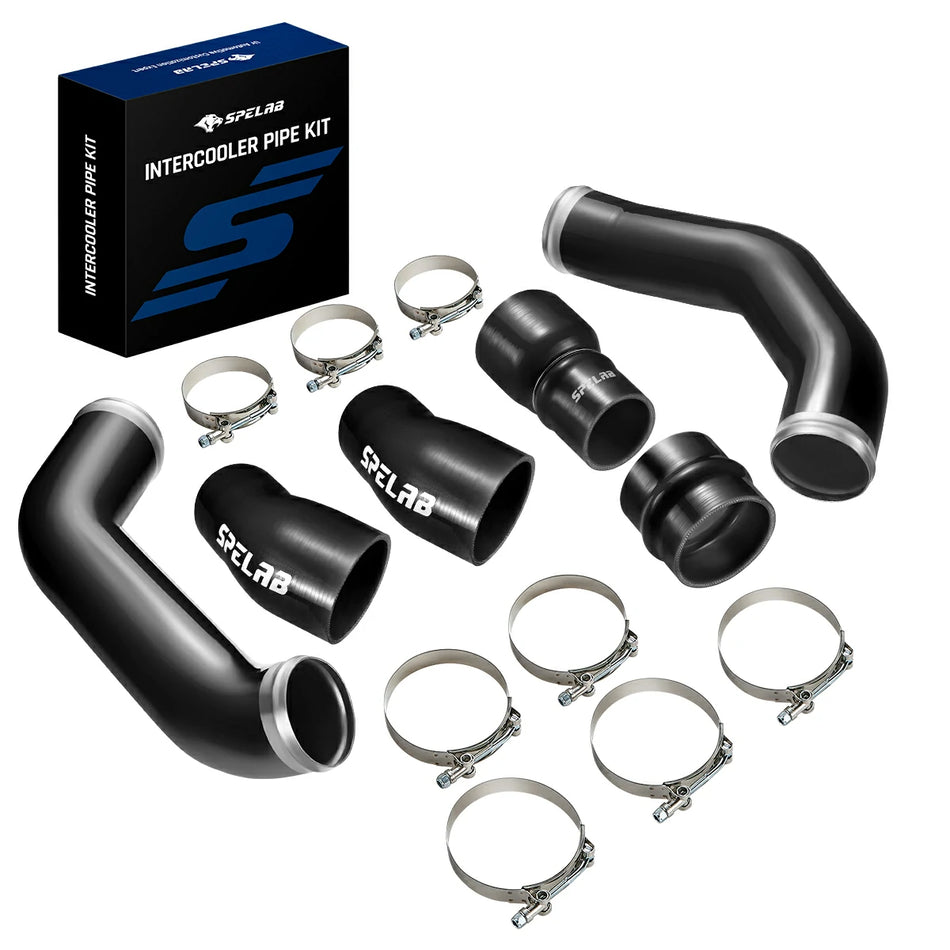
2017-2024 Ford 6.7L Power Stroke Cold-Side Intercooler Pipe

The 2017-2024 Power Stroke cold-side charge pipe is intended for listed F-250, F-350, and F-450 6.7L trucks using the stated factory-spec connection locations. Its Rigid aluminum construction can replace a confirmed cracked or ruptured plastic section. Pressure-test the whole system before and after installation; it does not solve every P0299 or low-power complaint.
2011-2019 Ford 6.7L Power Stroke 6R140 Transmission Pan

The 2011-2019 Power Stroke 6R140 transmission pan is a model-year-specific service and monitoring option, not a 2020+ ten-speed part. The product page specifies a 5.5-inch depth and seven-quart increase over the original pan, plus factory-filter compatibility. Verify ground clearance, gasket choice, fastener procedure, filter pickup relationship, and the correct Ford fill-level process. Extra fluid and fins cannot repair clutch slip, valve-body faults, converter problems, restricted cooler flow, or a bad calibration.
How Priorities Change With Real Truck Use
| Use case | Highest-risk checks | Buying decision |
|---|---|---|
| Fifth-wheel or gooseneck towing | Actual pin weight, rear GAWR, Payload label, bed/hitch structure, brakes, transmission trend, and rear axle | Choose the truck and hitch by measured load, not by badge |
| Conventional travel trailer or boat | Tongue weight, receiver rating, weight distribution, sway control, trailer brakes, cooling, and charge-air leaks | Fix stability and braking before adding power |
| Slide-in camper or full Payload | Rear tire capacity, GAWR, spring/shock condition, loaded ride height, wheel ends, and center of gravity | Suspension helpers do not increase the label rating |
| Jobsite and high idle hours | Engine hours, fan and A/C load, batteries, charging, dust restriction, wiring repairs, and transmission PTO history where applicable | Service by duty cycle, not odometer alone |
| Off-roading or ranch access | Axle and diff-cover impact, skid clearance, steering joints, sidewalls, underbody wiring, and mud-packed cooling stack | Choose protection only after checking full suspension and steering clearance |
| Extreme heat or cold | Battery pair, glow-plug system, coolant condition, hose integrity, fuel quality, fan control, tire pressure, and fluid specification | Use the exact seasonal fluids and Ford procedure for the truck |
Used-Truck Emissions and Road-Use Check
Federal law prohibits tampering with required emissions controls and the manufacture, sale, or installation of defeat devices. State inspection and registration rules may add requirements. Before buying a modified truck, verify its physical hardware, calibration, readiness monitors, permanent codes, and local compliance. A private sale, ranch use, Jobsite use, or occasional Off-roading does not automatically convert a registered road vehicle into an exempt vehicle.
Official Sources
Frequently Asked Questions
Q: Is an F-350 automatically safer for heavy towing than an F-250?
A: No badge answers that question by itself. Compare the specific truck's GVWR, front and rear GAWR, Payload label, SRW/DRW configuration, axle ratio, tires, hitch, GCWR, and actual loaded scale weights. An F-350 may offer more capacity in a given configuration, but the door labels and towing guide control the decision.
Q: What is the first test after buying a used 6.7L Power Stroke?
A: Record a complete module scan before clearing anything, check the VIN for recalls, identify previous calibrations and emissions changes, inspect all fluids and filters, and verify the truck's ratings. Then perform cold mechanical checks before a hot unloaded and loaded road test.
Q: Do all 2011-2024 6.7L Power Stroke trucks use the same transmission?
A: No. The 2011-2019 diesel pickups use a six-speed TorqShift generation, while 2020+ trucks use a ten-speed TorqShift. Fluid, filter, pan, calibration, scan interpretation, and service procedures must match the exact transmission.
Q: Does every 2020+ 6.7L Power Stroke use a Denso pump instead of a CP4?
A: No. That blanket claim conflicts with NHTSA 24V-957, which identifies a Bosch CP4 RP7 in affected 2020-2022 production and documents a later RP8 production change. Check the VIN, build date, installed pump, recall status, and the exact product's engineering compatibility.
Q: Will an intercooler pipe fix P0299 before towing?
A: Only if pressure testing confirms that pipe or its connection leaks. P0299 can also come from another boot, intercooler end tank, exhaust leak before the turbo, turbo-control fault, sensor bias, intake restriction, or EGR-related problem.
Q: Will a deep 6R140 transmission pan repair slipping or overheating?
A: No. It may add fluid capacity, cooling surface, a drain plug, or a sensor port on a correctly fitted 2011-2019 6R140, but it cannot repair worn clutches, a converter fault, valve-body trouble, restricted cooler flow, incorrect fluid level, or a calibration problem.
Q: How should I road-test a used Super Duty before a long tow?
A: Test it cold and fully hot, first empty and then under a controlled representative load. Watch braking, steering, vibration, coolant temperature, transmission trend, boost, rail pressure, commanded and actual gear, and converter slip. Reinspect for coolant, oil, fuel, boost, and axle leaks after shutdown.