Last reviewed: October 8, 2026
A 6.7L Power Stroke coming out of warranty does not need five random modifications; it needs a documented baseline and a plan for the failures that can strand the truck or contaminate an entire system. Check open recalls first, preserve scan data, catch up overdue maintenance, and then prioritize fuel-system protection, crankcase ventilation, charge-air integrity, cooling health, and emissions-compliant calibration around the truck's model year and actual workload.

Key Takeaways
The best first move for an out-of-warranty 6.7L Power Stroke is to establish the truck's recall, maintenance, and diagnostic baseline before buying hardware.
- Check the VIN for Ford safety recall 24S78 before purchasing an aftermarket CP4 protection part for an affected 2020-2022 truck.
- A disaster-prevention kit can limit downstream contamination on the pump design it was built for, but it cannot repair wear or guarantee that the high-pressure pump will not fail.
- Service the factory crankcase ventilation system according to the exact model year before deciding whether a catch-can or reroute solution fits the truck's use and local rules.
- Charge-air leaks, cooling faults, injector problems, and sensor bias can overload the aftertreatment system, so repeated regeneration requires diagnosis rather than an automatic DPF replacement.
- Street-driven trucks should retain required emissions equipment and use a compliant calibration matched to tire size, axle ratio, transmission, towing weight, fuel quality, and ambient conditions.
Real-World Owner Perspective: Tony's Project Garage
This guide expands on SPELAB's authorized collaboration with Tony's Project Garage. Tony frames the problem the way an owner does after the factory warranty ends: every preventable failure now comes out of the owner's pocket. The editorial recommendations below retain that practical viewpoint while separating preventive maintenance, system protection, emissions compliance, and model-year-specific fitment.
Editorial distinction: A KOL's personal build describes one truck and one use case. Ford service information, verified fitment, diagnostic evidence, and the law governing the vehicle's actual use remain the controlling references.
Know the Legal Boundary Before Modifying a Street Truck
Removing or disabling required EGR, DPF, DEF, SCR, OBD, or emissions-related calibration functions can violate the U.S. Clean Air Act and applicable state or local rules. A truck labeled “off-road” is not automatically exempt; the vehicle, engine, use, jurisdiction, and documented basis all matter. Public-road trucks should retain functioning emissions equipment and use compliant parts and calibrations.
Priority 1: Check Recalls and Establish a Mechanical Baseline
An out-of-warranty 6.7L Power Stroke should receive a VIN recall check, complete module scan, maintenance-record audit, fluid inspection, and underhood leak inspection before any reliability part is approved.
Ford safety recall 24S78 covers certain 2020-2022 Super Duty trucks and certain 2021-2022 medium-duty trucks equipped with the 6.7L diesel and RP7 high-pressure fuel pump. The listed Super Duty production period runs from February or April 2019, depending on assembly plant, through August 23, 2021. Model year alone does not confirm eligibility; the VIN and Ford's recall record do.
- Run the VIN. Record completed and open recalls, service campaigns, and prior high-pressure fuel-system work.
- Scan every module before clearing codes. Save DTCs, pending codes, freeze-frame data, rail-pressure data, injector corrections where supported, DPF load, differential pressure, EGT sensor data, boost target, and measured boost.
- Audit maintenance. Confirm engine oil, both fuel filters, water-separator draining, coolant condition, transmission service, axle fluid, air filter, and crankcase vent service against the manual for the exact year and duty cycle.
- Inspect cold and hot. Look for fuel seepage, coolant crust, oil tracks, loose grounds, rubbed wiring, split charge-air boots, cracked plastic piping, exhaust soot marks, and fan or belt damage.
- Road-test with data. Compare commanded and measured rail pressure and boost under a controlled load; do not begin with a full-throttle trailer pull.
A baseline inspection often costs roughly $150-$400 at an independent diesel shop, depending on local labor rates and scan depth. That expense is usually smaller than replacing a part selected from a fault code without confirming the failed system.
Priority 2: Protect the High-Pressure Fuel System
Fuel-system protection deserves early attention because a mechanically failing high-pressure pump can spread metal into the rails, injectors, lines, filters, and tank, turning one failed component into a high-four-figure or five-figure repair.
Long crank, P0087, reduced power, rail pressure that cannot follow command, stalling, or glitter on the volume-control valve screen are diagnostic warnings, not proof that every CP4 component has failed. If metal is found, stop driving and document where it was found; continued operation can circulate debris through additional components. The detailed metal-debris warning signs should be checked before a preventive kit is installed.
A model-year-correct 6.7L Power Stroke CP4 disaster prevention kit is a containment strategy installed before pump failure. Depending on the kit design, it may redirect or filter pump debris before the contamination reaches downstream high-pressure components. It does not restore pump lubrication, reverse internal wear, clear an active low-rail-pressure fault, or replace a Ford recall remedy.

Fuel-System Habits That Matter More Than Marketing Claims
- Replace both fuel filters at the interval required by the exact owner's manual or sooner when contaminated fuel or severe service justifies it.
- Drain the water separator as directed and investigate recurring water-in-fuel warnings rather than repeatedly resetting them.
- Buy fuel from high-turnover stations and keep receipts when contamination is suspected.
- Use only fuel additives that meet Ford's requirements; an additive is not a repair for low pressure, water contamination, or metal debris.
- Confirm the installed pump and kit fitment physically instead of relying only on a forum's model-year claim.
Priority 3: Service the CCV System Before Rerouting It
A restricted crankcase ventilation system can raise crankcase pressure and contribute to oil seepage, while a healthy closed system can still leave a light oil film in the intake; neither condition proves that a reroute is automatically required.
Ford provides a replaceable crankcase vent filter procedure for applicable 6.7L configurations and warns against cleaning or reconditioning the filter element. Filter design and service intervals vary by model year and application, so the owner's manual and engine label must settle the question. Oil around boots or the turbo inlet should be evaluated with blowby, filter condition, oil consumption, turbo condition, and crankcase-pressure symptoms rather than appearance alone.
A 6.7L Power Stroke CCV reroute kit with catch can may suit a confirmed application when the owner accepts the maintenance, odor, freezing, routing, inspection, and compliance tradeoffs. A poor hose route, undersized vent, frozen condensate trap, or neglected catch can can create the same crankcase-pressure problem the modification was supposed to avoid.

Priority 4: Inspect Charge-Air and Cooling Hardware Under Load
A 6.7L Power Stroke that tows should prove commanded boost, coolant control, and charge-air sealing before added torque is considered because a small cold-side crack or loose clamp can look like turbo, EGR, DPF, or tuning trouble.
Inspect the turbo-to-CAC pipe, charge-air cooler, CAC-to-manifold pipe, boots, clamps, MAP passage, air filter housing, and manifold joints. A light internal oil film can be normal; a fresh outward oil spray, dust track, split plastic seam, displaced boot, or pressure loss during a regulated test is stronger evidence of a leak.
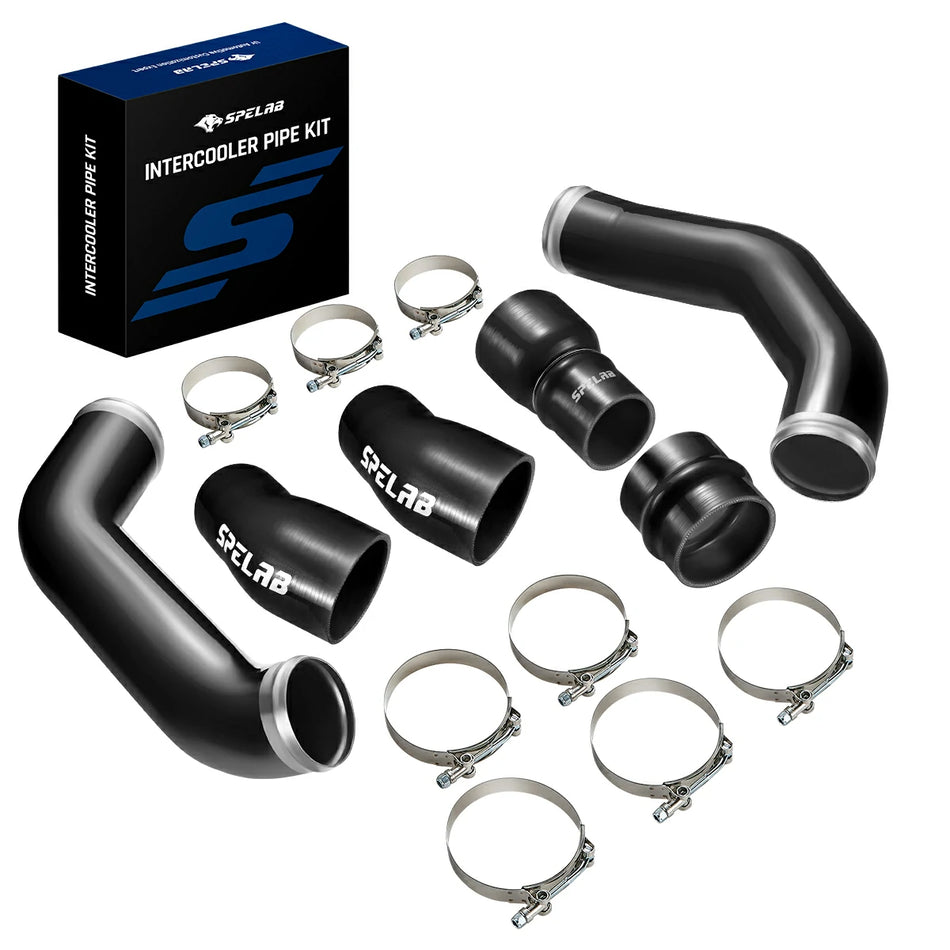
On 2017-2024 trucks with a confirmed cold-side pipe failure or repeat connection problem, a correctly fitted 6.7L Power Stroke cold-side intercooler pipe kit can replace the failed path. A metal pipe will not repair a leaking intercooler core, turbo-control fault, clogged MAP port, exhaust leak, or calibration problem.
Cooling checks should include both cooling circuits where equipped, coolant concentration, reservoir level, hose condition, fan operation, radiator and CAC debris, thermostat behavior, and temperature data during the truck's real workload. Avoid approving a radiator, thermostat, or coolant reroute from one elevated temperature reading without confirming sensor accuracy and operating conditions.
Priority 5: Diagnose the Aftertreatment System and Tune Conservatively
DPF regeneration, DEF/SCR faults, and EGR complaints must be separated by function before parts or calibration are changed: the DPF controls particulate matter, DEF supports SCR reduction of NOx, and EGR changes combustion conditions by recirculating exhaust.
| System | Primary job | Useful evidence | Common wrong assumption |
|---|---|---|---|
| EGR | Reduce NOx by controlling recirculated exhaust flow | Commanded versus measured EGR, MAP/MAF response, temperature data, valve position, soot deposits, and related DTCs | Every low-power complaint is caused by intake soot |
| DPF | Capture particulate matter and burn soot during regeneration | Differential pressure, calculated soot and ash load, EGT data, regen history, duty cycle, injector and boost health | Poor DEF quality directly causes normal DPF soot loading |
| DEF/SCR | Reduce NOx downstream with urea dosing and catalyst activity | DEF quality and level, dosing performance, NOx sensor data, SCR efficiency codes, inducement messages | Every DEF warning means the DPF is clogged |
| ECM/TCM calibration | Control engine torque, combustion, monitoring, and shift strategy | Truck configuration, tire size, axle ratio, towing weight, transmission data, EGT, boost, and emissions status | A larger power file automatically improves reliability |
Repeated regeneration every 50-100 miles can result from short trips, extended idle time, low exhaust temperature, biased pressure or temperature sensors, boost leaks, injector problems, excessive engine-out soot, or a filter carrying too much noncombustible ash. Scan evidence should identify which condition exists before a cleaning, filter replacement, or calibration is approved.
EZ LYNK is a delivery, monitoring, and communication platform rather than a guarantee that a calibration is legal or mechanically conservative. A street truck should use an emissions-compliant tune from a qualified provider. Towing files should prioritize controlled cylinder pressure, exhaust temperature, torque management, and transmission behavior over a peak horsepower claim.
6.7L Power Stroke Post-Warranty Priority Table
The correct spending order depends on evidence, but safety recalls and active faults come before optional hardware.
| Priority | Action | Typical cost range | Approve when | Do not expect |
|---|---|---|---|---|
| 1 | VIN recall check and baseline diagnosis | Recall remedy may be no-cost when eligible; independent inspection often roughly $150-$400 | Warranty has ended, history is incomplete, or the truck has new symptoms | A scan code alone to identify a failed part |
| 2 | Fuel filters, contamination checks, and model-correct CP4 protection | Often a few hundred dollars for preventive service or hardware; contamination repair can reach high four or five figures | No metal is present, fitment is verified, and preventive containment matches the installed pump | A prevention kit to repair an already failing pump |
| 3 | Factory CCV service or carefully selected ventilation hardware | Roughly $100-$600 depending on filter, labor, catch can, and routing | Service is due or testing confirms pressure, filter, hose, or oil-control concerns | Every trace of oil inside the intake to disappear |
| 4 | Charge-air and cooling repair | About $50 for a simple clamp or hose issue to $1,500+ for major pipe, CAC, radiator, or labor-intensive repairs | A pressure, visual, or temperature test identifies the failed component | One upgraded pipe to fix turbo control, sensor, or cooling faults elsewhere |
| 5 | Aftertreatment diagnosis and compliant calibration | Diagnosis may run roughly $150-$500; cleaning or component repair can range from hundreds to several thousand dollars | Live data identifies the restriction, sensor, dosing, injector, leak, or calibration issue | Delete hardware or a power tune to substitute for diagnosis on a street truck |
When Should a 6.7L Power Stroke Stop Driving?
A 6.7L Power Stroke should be shut down or towed when continued operation can spread contamination, remove lubrication, overheat the engine, create a fuel or exhaust fire risk, or produce an unsafe loss of power.
- Metallic debris appears on the VCV screen, in a fuel filter, or in a verified high-pressure fuel-system sample.
- The engine stalls, repeatedly loses rail pressure, or cannot maintain safe power in traffic.
- Fuel is leaking, spraying, or collecting around hot engine components.
- Coolant temperature continues rising, coolant is rapidly disappearing, or oil and coolant are mixing.
- A charge-air pipe is displaced or split badly enough to create severe smoke, no boost, or uncontrolled oil spray.
- The instrument cluster instructs the driver to stop safely or the truck enters a severe derate that makes road operation unsafe.
Frequently Asked Questions
These answers separate preventive spending from repairs that require diagnostic evidence.
What should I do first when my 6.7L Power Stroke goes out of warranty?
Run the VIN for recalls, scan every module without clearing codes, document maintenance history, inspect for fuel, coolant, oil, boost, and exhaust leaks, and road-test with live rail-pressure, boost, temperature, and aftertreatment data. Optional parts should come after active faults and overdue service.
Does Ford recall 24S78 replace the need for a CP4 disaster-prevention kit?
Recall 24S78 and an aftermarket disaster-prevention kit serve different purposes. Eligible owners should complete Ford's recall remedy first. A model-correct prevention kit may then be considered as downstream-contamination protection, but it cannot replace the recall, repair pump wear, or guarantee that a pump will not fail.
Does every 6.7L Power Stroke use the same CP4 protection kit?
No. Pump version, production date, plumbing, fittings, and kit design can vary. Verify the VIN, installed pump, connector locations, and product fitment before ordering; model year alone is not enough when the truck has received prior fuel-system repairs.
Should I service the factory CCV filter or install a reroute?
Service the factory system first when the filter is replaceable and due. Consider a reroute or catch can only after confirming fitment, crankcase pressure, local rules, winter condensation risk, maintenance requirements, and the owner's tolerance for odor and underhood routing.
What causes a 6.7L Power Stroke to regenerate too often?
Frequent regeneration can result from short trips, prolonged idle time, low exhaust temperature, boost leaks, injector problems, biased differential-pressure or EGT sensors, excessive engine-out soot, interrupted regens, or high ash loading. DEF-quality faults belong primarily to SCR diagnosis and should not automatically be treated as the cause of DPF soot accumulation.
Can EZ LYNK be used on a street-driven 6.7L Power Stroke?
EZ LYNK can provide monitoring, communication, and calibration delivery, but legality and mechanical risk depend on the tune installed. A public-road truck should retain required emissions equipment and use an emissions-compliant calibration from a qualified provider.
Is more horsepower a reliability upgrade after warranty?
No. Additional torque can increase cylinder pressure, exhaust heat, transmission load, driveline stress, and cooling demand. A towing or daily-driver calibration should be judged by controlled data, shift quality, temperature management, emissions compliance, and the truck's gross operating weight rather than peak horsepower.
Official Sources
The exact owner's manual, service information, recall record, and emissions rules for the truck take priority over a general guide.
Build the Reliability Plan Around the Truck
Start with the truck's year, VIN, mileage, engine hours, fault history, service records, towing weight, climate, and daily use. A commuter, fifth-wheel tow rig, fleet truck, and farm truck can share the same engine while needing different maintenance intervals and repair priorities.
Important Notice
This article is provided for educational purposes. Vehicle emissions, inspection, registration, competition-use, and nonroad rules vary by jurisdiction. SPELAB does not encourage removing, disabling, or tampering with required emissions equipment on vehicles operated on public roads. Confirm product fitment, follow the service information for the exact truck, and consult a qualified diesel technician before modifying a fuel, crankcase ventilation, cooling, charge-air, emissions, engine, or transmission system.